


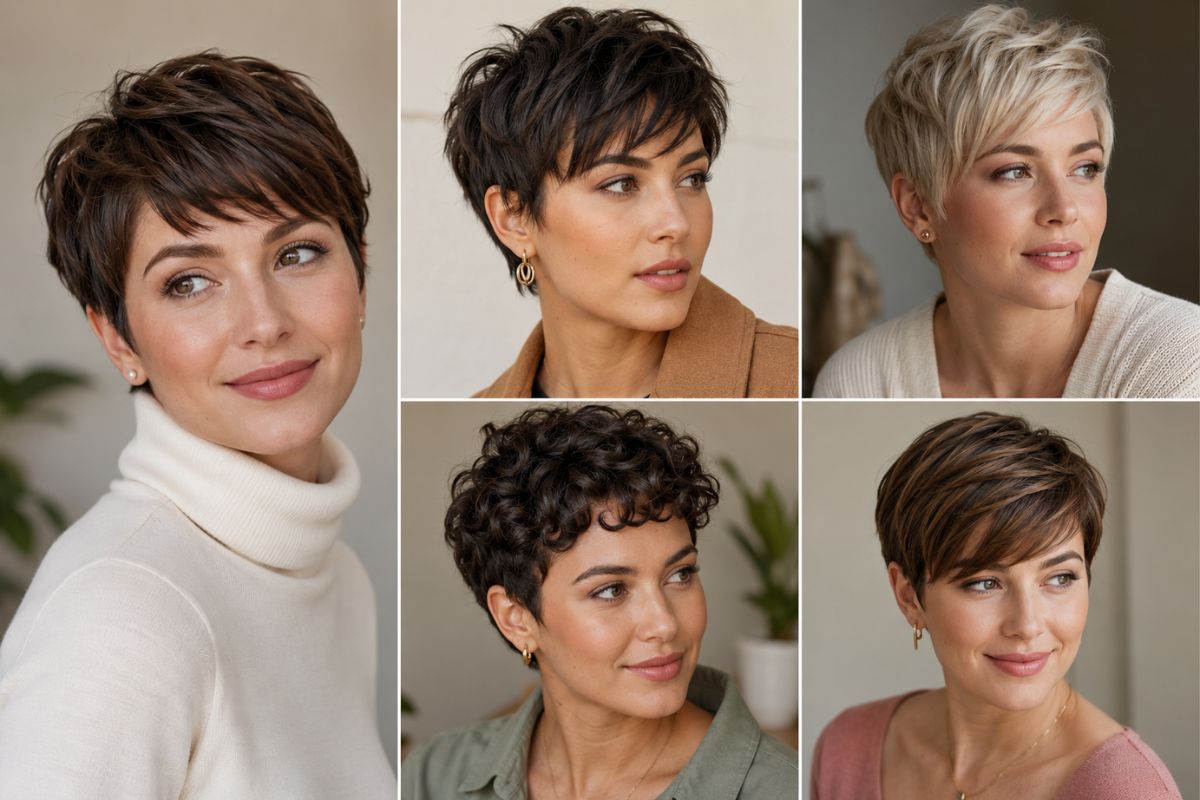
The short pixie cut never really leaves the trend cycle. It is bold without being fussy and puts your bone structure front and center. Despite its reputation as a high-commitment cut, it is one of the lowest-maintenance haircuts you can wear once the shape is right. A good pixie grows out gracefully, styles in minutes, and adapts to nearly every face shape.
Below are 24 distinct short pixie cuts, from the timeless classic to edgy undercuts. Each one includes honest notes on difficulty and upkeep so you can match the cut to your hair texture, face shape, and lifestyle before you book the appointment.
Quick Takeaways
- A pixie suits most face shapes. Fringe length and volume placement matter more than overall length.
- Most pixies need a trim every 4 to 6 weeks. Tapered and undercut versions need touch-ups every 2 to 4 weeks.
- Fine hair looks thicker in a pixie with crown layers. Thick hair needs interior thinning to lie flat.
- Curly and wavy textures pair well with pixies. Ask for a curl-aware cut, not a one-length crop.
- Apply heat protectant before any hot tool, and use toning shampoo weekly on platinum, auburn, or silver color.
1. Classic Short Pixie Cut

The original and still the most requested pixie in salons. Hair is cropped evenly short all over, with softly tapered sides and a slightly longer top swept gently to one side. It frames the eyes and cheekbones and needs little more than a quick finger-comb in the morning. This is the baseline every other pixie variation builds on.
It works on straight, wavy, and relaxed textures and flatters oval, heart, and square faces. The even crop grows out evenly, so you will not hit an awkward stage between appointments. A light pomade adds polish on days you want it.
Try this: ask your stylist to keep the top about two inches long so you can sweep it to either side.
Difficulty: Easy · Cost: $45–$90 (standard cut)
2. Textured Short Pixie Cut

Point-cut ends and tousled layers give this pixie its lived-in, piecey finish. The top carries most of the length while the sides sit close for contrast, which creates natural volume without teasing. A pea-sized amount of texturizing paste scrunched through dry hair is all it takes to bring the pieces to life.
This version suits straight to wavy hair and round or square faces, since the height on top adds length to the face. It is forgiving during grow-out because the texture disguises uneven lengths. Refresh with texturizing spray between washes.
Try this: sleep on it and revive the texture with dry shampoo instead of washing daily.
Difficulty: Easy · Cost: $45–$90 (standard cut)
3. Layered Short Pixie Cut

Stacked layers through the crown are the secret to a pixie that looks full even on finer strands. The layers graduate from longer at the top to shorter at the nape, giving lift and movement from every angle. Blow-dry with a small round brush for polish, or let it air-dry for a softer finish.
Fine to medium hair benefits most, and the added crown height flatters round faces. Layers lose their shape faster than one-length cuts, so this one asks for trims on the shorter end of the cycle. Ask your stylist where the shortest layer will fall before the first cut.
Try this: rough-dry upside down for two minutes to build root lift without any tools.
Difficulty: Easy to moderate · Cost: $50–$95 (layered cut)
4. Blonde Short Pixie Cut

A warm honey blonde takes a simple pixie from neat to noticeable. The color adds visible dimension to the short layers, so the cut reads thicker and more textured than it really is. Keep the tone fresh with a weekly toning shampoo and a gloss between color appointments.
This suits fair to medium skin tones and straight or wavy textures. The upkeep is real: roots show quickly on short hair, so budget for root touch-ups every 6 to 8 weeks alongside your trims. Color-depositing conditioner helps the tone hold between salon visits.
Try this: bring three reference photos in different lighting, since blonde shifts between indoor and outdoor light.
Difficulty: Moderate (color upkeep) · Cost: $120–$220 (cut + color)
5. Side Swept Pixie Cut

One long, dramatic fringe swept across the forehead softens this cut and makes it wonderfully face-framing. The back and sides stay cropped close while the front keeps enough length to tuck behind one ear. The asymmetry draws attention to the eyes and works on straight, wavy, and relaxed hair.
Round and square faces benefit most from the diagonal line the fringe creates. The fringe needs the most frequent tidying, so ask your stylist to teach you how to trim it at home between visits. A deep side part maximizes the sweeping effect.
Try this: blow-dry the fringe across your forehead first, then sweep it to the side for the smoothest finish.
Difficulty: Easy · Cost: $45–$90 (standard cut)
6. Choppy Pixie Cut

Jagged, razored ends give this pixie its edge. The uneven texture is the whole point, so it looks better slightly undone, which makes it one of the most forgiving cuts to grow out. Work a matte clay through the ends to separate the pieces and keep them defined through the day.
Thick, straight hair takes this texture best, and oval or heart faces wear it well. If you love this jagged finish, these choppy bob hairstyles show how the same edgy texture works with a little more length.
Try this: apply clay to dry hair only. Wet application makes razored ends clump instead of separating.
Difficulty: Easy · Cost: $50–$95 (razor cut)
7. Tapered Pixie Cut

Precision is the point here. The sides and nape fade gradually from close-cropped to longer on top, with crisp, clean lines. It is the sharpest, most tailored pixie and photographs well, but the fade grows out visibly, so it suits someone who does not mind regular salon visits.
Coily, curly, and straight textures all take a taper cleanly. Oval and diamond faces show off the shape best. Budget for trims every 3 to 4 weeks to keep the fade sharp, and ask your barber or stylist to clean up the neckline between full appointments.
Try this: a silk scarf at night keeps the tapered edges lying smooth and extends the fresh-cut look.
Difficulty: Moderate (frequent trims) · Cost: $45–$85 (cut, more often)
8. Curly Short Pixie Cut

Natural curls and a pixie are a strong match. The cut removes weight so curls spring up instead of dragging down. Keep the sides tapered and leave the curls longer on top for balance. A curl cream on damp hair plus a diffuser on low heat defines the pattern without frizz. Apply heat protectant before diffusing.
Ask for a curl-by-curl or dry cut so the stylist accounts for shrinkage. This suits 2C to 4C curl patterns and most face shapes, since curl volume works in every direction. Deep-condition weekly to keep the curls springy at this length.
Try this: pineapple your curls with a loose scrunchie at night to protect the shape.
Difficulty: Easy (with the right cut) · Cost: $55–$100 (curl-specialist cut)
9. Platinum Pixie Cut

Icy white-blonde on a pixie is high impact with surprisingly little daily effort. The pale color shows off every layer and makes the cut look almost sculptural. The real work is in the color: purple shampoo, bond-building treatments, and regular toners keep it from turning yellow or brassy.
This suits cool skin tones and anyone ready for the maintenance schedule. Tone every 1 to 2 weeks, trim every 4 to 5 weeks, and plan a toner refresh every 4 to 6 weeks. If your hair is dark, expect two or more lifting sessions to reach icy white safely.
Try this: do a strand test first. Previously colored hair lifts unevenly and may need a different approach.
Difficulty: High (color maintenance) · Cost: $150–$300+ (double process + cut)
10. Undercut Pixie Cut

The sides and nape are buzzed short in a visible undercut while the top stays long and textured. That is maximum contrast with minimum styling time. Flip the longer top to either side, sweep it back, or spike it up. One cut gives several looks, and it is a smart pick for very thick hair, since the undercut removes serious bulk.
Round faces gain length from the height on top, and thick or coarse textures benefit from the bulk removal. The undercut needs buzzing every 2 to 3 weeks to stay crisp, so this suits someone comfortable with frequent upkeep or confident with clippers at home.
Try this: ask for a disconnected undercut first. It is easier to blend later than a faded one if you change your mind.
Difficulty: Easy to wear, moderate to maintain · Cost: $50–$95 (cut + undercut)
11. Pixie Cut with Long Bangs

Long, curtain-like bangs draped across the forehead give this pixie a soft, romantic feel that shorter fringes cannot match. The length around the face balances strong jawlines and adds softness to the crop. Part them in the middle, sweep them aside, or pin them back on busy days.
Square and heart faces benefit most from the face-framing length. Trim the bangs every 3 to 4 weeks and the rest every 5 to 6 weeks. This is a good first pixie if you are nervous about going short, since the bangs keep a familiar frame around your face.
Try this: train new bangs with a flat brush and dryer for the first week so they learn the direction.
Difficulty: Easy · Cost: $45–$90 (standard cut)
12. Feathered Pixie Cut

Wispy, feathered layers swept back and away from the face create softness and movement in every direction. This is the gentlest pixie: nothing harsh, nothing severe. It is a lovely first step for anyone nervous about going short. A light mousse adds airiness without stiffness.
Fine to medium hair takes the feathering well, and the swept-back shape flatters long faces by adding width. Keep the feathered ends fresh with trims every 4 to 5 weeks. Avoid heavy waxes, which clump feathered ends together.
Try this: flip the layers outward with a round brush for a windswept finish that lasts all day.
Difficulty: Easy · Cost: $45–$90 (standard cut)
13. Pixie Bob Cut

Sitting exactly between a pixie and a bob, this cut keeps the cropped pixie feeling with extra length at the nape and around the ears. The result is a full, rounded shape that flatters almost every face shape. It is also the easiest pixie to grow out, since you are already halfway to a bob.
Oval, round, and heart faces all wear it well. Style with a round brush for the rounded silhouette or air-dry for a softer look. Trims every 5 to 7 weeks keep the shape, and the grow-out stays intentional rather than awkward.
Try this: if you are growing out a pixie, this is the cut to ask for at your next appointment.
Difficulty: Easy · Cost: $45–$90 (standard cut)
14. Shaggy Pixie Cut

Tousled layers, choppy ends, and curtain bangs give this pixie its carefree, rock-and-roll attitude. The shag technique builds in texture, so the messier it looks, the better it works. Sea salt spray on damp hair and a quick scrunch is the entire styling routine.
Wavy and straight textures take the shag well, and it flatters most face shapes. Love that undone energy? These wolf cut hairstyles take the same lived-in texture even further with more length.
Try this: skip the brush entirely. Finger-styling keeps shaggy layers piecey instead of fluffy.
Difficulty: Easy · Cost: $50–$95 (layered cut)
15. Asymmetrical Pixie Cut

One side cropped close, the other falling longer with a sweeping fringe. The asymmetry is deliberate and striking. It draws the eye diagonally across the face, which flatters round and square face shapes. The longer side can be tucked, pinned, or left to swing.
This needs trims every 3 to 4 weeks, since asymmetry looks messy fast when it grows out. It suits straight and slightly wavy textures best. Ask your stylist to show you the length difference with a comb before cutting so you agree on how dramatic to go.
Try this: tuck the short side behind your ear with a decorative pin for an evening look.
Difficulty: Moderate · Cost: $50–$95 (precision cut)
16. Pixie Cut for Fine Hair

Short, softly layered, and lifted at the roots. This pixie is engineered to make fine hair look twice as thick. Keep the ends blunt enough to look dense while layering only through the crown for lift. A root-lifting spray and a quick upside-down blast with the dryer does most of the work.
Fine hair has its own rulebook. See these bob hairstyles for fine hair for more volume-boosting ideas with a bit more length. Avoid heavy conditioners near the roots, which flatten the lift this cut builds in.
Try this: dry shampoo at the roots on day two adds grit and volume without a full wash.
Difficulty: Easy · Cost: $45–$90 (standard cut)
17. Pixie Cut for Thick Hair

Dense hair needs a pixie with the bulk carved out, not just cut short. Thinned interior layers and a tapered nape let thick hair lie smooth instead of puffing out into a triangle. A smoothing cream on damp hair tames volume while keeping the shape.
This suits coarse and dense textures and most face shapes. Ask specifically for interior thinning, not just shorter layers, since surface cutting alone will not remove enough weight. Trims every 5 to 6 weeks keep the interior work fresh.
Try this: a boar-bristle brush smooths thick pixies flat without heat.
Difficulty: Easy (with proper thinning) · Cost: $50–$95 (textured cut)
18. Silver Gray Pixie Cut

Natural silver, worn with confidence, turns a pixie into a signature look. The short length shows off the metallic dimension of gray hair, and a side-parted fringe keeps it soft rather than severe. Purple shampoo keeps the silver bright instead of dull or yellow.
Mature hair pairs well with short cuts. Browse these short hairstyles for older women for more flattering options. Tone weekly and trim every 4 to 6 weeks to keep the shape and color crisp.
Try this: a clear gloss every 6 weeks adds shine that makes silver look intentional, not neglected.
Difficulty: Easy · Cost: $45–$90 (cut) + gloss as needed
19. Pixie with Micro Bangs

An ultra-short baby fringe sitting high on the forehead gives this pixie its playful, fashion-forward punch. It opens up the whole face and puts the focus squarely on the eyes, while the rest of the cut stays neat and tapered so the tiny fringe stays the star.
Long and oval faces wear micro bangs best, since the short fringe shortens the forehead visually. The fringe needs trimming every 2 to 3 weeks, which is the main commitment here. Style it with a dab of pomade for piecey separation.
Try this: learn to trim the fringe yourself. It is a straight line, and salon visits add up fast.
Difficulty: Moderate (fringe needs precision) · Cost: $45–$90 (cut)
20. Messy Pixie Cut

Deliberately undone, with flicked-out ends and windswept volume, this is the wash-and-go champion of the pixie family. The cut is designed to look good tousled, so bedhead works in your favor. A dab of pomade on dry hair enhances the piecey finish.
Straight to wavy textures and most face shapes suit this low-effort style. Trims every 5 to 7 weeks keep it intentional, and the texture hides grow-out well. This is the pixie to pick if you want short hair without a styling routine.
Try this: twist random sections while the hair is damp for natural-looking separation as it dries.
Difficulty: Very easy · Cost: $45–$90 (standard cut)
21. Sleek Pixie Cut

Smooth, glossy, and lying flat against the head with a neat side part. The sleek pixie is pure polish. A flat iron and a shine serum create the glass-like finish. It works best on straight or straightened hair and suits professional settings well. Always apply heat protectant before the flat iron.
Oval and heart faces show off this clean shape best. The sleek line shows grow-out fast, so plan trims every 4 weeks. A silk pillowcase reduces morning frizz and keeps the smooth finish intact overnight.
Try this: flat-iron in small sections and finish with a cool shot from the dryer to lock the shine.
Difficulty: Moderate (daily heat styling) · Cost: $45–$90 (cut)
22. Auburn Pixie Cut

Rich copper-red color turns a simple pixie into a head-turner. The warm tones add visible depth to short layers and flatter fair and warm skin tones especially well. Red fades fast, so color-depositing conditioner and cool-water washes are non-negotiable.
Refresh the color every 4 to 6 weeks and trim every 5 weeks. Sun exposure fades red quickly, so a hat or UV spray helps on bright days. If you are new to red, start one shade deeper than your target, since it will lighten as it fades.
Try this: wash with lukewarm water and finish with a cool rinse to slow color fade.
Difficulty: Moderate to high (red fades fast) · Cost: $130–$250 (cut + color)
23. Grown-Out Pixie Cut

A few months past its last trim, the grown-out pixie develops soft length on top and around the ears. It is a look in its own right. Feathered and feminine, it bridges the gap between a pixie and a short shag without an awkward phase. Tuck one side behind the ear for shape.
All textures and face shapes can wear this transitional style. Shape-up trims every 8 to 10 weeks keep it looking deliberate, and minimal styling is needed. This is proof that growing out a pixie does not have to mean months of bad hair days.
Try this: add curtain bangs during the grow-out. They blend the longer top into the rest of the cut.
Difficulty: Very easy · Cost: $35–$70 (shape-up trims)
24. Disconnected Edgy Pixie Cut

A buzzed-short side slammed against long, jagged top layers. The disconnection is the entire point of this daring cut. Razored, uneven pieces on top can be styled spiky, swept, or piecey for completely different moods. It is the boldest pixie on this list.
Straight, thick textures hold the contrast best. Buzz the short side every 2 to 3 weeks and trim the top every 4 to 5 weeks. This suits someone who enjoys being noticed and does not mind the upkeep that comes with a high-contrast cut.
Try this: strong-hold wax on the top pieces keeps the jagged texture defined through a full day.
Difficulty: Moderate to high · Cost: $50–$100 (cut + undercut)
Pixie Cut Comparison Table
| Pixie style | Best for | Daily styling | Trim every |
|---|---|---|---|
| Classic | First pixie, most face shapes | 2 minutes | 4-6 weeks |
| Textured | Straight to wavy, round faces | 3 minutes | 5-7 weeks |
| Layered | Fine hair, round faces | 5 minutes | 4-5 weeks |
| Blonde | Fair to medium skin, color fans | 3 minutes | 5 weeks |
| Side swept | Round and square faces | 4 minutes | 4-6 weeks |
| Choppy | Thick straight hair | 3 minutes | 5-6 weeks |
| Tapered | Coily, curly, straight | 5 minutes | 3-4 weeks |
| Curly | 2C-4C curl patterns | 8 minutes | 6-8 weeks |
| Platinum | Cool skin, high-maintenance OK | 5 minutes | 4-5 weeks |
| Undercut | Thick hair, bold style | 5 minutes | 2-3 weeks (buzz) |
| Long bangs | Square and heart faces | 4 minutes | 5-6 weeks |
| Feathered | Fine to medium, long faces | 5 minutes | 4-5 weeks |
| Pixie bob | Growing out, most faces | 5 minutes | 5-7 weeks |
| Shaggy | Wavy and straight, most faces | 3 minutes | 6-8 weeks |
| Asymmetrical | Round and square faces | 5 minutes | 3-4 weeks |
| For fine hair | Fine, flat hair | 4 minutes | 4-5 weeks |
| For thick hair | Dense, coarse hair | 4 minutes | 5-6 weeks |
| Silver gray | Natural gray, mature hair | 3 minutes | 4-6 weeks |
| Micro bangs | Long and oval faces | 3 minutes | 4-6 weeks |
| Messy | Straight to wavy, low effort | 2 minutes | 5-7 weeks |
| Sleek | Straight hair, polished look | 10 minutes | 4 weeks |
| Auburn | Warm skin, red lovers | 5 weeks | |
| Grown-out | Transitioning length | 2 minutes | 8-10 weeks |
| Disconnected edgy | Thick straight, bold style | 7 minutes | 4-5 weeks |
How to Choose the Right Short Pixie Cut
With 24 options on the table, run through these four checkpoints before you book the appointment.
- Face shape: Round faces benefit from height on top and asymmetry. Long faces look best with fringe and width at the sides. Oval faces can wear almost any version. Square faces soften with side-swept bangs and texture around the jawline.
- Hair texture: Fine hair needs blunt ends and crown layers for the look of density. Thick hair needs interior thinning to lie flat. Curls need a curl-by-curl cut. Very straight hair shows precision lines best.
- Lifestyle: If you dislike frequent salon visits, choose a textured, shaggy, or grown-out pixie. If you enjoy daily styling, the sleek and tapered versions reward the effort.
- Color commitment: Going platinum or auburn roughly doubles maintenance. Be honest about keeping up with toners, glosses, and root appointments.
What to avoid: Do not pick a cut that fights your natural texture every morning, and skip ultra-short fringes unless you will trim them every two to three weeks.
Frequently Asked Questions
How often does a short pixie cut need trimming?
Most pixies need a trim every four to six weeks. Tapered, undercut, and asymmetrical versions grow out visibly, so plan a touch-up every two to four weeks. Textured, shaggy, and grown-out styles can stretch to seven or eight.
What face shape suits a pixie cut best?
Pixies can flatter every face shape. Styling details matter more than length. Round faces look slimmer with height on top and an asymmetrical fringe. Long faces benefit from bangs and width at the sides. Square faces soften with side-swept texture. Oval faces can wear nearly any version.
Can I get a pixie cut if my hair is curly?
Yes. Removing length lets curls spring up with natural volume, so they pair well with pixies. Ask for a curl-by-curl or dry cut to account for shrinkage, keep the sides tapered, and use a curl cream with a diffuser to define the pattern without frizz.
Is a short pixie cut really low maintenance?
Day to day, yes. Most pixies style in under five minutes with a little paste, cream, or salt spray. The trade-off is salon frequency: expect trims every four to six weeks, plus toning and gloss appointments if you go platinum or auburn.
How long does it take to grow out a pixie cut?
Growing a pixie into a bob typically takes six to twelve months. Shaping trims every eight to ten weeks keep it looking intentional instead of awkward, and the pixie bob or grown-out pixie make excellent transition cuts along the way.
If you have a rounder face shape, our guide to long pixie haircuts for round faces shows which cuts slim and flatter best.
Prefer a longer top with bangs? Our long pixie haircuts with bangs gallery has 25 ideas.
If low effort matters more than edge, our list of pixie haircuts thin fine hair easy to style rounds up the simplest options for fine hair.
Final Thoughts
Twenty-four cuts, one takeaway: the short pixie is not a single haircut but a whole family of them. Whether you want wash-and-go ease, sharp tailored lines, or a bold color statement, there is a version here for your texture, face shape, and effort level.
Save your favorites, take them to your stylist, and be honest about your styling habits. The best pixie is the one you will happily maintain. For more short-hair inspiration across every length and texture, browse the full PrimeHairPicks hairstyle collection and find your next look.
For more on this topic, see pixie hairstyles for black women.

