


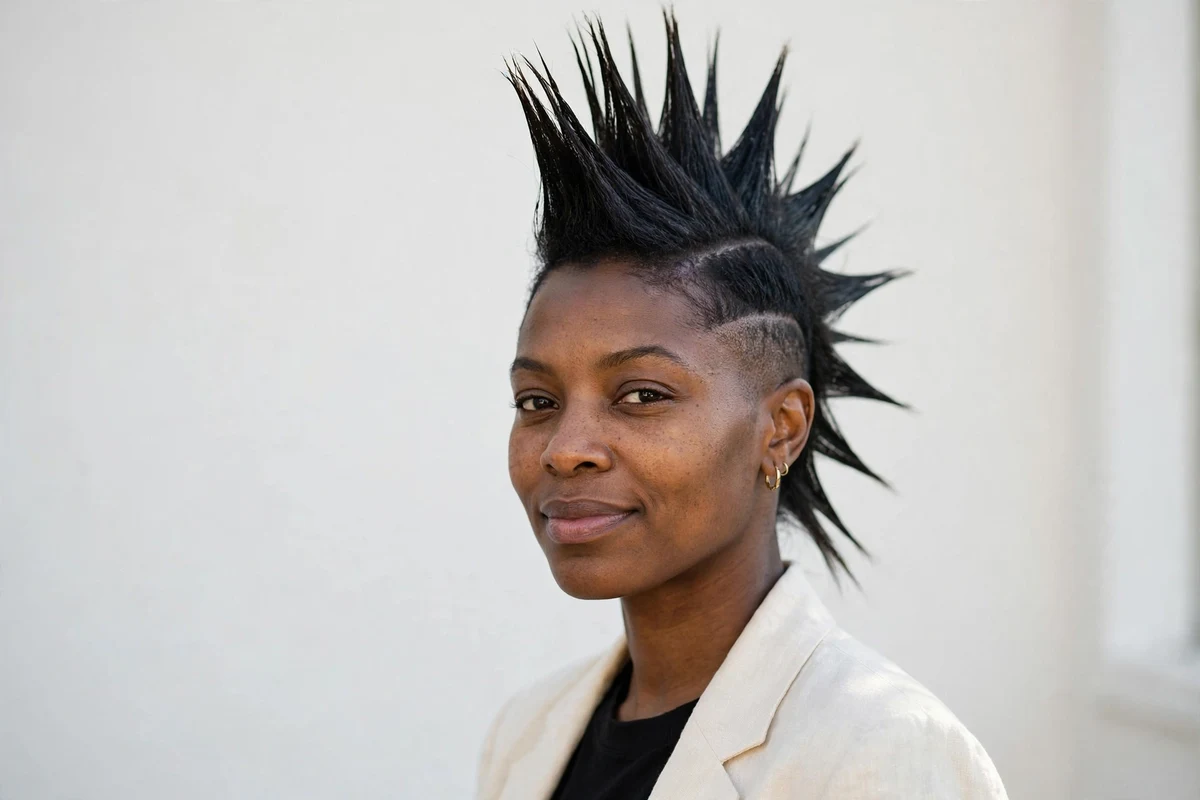
A mohawk is the fastest way to turn hair into a statement. The shaved or tapered sides pull every eye to the center strip, and what you do with that strip decides whether the look reads punk, polished, playful, or high fashion.
After years of writing about statement cuts, the mohawk is the one I get asked about most. Below are 30 bold mohawk hairstyles for women, covering every texture from pin-straight to coily, plus color ideas, braided versions, and no-shave options for anyone not ready to commit to the clippers.
Quick answer: A bold mohawk pairs shaved or tapered sides with a longer center strip styled up, out, or braided. Curly and coily textures need the least product, fine hair benefits from teasing and texturizing powder, and vivid color makes even a short strip look dramatic. Expect side trims every 2 to 4 weeks to keep the shape sharp.
Quick Takeaways
- A mohawk is two decisions: how short the sides go and what the center strip does.
- Curly, coily, and thick hair hold height with the least effort and product.
- Faux hawks and braided versions give the silhouette with zero shaving.
- Vivid color (blue, red, pink, purple) doubles the impact of even a short strip.
- Budget for side trims every 2 to 4 weeks, plus color touch-ups if you dye the strip.
Why Mohawks Work for Women
The shape does the talking. Narrow sides and a raised center create height at the crown, which lengthens the face and draws attention upward. That is why the cut flatters round faces especially well, and why a taller strip photographs so strongly.
It also adapts to commitment level. A full shave is the classic, but a tight taper, an undercut with shaved designs, or a pinned faux hawk all read as mohawk. You can go as far as your comfort allows and still get the attitude.
Texture is your shortcut. Curls, coils, and waves build volume naturally along the strip, so women with textured hair often style a mohawk in minutes. Straight or fine hair needs more help: teasing at the roots, texturizing powder, and a strong-hold spray.
Before You Book the Cut
Decide the side length first. A #1 or #2 clipper guard gives the classic punk contrast; a longer taper or fade keeps the look softer and grows out with less awkwardness. Show your stylist photos of the exact side finish you want, since “shaved” means different things to different people.
Talk about your real routine. If you will not style daily, pick a version that works finger-styled, like the low-maintenance mohawk or the natural braided mohawk below. If you love product and precision, the spiky and slicked versions will reward the effort.
Plan the grow-out. Sides take about 3 to 6 months to reach a pixie-ish length. A taper grows out more gracefully than a skin-tight shave, so factor that in if you think you might reverse the decision within a year.
1. Classic Spiky Punk Mohawk with Shaved Sides

This is the original: sides buzzed close with a #1 or #2 guard, center strip left long and styled straight up into defined spikes. The contrast between the tight sides and the tall strip is what gives it that unmistakable punk silhouette. It suits oval, square, and heart faces, since the height balances strong jawlines and wide foreheads.
Ask your stylist to keep the strip about 2 to 3 inches wide so it has enough hair to spike. Try this: work strong-hold gel through damp hair, pinch small sections into spikes while blow-drying upward with a concentrator nozzle, then mist with maximum-hold hairspray. Difficulty: Medium. Cost: standard short cut plus product.
2. Curly Mohawk

Curls might be the easiest path to a mohawk. The natural volume of the center strip does most of the work, so you get height and texture without teasing. Keep the sides tapered rather than shaved skin-tight if you want a softer grow-out, and let the curls run wild down the middle.
Define the curls with mousse or curl cream, then shake them out for fullness. Try this: add small hair rings or cuffs on a few curls near the front for a personal touch, and use edge control to keep the hairline crisp. Difficulty: Easy. Cost: standard cut.
3. Braided Faux Hawk

No clippers required here. Braids along both sides get pulled toward the center and pinned, which builds the raised mohawk shape while all your length stays intact. It reads edgy in photos but stays office-friendly in person, and it washes out completely.
Two Dutch braids from the temples meeting at the crown give the cleanest shape. Try this: pancake the braids (gently pull them wider) for extra volume, and anchor everything with bobby pins in a crossed pattern so the style survives the day. Difficulty: Medium. Cost: none if you braid it yourself.
4. Vivid Color Mohawk

Color is the cheapest way to make a mohawk louder. Electric blue, hot pink, fiery red, and purple all turn a basic strip into the focal point of your whole look. The shaved sides keep the color contained to one clean panel, which makes the shade look even more intense by contrast.
Pre-lightening is usually needed for true vivid tones on dark hair. Try this: use a color-depositing conditioner between salon visits to keep the shade from fading, and wash with cool water. Difficulty: Medium. Cost: $60 to $150 for salon color, plus upkeep products.
5. Colored Tips Mohawk

Not ready to dye the whole strip? Coloring just the tips gives you the punk payoff with a smaller commitment. The colored ends draw the eye upward, which makes the mohawk look taller, and regrowth is invisible since the roots stay natural.
This works on any mohawk length from one inch up. Try this: use a temporary color wax for a weekend test before committing to permanent dye, and apply the color with a small brush so the line between natural and colored stays clean. Difficulty: Easy. Cost: $10 to $40 DIY, more at a salon.
6. Two-Tone Color Contrast Mohawk

Pairing opposite shades, like platinum sides against a jet-black strip or purple against electric blue, creates the most dramatic version of this cut. The color blocking emphasizes the architecture of the mohawk: you see the shape even before you notice the styling.
Keep one side of the pairing low-maintenance (a natural dark) and put the high-maintenance shade on the smaller area. Try this: ask for a root shadow on the vivid section so grow-out looks intentional for weeks. Difficulty: Hard. Cost: $100 to $200 for salon color.
7. Voluminous Textured Mohawk

Height is the whole point of this one. The center strip gets backcombed and lifted into a tall, textured shape while the sides stay softly tapered instead of shaved. It reads glamorous rather than punk, which makes it a strong pick for photoshoots and nights out.
Start with second-day hair or add dry shampoo at the roots for grip. Try this: tease the crown with a fine-toothed comb, smooth only the very top layer over the teasing, and lock it with flexible-hold hairspray so it moves a little. Difficulty: Medium. Cost: standard cut plus styling time.
8. Peaky Textured Spikes

Where the classic punk mohawk is raw, the peaky version is precise. Spikes get shaped into sharp, clean points with pomade, and the sides are tapered neatly instead of buzzed harshly. The result keeps the edge but looks deliberate enough for creative workplaces.
Work with small sections so each spike stays separated and sharp. Try this: warm a pea-sized amount of pomade between your palms, twist each section to a point, and set the tips with a cool shot from the dryer. Difficulty: Medium. Cost: standard cut.
9. Sleek Styled Sides Mohawk

Instead of buzzing the sides, this version slicks them flat with gel while the top stays full and lifted. The contrast is about texture rather than length: smooth against voluminous. It is one of the most wearable mohawks because nothing is actually shaved.
Comb the sides down tight with strong-hold gel and let the crown air-dry with volume. Try this: use a boar-bristle brush on the sides for a glassy finish, and keep a travel-size gel for touch-ups. Difficulty: Easy. Cost: product only.
10. Slicked-Back Mohawk

All the hair sweeps straight back into the mohawk shape, held with gel or pomade. The finish is smooth and controlled, closer to high fashion than punk, and it works on short, medium, and long hair alike. Round faces benefit most, since the backward sweep opens up the face.
Apply gel to damp hair and comb everything back, then let it set. Try this: blow-dry the crown section upward first for lift, then slick the rest back over it so the shape holds without going flat. Difficulty: Easy. Cost: product only.
11. Mohawk Mullet

Two rebellious cuts in one. The top carries the bold mohawk volume while the back keeps mullet length, and the sides stay short to connect them. It is retro and current at once, and the extra length at the back gives you styling options the classic mohawk lacks, like ponytails and braids.
Ask for disconnected layers so the top and back read as intentional, not grown-out. Try this: style the top with texturizing paste for piecey separation and leave the back piece straight or loosely waved. Difficulty: Medium. Cost: standard cut.
If you like cuts that mix eras and attitudes, emo shag haircuts layer choppy texture with the same alternative spirit.
12. Pixie Mohawk

A pixie on top, a mohawk in attitude. The sides get undercut or tapered close while the pixie length on top is styled upward and forward with texture. It is the lowest-commitment true mohawk here: short all over, fast to style, and it grows out into a pixie rather than an awkward in-between.
Texturizing paste is the whole styling routine. Try this: rub paste between your palms and push the top forward and up in pieces, leaving the fringe slightly longer for softness around the forehead. Difficulty: Easy. Cost: standard pixie cut.
13. Tapered Mohawk

A fade replaces the hard shave: the sides graduate from very short at the hairline to longer near the strip. The transition looks smooth and modern, and it suits women who want the mohawk shape without the harsh line of a buzz cut. Curly and coily tops pair especially well with a taper.
Ask your barber for a low or mid fade depending on how much contrast you want. Try this: keep the fade lined up every 2 weeks with a quick edge-up so the gradient stays crisp. Difficulty: Easy. Cost: standard cut, plus barber visits for the fade.
14. Undercut Mohawk with Shaved Patterns

The sides become the canvas. Geometric shapes, delicate swirls, or mixed thin-and-thick lines get shaved into the undercut while the top stays full. It is the most artistic mohawk on this list, and the design makes even a simply styled top look intentional.
Bring reference photos of the exact pattern you want, since freehand designs vary by barber. Try this: keep the design touched up every 2 to 3 weeks, because patterns blur fast as hair grows, and use a clear brow gel to lay down any regrowth between visits. Difficulty: Hard. Cost: $40 to $80 for the design work.
15. Asymmetrical Mohawk

Break the symmetry on purpose. One side gets shaved higher than the other, or the strip sits slightly off-center following your natural part. The unevenness adds visual interest and lets you keep more hair on one side, which softens the grow-out.
Decide which side is your “photo side” and keep the longer side there. Try this: sweep the strip toward the longer side for an editorial feel, and use medium-hold pomade so the shape stays flexible. Difficulty: Medium. Cost: standard cut.
16. Low-Maintenance Mohawk

For women who want the shape without the styling session. The sides are tapered (not shaved), the top keeps natural waves or curls, and the whole thing gets finger-styled with a dab of cream. It never looks overdone, and it survives second-day hair easily.
Ask for light layering through the top so the waves fall into the mohawk shape on their own. Try this: scrunch in a lightweight curl cream on damp hair and let it air-dry; refresh with a spritz of water in the morning. Difficulty: Easy. Cost: standard cut.
17. Box Braids Mohawk

Box braids and a mohawk are a natural match. The braids get gathered and pinned up the center while the sides stay tapered or shaved, giving you a protective style with real presence. It lasts for weeks, which makes it one of the most practical bold options here.
Keep the braids medium-sized so they stack neatly up the center without bulk. Try this: wrap a few braids around the base of the updo to hide pins, and oil your scalp weekly while the style is in. Difficulty: Medium. Cost: $150 to $300 for the braids.
18. Teased Long Hair Mohawk

Who says mohawks have to be short? Backcomb the top into a tall, dramatic shape while the sides get slicked back or braided flat. You keep all your length, and the height reads unmistakably mohawk from every angle. It is a favorite for concerts and events where you want maximum impact.
Work in sections, teasing each one at the roots before moving on. Try this: blast each teased section with hairspray before releasing it, and smooth only the outer layer so the height does not collapse. Difficulty: Hard. Cost: styling time and product.
19. Cassie Bun Mohawk

Made famous by singer Cassie, this style lines a series of small buns down the center of the head with sleek, shaved sides. It is elegant and fierce at once, and it works for formal events where a spiky mohawk would feel out of place.
Section the center into 4 to 6 equal parts, twist each into a bun, and pin securely. Try this: slick the sides with edge control for a glassy finish, and make the front bun slightly larger to frame the face. Difficulty: Medium. Cost: styling time only.
20. Rolled-Up Mohawk Braid

A single thick braid gets rolled and pinned up the center into a raised, sculptural shape. The finish looks vintage-inspired and intricate, closer to a formal updo than a punk cut, which makes it a strong pick for weddings and special occasions.
Braid loosely first, then roll and pin; a too-tight braid will not roll well. Try this: pancake the braid before rolling to double its width, and finish with a light mist of flexible-hold spray. Difficulty: Hard. Cost: styling time or a stylist appointment.
21. Natural Braided Mohawk

Braids along the sides feed into a crown of natural curls or coils on top. It protects the hairline, shows off your texture, and keeps the mohawk shape for days with minimal daily work. This is one of the most popular mohawk styles for natural hair, and for good reason.
Cornrows or flat twists on the sides both work; pick whichever your hair holds better. Try this: define the top curls with shea butter or curl cream, and tie a silk scarf around the edges at night to keep everything neat. Difficulty: Medium. Cost: $80 to $180 for the braids.
For more cuts that play with bold texture and shape, trending wolf cut hairstyles bring the same high-volume energy in a grown-out silhouette.
22. Cornrow Mohawk

Tight cornrows run up the sides and release into a curly or twisted center strip. The cornrows give you crisp, clean sides without clippers, and the style lasts 2 to 3 weeks with proper care. It is sharp, geometric, and deeply rooted in Black hair culture.
Keep the cornrows medium-tight; too much tension risks breakage at the hairline. Try this: ask your braider to feed the cornrows directly into the center strip so the transition looks seamless. Difficulty: Medium. Cost: $60 to $150.
23. French Braided Mohawk

One thick French braid runs down the center with sleek or shaved sides for contrast. It is tidy, feminine, and functional: the braid keeps hair off your face for days, and the style works for workouts, work, and weekends alike.
Start the braid at the front hairline so it sits high and visible. Try this: add small clear elastics every few inches inside the braid for extra hold, and wrap a thin strand of hair around the final elastic to hide it. Difficulty: Medium. Cost: none if you braid it yourself.
24. Fishtail Mohawk

The fishtail technique gives the center strip a woven, intricate texture that a regular three-strand braid cannot match. With the sides pinned sleek or shaved, the fishtail becomes the star. It leans boho rather than punk, which suits women who want edge without aggression.
Fishtails look best slightly loosened, so do not pull too tight. Try this: gently tug the edges of the finished braid wider for a fuller look, and secure the tail with a small elastic wrapped in hair. Difficulty: Hard. Cost: styling time.
25. Triple Dutch Braid Mohawk

Three raised Dutch braids run parallel down the head, forming the mohawk shape through braiding alone. The raised texture catches light well, and the style holds for days. It is intricate enough to wear to an event but sturdy enough for daily life.
Keep the three braids evenly spaced so the shape reads as one mohawk, not three separate braids. Try this: braid with slightly damp hair and a little gel for a cleaner finish that lasts longer. Difficulty: Hard. Cost: styling time or a braider.
26. High Ponytail Mohawk

The center hair gets slicked into a high ponytail while the sides stay tapered or shaved. It is sporty, clean, and fast: five minutes with a brush and gel. The ponytail adds movement that a static spiky mohawk lacks, and it suits gym days as well as nights out.
Anchor the ponytail high at the crown for the tallest silhouette. Try this: use two elastics (one stacked above the other) so a heavy ponytail does not sag, and wrap a strand of hair around the base to hide them. Difficulty: Easy. Cost: product only.
27. Faux Hawk with Curly Bangs

Soft meets edgy. The sides get pinned back to form the faux hawk shape while voluminous curls fall forward as bangs. The curls keep the look playful and feminine, which makes this one of the most approachable mohawks for first-timers.
Pin the sides up and back, letting the top curls do the talking. Try this: diffuse the curls upside down for maximum volume, and use a light curl cream so the bangs stay bouncy instead of crunchy. Difficulty: Easy. Cost: none.
28. Side-Parted Mohawk

A deep side part shifts the whole mohawk off-center for an asymmetrical, editorial feel. The volume sweeps to one side while the other side stays tapered, which flatters wider faces and gives the style a fashion-week polish.
Part on the opposite side from your natural part for the most lift. Try this: set the sweep with a medium-hold pomade so it stays flexible, and tuck the shorter side behind your ear to show off earrings. Difficulty: Easy. Cost: standard cut.
29. Frohawk

The frohawk shapes natural hair into the mohawk silhouette without straightening a single strand. The sides get tapered close while the center keeps its full, rounded volume. It celebrates texture as the main event and needs almost no product to hold its shape.
Shape matters more than length here, so find a barber experienced with natural hair. Try this: pick the roots at the crown for extra height, and moisturize with a leave-in so the shape stays soft, not dry. Difficulty: Easy. Cost: standard cut.
30. Mohawk Locs

Locs meet mohawk. The center locs get gathered and styled upright while the sides stay shaved or tapered, creating a look that is earthy, spiritual, and commanding all at once. It works with sisterlocks, traditional locs, and faux locs alike.
Retwist the roots before styling so the base stays neat under the height. Try this: use pipe cleaners or loc rods at the roots for extra lift, and tie a scarf around the hairline at night to protect the style. Difficulty: Medium. Cost: standard loc maintenance.
Bold Mohawk Hairstyles Comparison at a Glance
| Style | Best Occasion | Difficulty | Hold Time |
|---|---|---|---|
| Classic Spiky Punk Mohawk | Concerts, festivals | Medium | All day with spray |
| Curly Mohawk | Everyday, creative work | Easy | All day |
| Braided Faux Hawk | Work, parties | Medium | 1 day |
| Vivid Color Mohawk | Events, photoshoots | Medium | 3 to 6 weeks per dye |
| Colored Tips Mohawk | Weekends, festivals | Easy | 4 to 8 weeks |
| Two-Tone Color Contrast | Photoshoots, nights out | Hard | 4 to 6 weeks |
| Voluminous Textured Mohawk | Evenings, photoshoots | Medium | Evening |
| Peaky Textured Spikes | Everyday edgy | Medium | All day with pomade |
| Sleek Styled Sides | Work, dinners | Easy | All day with gel |
| Slicked-Back Mohawk | Formal events | Easy | All day with gel |
| Mohawk Mullet | Concerts, casual | Medium | All day |
| Pixie Mohawk | Everyday | Easy | All day with paste |
| Tapered Mohawk | Everyday, work | Easy | All day |
| Shaved Pattern Undercut | Festivals, events | Hard | 2 to 3 weeks per design |
| Asymmetrical Mohawk | Everyday, creative work | Medium | All day |
| Low-Maintenance Mohawk | Everyday | Easy | 1 to 2 days |
| Box Braids Mohawk | Everyday, travel | Medium | 4 to 6 weeks |
| Teased Long Hair Mohawk | Concerts, events | Hard | Evening |
| Cassie Bun Mohawk | Formal events | Medium | Evening |
| Rolled-Up Mohawk Braid | Weddings, formal | Hard | Evening |
| Natural Braided Mohawk | Everyday | Medium | 1 to 2 weeks |
| Cornrow Mohawk | Everyday | Medium | 2 to 3 weeks |
| French Braided Mohawk | Work, workouts | Medium | 2 to 4 days |
| Fishtail Mohawk | Events, dates | Hard | Evening |
| Triple Dutch Braid Mohawk | Events, everyday | Hard | 2 to 3 days |
| High Ponytail Mohawk | Gym, nights out | Easy | All day |
| Faux Hawk with Curly Bangs | Everyday, dates | Easy | 1 day |
| Side-Parted Mohawk | Work, events | Easy | All day |
| Frohawk | Everyday | Easy | All day |
| Mohawk Locs | Everyday, events | Medium | 1 to 2 weeks |
How to Choose the Right Mohawk for You
Start with your texture. Curly and coily hair should lean into styles that use natural volume: the curly mohawk, frohawk, tapered mohawk, and mohawk locs. Straight or fine hair does better with structure from product and teasing: spiky, peaky, voluminous, or slicked versions.
Next, set your commitment level. Shaving is a months-long decision, so if you are unsure, start with a braided faux hawk, sleek styled sides, or a pinned faux hawk. You get the silhouette with zero regrets.
Finally, match the upkeep to your calendar. Shaved sides need a trim every 2 to 4 weeks, vivid color needs touch-ups every 3 to 6 weeks, and braided protective styles last weeks with almost no daily work. Pick the one you will actually maintain, because a grown-out mohawk loses its edge fast.
Statement cuts with architectural shapes are having a moment right now, and jellyfish haircuts take the same love of dramatic contrast in a completely different direction.
Mistakes to Avoid
Do not shave the sides too narrow. A strip under 2 inches wide limits styling options and can look sparse once it grows even a little. Wider strips give you more to work with and a softer grow-out.
Do not skip the consultation on color. Vivid shades need pre-lightening on dark hair, and that process affects the health of the strip you are about to style daily. A strand test tells you what your hair can handle.
Do not use heavy products on fine hair. Thick waxes and heavy gels flatten the lift you are trying to build. Lightweight mousse, texturizing powder, and flexible-hold spray build height without dragging it down.
Do not ignore the neckline. A mohawk with a fuzzy, grown-out nape looks unfinished in days. Keep the back of the neck cleaned up between full trims, either at home with clippers or with a quick barber visit.
When a cut grows out, the grow-out phase matters as much as the cut itself, which is why octopus haircut fans plan their trims around the shape too.
Frequently Asked Questions
Do I have to shave my head to get a mohawk?
No. A true mohawk uses shaved or closely tapered sides, but a faux hawk creates the same silhouette by pinning or braiding the sides up, with nothing cut. The braided faux hawk, sleek styled sides, and pinned faux hawk in this list all skip the clippers entirely.
Will a mohawk work with thin or fine hair?
Yes, with the right approach. Teasing at the roots, texturizing powder, and lightweight mousse build the height fine hair lacks naturally. An undercut mohawk with shaved side patterns also works well, since the design adds interest while volumizing techniques lift the top.
How often do the sides of a mohawk need trimming?
Every 2 to 4 weeks for a crisp look. Shaved sides show regrowth fast, and shaved patterns blur even faster, so budget for regular touch-ups. A tapered fade needs edging every 2 weeks to keep the gradient clean.
Can I grow out a mohawk without an awkward stage?
Mostly, with a plan. Tapered sides grow out more gracefully than skin-tight shaves. As the sides lengthen, transition through a pixie or short shag shape, and use headbands, braids, or texture to blend the different lengths during the 3 to 6 month grow-out.
Is a mohawk appropriate for a professional workplace?
It depends on the version and the workplace. A braided faux hawk, sleek styled sides, or side-parted mohawk reads polished in most creative and business-casual offices. A tall spiky punk mohawk with shaved sides is harder to wear in conservative settings, so pick the version that fits your daily reality.
Final Thoughts
A bold mohawk is less about rebellion than it looks like from the outside. It is a practical haircut: the shape is built into the cut, the styling has a clear formula, and the upkeep is predictable. Pick the version that matches your texture and your week, and the attitude takes care of itself.

