



Wavy hair and bobs were made for each other. Natural waves give a bob the body and movement that straight hair has to fake, so the cut looks alive even on days you do almost nothing to it. After years of working with wavy hair, I’ve seen which bob shapes hold up and which ones fight the texture.
This guide covers 21 bob haircuts for wavy hair, from chin-length classics to shoulder-grazing lobs, plus the styling and trimming habits that keep the shape sharp. Every cut here works with your wave pattern instead of against it.
When your waves run curlier, the same bob shapes need curl-specific tweaks, which is why we put together curly bob hairstyles with 30 ideas for every curl type.
Quick answer: The best bob haircuts for wavy hair sit between the chin and the collarbone, with light layers or a clean blunt edge depending on your density. Fine waves do best with blunt perimeters and minimal layering; thick waves need internal layers to remove weight without frizz. Trim every 6 to 8 weeks to keep the shape.
Quick Takeaways
- Chin-to-collarbone length lets waves form fully without dragging the shape down.
- Fine wavy hair keeps more visual weight with blunt edges and limited layering.
- Thick wavy hair needs internal layering, not aggressive thinning, to control width.
- Air-drying with curl cream or diffusing on low heat defines waves without frizz.
- A trim every 6 to 8 weeks keeps the bob’s outline crisp as it grows.
Why Bobs and Wavy Hair Work So Well
Waves create natural volume, which means a bob never sits flat. The texture fills out the shape from the inside, so even a simple one-length cut looks full and dimensional. That built-in body is the reason bobs photograph so well on wavy hair.
The length matters more than the exact style name. Chin-length gives waves enough room to form while keeping a clear outline. Collar-bone length lets heavier waves stretch out instead of stacking into a triangle. Either way, the cut should be planned around your natural wave pattern, not your wet hair.
Ask your stylist to assess your hair dry or air-dried before cutting. Waves shrink as they dry, so a shape that looks chin-length when wet can sit noticeably higher once it is fully dry.
1. Classic Chin-Length Wavy Bob

A chin-length bob is the entry point for wavy hair. The cut lands right at the jaw, where natural bends turn the ends outward or under on their own. One even perimeter keeps the outline clean, and the waves supply all the movement. It suits oval, heart, and square faces because the length frames the jawline without hiding it.
Try this: Work a pea-sized amount of curl cream through damp ends and air-dry. The cream keeps the perimeter smooth while the waves form naturally.
If chin length is your sweet spot, our roundup of chin length bob hairstyles wavy collects 24 wave-specific takes on this exact length, from beachy to retro.
2. Soft Wavy Lob

The lob gives waves more runway. Falling just above the shoulders, it lets the wave pattern stretch into loose bends instead of tight curves. Long, barely-there layers remove just enough weight to stop the bottom from flaring. It is the easiest bob for women growing out a shorter cut or nervous about going short.
Try this: Sleep with two loose braids and shake them out in the morning for heatless, even waves.
3. Blunt-Edge Wavy Bob
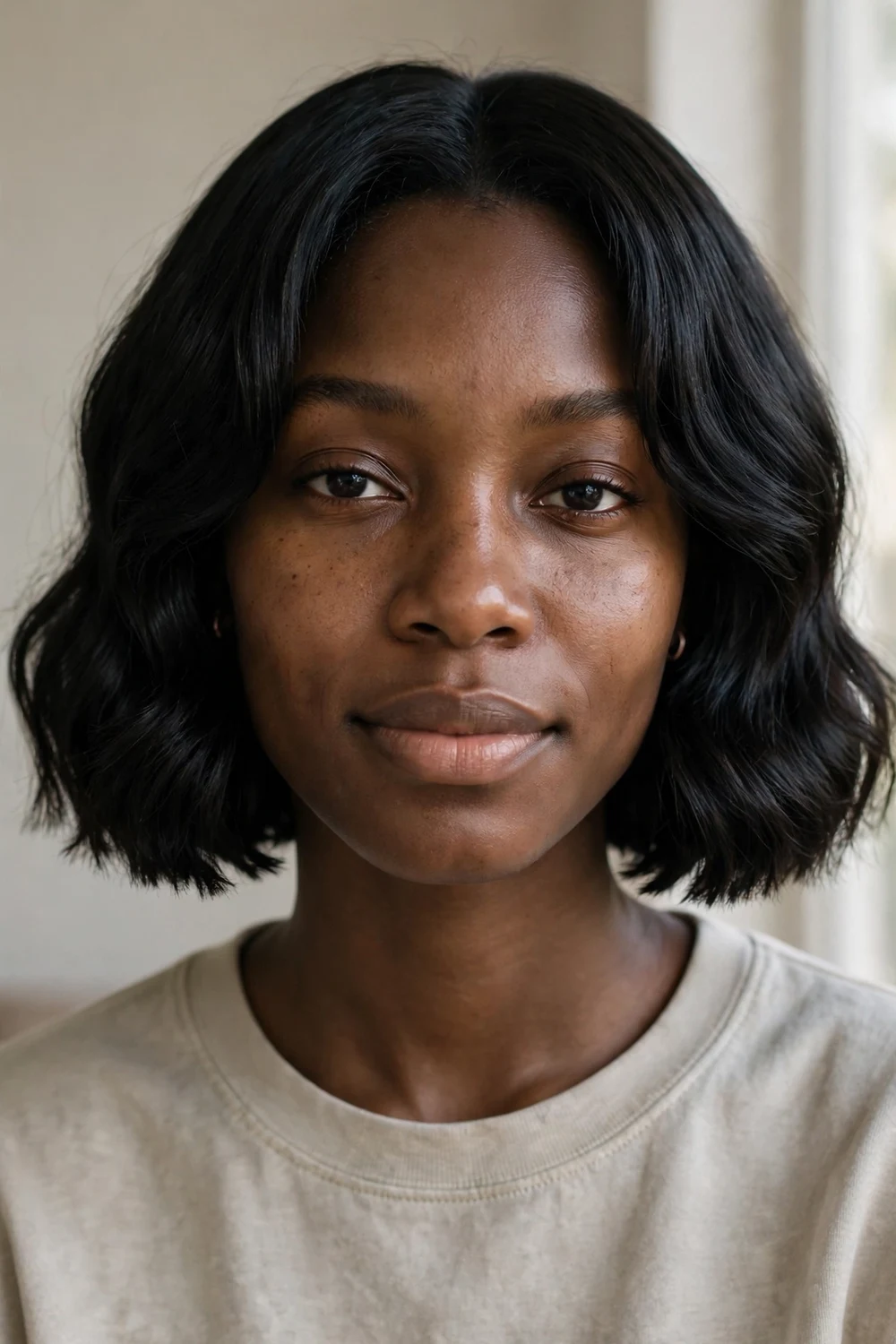
A blunt perimeter makes wavy ends look thicker. With no wispy finish to thin the outline, the eye reads the bottom line as full and healthy. This cut works best on fine to medium waves, where the waves are soft enough to show off the sharp edge. Ask for a clean cut line and keep texture inside the shape only if your stylist recommends it.
Try this: Smooth a drop of serum over dry ends to make the blunt line gleam without flattening the waves above it.
4. French Bob with Natural Waves

The French bob sits at the cheekbone or just below the ear, shorter than the classic bob, and waves soften its graphic shape. The result looks chic without trying, especially with a deep side part or short fringe. Thick waves may need light internal texture so the sides do not puff out; fine waves can wear it as-is.
Try this: Let it air-dry completely untouched, then flip the part to the opposite side once dry for instant root lift.
5. Layered Collar-Length Wavy Bob
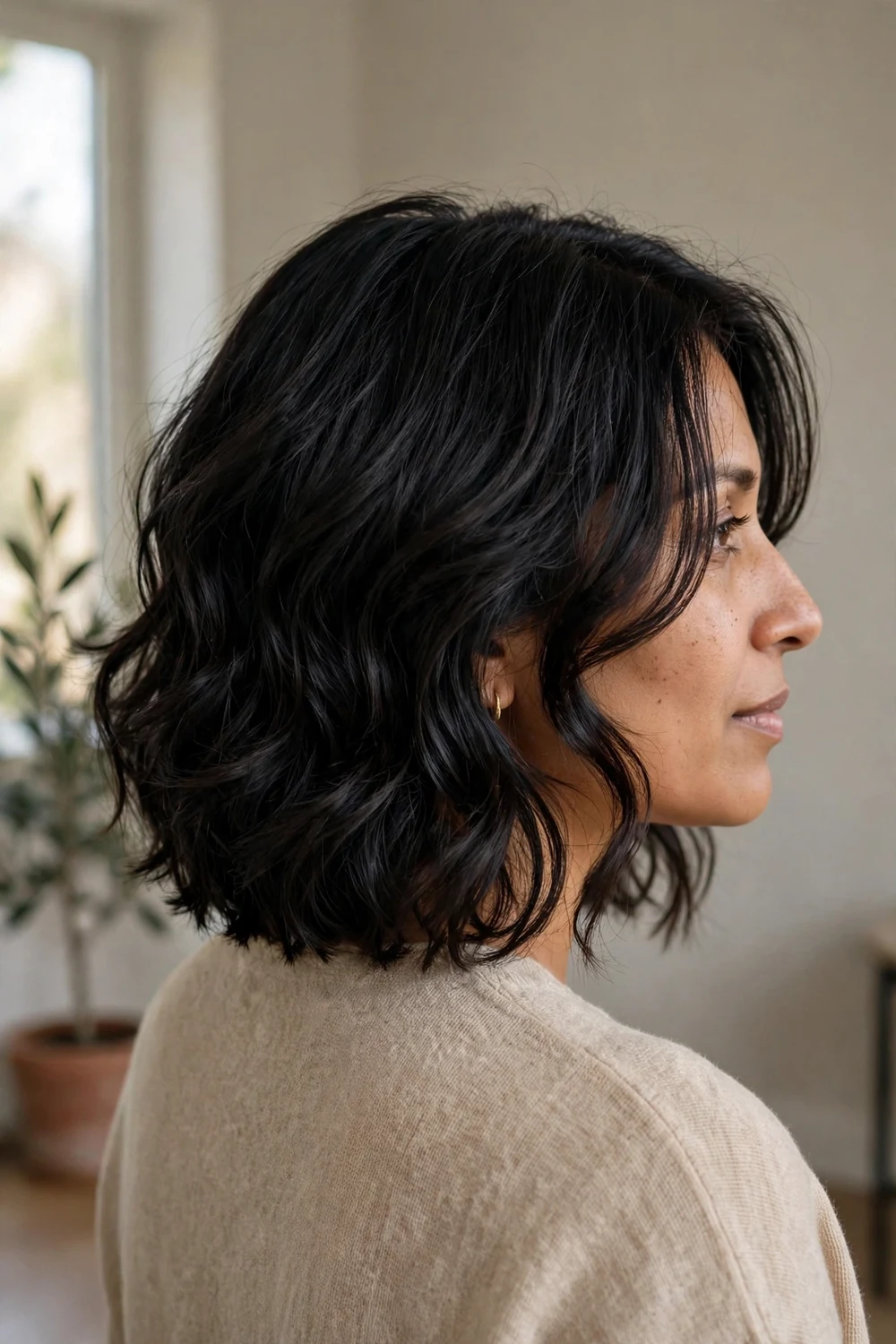
Long layers through a collar-length bob distribute weight so waves fall in ribbons instead of a solid mass. The layering starts around the cheekbones and continues to the ends, which keeps thick hair from widening at the sides. It is a forgiving cut for uneven wave patterns, since straighter sections near the crown blend into the layers.
Try this: Diffuse upside down on low heat for 5 minutes to set the layers with bounce.
6. Shaggy Wavy Bob with Face-Framing Layers

Shag-inspired layering turns wavy texture into the whole point of the cut. Shorter layers around the crown and face create lift, while longer pieces at the nape keep the bob’s outline. The finish is deliberately undone, so it actually looks better as it gets messier through the day. Best on medium to thick waves that can carry the volume.
Try this: Scrunch a salt spray into dry hair for piece separation that lasts all day.
7. Wavy Bob with Curtain Bangs

Curtain bangs melt into wavy hair because the center part follows the hair’s natural fall. The fringe opens over the forehead and blends into the sides, framing the eyes and cheekbones. Keep the bangs long enough to tuck behind the ears on busy days. They grow out gracefully, which makes them lower commitment than a straight fringe.
Try this: Twist the bangs away from your face while damp, then release once dry for a soft split.
8. Italian Wavy Bob with Airy Ends

The Italian bob is chin-length with bouncy, airy ends that flip and move. On wavy hair, those ends happen naturally, which makes this one of the easiest versions to maintain. The cut has soft volume through the sides rather than a flat, graphic line. It flatters round and square faces because the lifted ends draw the eye outward, not down.
Try this: Blow-dry the ends with a round brush, flipping them outward for that signature bounce.
9. A-Line Wavy Bob with Face-Framing Layers
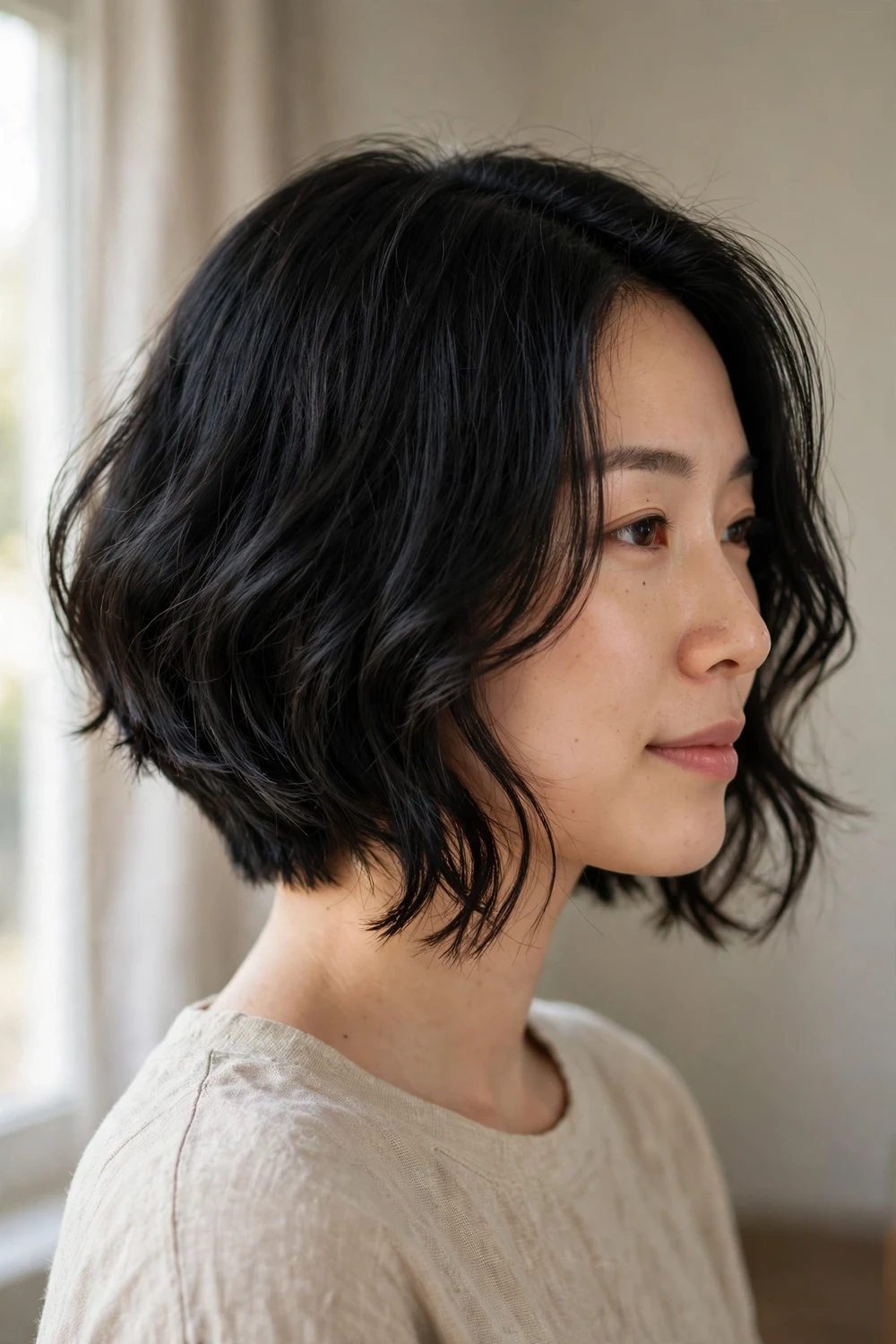
An A-line bob runs shorter at the back and longer toward the face, giving waves a clear direction to follow. The front pieces skim the collarbone while the back sits at the nape, which keeps thick hair from stacking up behind. Face-framing layers blend the two lengths so the transition looks smooth, not choppy.
Try this: Curl the two front pieces away from the face with a flat iron for a polished finish.
10. Asymmetrical Wavy Bob

One side sits noticeably longer than the other, and waves make the uneven perimeter look intentional instead of accidental. The asymmetry adds edge to an otherwise classic shape, which suits women who want a bob with personality. The longer side usually falls toward the front, framing one side of the face.
Try this: Part on the shorter side so the longer section sweeps across and shows off the difference.
11. Collar-Bone Wavy Bob with Texture

Point-cut ends through a collar-bone bob break up the bottom line so waves separate into defined pieces. The texture is cut in, not styled in, which means the separation shows up even on air-dried days. It is a smart choice for medium-density waves that look too solid in a blunt cut but too thin with heavy layers.
Try this: Rake a small amount of styling cream through the mid-lengths to encourage the textured pieces to clump.
12. Wavy Bob with Middle Part

A middle part turns a wavy bob symmetrical and sleek. The waves fall evenly on both sides, which balances a strong jawline or wide forehead. It shows off the cut’s shape more honestly than a side part, so it works best when the perimeter is freshly trimmed. Fine waves look fuller here because the hair is distributed evenly.
Try this: Use the handle of a rattail comb to draw the part while hair is damp, then leave it alone as it dries.
13. Balayage Wavy Bob
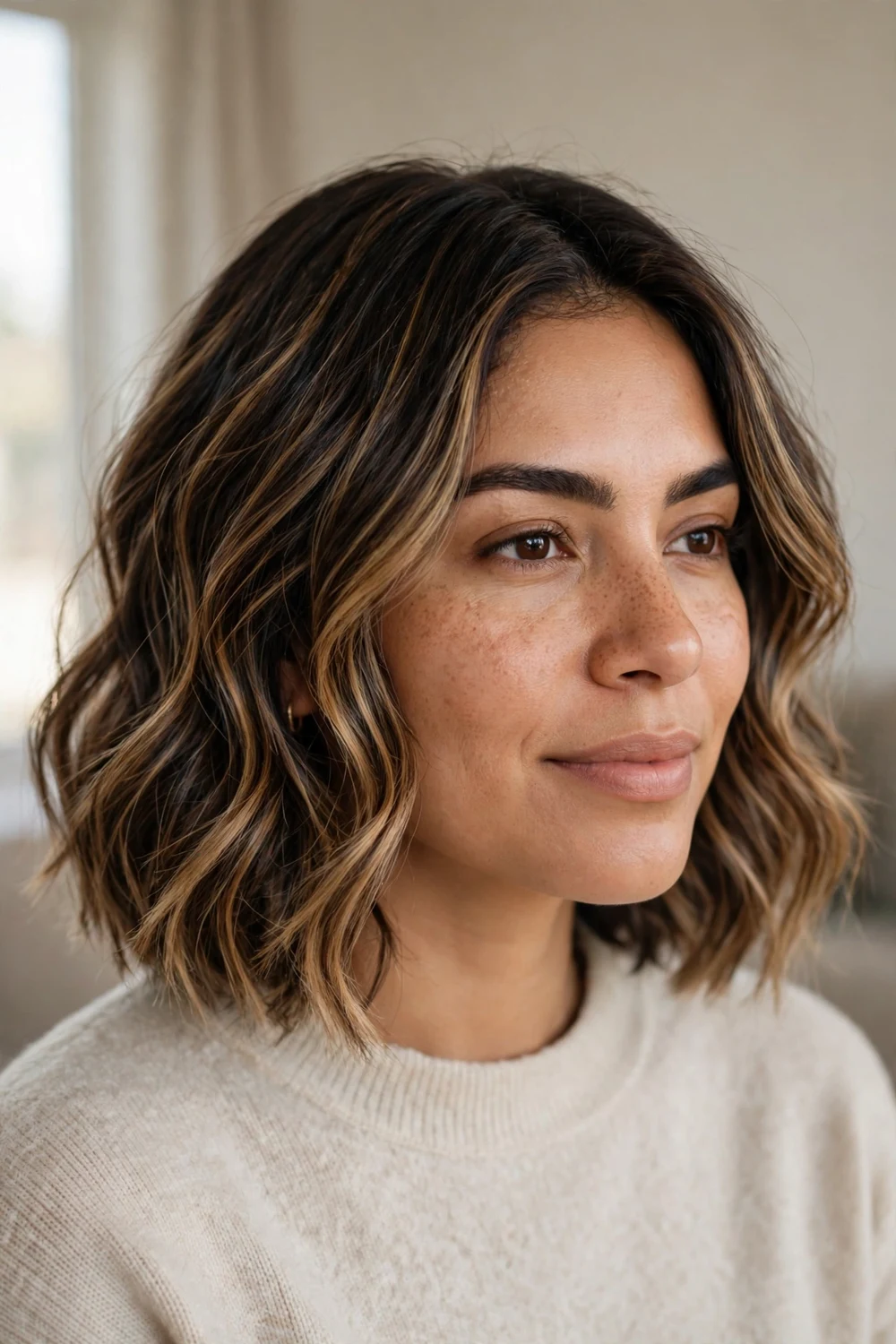
Balayage and waves amplify each other. The hand-painted color follows the bends, so every wave catches a different tone and the cut looks more dimensional than it is. Keep the contrast soft, no more than two shades from your base, so grow-out stays seamless. This is color, not a cut, so pair it with any bob shape on this list.
Try this: Use a color-safe shampoo and a weekly mask to keep the lightened ends from drying out.
14. Wavy Bob with Wispy Bangs

Wispy bangs are cut thin and feathered, so they sit softly over the forehead instead of forming a solid wall. On wavy hair they blend into the texture instead of fighting it. This fringe suits high foreheads and long faces, and it is forgiving if your waves do something unexpected overnight.
Try this: Blow-dry bangs first, side to side with a small brush, before they set in a wave you did not plan.
15. Chunky-Textured Wavy Bob

Chunky texture is a cutting technique, not a styling choice. Deep point-cutting and slicing create visible separation between sections, which makes waves look piece-y and modern. The cut does the work, so styling can be as simple as air-drying with a little cream. Thick waves benefit most because the technique removes bulk without thinning shears.
Try this: Pinch individual wave clumps with a dab of wax to define the chunky pieces.
16. Half-Up Wavy Bob

A half-up style proves a bob is not limiting. Pull the top section back and pin it, leaving the waves loose below. The crown lift adds height, and the loose bottom keeps the look soft. It takes two minutes and works for office days, dinners, and everything between. A small claw clip or two bobby pins in a crossed pattern hold it.
Try this: Tease the crown lightly with a comb before pinning for extra lift that lasts.
17. Wavy Bob with One Side Tucked

Tucking one side behind the ear is the fastest way to change a bob’s mood. It opens up the face, shows off earrings, and creates asymmetry without a cut. The untucked side keeps its waves, so the style still reads as a bob. Secure the tucked side with a bobby pin if it slips, especially on freshly washed hair.
Try this: Add a drop of smoothing cream behind the ear first so the tucked section stays flat.
18. Grown-Out Wavy Bob

A bob between trims is a style of its own. As the cut grows past the chin toward the shoulders, waves stretch out and the shape softens into a shaggy lob. Resist the urge to trim it back immediately; dust the ends every 10 to 12 weeks instead of the usual 6 to 8. The in-between stage suits waves because the texture disguises uneven growth.
Try this: Add long face-framing layers at your next appointment to shape the grow-out instead of cutting it all off.
19. Fine-Hair Wavy Bob with Blunt Perimeter

Fine waves lose visual weight fast, so this bob protects the ends. The perimeter stays blunt and one-length while any layering stays internal and minimal. The result reads as thicker hair, not thinner, which is the opposite of what heavy layers do to fine texture. Keep the length at or above the chin so the ends do not go see-through.
Try this: Apply volumizing mousse at the roots only, so the ends keep their weight.
20. Thick-Hair Wavy Bob with Internal Layers

Thick waves need weight removed from inside the shape, not off the ends. Internal layers cut shorter underneath the top sections let the hair collapse inward instead of pushing outward into a triangle. The outside keeps its length and the bob keeps its outline. This is a cut to discuss in detail with your stylist, because over-thinning thick waves creates frizz.
Try this: Use a leave-in conditioner before diffusing to keep the interior layers smooth.
21. Low-Maintenance Long-Layer Wavy Bob

Two or three long layers are all this bob needs. The cut is simple enough to grow out for months, and the waves provide the styling. Wash, add cream, air-dry, and go. It is the right pick if you want a bob but visit the salon twice a year. The trade-off is less shape than a precision cut, but the texture covers it.
Try this: Refresh second-day waves with a water spray bottle and a scrunch instead of re-washing.
Bob Haircuts for Wavy Hair Comparison at a Glance
| Style | Best For | Difficulty | Upkeep |
|---|---|---|---|
| Classic Chin-Length Wavy Bob | First-time bob wearers | Easy | Trim every 6-8 weeks |
| Soft Wavy Lob | Growing out a short cut | Easy | Trim every 8-10 weeks |
| Blunt-Edge Wavy Bob | Fine to medium waves | Easy | Trim every 6 weeks |
| French Bob with Natural Waves | Bold, chic looks | Easy | Trim every 6-8 weeks |
| Layered Collar-Length Wavy Bob | Thick or uneven waves | Medium | Trim every 8 weeks |
| Shaggy Wavy Bob with Face-Framing Layers | Medium to thick waves | Medium | Trim every 8-10 weeks |
| Wavy Bob with Curtain Bangs | Soft face framing | Medium | Bang trim every 4-6 weeks |
| Italian Wavy Bob with Airy Ends | Round and square faces | Easy | Trim every 6-8 weeks |
| A-Line Wavy Bob with Face-Framing Layers | Thick hair | Medium | Trim every 6-8 weeks |
| Asymmetrical Wavy Bob | Edgy personal style | Easy | Trim every 6 weeks |
| Collar-Bone Wavy Bob with Texture | Medium-density waves | Easy | Trim every 8 weeks |
| Wavy Bob with Middle Part | Balanced, sleek looks | Easy | Trim every 6-8 weeks |
| Balayage Wavy Bob | Added dimension | Medium | Color refresh every 3-4 months |
| Wavy Bob with Wispy Bangs | High foreheads | Medium | Bang trim every 4-6 weeks |
| Chunky-Textured Wavy Bob | Thick waves | Easy | Trim every 8 weeks |
| Half-Up Wavy Bob | Quick occasion styling | Easy | None extra |
| Wavy Bob with One Side Tucked | Showing off earrings | Easy | None extra |
| Grown-Out Wavy Bob | Between salon visits | Easy | Dust ends every 10-12 weeks |
| Fine-Hair Wavy Bob with Blunt Perimeter | Fine waves | Easy | Trim every 6 weeks |
| Thick-Hair Wavy Bob with Internal Layers | Thick waves | Medium | Trim every 8 weeks |
| Low-Maintenance Long-Layer Wavy Bob | Minimal salon visits | Easy | Trim every 10-12 weeks |
How to Choose the Right Bob for Your Waves
Start with density. Fine waves do best with blunt edges and chin-length cuts that keep the ends full. Medium waves can handle light layering and collar-bone length. Thick waves need internal layers and a stylist who cuts dry or air-dried hair so the shape accounts for shrinkage.
Then think about your routine. If you air-dry most days, pick a cut that looks good untouched: classic, blunt-edge, or long-layer bobs. If you diffuse or heat-style, you can carry more demanding shapes like the A-line or curtain-bang versions. Bring photos of the exact length you want, not just the vibe, because “bob” means very different lengths to different people.
Mistakes to Avoid
The most common mistake is cutting wavy hair wet and straight, then being surprised when it springs up shorter and wider. Always discuss how your waves behave dry. The second is over-layering fine waves, which thins the ends until they look wispy. The third is skipping trims: a bob loses its shape fast, and waves make uneven growth obvious.
Avoid heavy thinning shears on thick waves too. They can create frizz and uneven ends that no product fully fixes. Strategic internal layering with regular shears gives a cleaner result.
If you are deciding between lengths, our guide to long bob hairstyles breaks down the shoulder-grazing end of the bob family.
For wave-friendly layering in more detail, see layered bob hairstyles and how the layers are placed.
If your waves lean thick, choppy bob hairstyles shows how choppy texture tames volume.
The bouncy European shape gets its own breakdown in italian bob haircuts, including who it suits.
Frequently Asked Questions
What is the best bob length for wavy hair?
Chin to collarbone is the sweet spot. Chin-length keeps waves compact and full, while collar-bone length lets heavier waves stretch out instead of stacking wide. Shorter than the chin, shrinkage can make the cut sit higher than planned.
Should wavy hair be cut wet or dry?
Dry or air-dried cutting gives the most predictable result because the stylist sees your real wave pattern and shrinkage. Wet cutting works if your stylist is experienced with waves and leaves extra length to account for spring.
Do bobs work on thick wavy hair?
Yes, with the right internal structure. Thick waves need layers cut inside the shape to remove weight without touching the perimeter. Blunt one-length bobs on very thick waves can turn triangular, so internal layering keeps the outline intact.
How often should a wavy bob be trimmed?
Every 6 to 8 weeks for precision shapes like blunt or A-line bobs. Softer cuts with long layers can stretch to 10 to 12 weeks. Bangs need their own trim every 4 to 6 weeks.
Can I air-dry a wavy bob every day?
Yes, most of the cuts in this guide are designed for it. Apply curl cream or mousse to damp hair, scrunch gently, and leave it alone until fully dry. Touching waves while they dry is what causes frizz.
Final Thoughts
A wavy bob is one of the lowest-effort ways to look put together. Pick the length and structure that match your density, find a stylist who respects your wave pattern, and keep the trims regular. The texture does most of the work for you.

