


Short Answer: The modern pixie after 60 is defined by contrast: a soft undercut under a longer top, one side longer than the other, a quiff or curtain micro bangs up front. The 23 cuts below take the classic pixie shape and update the lines, so each one looks current rather than copied from an older salon book.
Start with the Asymmetric Bixie with a Long Cheek Piece if you want coverage with a current line, or the Soft Nape Undercut with a Long Sweeping Top if thick hair needs weight taken out underneath. The Razored Pixie Shag with Shattered Ends suits women who air-dry, while the Modern Quiff Pixie with Tapered Sides gives fine hair height that lasts past breakfast. If you want the classic versions for comparison, the main roundup of pixie haircuts for women over 60 covers them in depth.
Every idea below lists who it suits, one styling tip to try at home, and the difficulty, cost band, and daily styling time. Trims matter more than products with cuts this short: most of these shapes hold for four to six weeks, and the undercut versions need a quicker tidy-up at the nape or temples between full cuts.
Key Takeaways
- Current pixie shapes use contrast: short underneath, longer on top, or longer on one side than the other.
- A soft undercut at the nape or one temple removes bulk while the top keeps its coverage.
- Razored and point-cut ends keep short hair moving, which helps fine hair look fuller.
- Fringe is cut longer and lighter now: curtain micro bangs, brow-length sweeps, and piecey fronts.
- Most modern pixies style in 5 to 10 minutes and need a trim every 4 to 6 weeks.
1. Asymmetric Bixie with a Long Cheek Piece

The bixie blends a pixie back with bob-length pieces at the front, and this version pushes the blend further: one cheek piece stays noticeably longer than the other. The long piece softens the jaw line while the cropped back keeps the shape light and current.
Ask for the back cut close with soft stacking, and keep the longer front piece at cheek level so it can tuck behind the ear. It suits fine to medium hair that feels too exposed in a short crop, and it grows out evenly toward a bob.
Try this: Try this: blow-dry the long cheek piece forward with a small round brush, then tuck the shorter side behind your ear to show the contrast.
Difficulty: Easy | Cost: $$ | Time: 8 minutes
2. Soft Nape Undercut with a Long Sweeping Top

The undercut sits only at the nape, hidden under a top that stays long enough to sweep back or to one side. From the front and sides the cut reads as a classic long pixie; the clipped nape only shows when the hair is lifted.
This is the undercut to pick when thick hair goes bulky at the back within weeks of a cut. Removing that hidden layer keeps the neckline neat for longer and stops the back from pushing the top forward. More shapes in this family sit in the guide to undercut pixie haircuts for women over 60.
Try this: Try this: sweep the top back with your fingers and a pea-size amount of cream, and let the clean nape do the talking.
Difficulty: Easy | Cost: $ | Time: 5 minutes
3. Razored Pixie Shag with Shattered Ends

Short shag layers cut with a razor give this pixie its loose, shattered outline. The crown layers stay choppy and the ends are feathered by the blade, so the hair separates into pieces instead of sitting in one solid cap.
It suits wavy hair best, since the wave pattern fills the layers out. Straight hair can wear it with a mist of texture spray scrunched in while damp. Ask your stylist to keep the fringe broken up and longer at the sides.
Try this: Try this: scrunch a little mousse into damp hair, push the pieces into place with your fingers, and air-dry without brushing.
Difficulty: Easy | Cost: $ | Time: 5 minutes
4. Angled Pixie with a Longer Front and Short Back

The outline runs on a diagonal: cropped close at the back, then lengthening toward the front until the pieces graze the cheekbones. That slope draws the eye down and across, which is why the cut flatters round faces.
Keep the angle moderate, about an inch of difference, so the cut reads shaped rather than severe. It works on straight and lightly wavy hair, and the front pieces can be worn forward or tucked back.
Try this: Try this: dry the front pieces with a paddle brush angled toward the chin, and finish the back with your fingers for contrast.
Difficulty: Medium | Cost: $ | Time: 8 minutes
5. Temple Undercut Pixie with a Side Sweep
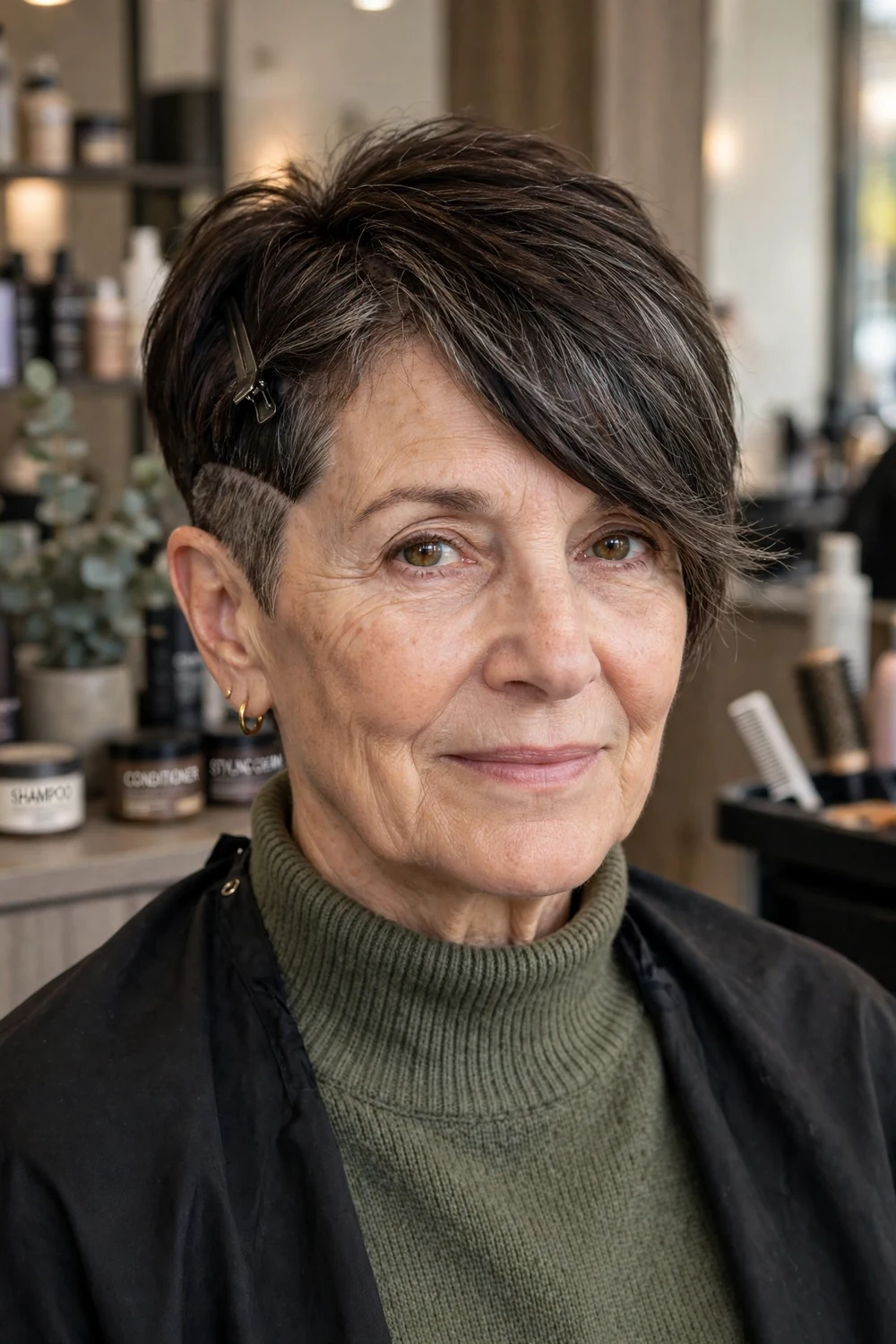
One temple is clipped short under a longer top that sweeps across the forehead. The sweep covers the clipped side when worn down, and a change of part shows it off, so the same cut gives you a quiet weekday version and a bolder one.
The clipped temple also takes weight out where thick hair tends to push outward. Plan a tidy-up of the undercut every four weeks, even if the rest of the cut can wait six.
Try this: Try this: dry the sweep with a vent brush from the undercut side across, so the hair lies flat in the direction it will sit all day.
Difficulty: Medium | Cost: $ | Time: 8 minutes
6. Modern Quiff Pixie with Tapered Sides
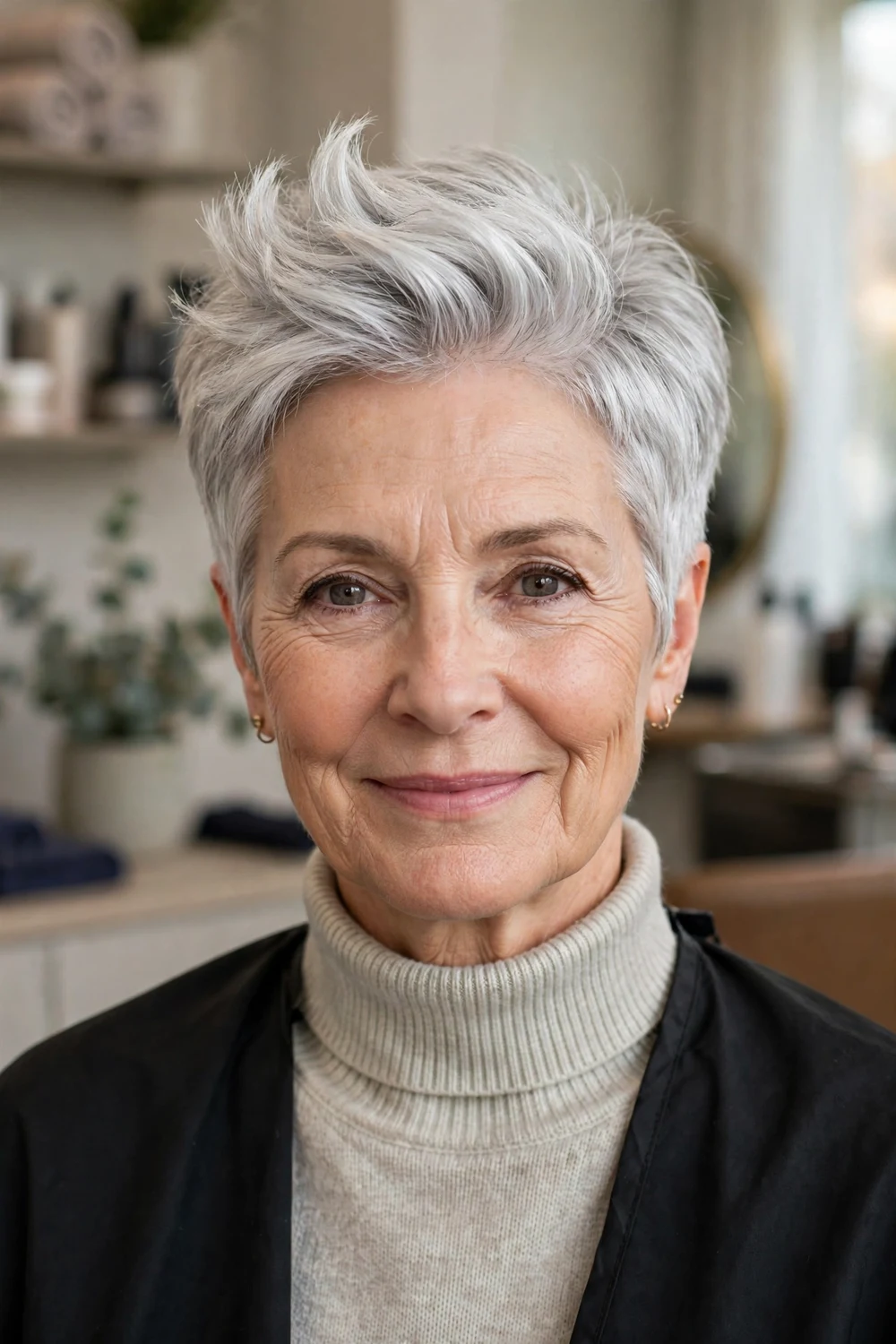
The front section stands up and slightly back in a quiff, while the sides taper close to balance the height. On fine hair, the lifted front is where the eye lands, so the rest of the cut can stay simple and close.
Ask for enough length at the front to fold back on itself, usually two to three inches. The quiff holds best on straight to lightly wavy hair; very curly hair will fight the shape and is happier in a curl-led cut.
Try this: Try this: blow-dry the front section up and back with a small round brush, then pinch the roots with a little matte paste once dry.
Difficulty: Medium | Cost: $ | Time: 10 minutes
7. Curtain Micro Bang Pixie with a Soft Center Part
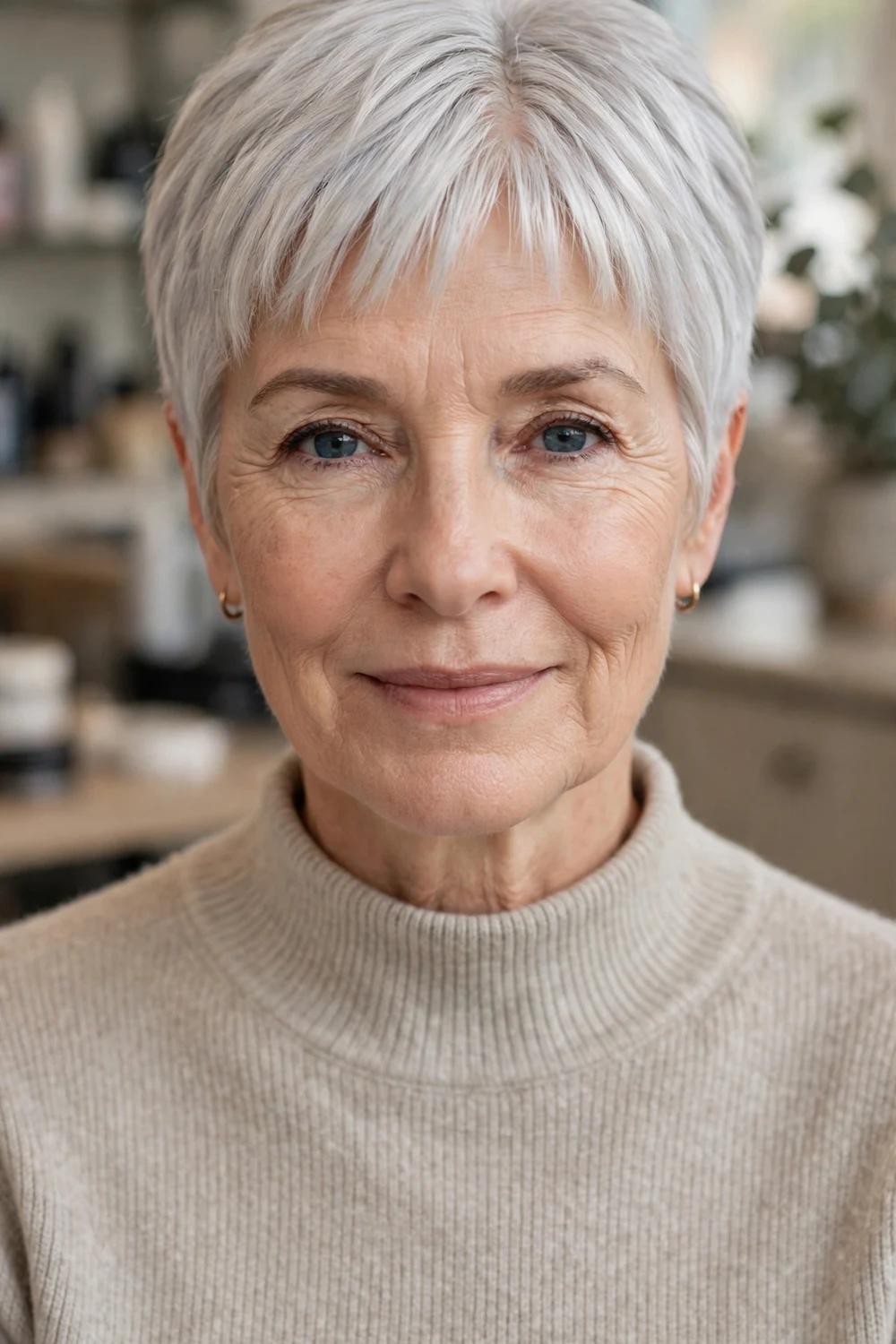
The fringe is cut short and parted in the middle, so two small curtain pieces frame the brow instead of covering it. The rest of the pixie stays neat and close, which keeps the short fringe as the detail that dates the cut to now.
Micro bangs suit smaller foreheads and straight hair that lies flat without a fight. They grow out into a regular curtain fringe within a few weeks, so the commitment is low and the in-between stage still looks deliberate.
Try this: Try this: while the fringe is damp, clip the two pieces away from your face for five minutes so the part sets as the hair dries.
Difficulty: Easy | Cost: $ | Time: 5 minutes
8. Forward-Swept Pixie with a Brow-Length Fringe
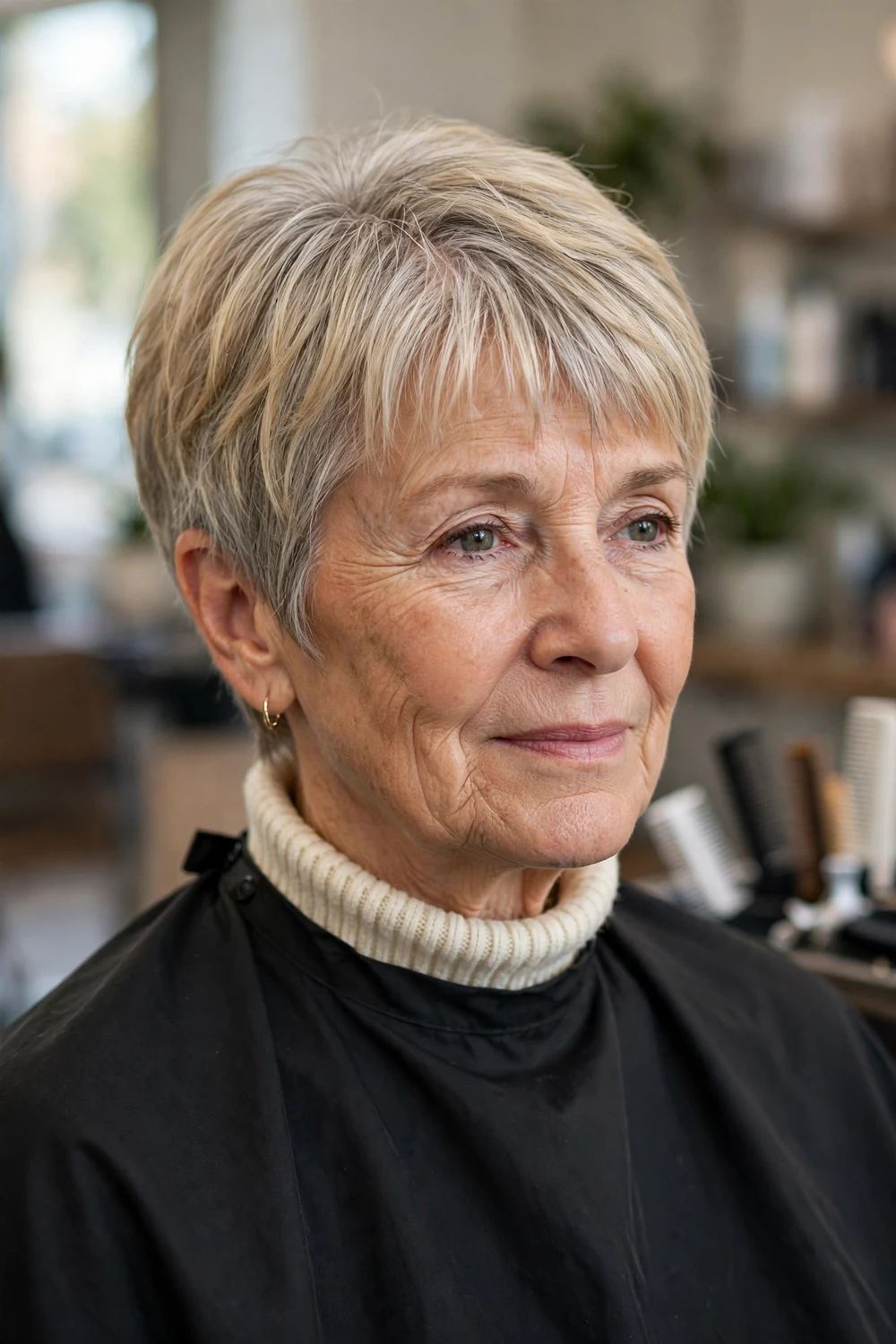
Everything on top is cut and styled forward, ending in a fringe that rests right at the brow. The forward direction shortens the look of a long face and gives high foreheads soft coverage without a heavy curtain of hair.
Ask for the fringe point-cut so it sits in light pieces rather than a solid line. It suits straight and fine hair well, and the fringe can be pushed to one side on days you want a change.
Try this: Try this: blow-dry the top forward with your fingers, following the direction of growth, and stop while a little movement is still in it.
Difficulty: Easy | Cost: $ | Time: 5 minutes
9. Spiral Curly Pixie with a Rounded Top
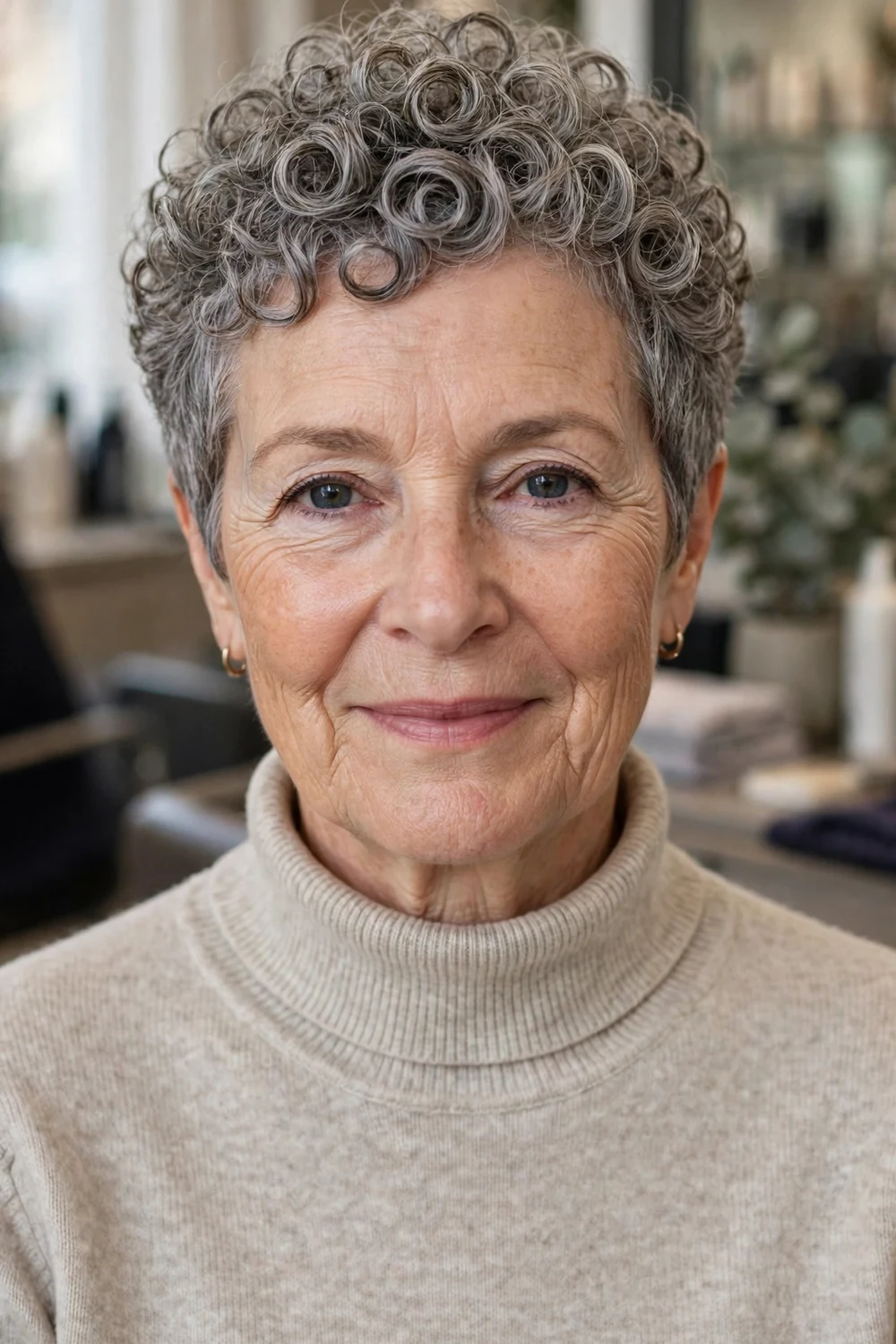
Curls are left long enough on top to form full spirals, and the overall outline is rounded rather than flat at the sides. The rounded shape keeps curly pixies from widening into a triangle as they grow.
Ask for a dry cut, curl by curl, so the length accounts for shrinkage. The full set of curl-first shapes lives in the guide to curly pixie haircuts for women over 60. This cut needs moisture more than hold: a leave-in conditioner and a light curl cream are the whole routine.
Try this: Try this: scrunch curl cream into soaking-wet hair, then diffuse on low heat with your head tipped forward for lift at the roots.
Difficulty: Easy | Cost: $$ | Time: 8 minutes
10. Piecey Silver Pixie with a Matte Finish
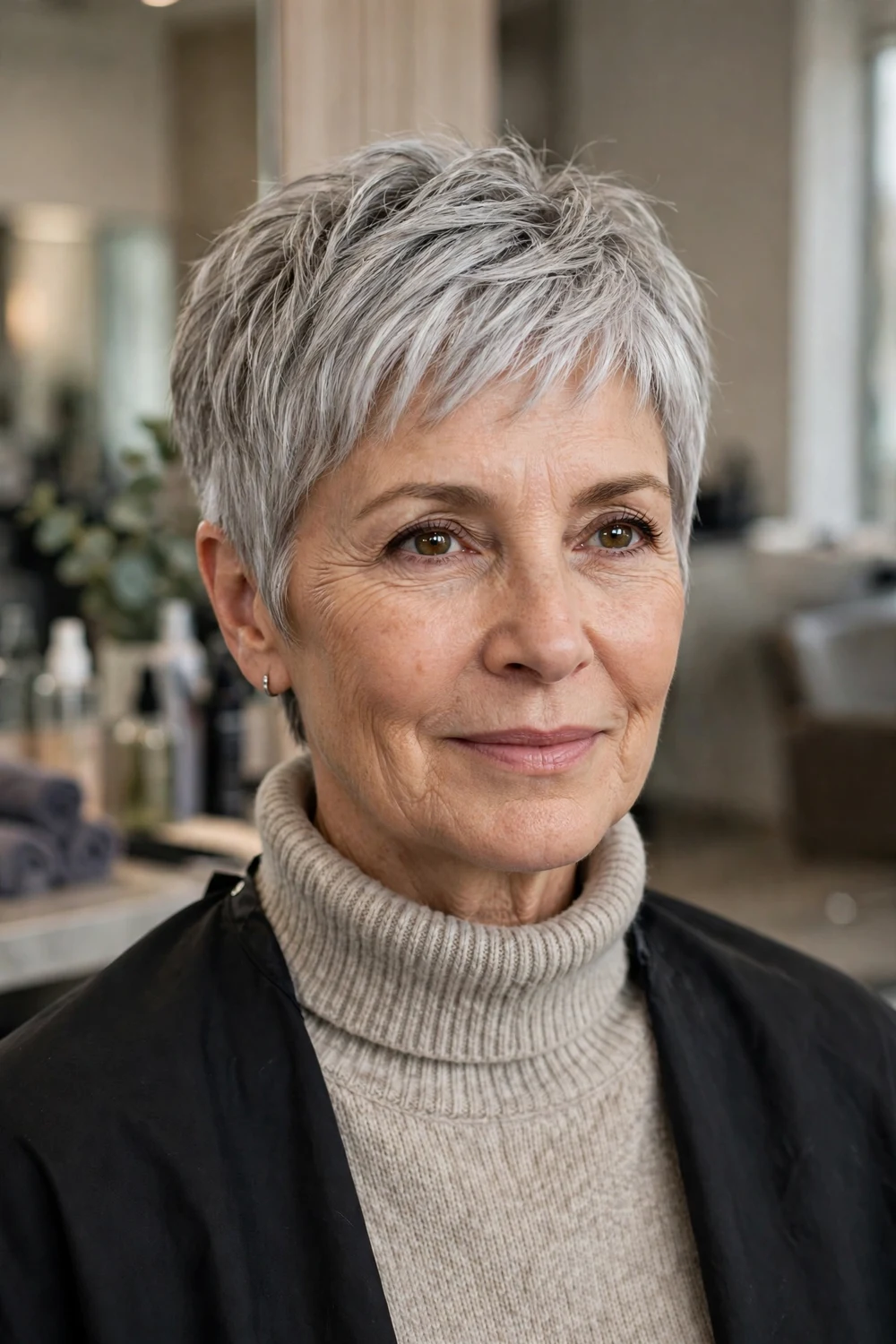
The top is point-cut into separated pieces that show clearly on silver hair, since pale strands catch light along every cut edge. A matte finish keeps the look current and stops silver hair from reading frizzy under bright light.
This cut is cut for fine hair: the pieces are kept short enough to stand apart instead of clumping. Skip shine sprays and oils, which collapse the separation within the hour.
Try this: Try this: warm a fingertip of matte paste and twist just the ends of the top pieces, one by one, for definition that lasts the day.
Difficulty: Easy | Cost: $ | Time: 5 minutes
11. Wedge-Back Pixie with a Rounded Silhouette
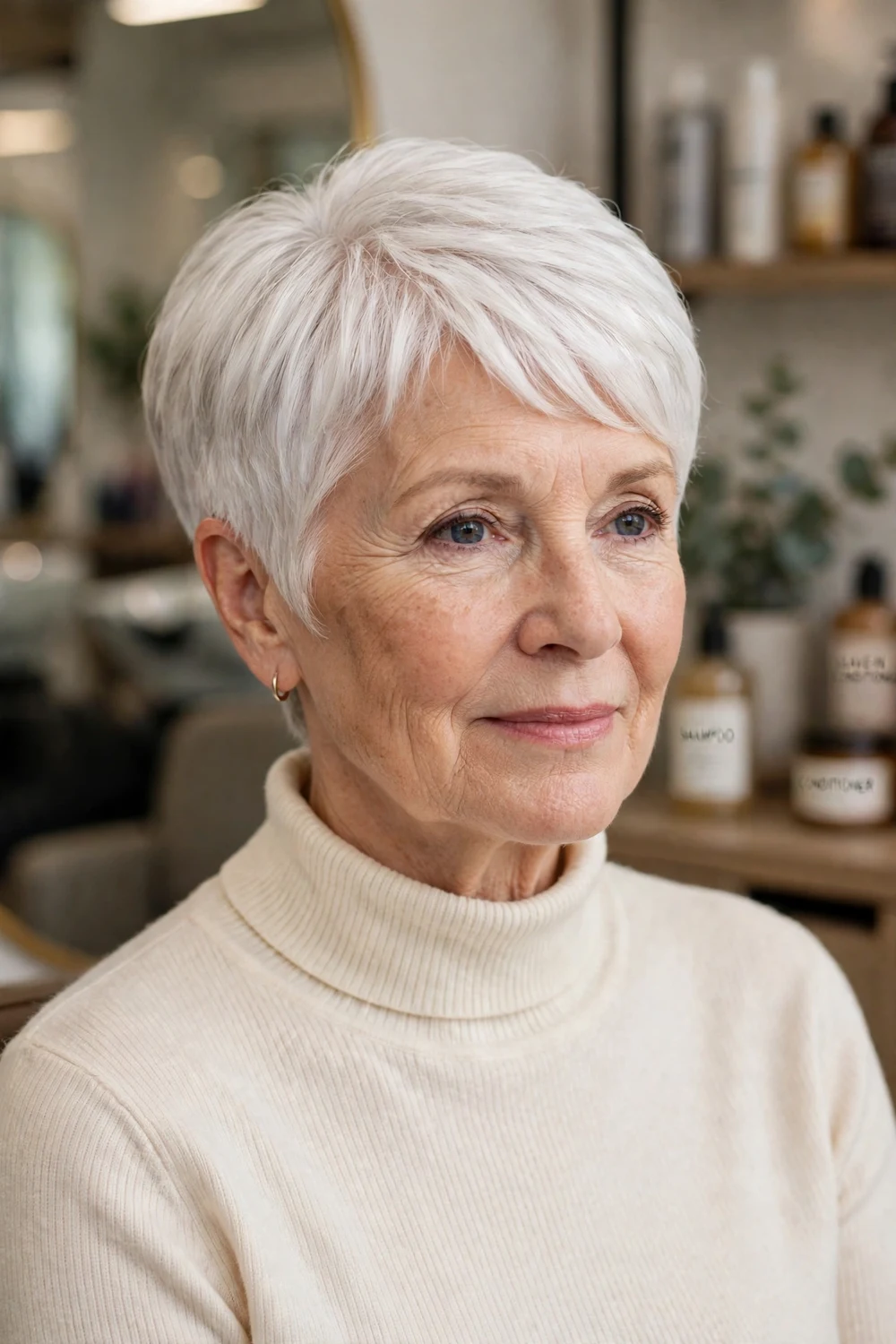
The back is graduated into a wedge, a stacked curve that holds its round shape through the day. The front stays softer and longer, so the strong back shape is balanced by a gentle frame at the face.
A wedge back suits hair that collapses at the rear crown, a common pattern after 60. It needs a stylist who cuts graduation cleanly, and a reshape every five weeks keeps the curve sitting where it should.
Try this: Try this: blow-dry the back with a small round brush, rolling it under at the nape, to set the rounded line.
Difficulty: Medium | Cost: $ | Time: 8 minutes
12. Long-Line Pixie with Ear-Length Sides
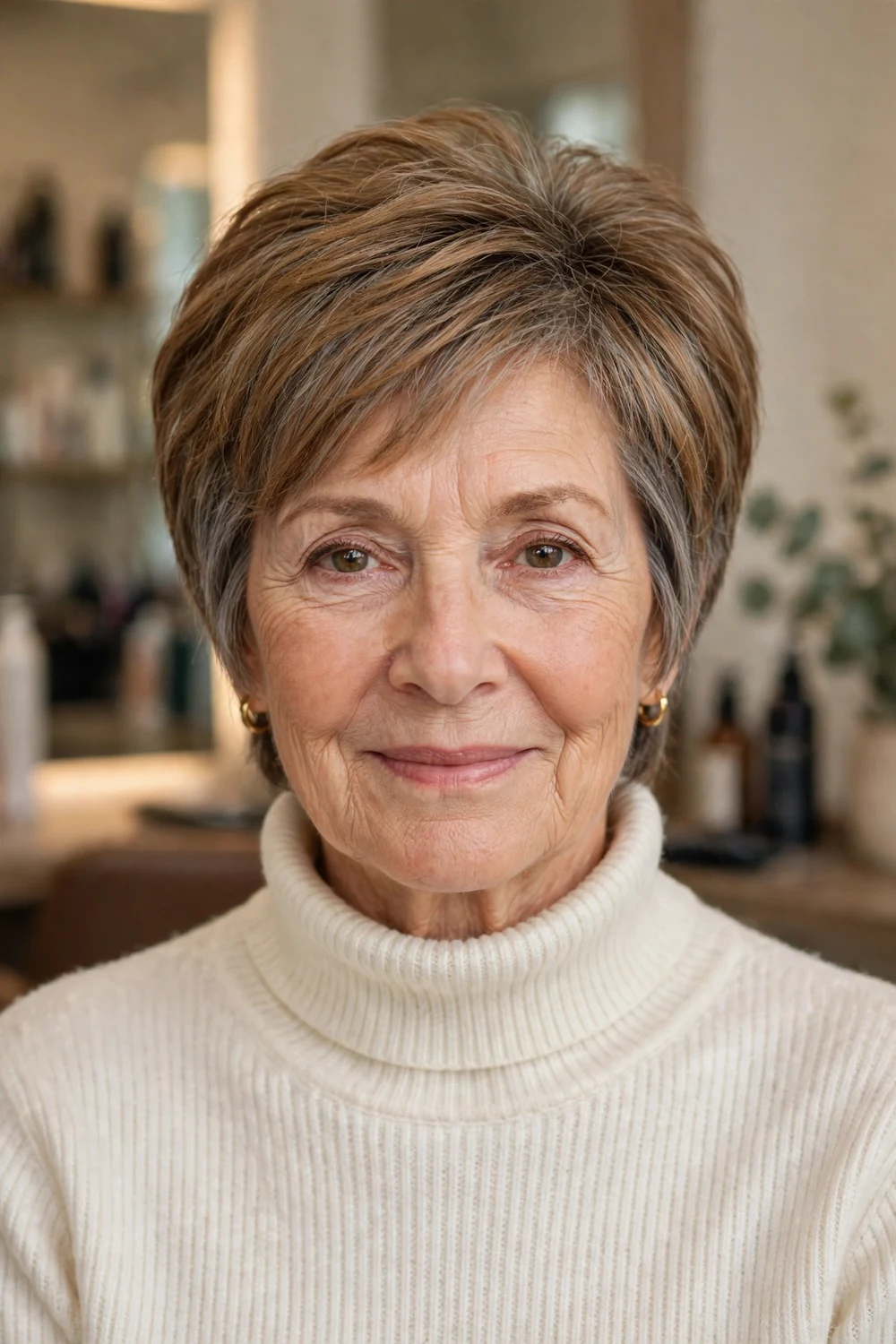
This pixie keeps its length: the sides cover the ears and the top runs long enough to part and sweep. It reads as a pixie because of the cropped, shaped nape, but it keeps the coverage women worry about losing with a short cut.
It is a sensible first step down from a bob, and it grows into a bixie without an awkward stage. Longer versions and gentler shapes are rounded up in the short pixie haircuts for older women guide if you want to compare.
Try this: Try this: wear it with a deep side part for a week, then try a center part; the extra length gives you both options.
Difficulty: Easy | Cost: $ | Time: 8 minutes
13. Faux Hawk Pixie with a Lifted Center Strip
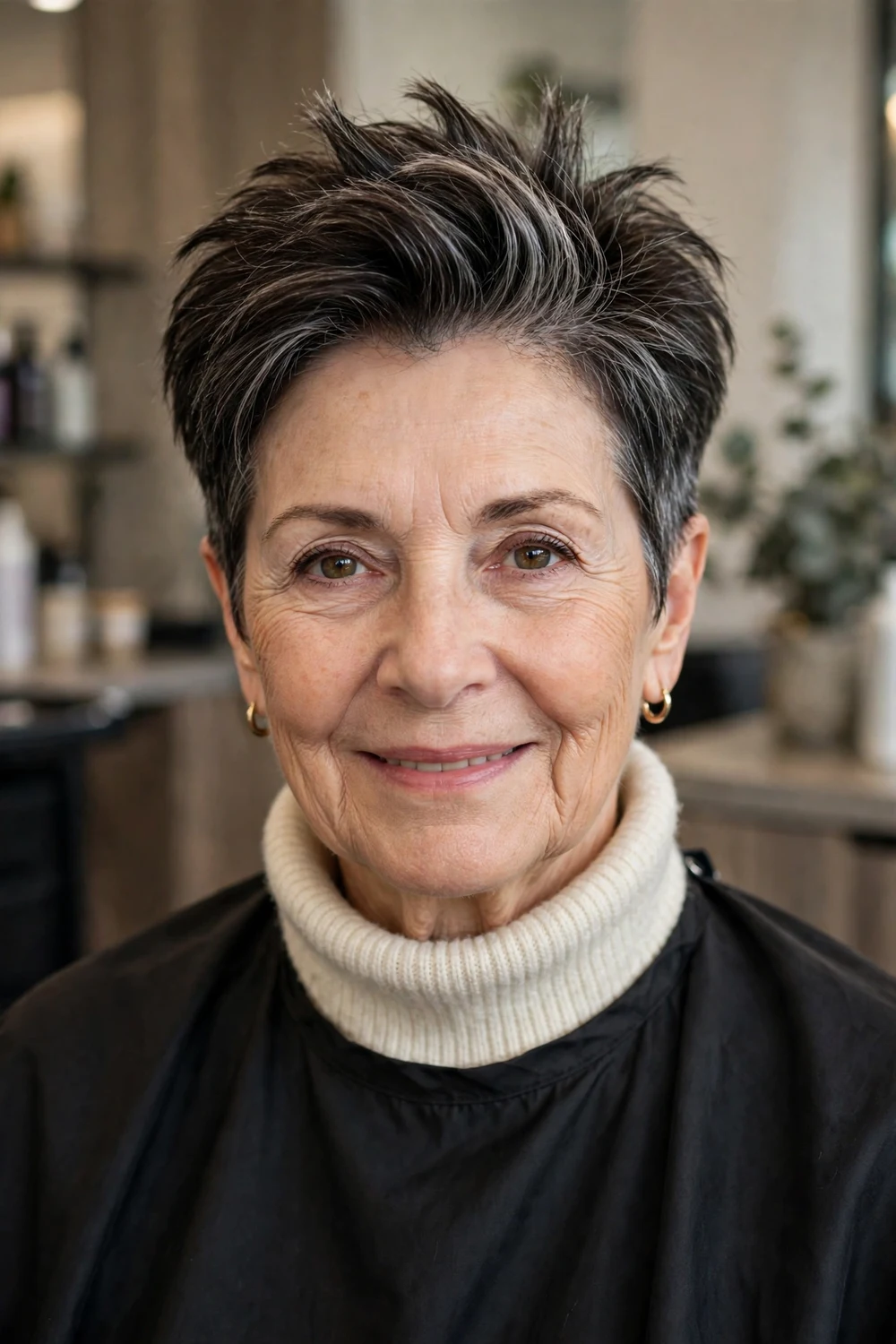
A center strip of longer hair runs from the forehead to the crown and is styled upward, while both sides stay clipped short. The strip is narrower and softer than a true mohawk, so the shape reads playful rather than costume-like.
It suits straight and wavy hair with enough density on top to hold the lift. This is the highest-effort cut on the list: the strip needs drying upward and a firm product most days.
Try this: Try this: blow-dry the center strip straight up with a vent brush, then press a little strong-hold paste along the strip to keep the ridge.
Difficulty: Hard | Cost: $$ | Time: 10 minutes
14. Face-Brightening Pixie with Light Front Panels
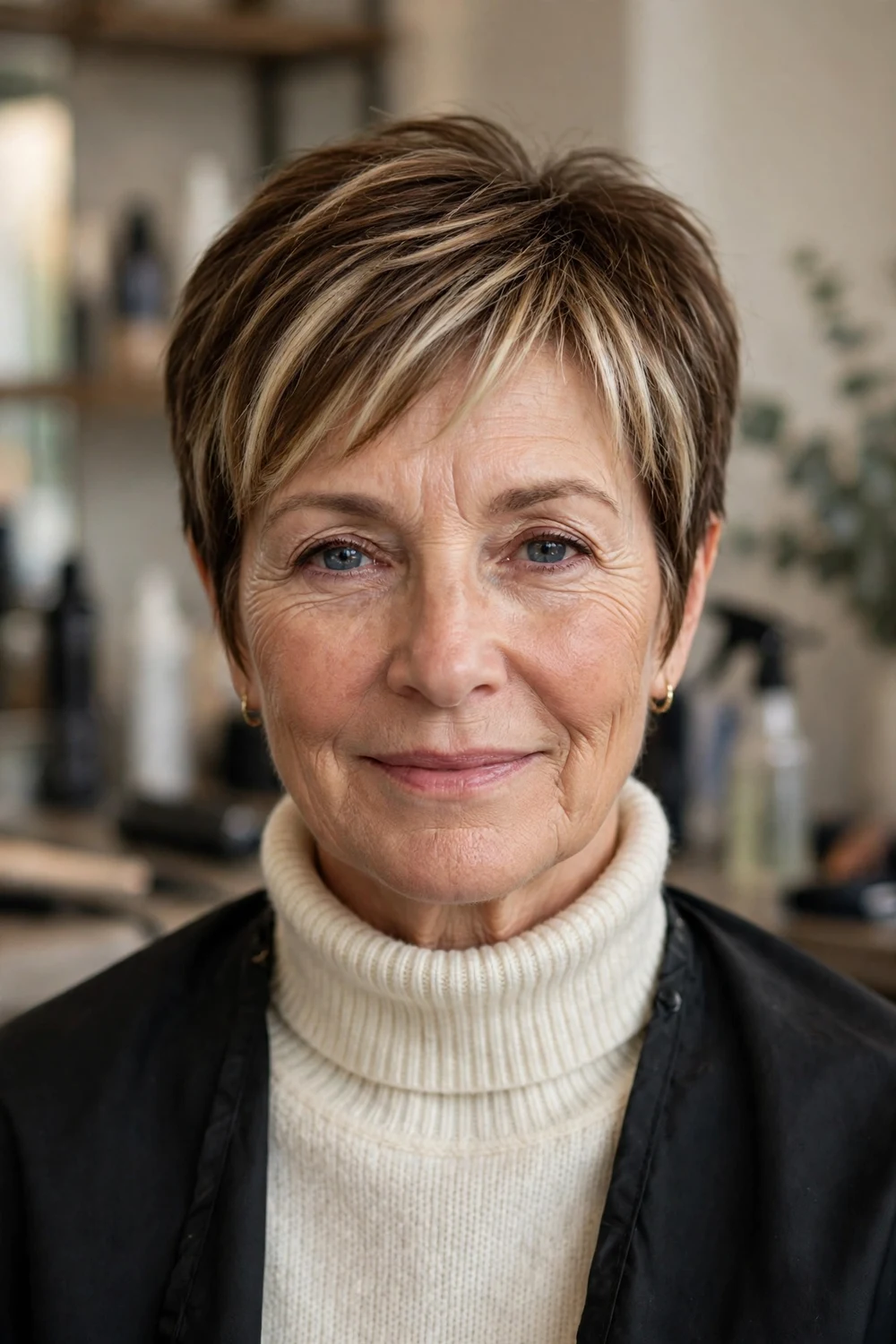
Two light panels are painted through the front sections of the pixie while the rest of the hair stays at its natural depth. On a cut this short, the panels sit right against the face and lift the whole look.
Keep the panels no more than two shades lighter than your base so the grow-out stays soft. Because pixies are trimmed often, ask your colorist to place the panels slightly above where the trim line will sit.
Try this: Try this: part the hair so the lighter panel falls on the side you want to draw the eye to, and keep that side untucked.
Difficulty: Medium | Cost: $$ | Time: 8 minutes
15. Lavender-Tinted Wispy Pixie
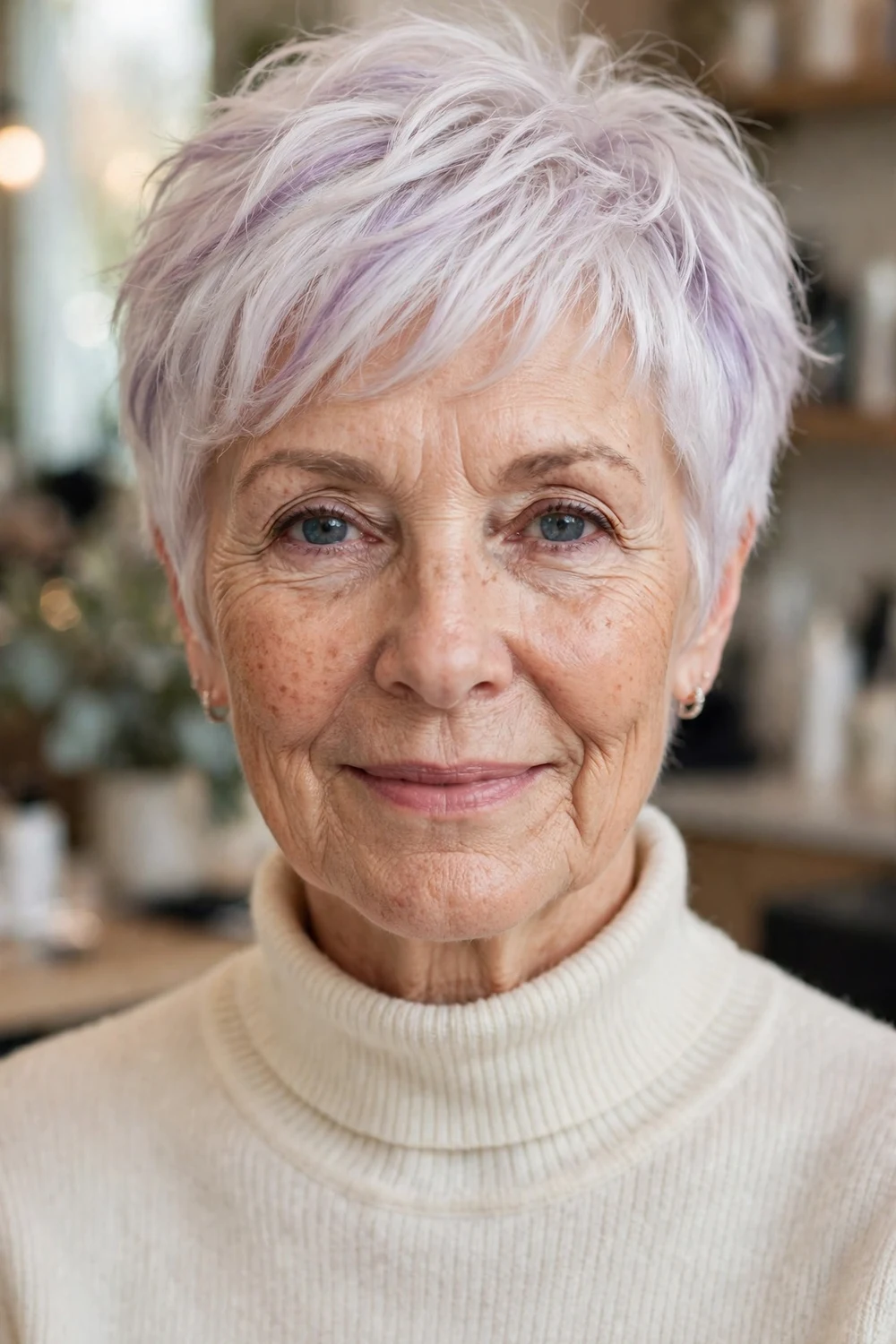
A pale lavender tint is washed over a white or near-white pixie, and the wispy, feathered cutting keeps the color looking soft. The tint fades a little with every wash, which makes it a low-risk way to test a fashion shade after 60.
The tint only takes on hair that is already white or very light grey, so darker hair needs lightening first and a longer talk with a colorist. Use a color-safe shampoo and expect the tint to need refreshing every few weeks.
Try this: Try this: ask for the tint diluted and applied as a gloss first, so you can judge the shade in daylight before going stronger.
Difficulty: Medium | Cost: $$ | Time: 5 minutes
16. Warm Copper Tapered Pixie
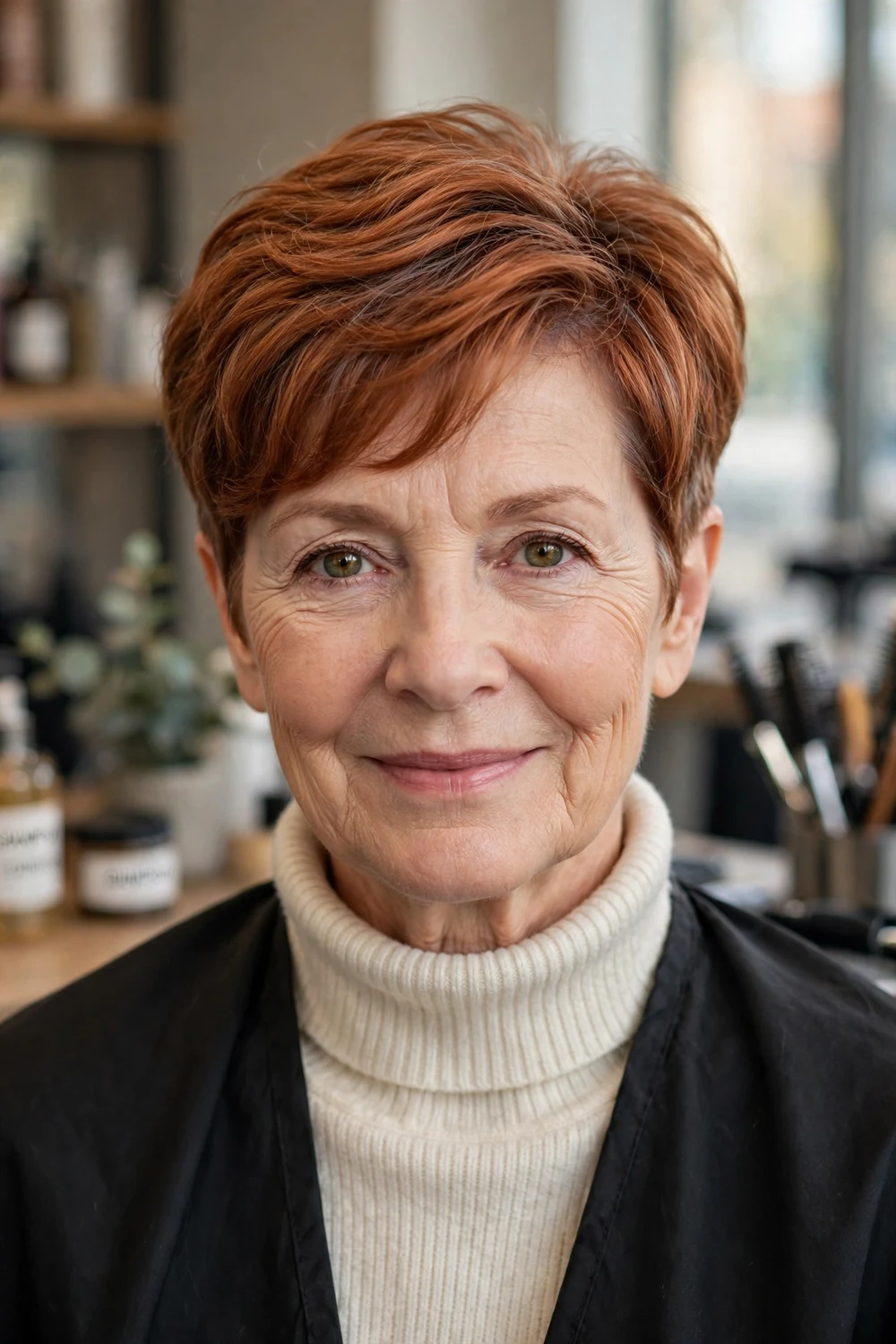
A warm copper shade over a softly tapered pixie brings color back to fair skin without heavy makeup. The cut stays close around the ears and neck, with a longer top that can sweep across the forehead.
Copper fades faster than most shades, so plan a gloss refresh between full color appointments and wash with lukewarm water. The taper keeps the outline neat even as the color softens.
Try this: Try this: use a copper-tinted conditioner once a week to top up the warmth between salon visits.
Difficulty: Medium | Cost: $$ | Time: 5 minutes
17. Precision Pixie with a Blunt Perimeter

Every edge of this pixie is cut in a clean, blunt line, which makes the perimeter look as thick as the hair allows. The top is smoothed rather than textured, so the outline, not the pieces, is the style.
Blunt cutting is a kind approach to fine hair, since thinning shears and razors can leave sparse ends looking thinner. The trade-off is precision: the line needs a tidy trim every four to five weeks to stay sharp.
Try this: Try this: dry the hair with a paddle brush following the shape of the head, and let the blunt edge fall where it was cut.
Difficulty: Medium | Cost: $ | Time: 8 minutes
18. Lixie with Long Layers and a Deep Side Part
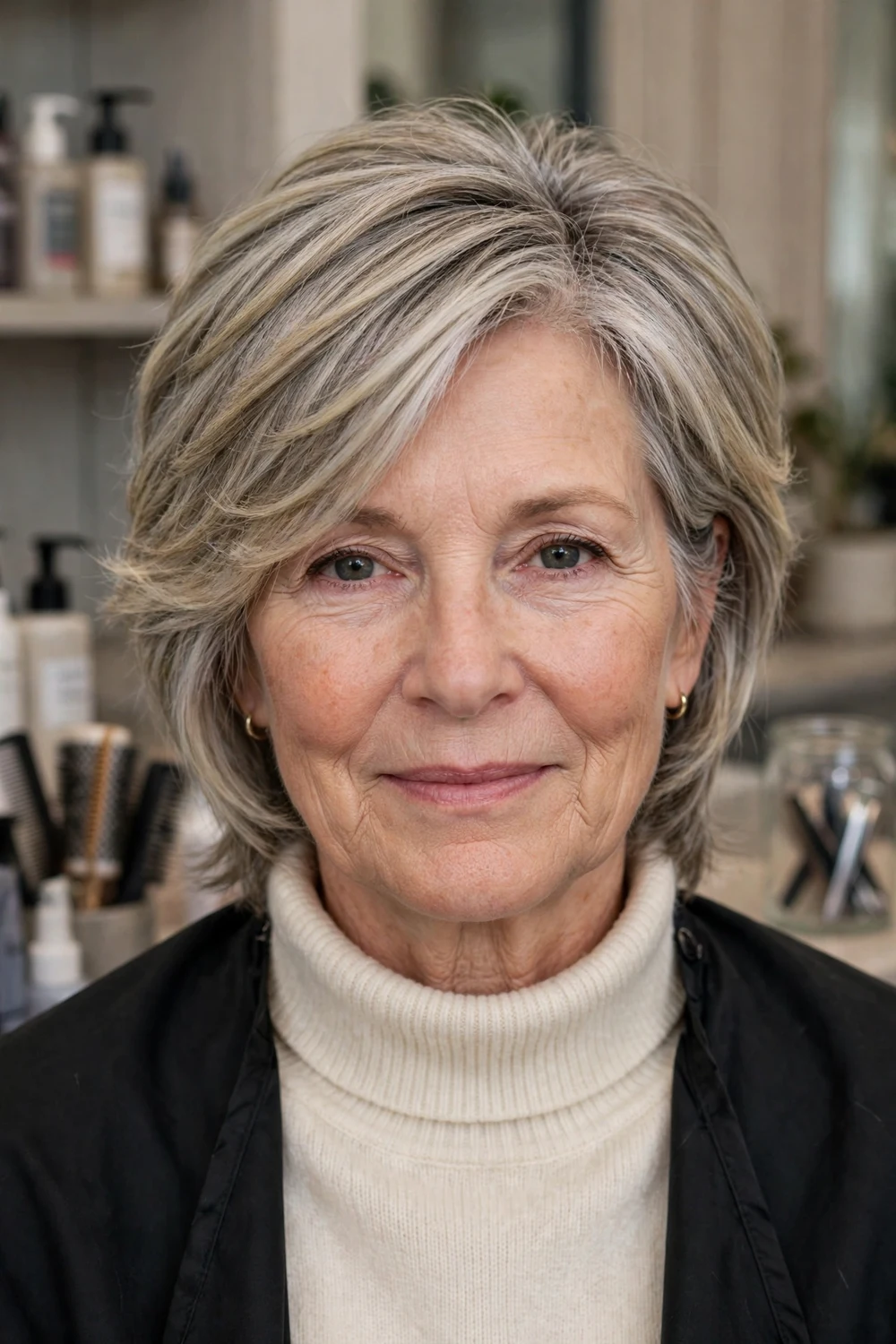
The lixie is the longest member of the pixie family: long layers throughout, a deep side part, and a back that stays shaped rather than grown out. It moves like a short bob from the front and cuts styling time like a pixie.
The deep side part is doing quiet work here, shifting weight to one side so fine hair looks fuller at the crown. Wear the part on either side, push the top back, or tuck both sides for a sleeker line.
Try this: Try this: set the part while the hair is damp and dry the heavier side away from the face with a round brush for lift that holds.
Difficulty: Easy | Cost: $$ | Time: 10 minutes
19. Money Piece Pixie with a Darker Crown
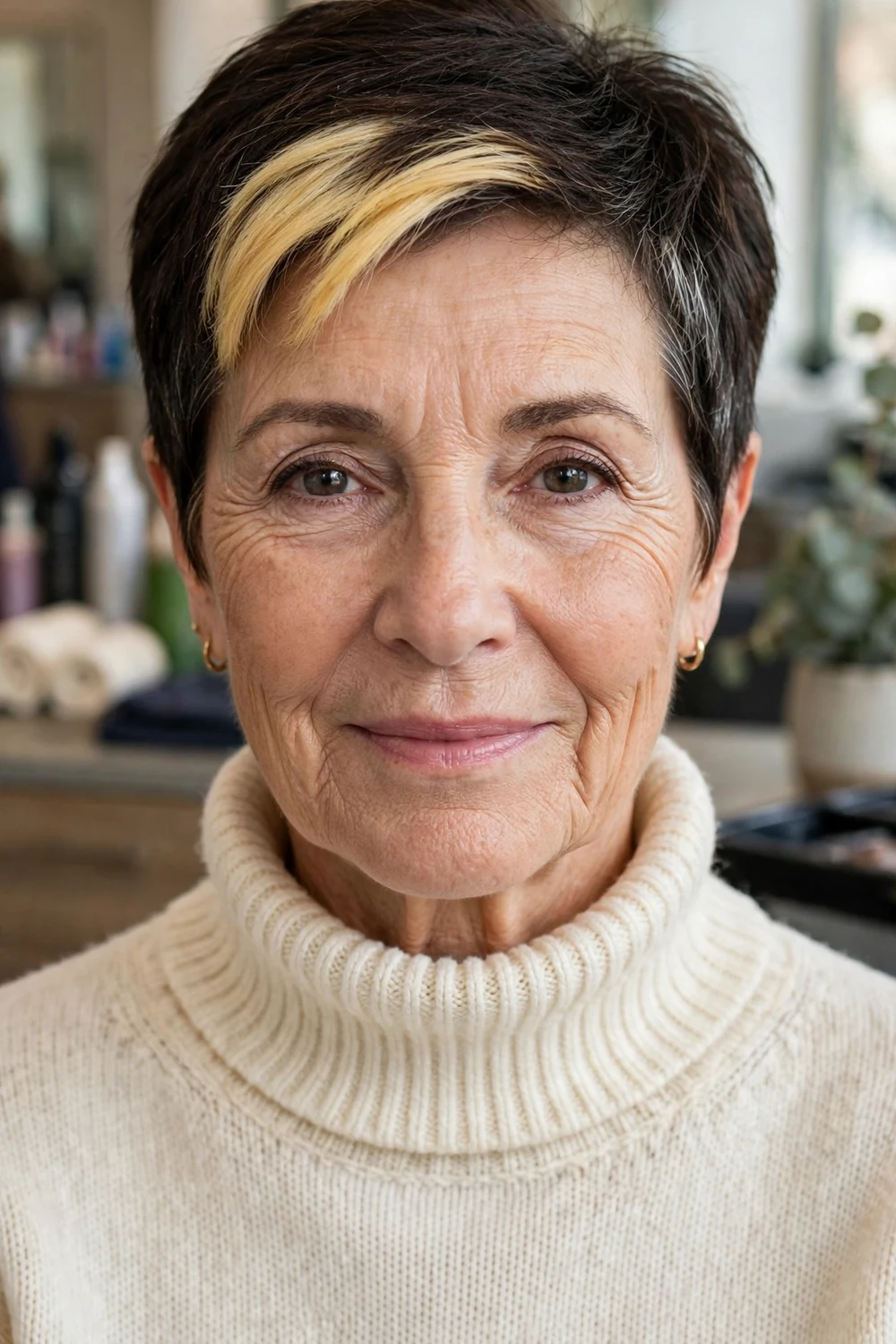
Here the contrast is stronger than idea 14: a bright panel at the hairline set against a crown kept deliberately dark. On short hair the bright frame is always in view, and the dark crown makes the top look denser.
This version suits brunettes who like a clear color statement and do not mind a refresh every eight to ten weeks. Ask for the bright panel to start a little behind the hairline so the grow-out line stays hidden in the fringe.
Try this: Try this: style the fringe forward so the bright panel frames both sides of the forehead, not just one.
Difficulty: Medium | Cost: $$ | Time: 8 minutes
20. Wave-Set Pixie with Soft S-Shaped Top
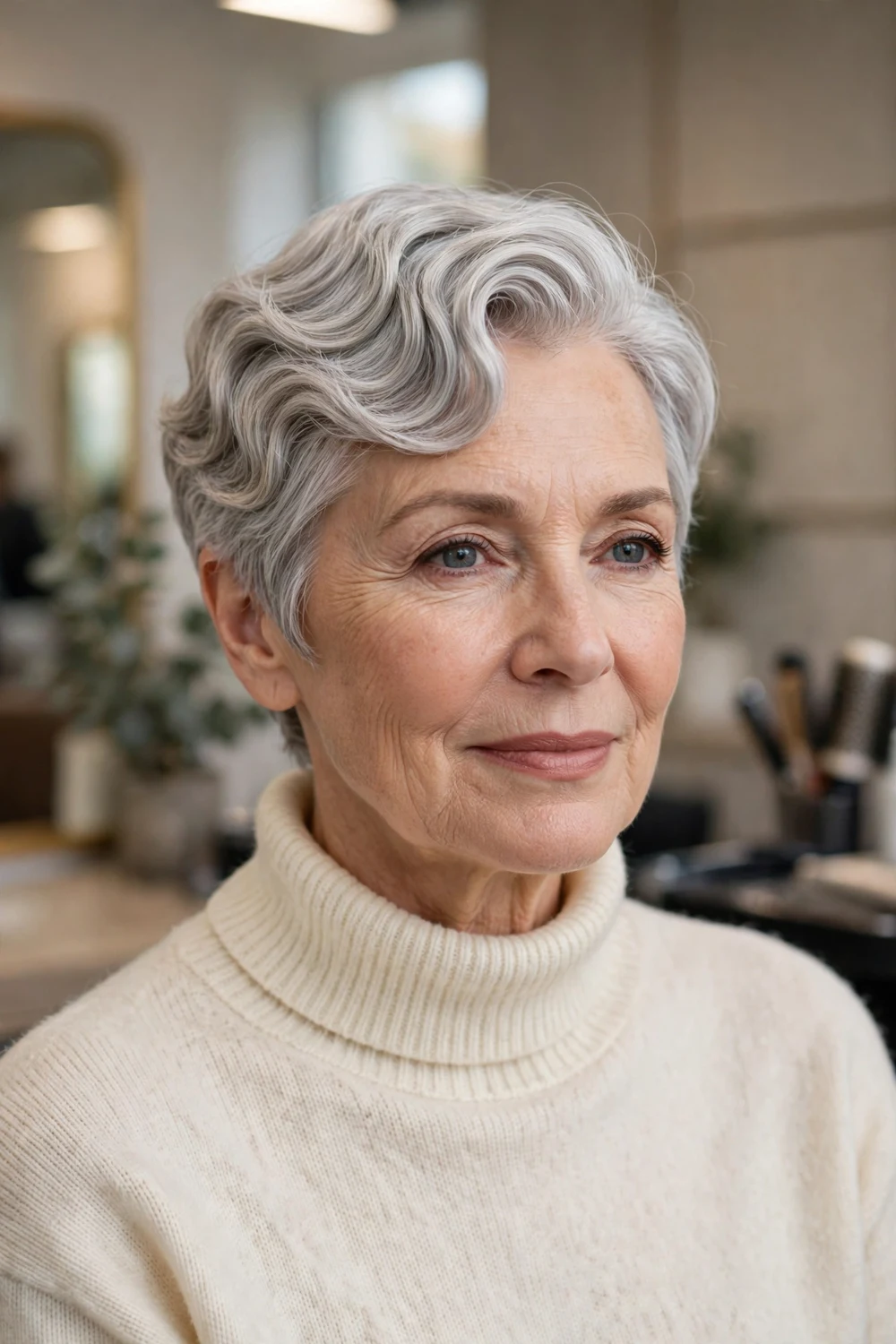
The cut itself is a simple, longer pixie; the style comes from soft S-shaped waves set through the top with a small wand. The wave pattern breaks up straight hair that otherwise lies in one flat sheet.
Cut the top long enough to bend, at least two inches, or the waves will not form. This is a good option for women who like one cut with two finishes: smooth on plain days, waved when they want more shape.
Try this: Try this: wrap alternate sections in opposite directions around the wand, leave the ends out, and shake the waves loose once cool.
Difficulty: Medium | Cost: $$ | Time: 10 minutes
21. Ear-Length Pixie with Hidden Undercut

The top and sides keep ear-length coverage, while a small undercut hides underneath at the back and lower sides. Worn down, nothing about the cut looks clipped; the hidden section only appears when the hair is tucked or lifted.
It is a practical answer for thick hair in a conservative setting: the bulk is gone, but the visible outline stays soft and covered. The hidden section needs a quick cleanup every four to five weeks.
Try this: Try this: tuck one side behind your ear on warm days to let the undercut cool the neck, then drop it back down for a covered look.
Difficulty: Easy | Cost: $ | Time: 5 minutes
22. Crown-Lift Pixie with Short Clipped Sides
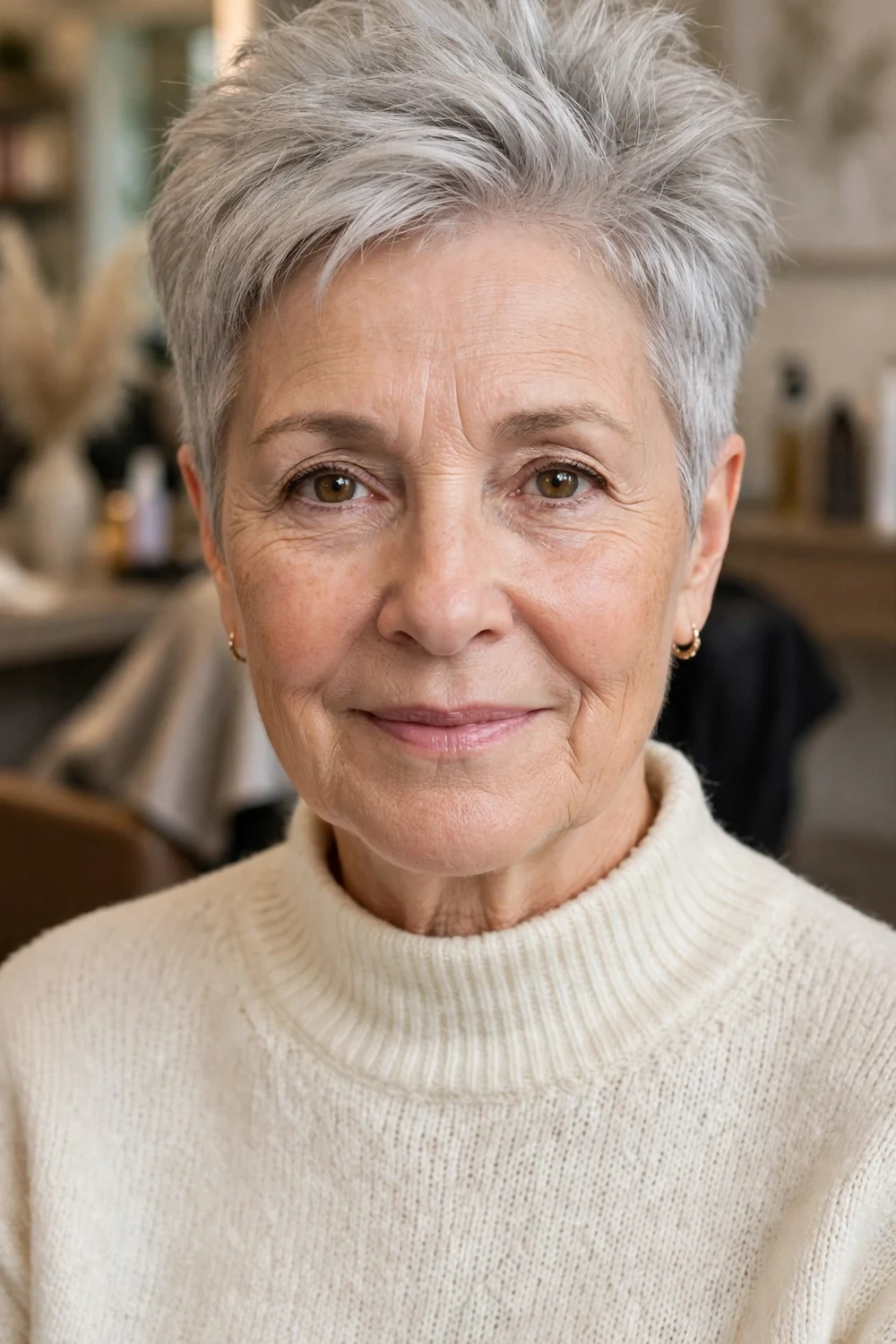
The sides are clipped short and the crown is cut in short stacked layers that stand away from the scalp. Putting nearly all of the length and lift at the crown is what makes a thinning top look covered.
Ask your stylist to layer the crown only, and to leave the front hairline soft rather than clipped, so the lift does not come with a harsh edge. Root-lift spray on damp crown hair, dried upward, doubles the effect.
Try this: Try this: dry the crown in the opposite direction to how it will sit, then flip it back into place for lift that lasts longer.
Difficulty: Easy | Cost: $ | Time: 8 minutes
23. Two-Tone Pixie with a Longer Silver Top
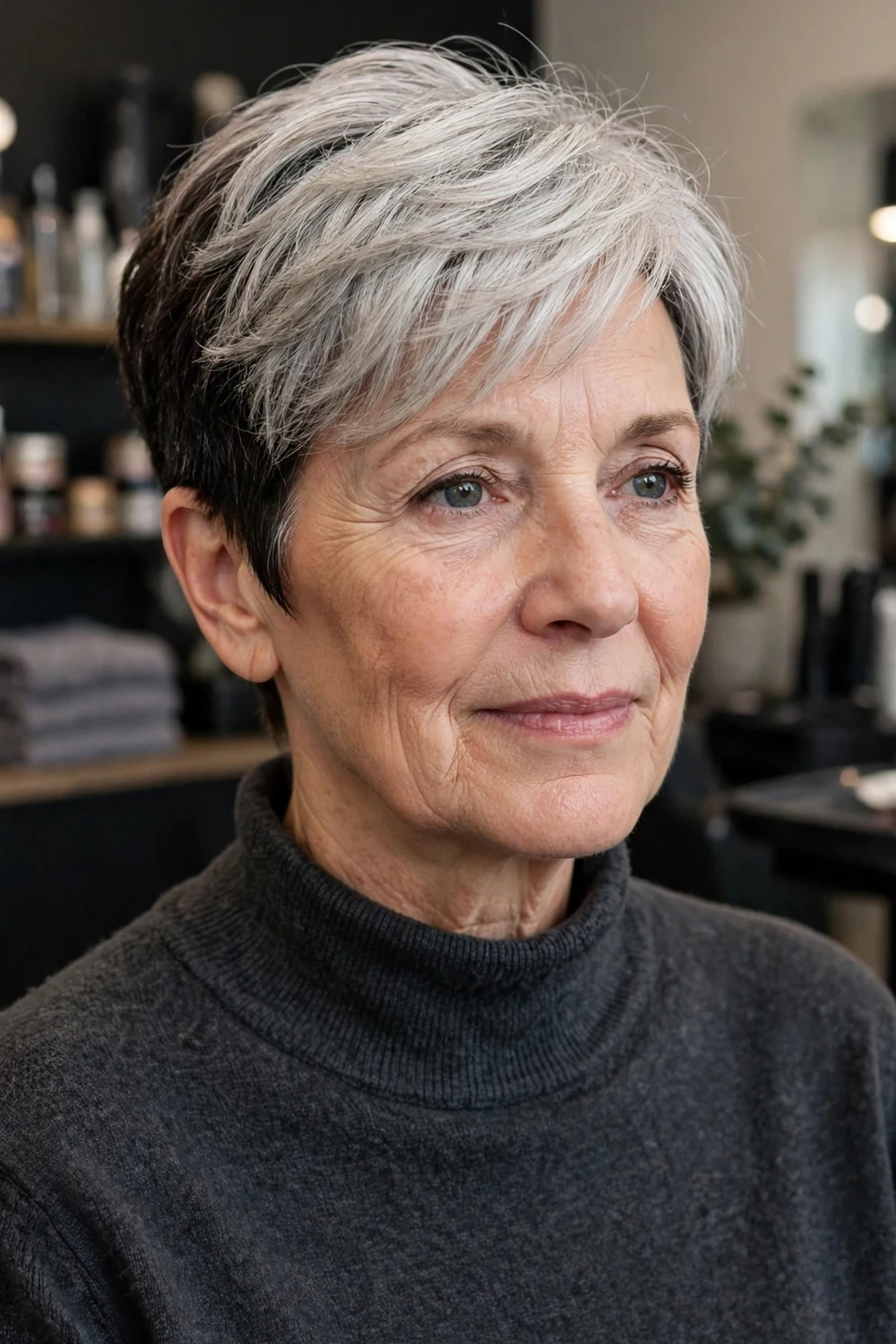
The top is left silver and longer, while the cropped sides keep their darker natural shade. The two tones are worn as the design, which turns a grey grow-out into a finished cut instead of a phase to hide.
It suits women whose grey is concentrated on top, a very common pattern. There is no color to maintain; the salon work is only the trim, every five to six weeks, to keep the length difference clear.
Try this: Try this: brush the silver top to one side so the darker cropped side shows, and the two-tone effect reads clearly.
Difficulty: Easy | Cost: $ | Time: 5 minutes
| Name | Best For | Difficulty | Cost | Time |
|---|---|---|---|---|
| Asymmetric Bixie with a Long Cheek Piece | Fine to medium hair that wants coverage | Easy | $$ | 8 minutes |
| Soft Nape Undercut with a Long Sweeping Top | Thick hair that puffs at the back | Easy | $ | 5 minutes |
| Razored Pixie Shag with Shattered Ends | Wavy hair and air-dry routines | Easy | $ | 5 minutes |
| Angled Pixie with a Longer Front and Short Back | Round faces that suit a diagonal line | Medium | $ | 8 minutes |
| Temple Undercut Pixie with a Side Sweep | Thick hair and warmer climates | Medium | $ | 8 minutes |
| Modern Quiff Pixie with Tapered Sides | Fine hair that needs height | Medium | $ | 10 minutes |
| Curtain Micro Bang Pixie with a Soft Center Part | Straight hair and smaller foreheads | Easy | $ | 5 minutes |
| Forward-Swept Pixie with a Brow-Length Fringe | Long faces and high foreheads | Easy | $ | 5 minutes |
| Spiral Curly Pixie with a Rounded Top | Natural curls from loose to coily | Easy | $$ | 8 minutes |
| Piecey Silver Pixie with a Matte Finish | Fine silver hair that lies flat | Easy | $ | 5 minutes |
| Wedge-Back Pixie with a Rounded Silhouette | Hair that falls flat at the back | Medium | $ | 8 minutes |
| Long-Line Pixie with Ear-Length Sides | A first short cut after longer hair | Easy | $ | 8 minutes |
| Faux Hawk Pixie with a Lifted Center Strip | Bold styles on straight or wavy hair | Hard | $$ | 10 minutes |
| Face-Brightening Pixie with Light Front Panels | Darker hair that needs light at the face | Medium | $$ | 8 minutes |
| Lavender-Tinted Wispy Pixie | White hair and a playful color change | Medium | $$ | 5 minutes |
| Warm Copper Tapered Pixie | Fair skin that suits warm tones | Medium | $$ | 5 minutes |
| Precision Pixie with a Blunt Perimeter | Fine hair that needs a thicker-looking edge | Medium | $ | 8 minutes |
| Lixie with Long Layers and a Deep Side Part | Longer pixie length with styling options | Easy | $$ | 10 minutes |
| Money Piece Pixie with a Darker Crown | Brunette hair that suits contrast | Medium | $$ | 8 minutes |
| Wave-Set Pixie with Soft S-Shaped Top | Straight hair styled with a wand | Medium | $$ | 10 minutes |
| Ear-Length Pixie with Hidden Undercut | Thick hair worn neat at work | Easy | $ | 5 minutes |
| Crown-Lift Pixie with Short Clipped Sides | Thinning crowns on fine hair | Easy | $ | 8 minutes |
| Two-Tone Pixie with a Longer Silver Top | Grey grow-out worn as a style | Easy | $ | 5 minutes |
Frequently Asked Questions
What makes a pixie cut look modern after 60?
Contrast and movement. A longer top over clipped sides, one side longer than the other, a razored outline, or a short curtain fringe all date a pixie to now. Smooth, one-length, heavily sprayed shapes are the ones that read dated.
How often do modern pixie cuts need a trim?
Every four to six weeks for most shapes. Undercut sections grow out fastest, so a nape or temple tidy-up at four weeks keeps the contrast clean between full cuts.
Can a modern pixie work on thinning hair?
Yes. Short clipped sides with stacked layers at the crown put the visible fullness where thinning shows most, and a blunt perimeter keeps fine ends looking thicker. Ask for layering at the crown only, and skip heavy texturizing through the ends.
Do undercut pixies suit women over 60?
The soft versions do. A hidden nape undercut or a single clipped temple removes bulk under a longer top, so the visible cut still looks covered and neat. The shaved section only shows when the top is tucked or lifted.
What should I ask for at the salon?
Bring two or three photos of the exact cut, and name the details: where the undercut sits, how long the top stays, and how the fringe is cut. Ask how the cut grows out and when the first tidy-up should be booked.
Final Thoughts
A modern pixie after 60 is a shape decision, not an age decision. Pick the contrast you are comfortable with: a hidden nape undercut for a quiet update, an asymmetric bixie for coverage with a current line, or a quiff when fine hair needs height. Keep the trim booked every four to six weeks, and the cut will keep doing the styling work for you. For even lower daily effort beyond pixies, the roundup of low-maintenance haircuts for women over 60 is worth a look before you book.

