



Shoulder-length hair with bangs is one of the most reliable ways to make fine hair look fuller. The bangs add density across the forehead, the shoulder length keeps weight from dragging the roots flat, and the two together frame the face in a way that reads thick even on very fine strands. I’ve spent years testing haircuts that give fine hair real body, and this combination keeps landing at the top.
You’ll find 20 ideas below, from soft side bangs to bold micro-bangs. Each one includes a practical styling tip so you can get the look right at home.
Quick answer: Bangs add instant fullness to fine shoulder-length hair when the cut keeps layers light and the bangs textured. Wispy, curtain, and side-swept bangs flatter fine hair best, while blunt or choppy styles need enough density to sit right. Trim bangs every 3 to 4 weeks so they keep their shape.
Quick Takeaways
- Wispy, curtain, and side-swept bangs give fine hair the most fullness with the least upkeep.
- Keep layers long and light; short choppy layers can make fine hair look thinner at the ends.
- Blow-dry bangs right after washing so they don’t dry flat against your forehead.
- Dry shampoo at the roots keeps bangs from separating and showing scalp by midday.
- Trim bangs every 3 to 4 weeks; fine hair shows uneven growth faster than thick hair.
Why Bangs Work on Fine Shoulder-Length Hair
Fine hair struggles most at the roots, where it lies flat against the scalp. Bangs solve this by pulling hair forward, which creates visible fullness exactly where fine hair looks thinnest. The forehead coverage reads as density even when the strands themselves are delicate.
Shoulder length is the sweet spot for this trick. It is long enough to style with waves or bends, but short enough that the hair doesn’t pull the crown flat. Pair that length with bangs and you get fullness at the front, movement through the mid-lengths, and ends that still look solid.
The key rule: keep the rest of the cut light. Heavy layering removes weight that fine hair can’t spare. Long, soft layers with a few face-framing pieces give movement without thinning out the perimeter.
1. Layered Shoulder-Length Cut with Side Bangs

Ask your stylist for long layers that start below the chin, then have the front blended into a side bang. The diagonal line of the bang pulls the eye across the face instead of down, which makes fine hair look wider and fuller at the front. This cut works on straight and wavy textures and grows out gracefully, since a side bang just becomes a face-framing layer as it lengthens. It suits oval, round, and square faces equally well.
Try this: Blow-dry the bang with a small round brush, rolling it away from the part for lift. A pea-sized amount of lightweight mousse at the roots keeps the sweep in place without stiffness.
2. Blunt Shoulder-Length Bob with Straight Bangs
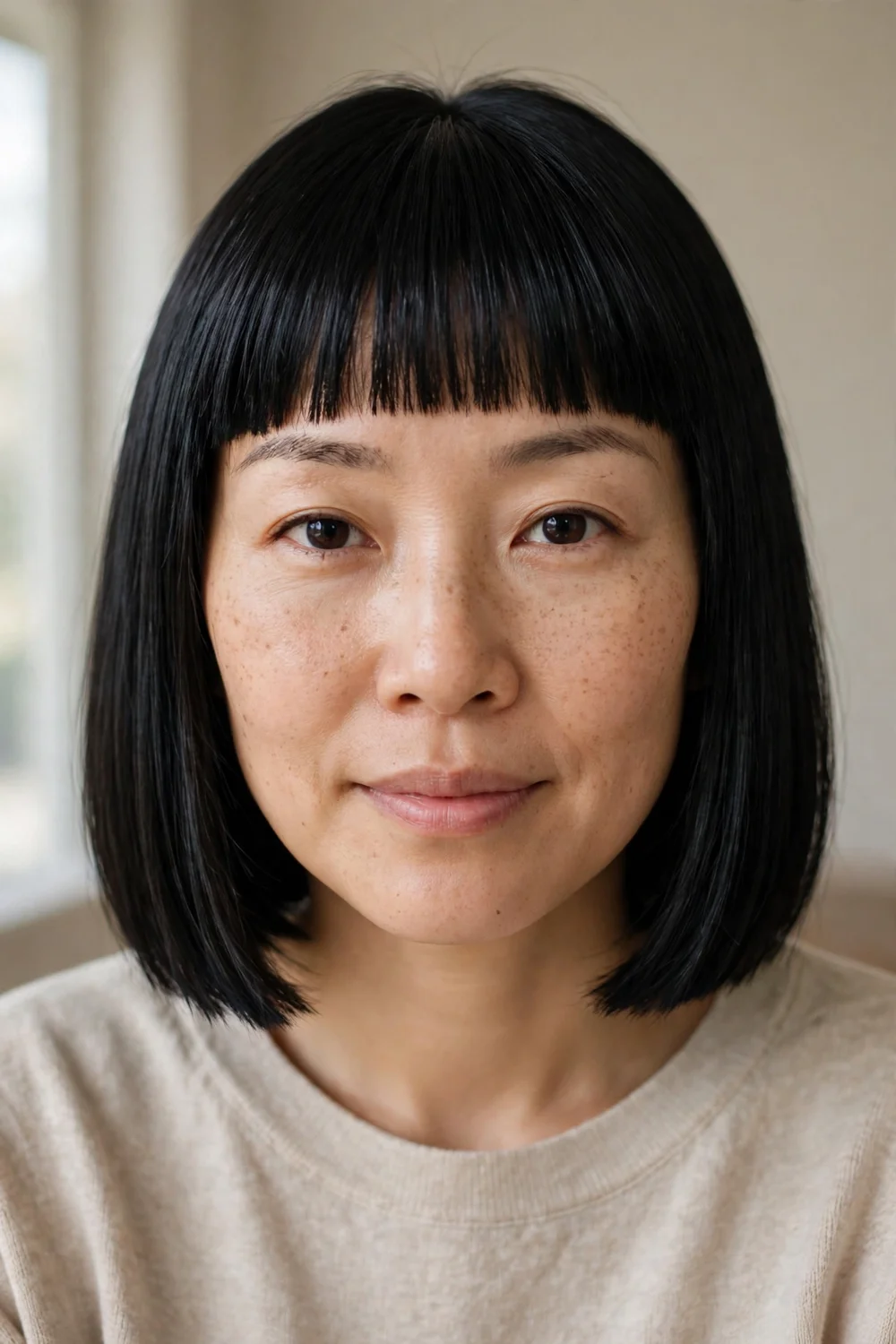
A blunt perimeter is the fastest way to fake thickness on fine hair, and straight bangs extend that solid edge right across the forehead. Ask for the bob cut at collarbone level with zero layering through the ends, and the bangs cut just above the brows with a clean line. This style looks sharpest on straight hair, where the blunt lines read crisp. Keep the bangs trimmed so they never fall into your eyes, which happens fast on fine hair.
Try this: Flat iron the bangs with one quick pass each morning, then set them with a light mist of flexible-hold hairspray. It takes under two minutes and keeps the line sharp all day.
3. Textured Lob with Wispy Bangs
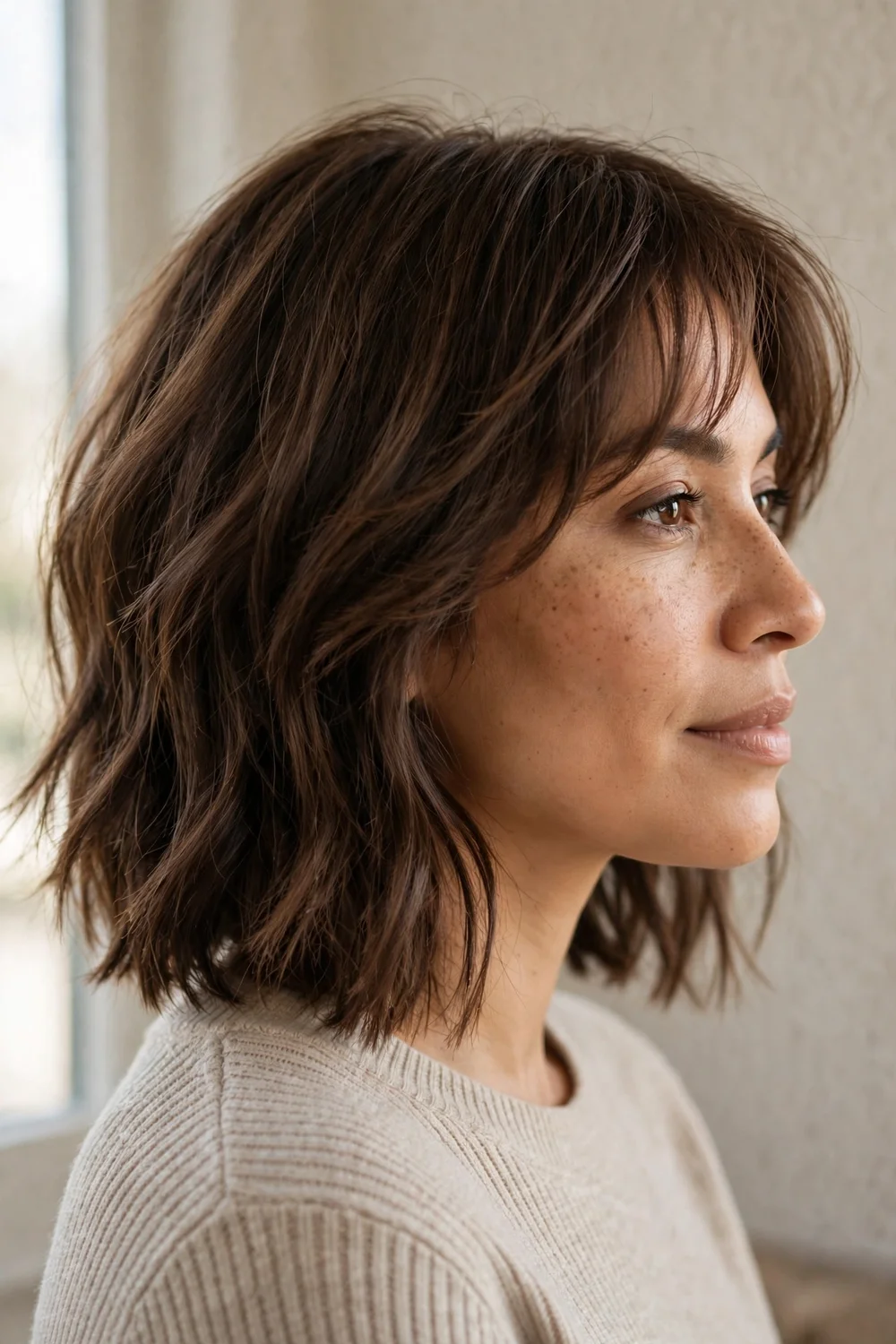
Want fullness without a heavy bang? Wispy bangs give you forehead coverage while letting a little skin show through, which keeps the look soft instead of dense. The textured lob underneath adds separation through the mid-lengths, so the whole cut reads airy but full. This is one of the easiest styles on the list to maintain, since wispy bangs don’t need precision trimming to look right. It flatters long and oval faces especially well.
Try this: Scrunch a dime-sized amount of texturizing cream through the ends while damp, then let the hair air-dry. The texture builds volume without any heat styling.
If you like this length but want even more bang shapes to compare, medium length hairstyles with bangs rounds up more options that sit right at this cut.
4. Curtain Bangs with a Shoulder-Length Cut
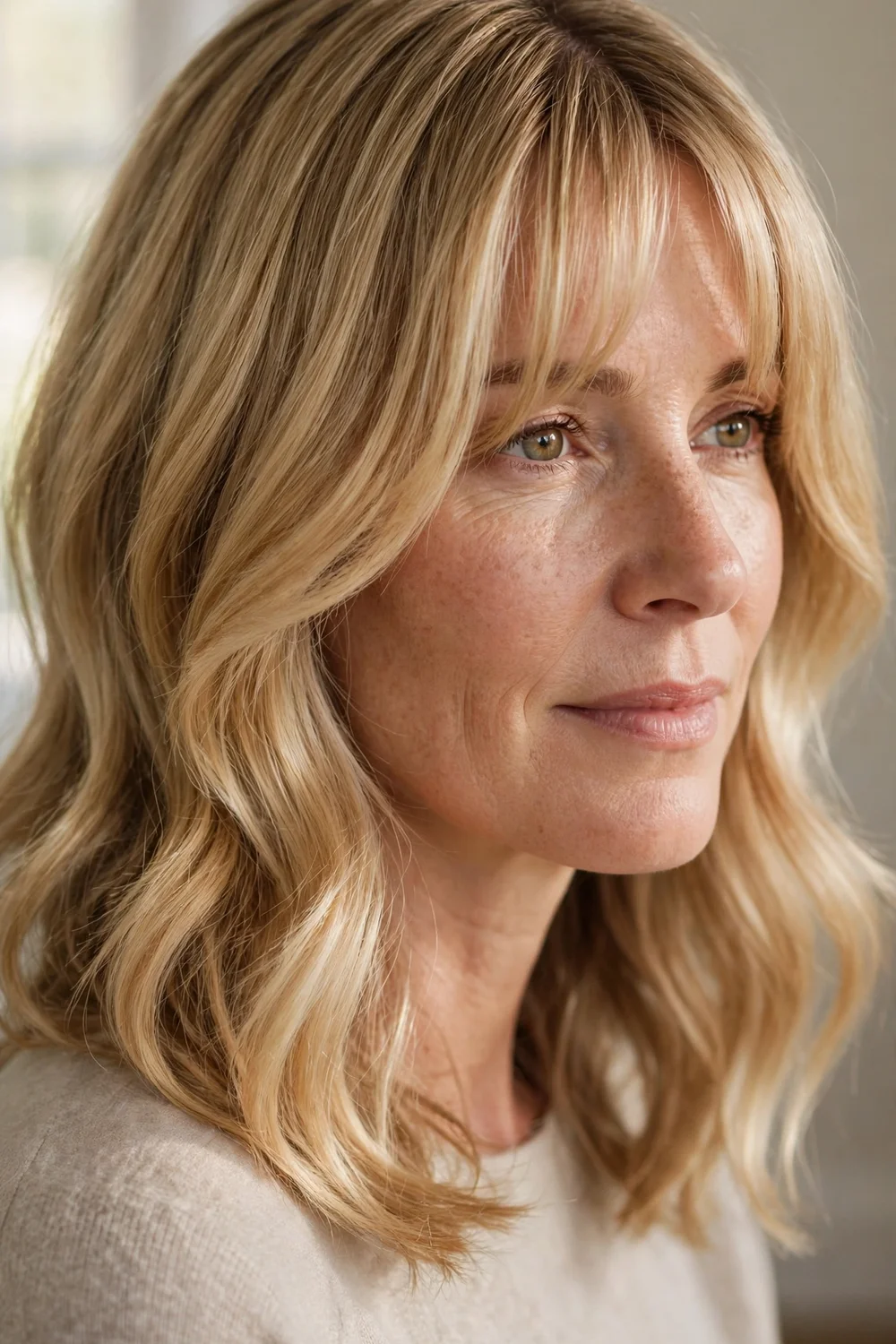
If you want bangs without committing to daily styling, curtain bangs are the answer. They part in the middle and sweep outward, framing the cheekbones while blending straight into the shoulder-length layers. Because the bangs are longer, they hold a blowout shape for days and can be tucked behind the ears when you want them gone. This style flatters round faces in particular, since the center part and sweeping lines lengthen the face.
Try this: Blow-dry each side of the curtain bang outward with a round brush, rolling away from the face. It creates that signature swoop that frames the cheeks.
5. Shoulder-Length Hair with Soft Wavy Bangs
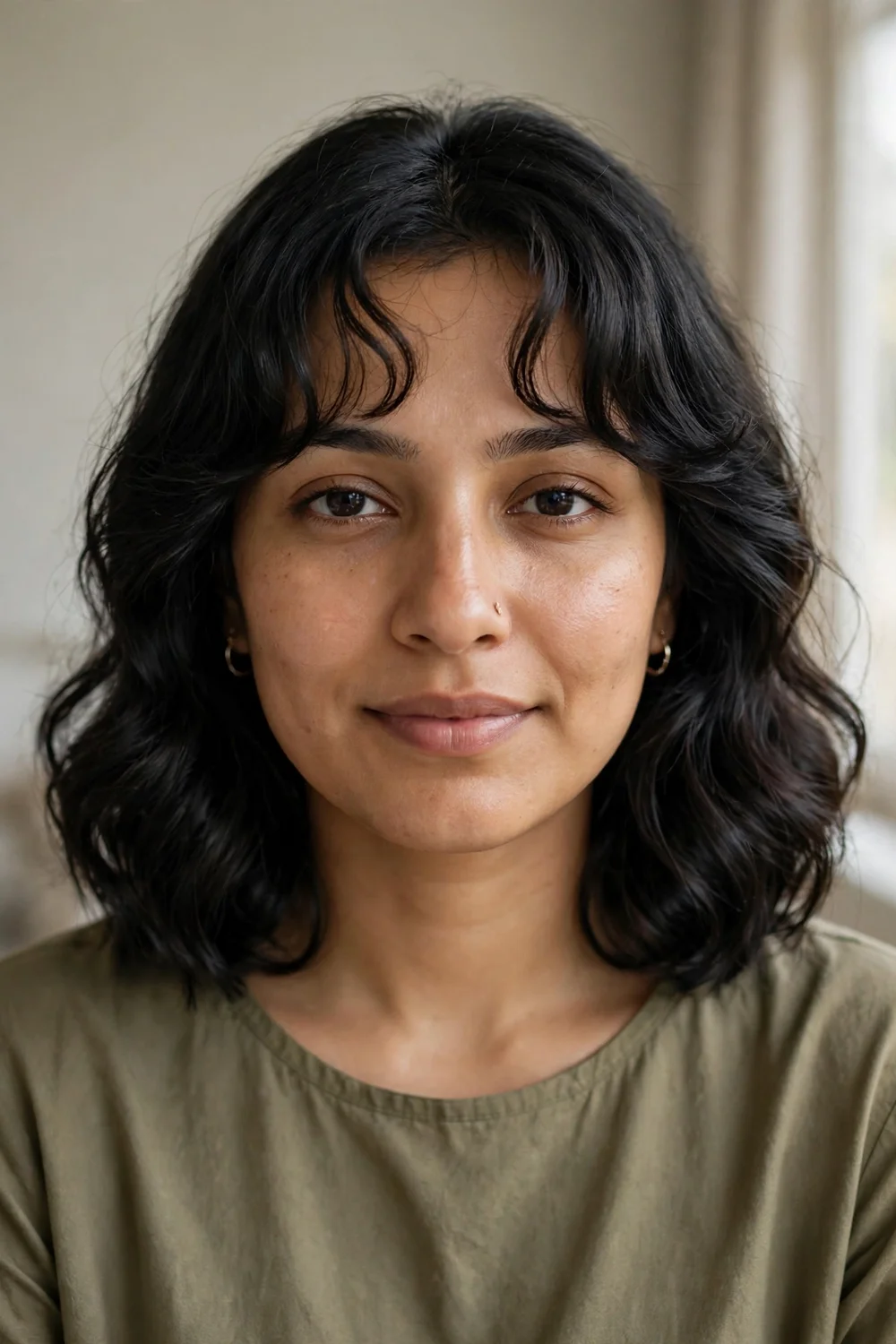
Wear your bangs with a gentle bend instead of pin straight and they pick up instant texture. Soft wavy bangs break up the forehead in loose curves, which reads as fullness on fine hair. The waves also help the bangs blend into layered lengths, so the whole style looks like one continuous shape. This works on naturally wavy hair with almost no effort, and on straight hair it takes a quick pass with a curling wand on the bangs only.
Try this: Wrap just the bangs around a one-inch curling wand, hold for five seconds, then shake them out with your fingers. It softens the wave so it looks natural, not curled.
6. Multi-Tonal Mid-Length Cut with Wispy Bangs
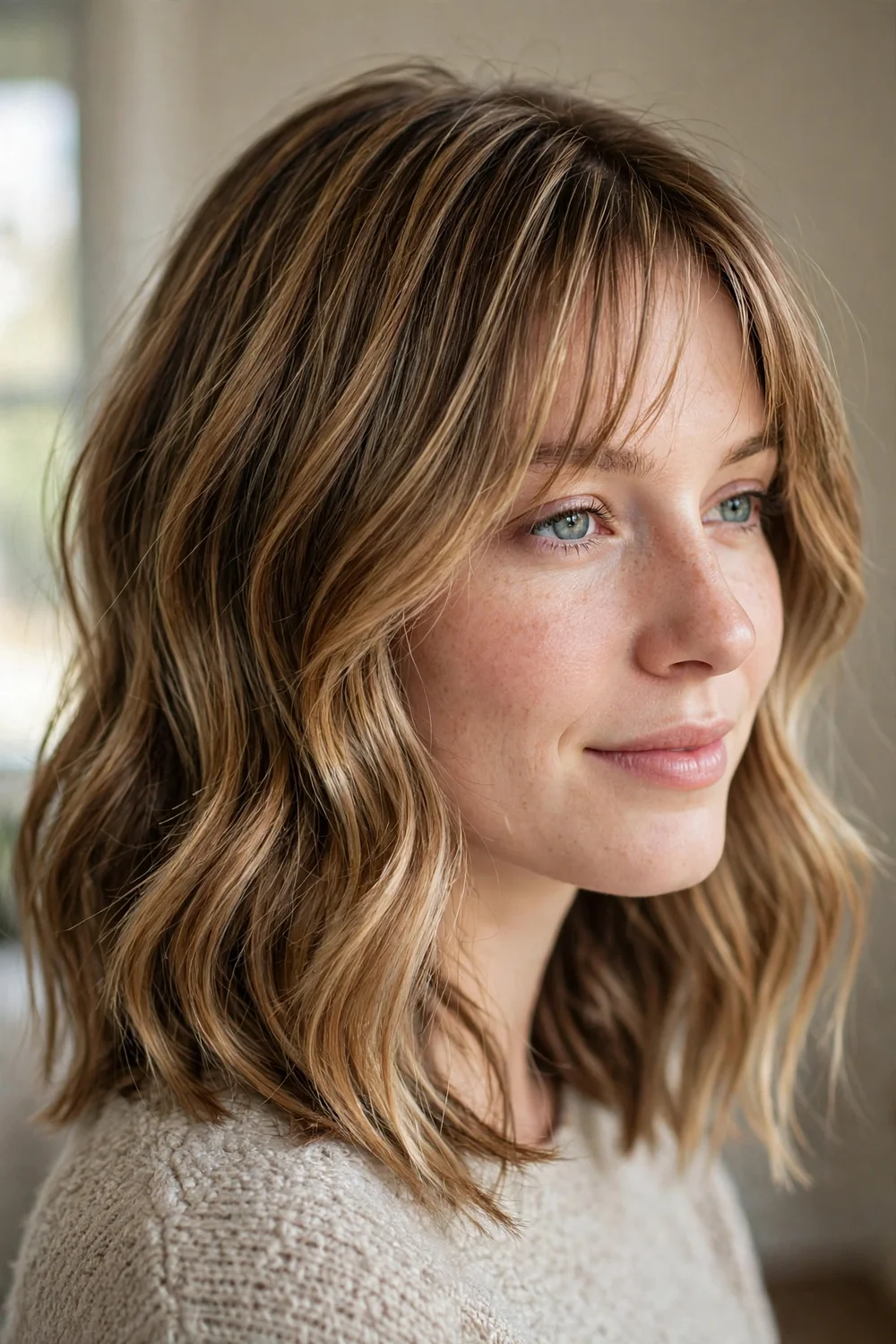
Color can do half the volumizing work for you. A multi-tonal balayage or highlight pattern creates light and shadow through fine hair, which the eye reads as depth and thickness. Pair it with wispy bangs and the front gets the same dimensional treatment, so nothing looks flat or one-note. Ask your colorist for ribbons of color two shades lighter than your base, concentrated around the face and through the ends. The cut itself stays simple with long layers.
Try this: Use a color-safe volumizing shampoo and skip heavy glosses, which coat fine hair and kill the dimension the color just created.
7. Shoulder-Length Cut with Swoopy Bangs
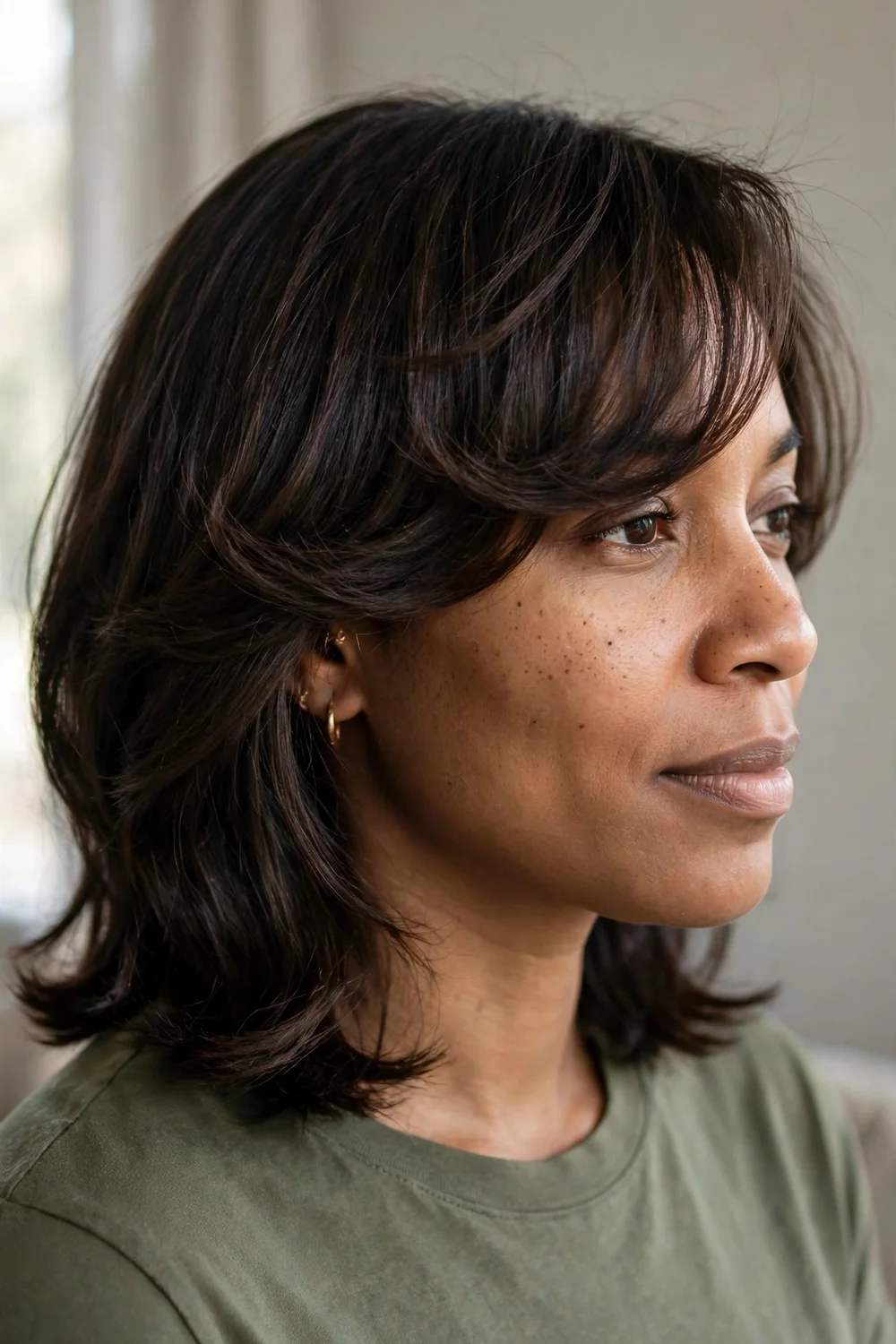
Second-day hair and a long swoopy bang are a natural match. These bangs sweep from one side across the forehead in a single dramatic curve, adding volume right where the eye lands first. Because the bang is long, it doubles as a face-framing layer when you sweep it fully to the side. The style takes shape best with a side part, which also gives fine hair instant root lift on the heavy side of the part.
Try this: Set the swoop with a large Velcro roller on the bang while you finish getting ready. Ten minutes of set time locks in the curve without heat.
Curious how bangs pair with other textures at this length? Browse hairstyles for medium length hair with bangs for more combinations to try.
8. Layered Mid-Length Cut with Choppy Bangs
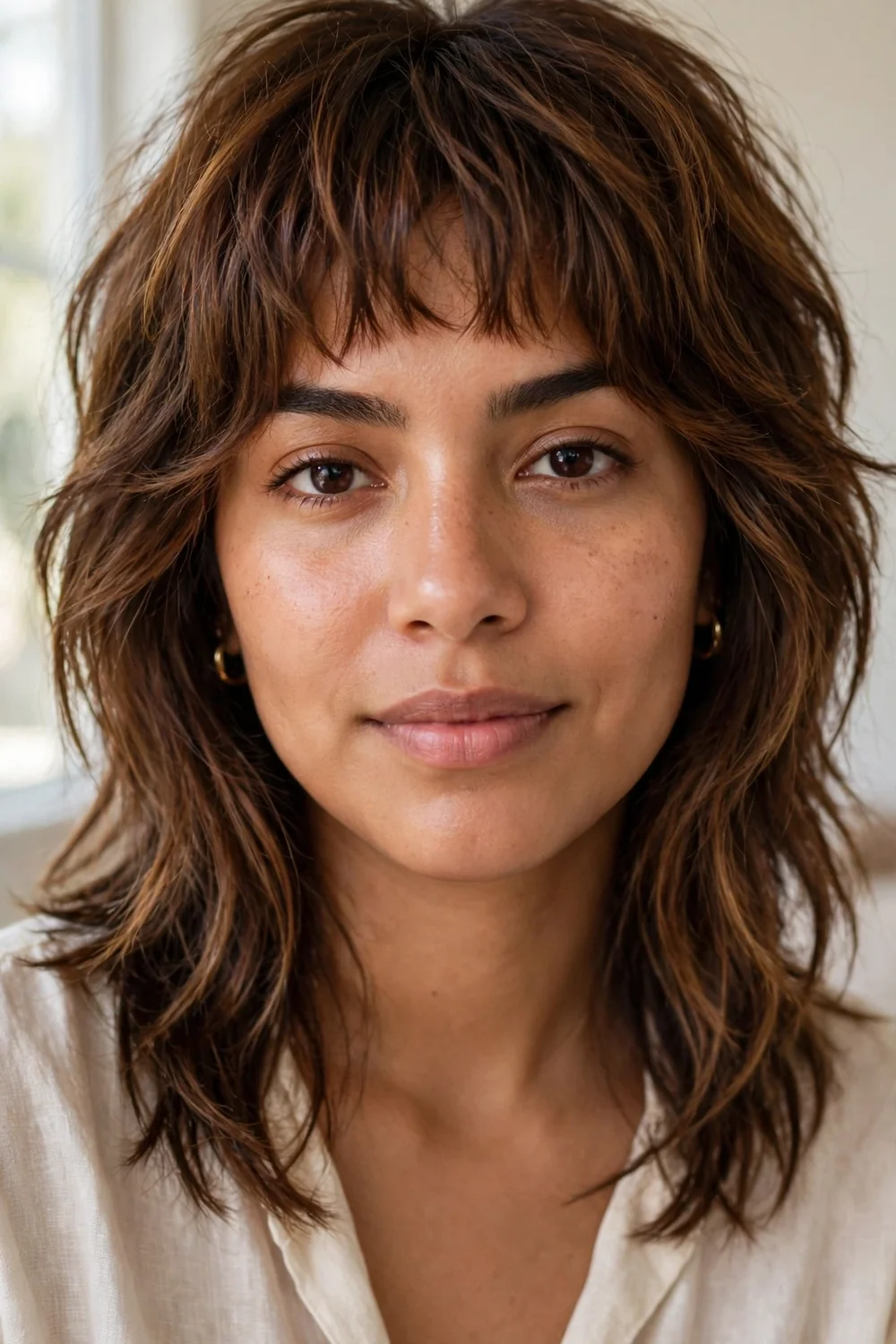
Choppy bangs add edge and volume in one move. The uneven ends create separation across the forehead, which makes fine hair look thicker than a straight-across cut. Keep the choppiness in the bangs only and the mid-lengths smooth with long layers, so the contrast reads intentional instead of messy. This style suits women who want their cut to look modern with minimal styling effort. A quick tousle in the morning is usually enough.
Try this: Pinch small sections of the bangs between your fingers and twist them lightly with texturizing paste. It defines the choppy ends without clumping them together.
9. Shag with Wispy Bangs
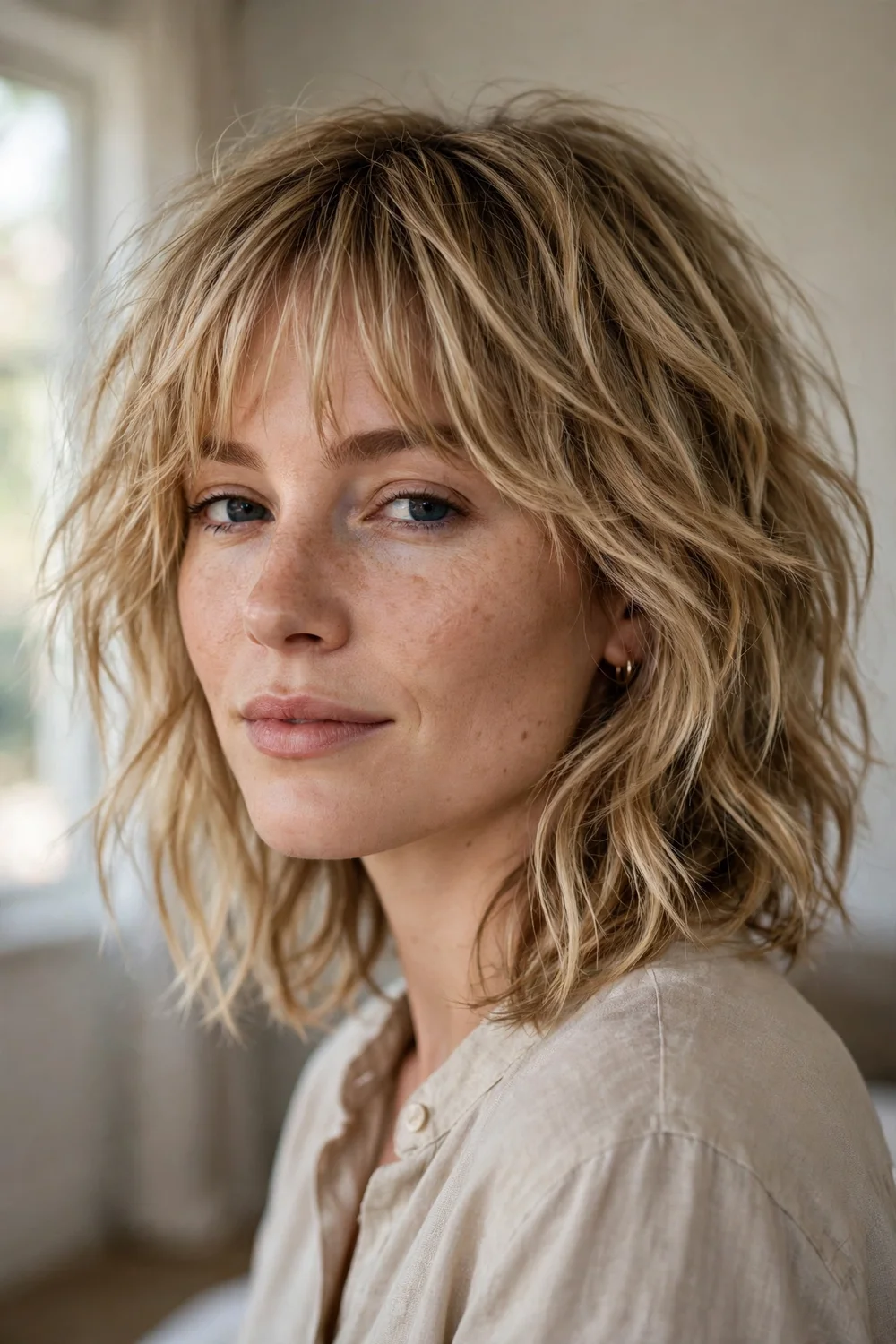
The shag is built for fine hair because its all-over layering manufactures movement where the hair has none. Wispy bangs finish the look by softening the forehead and blending the shortest layers into the rest. Ask for the layers to start around the cheekbones and keep the ends textured but not thinned out. The deliberately undone finish means this cut looks better slightly messy, which takes pressure off your morning routine.
Try this: Flip your head upside down and blast the roots with the dryer for 30 seconds, then flip back up. The crown lift makes the shag look twice as full.
10. Collarbone Shag with Side-Swept Bangs
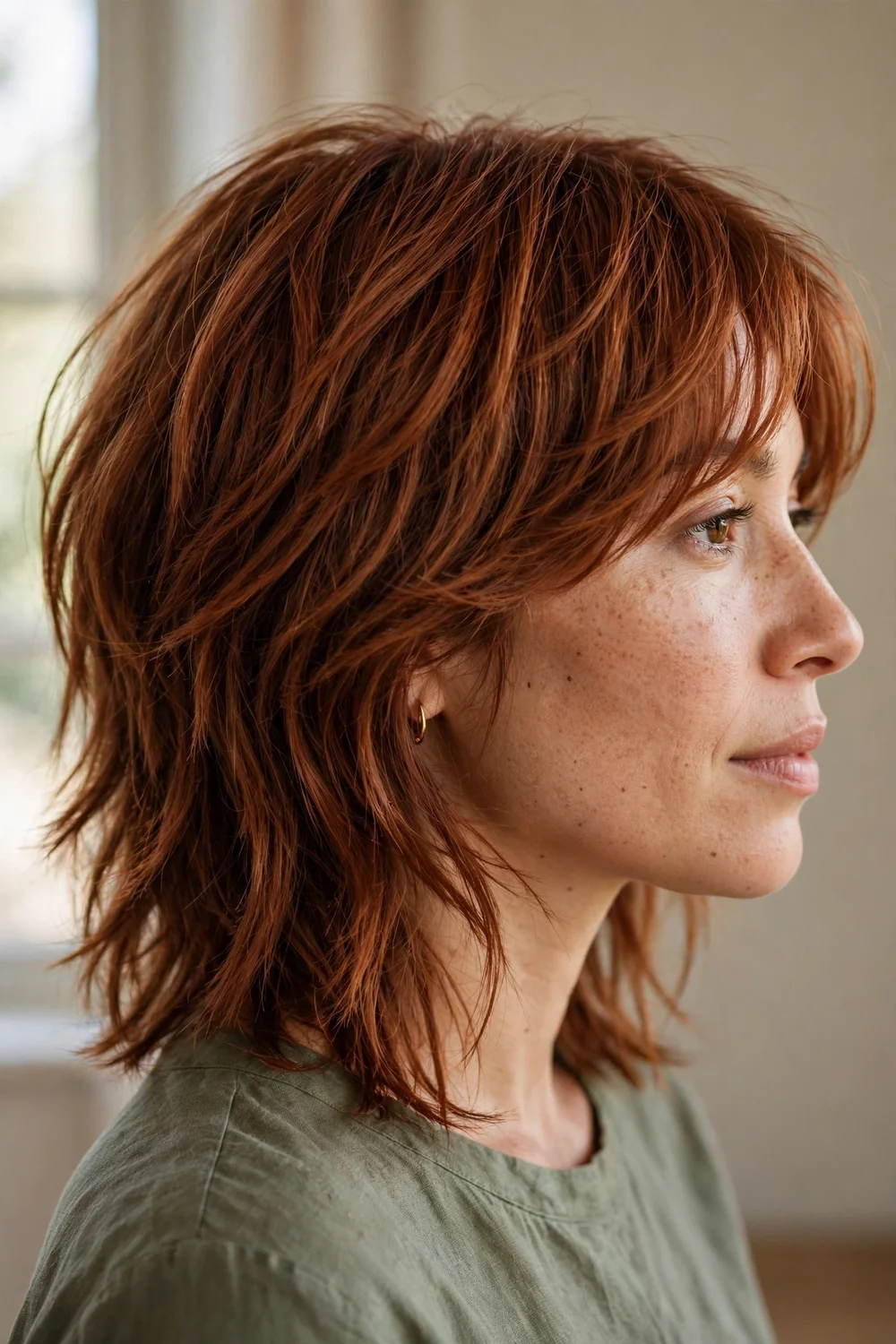
Hitting right at the collarbone, this shag sits at the shortest end of shoulder length, which gives fine hair a natural bounce. The side-swept bangs melt into the choppy face-framing layers, so the whole front moves as one piece. Shorter layers around the crown create height while the length stays swinging. This is a strong pick for wavy textures, where the layers encourage the wave pattern instead of fighting it.
Try this: Scrunch texturizing spray into damp hair and let it air-dry. The layers dry into place and the bangs fall into their sweep on their own.
11. Graduated Shag with Micro-Bangs
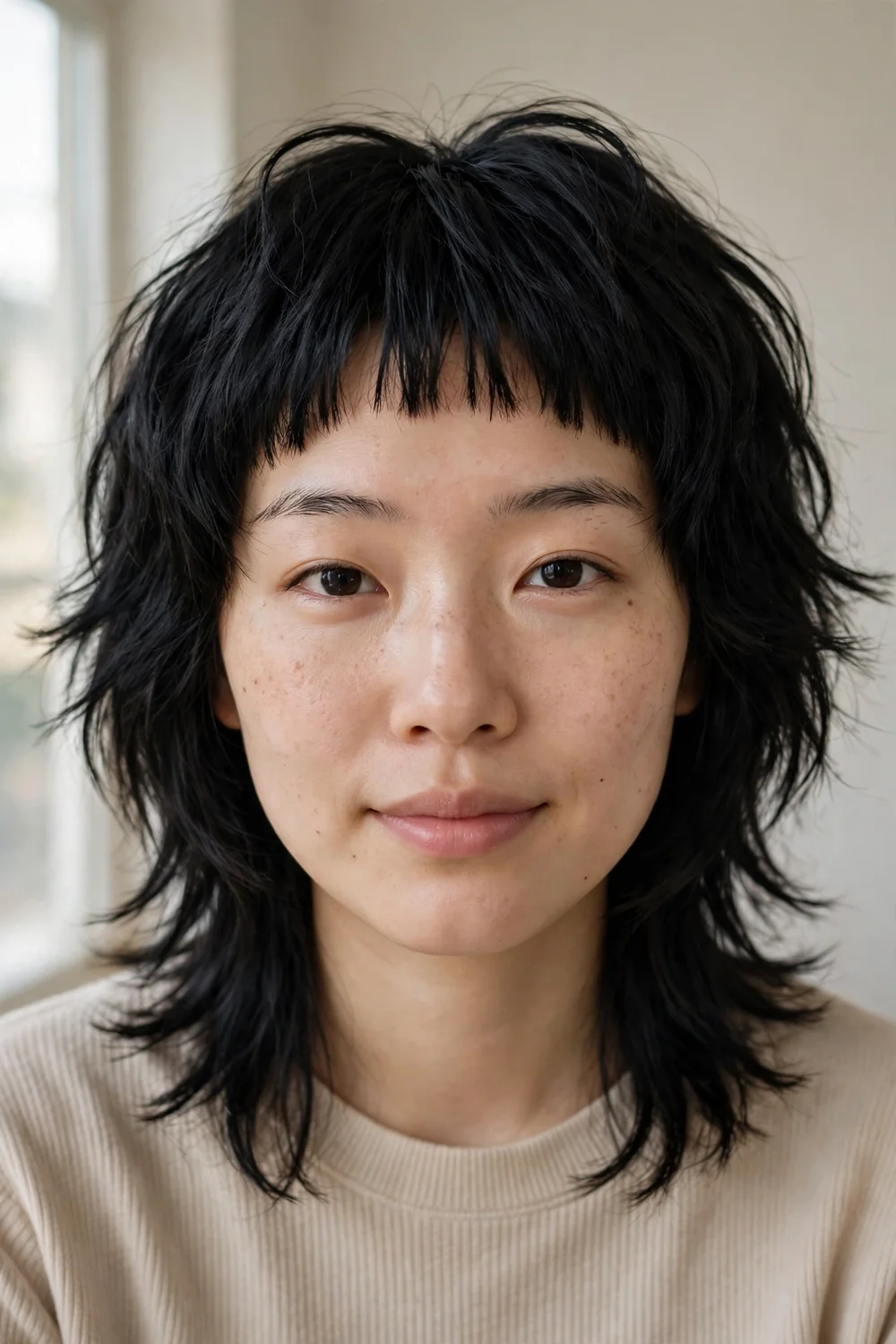
Micro-bangs are the boldest choice on this list, and they pay off by drawing every eye upward. Cut well above the brows, they expose more of the face while the graduated layers stack volume through the crown and sides. The wedge-like shape behind the bangs tricks the eye into seeing density that fine hair doesn’t naturally have. This style suits straight hair best, where the short bang sits clean and graphic.
Try this: Book bang trims every 2 to 3 weeks for this one. Micro-bangs lose their shape fast on fine hair, and the look depends on that sharp short line.
12. Voluminous Bob with Side Bangs
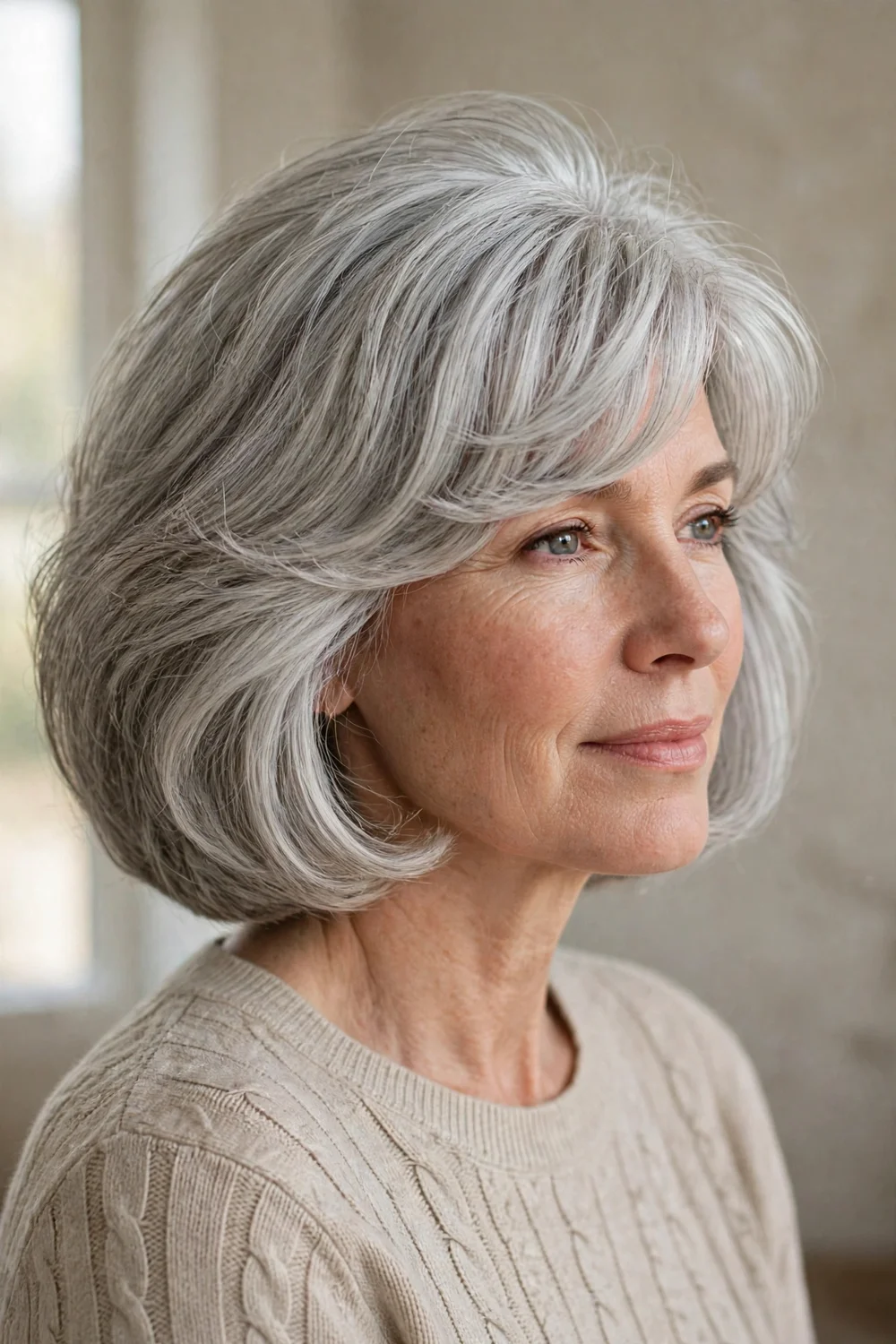
Women over 50 with fine hair get a lot from this rounded shape. The bob is cut with internal layering that builds fullness through the crown, while the outside stays smooth and polished. Side bangs soften the forehead and can be swept to either side depending on your part. Silver and gray hair looks especially good here because the rounded surface catches light and shows off the color’s shine. The whole style reads neat without looking stiff.
Try this: Blow-dry with a large round brush, lifting each section straight up from the root. The upward tension is what builds the crown volume that defines this cut.
The fullness tricks here build on the same ideas in shoulder length hairstyles for thin fine hair, which covers volume cuts without bangs.
13. Shoulder-Length Cut with Layered Bangs
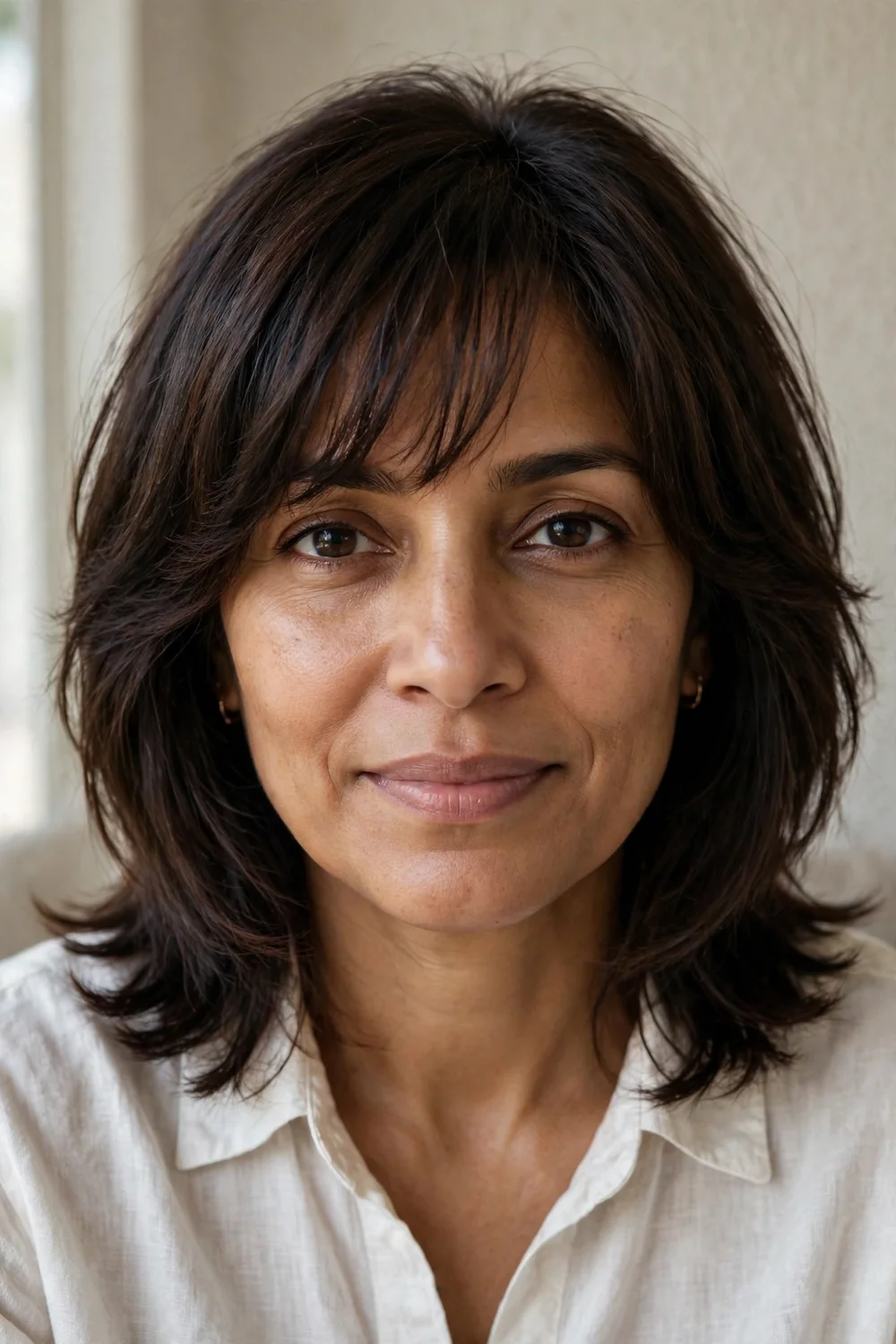
One common complaint about bangs on fine hair is that they sit as a single flat sheet. Layered bangs fix that by cutting the fringe in stacked pieces that move independently. Each layer catches light differently, which creates the illusion of more hair across the forehead. The rest of the cut stays simple at shoulder length with soft ends. This is a forgiving style for first-time bang wearers because the layers grow out softly instead of leaving a blunt line.
Try this: Dry the bangs with your fingers instead of a brush, lifting at the roots. The finger-drying keeps the layers separated instead of smoothing them into one sheet.
14. Feathered U-Cut with Light Bangs
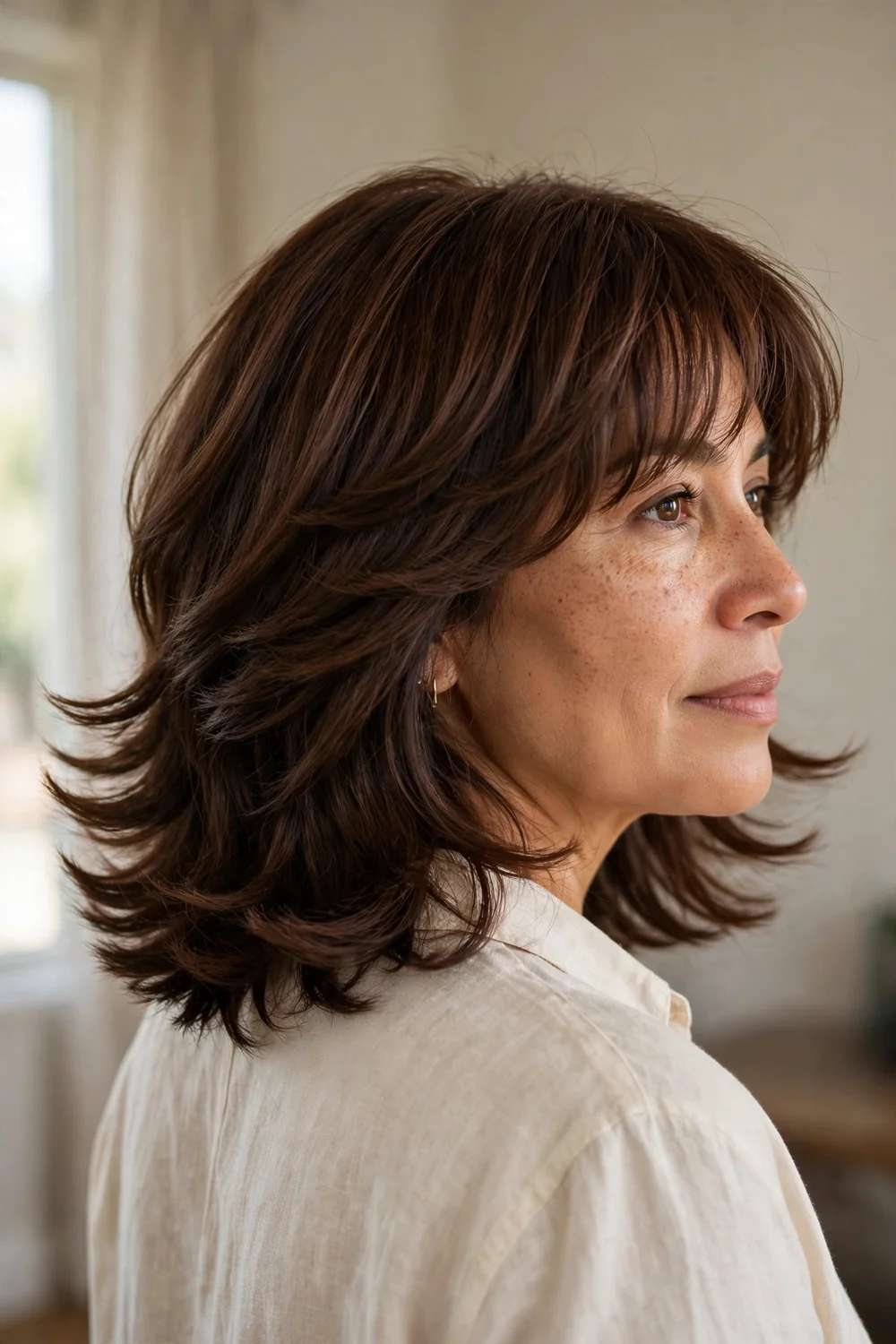
Feathered ends give fine hair a weightless bounce that blunt ends can’t. The U-shaped cut keeps the back slightly longer while the front layers sweep up toward the face, and light bangs complete the frame. When the ends flip softly outward, the hair looks like it has more movement than it actually does. This style looks best in photos from the back and side, where the feathering shows most. It suits straight to slightly wavy hair.
Try this: After blow-drying, flip just the bottom two inches outward with a flat iron. The flick at the ends sells the feathered effect in under a minute.
15. Butterfly Cut with Curtain Bangs
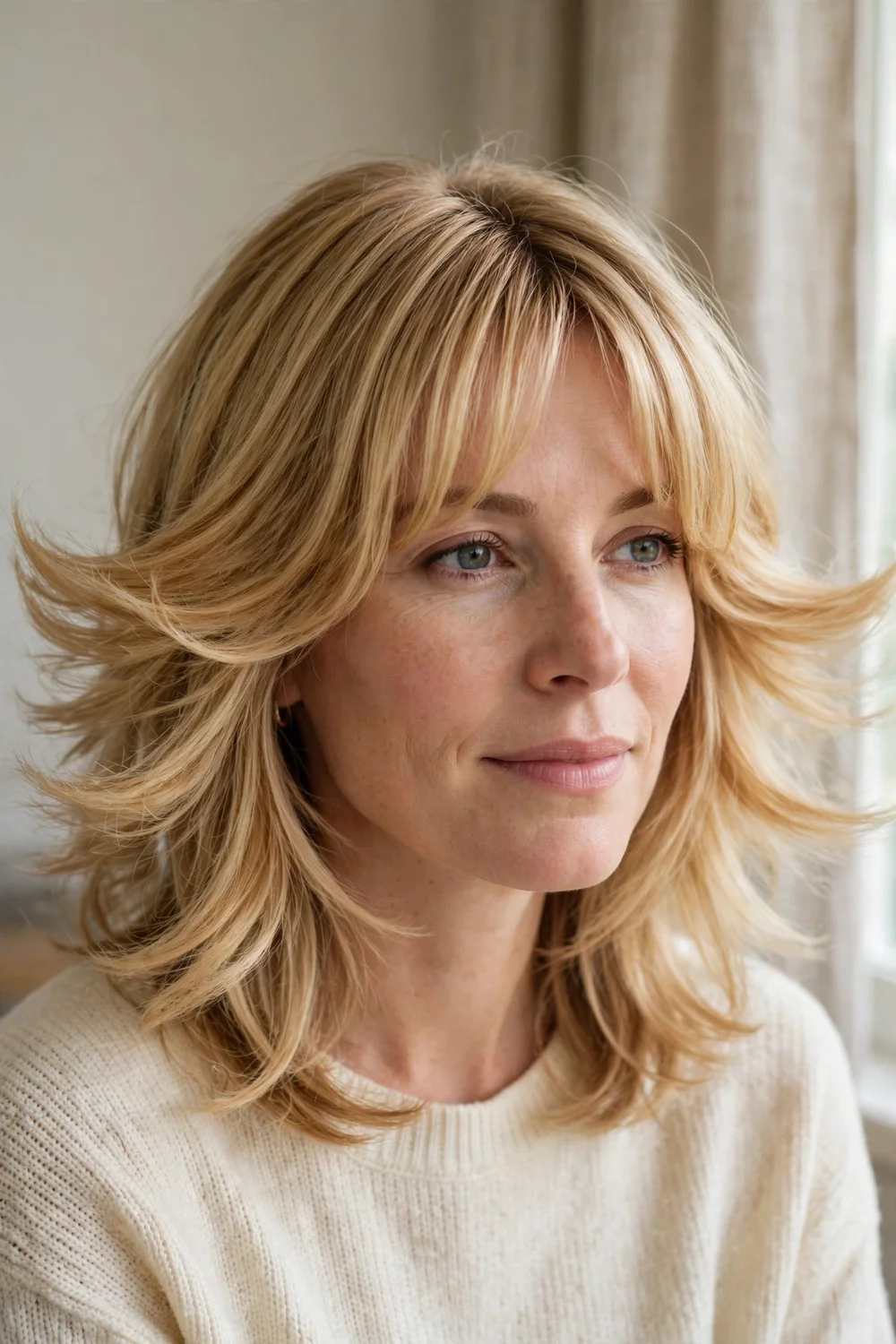
The butterfly cut’s short face-framing layers graduate into longer shoulder length pieces, creating wings of movement around the cheeks. Curtain bangs blend right into those short layers, so the front flows in one continuous curtain of hair. This layering pattern is kind to fine hair because the short pieces sit on top and create visible fullness while the length underneath stays intact. It flatters most face shapes thanks to the built-in framing.
Try this: Use a round brush to blow the face-framing layers outward and away from the cheeks. The outward flip is what creates the butterfly wing effect.
16. Asymmetrical Lob with Angled Bangs
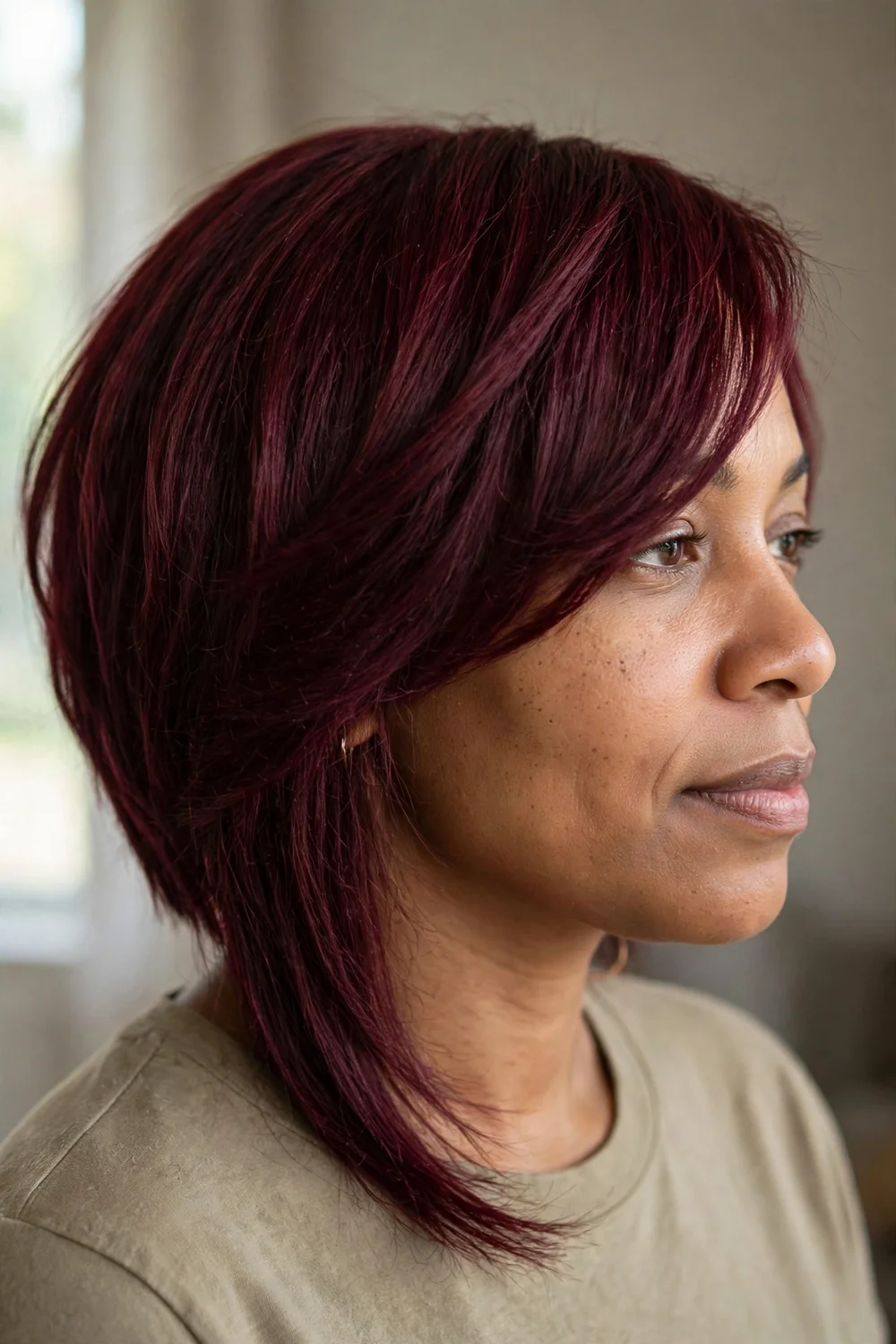
An asymmetrical lob, longer on one side, adds instant drama to fine hair because the uneven line keeps the eye moving. Angled bangs cut diagonally across the forehead echo that asymmetry and pack visual interest into the front. The diagonal lines create the impression of movement and density, even on very fine strands. Keep the longer side at the collarbone and the shorter side just below the chin for the most flattering contrast.
Try this: Part your hair on the opposite side from the bang’s angle to create extra lift at the roots. The opposing directions build height where fine hair needs it.
17. Rounded Bob with Full Bangs and Flipped Ends
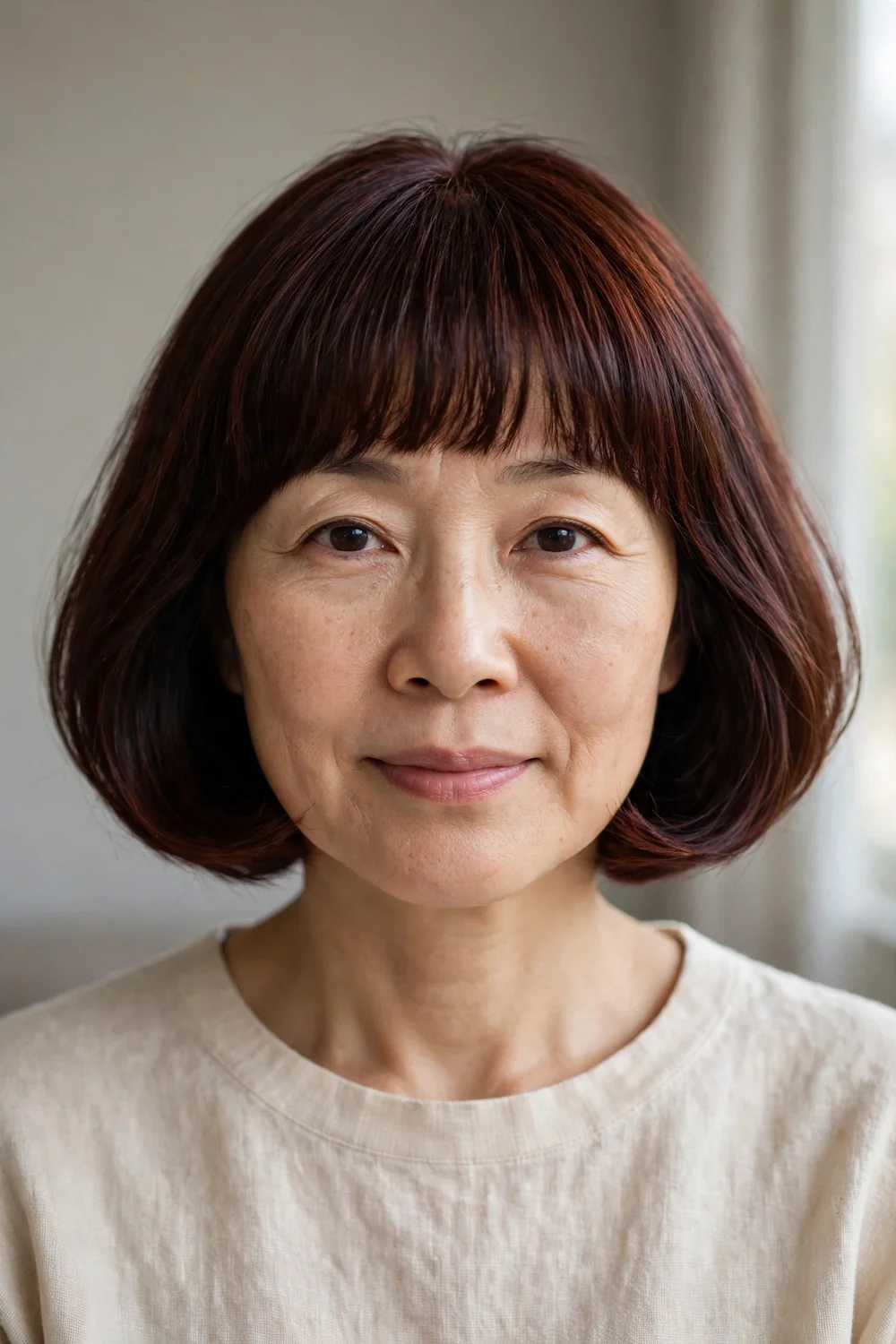
This retro-modern shape brings the ends forward and flips them out, which makes fine hair look bouncy instead of limp. Full bangs cut straight across balance the curved silhouette, and the rounded sides hug the jawline. The curved shape also lifts the hair away from the neck, which keeps the silhouette light. The style works best with a blowout, since the shape depends on smooth, curved ends. It’s a polished pick for workdays and events where you want your hair to look deliberately styled.
Try this: Flip the ends outward with a round brush while blow-drying, then run a flat iron over just the flipped tips to lock the curve. A light hairspray holds the shape without crunch.
For days when you want less polish and more texture at this length, messy hairstyles for medium length hair has easy options that still suit fine hair.
18. Center-Parted Curtain Bangs with Face-Framing Layers
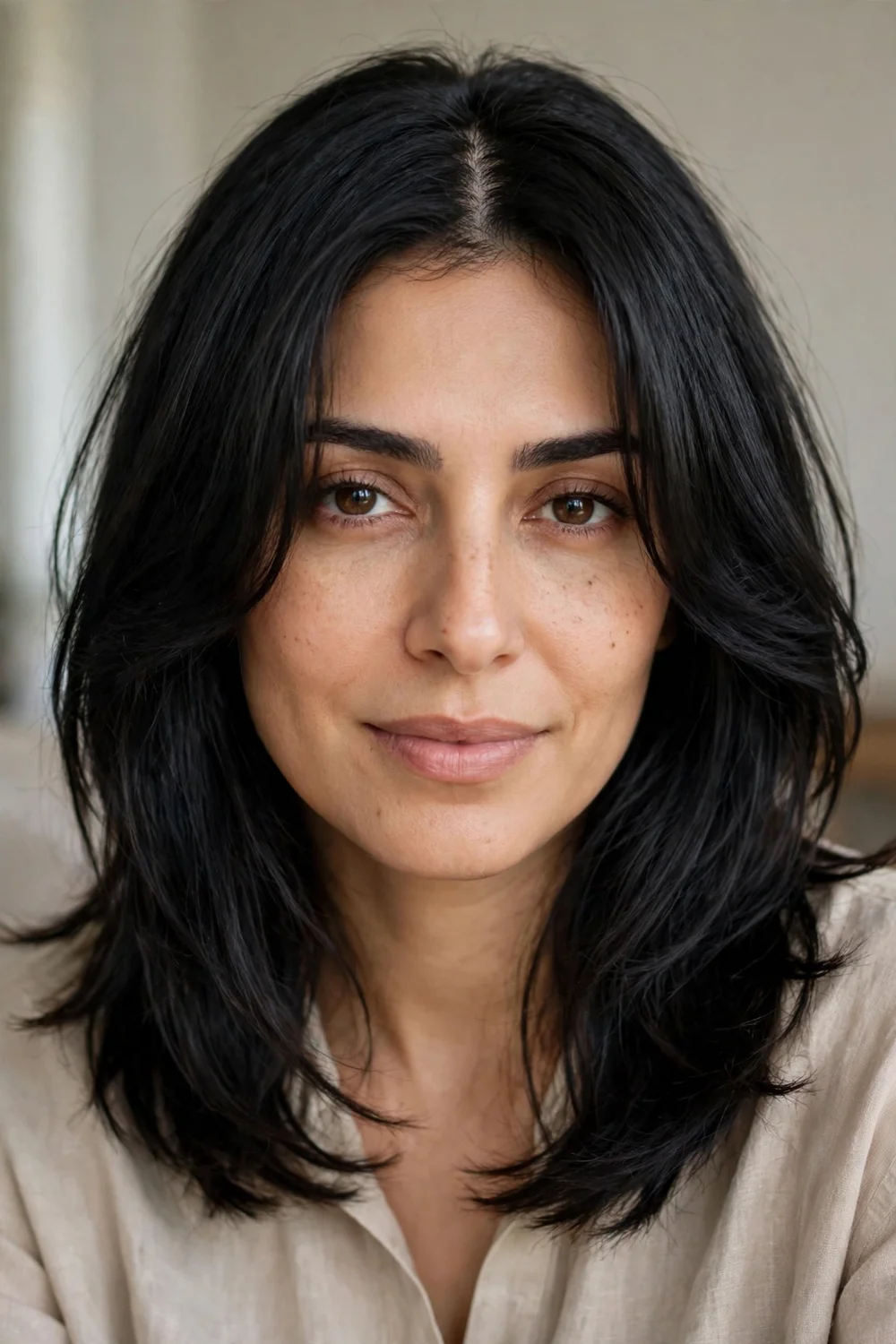
Part placement changes everything on fine hair, and a center part with curtain bangs distributes volume evenly on both sides. The bangs split down the middle and melt into long face-framing layers that fall past the chin. This symmetry flatters oval and long faces, and it makes styling simple because both sides mirror each other. The look stays neat for days since there’s no heavy bang to fall out of place.
Try this: Train the center part by blow-drying the bangs flat against the forehead first, then splitting them. The flat-dry sets the part line so it holds all day.
19. Shoulder-Length Cut with See-Through Bangs
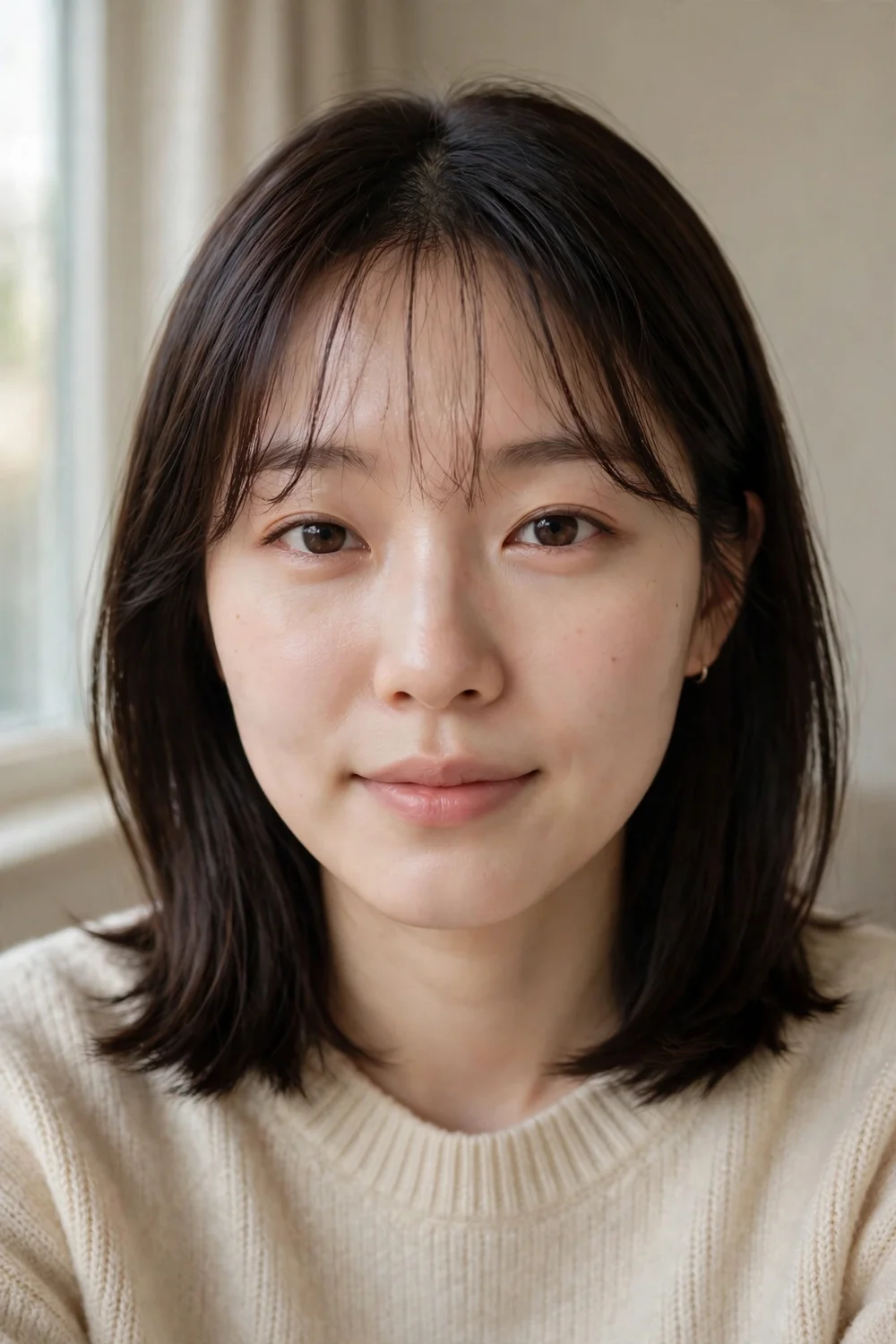
See-through bangs take so little hair that fine-haired women can wear them without thinning the rest of the cut. The sheer fringe shows a hint of forehead, which keeps the look light and youthful. Because only a thin section is used, the remaining hair keeps its full density through the lengths. This style suits straight hair best, where the wispy strands sit neatly. It’s also the lowest-commitment bang on this list, since the section is small enough to pin back while it grows out.
Try this: Smooth the bangs with a mini flat iron instead of a full-size one. The smaller plates grip the thin section better and give you more control.
20. Deep Side Part with Long Side-Swept Bangs
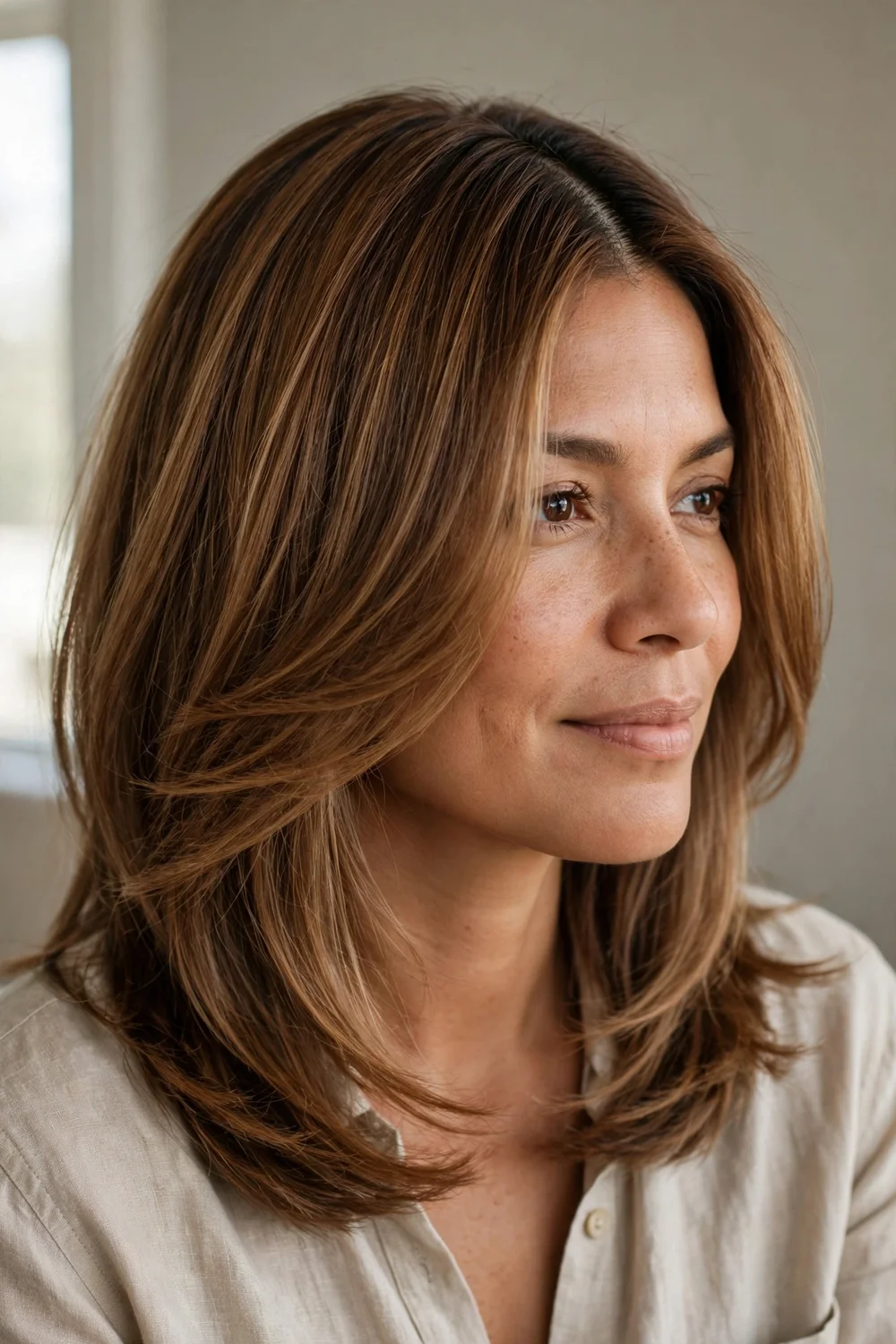
A deep side part is the oldest volume trick in the book, and it still works. Shifting the part several inches off center piles hair onto one side, which reads as instant thickness at the roots. Long side-swept bangs extend that sweep across the forehead and fall past the cheekbones into the layers. This is the most grown-out-friendly bang on the list; when it gets too long, it simply becomes a face-framing layer with no awkward phase.
Try this: Apply volumizing mousse to the roots on the heavy side of the part before blow-drying. The product holds the lifted roots in place for hours.
Shoulder Length Bang Styles Comparison at a Glance
| Style | Best Occasion | Difficulty | Hold Time |
|---|---|---|---|
| Layered cut with side bangs | Everyday, work | Easy | All day |
| Blunt bob with straight bangs | Work, formal events | Medium | All day |
| Textured lob with wispy bangs | Casual outings | Easy | 6 to 8 hours |
| Curtain bangs with shoulder cut | Brunch, dates | Easy | 2 to 3 days |
| Soft wavy bangs | Weekends, vacations | Easy | 6 to 8 hours |
| Multi-tonal cut with wispy bangs | Photos, events | Easy | All day |
| Swoopy bangs | Evenings out | Easy | All day |
| Choppy bangs | Casual, creative settings | Easy | 6 to 8 hours |
| Shag with wispy bangs | Everyday, concerts | Easy | All day |
| Collarbone shag with side-swept bangs | Weekends | Easy | All day |
| Graduated shag with micro-bangs | Fashion events | Medium | All day |
| Voluminous bob with side bangs | Work, family gatherings | Medium | All day |
| Layered bangs | Everyday | Easy | 6 to 8 hours |
| Feathered U-cut with light bangs | Dates, dinners | Medium | 6 to 8 hours |
| Butterfly cut with curtain bangs | Events, photos | Medium | All day |
| Asymmetrical lob with angled bangs | Nights out | Medium | All day |
| Rounded bob with full bangs | Work, formal events | Medium | All day |
| Center-parted curtain bangs | Everyday, weddings | Easy | 2 to 3 days |
| See-through bangs | Casual, daily wear | Easy | 6 to 8 hours |
| Deep side part with long bangs | Everyday, work | Easy | All day |
How to Choose the Right Bangs for Your Fine Hair
Start with your density. If your hair is fine but you have a lot of it, you can carry blunt or full bangs. If it is fine and sparse, stick with wispy, curtain, or side-swept styles that don’t demand much hair. A good test: if you can see your scalp through the section your stylist pulls forward for bangs, choose a sheerer style.
Next, think about your morning routine. Curtain and side-swept bangs survive second-day hair with a quick fluff. Straight and micro-bangs need daily heat styling to look right. Pick the bang that matches the effort you will actually give it, not the one you wish you would.
Finally, consider your face shape. Curtain bangs lengthen round faces, side bangs soften square jawlines, and wispy bangs suit long faces because they don’t add length. Bring reference photos to your stylist and point to the bang shape, not just the overall cut.
Mistakes to Avoid
The biggest mistake is cutting bangs too thick. On fine hair, a heavy bang section borrows hair from the crown and sides, leaving the rest looking thinner. Keep the bang section shallow so the lengths keep their density.
Don’t skip heat protectant on the bangs. Fine bangs get heat styled almost daily, which means they take more damage than the rest of your hair. A light spray before the flat iron keeps them from going brittle and breaking off shorter than you want.
Avoid heavy oils and serums near the fringe. Fine bangs absorb product fast and go stringy within hours. If your ends need oil, apply it from the mid-lengths down and keep it away from the forehead.
Don’t let bangs grow too long between trims. Fine hair shows uneven growth quickly, and a bang that falls into your eyes looks messy instead of styled. A quick trim every 3 to 4 weeks keeps the shape intentional.
Frequently Asked Questions
Do bangs make fine hair look thinner?
No, the right bangs make fine hair look fuller. Wispy, curtain, and side-swept bangs add visible density across the forehead without taking much hair from the rest of the cut. The only styles that can backfire are very thick blunt bangs on sparse hair, since they borrow density from the crown and leave the lengths looking thinner.
Which bangs are best for fine hair?
Wispy bangs, curtain bangs, and side-swept bangs work best on fine hair. They need less hair to look full, they grow out gracefully, and they don’t demand daily precision styling. Choppy and layered bangs also work well because their texture reads as fullness. Heavy straight-across bangs can work too, but only if your hair has enough density to fill them.
How do I stop my fine bangs from separating during the day?
Dry shampoo at the roots is the fastest fix. Apply it to the bang roots in the morning, even on clean hair, to absorb oil before it starts. Blow-dry bangs immediately after washing instead of letting them air-dry flat, and avoid touching them through the day since fingers transfer oil. A light mist of flexible-hold hairspray helps them stay put without stiffness.
How often should I trim bangs on fine hair?
Trim bangs every 3 to 4 weeks. Fine hair shows uneven growth faster than thick hair, so a bang that looked sharp last week can fall into your eyes this week. Many salons offer free or low-cost bang trims between full appointments, which makes the upkeep easy. Micro-bangs need trimming every 2 to 3 weeks since their short line loses shape fastest.
Can fine shoulder-length hair hold a style with bangs all day?
Yes, with the right lightweight products. Apply volumizing mousse to damp roots before blow-drying, use dry shampoo at the roots on second-day hair, and finish with flexible-hold hairspray. Avoid heavy creams, oils, and waxes near the bangs, since they weigh fine hair down within hours. Most of the styles in this guide hold from morning to evening with this routine.
Final Thoughts
Bangs remain the quickest upgrade for fine shoulder-length hair. Pick the bang shape that matches your density and your mornings, keep the trims regular, and let lightweight products do the heavy lifting. I’ve spent years fine-tuning bang styles for fine hair, and the twenty above are the ones I recommend first.

