



After 60, hair changes: it thins, it grays, and it loses the weight that once held a style together. Short cuts answer all three at once. They remove the drag of long hair, build volume into the shape itself, and need only minutes of styling. The 22 cuts below come from the most recommended styles for this age group, with attention to thin hair, gray blending, glasses, and face shape.
Weekday mornings rarely leave time for round brushes and sectioning clips, so every cut here earns its place by being easy to live with. Each one notes the detail that makes it work, a quick styling tip, and a difficulty label. If you want the broader picture beyond the 60-plus bracket, this roundup of short hairstyles for older women covers every age.
Quick Takeaways
- Shorter usually reads fuller. Hair cut above the chin removes the weight that pulls thin strands flat.
- Texture creates the illusion of density. Choppy layers, stacked backs, and feathered ends all add visual body.
- Your natural color can do half the work. Gray blending, salt-and-pepper tones, and lowlights add dimension without dye.
- Match the cut to your routine. Pixies need trims every 4 to 6 weeks; bobs can stretch to 8.
- Glasses and hearing aids change the math. Tapered sides and open ears keep frames and devices comfortable.
1. Classic Pixie Cut

The classic pixie is the baseline every other short cut is measured against. Sides are tapered close, the back is neatly shaped, and the top keeps enough length to sweep or tousle. That balance is why it suits so many face shapes: the short sides slim a round face, while the textured top adds height for longer ones. It works with silver, white, salt-and-pepper, or dyed color, and it asks for almost no daily effort. A trim every 5 to 6 weeks keeps the outline crisp. This is the cut to start with if you are going short for the first time.
Try this: blow dry the top upward with your fingers, then press a pea-sized amount of light wax into the ends for definition.
Difficulty: Low | Styling time: 5 minutes | Salon visits: every 5 to 6 weeks
2. Choppy Pixie for Thin Hair

When hair is fine, the trick is building volume into the cut instead of asking products to do it. A choppy pixie does exactly that. Short, disconnected layers through the crown lift away from the scalp, so thin hair reads as a full head of hair rather than flat strands. The sides stay neat, which keeps the silhouette controlled. Ask your stylist to point-cut the ends rather than blunt-cutting them; the rough texture is what creates the fullness.
If thin hair is your main concern, these older short hairstyles for fine hair over 60 go deeper into density-building cuts.
Try this: shake dry texturizing powder at the roots, then work the crown upward with your fingers.
Difficulty: Low | Styling time: 5 minutes | Salon visits: every 5 to 6 weeks
3. Feathered Pixie
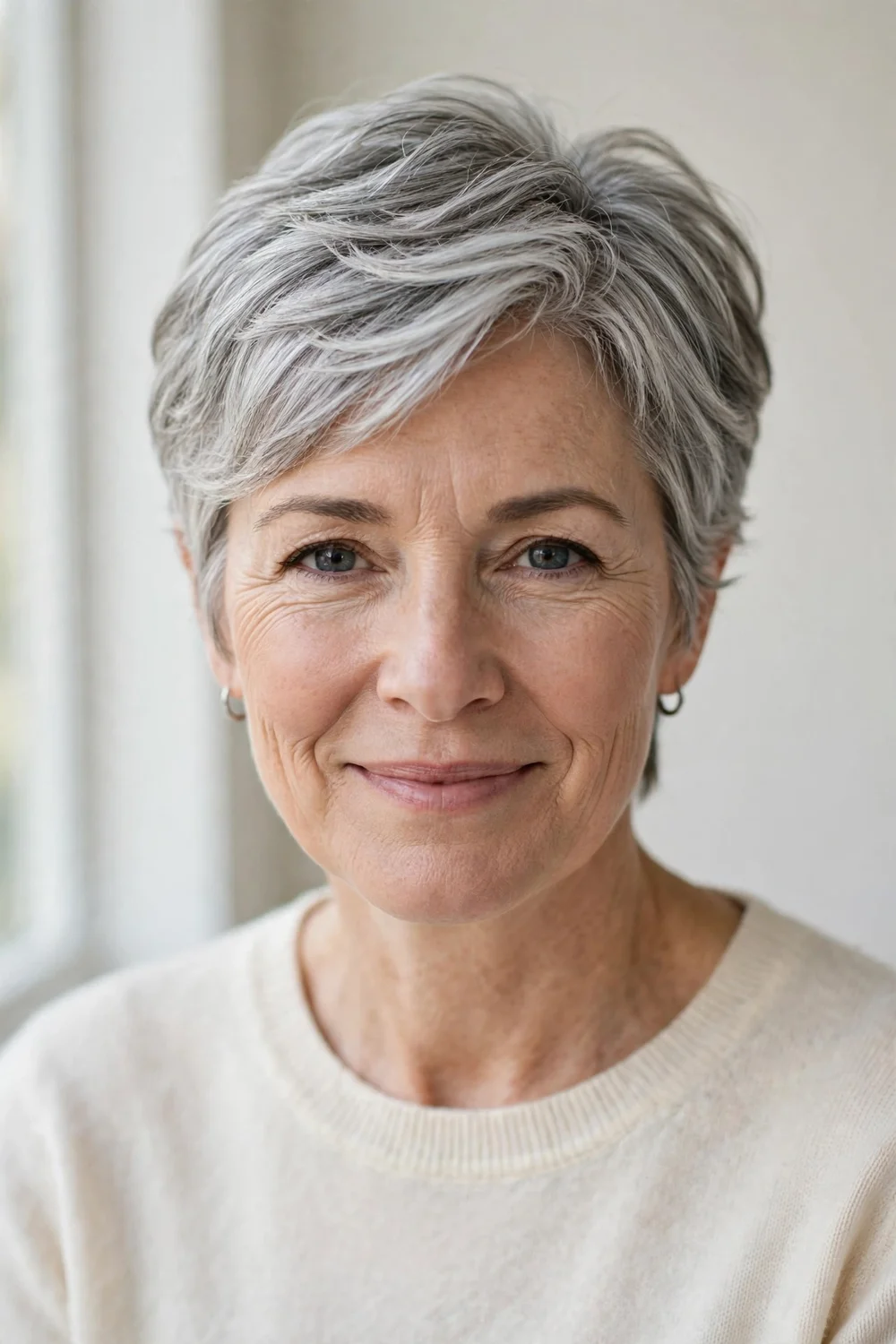
Feathered layers are the softest version of the pixie. The ends are cut at an angle so they flick outward or lie back in light, airy pieces instead of forming a solid block. That feathering is kind to thinning hair because it never exposes one dense spot against a sparse one. It flatters round and oval faces, and it styles with little more than a brush. The look stays polished for weeks, though the feathered ends need a trim around week six to keep their shape. Gray hair wears this cut well, since the layering catches the light.
Try this: blow dry with a flat paddle brush, pulling sections away from the face so the feathering fans out.
Difficulty: Low | Styling time: 8 minutes | Salon visits: every 6 weeks
4. Spiky Pixie

A spiky pixie trades softness for lift. The top is cut short and textured, then styled upward with a matte product so every piece stands apart. All that height does two things: it makes thin hair look abundant, and it draws the eye upward, away from the jawline and neck. The style pairs well with glasses, since the vertical direction balances frames. Keep the spikes piecey rather than stiff; separated texture reads as fullness, while glued clumps can expose the scalp.
If you like how upward styling works with frames, these short hairstyles for women over 50 with glasses show more frame-friendly cuts.
Try this: warm a pea-sized amount of matte wax between your palms and lift small sections straight up, working from back to front.
Difficulty: Low | Styling time: 5 minutes | Salon visits: every 4 to 6 weeks
5. Side-Swept Pixie
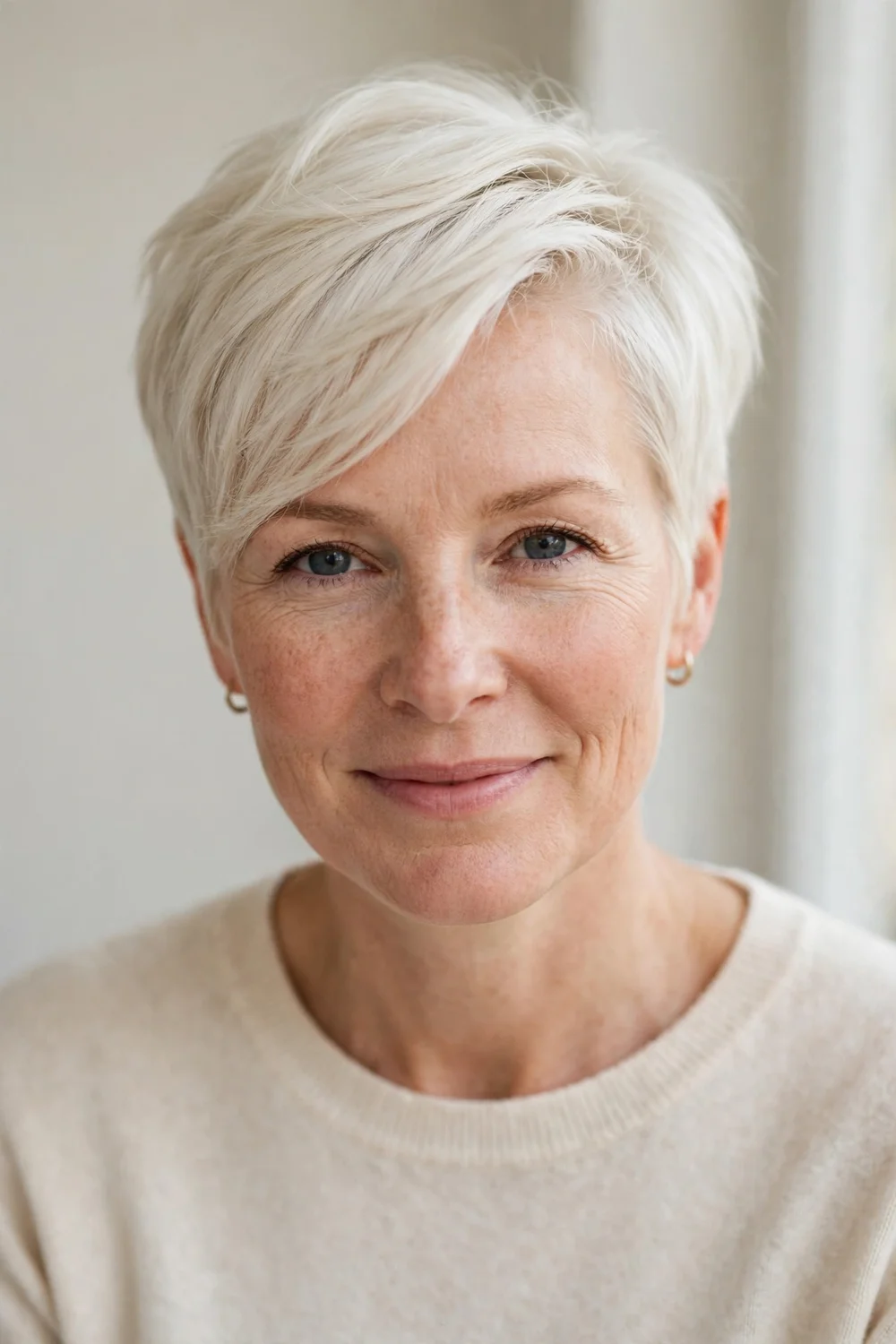
The side-swept pixie keeps the pixie’s short back and sides but leaves real length across the top. A deep side part sends the longer top sweeping across the forehead, which softens the face and covers a thinning front hairline without a fringe. The asymmetry adds visual width to one side of the crown, helping thin hair look denser. It suits straight and slightly wavy textures, and it grows out gracefully because the sweep simply gets longer. One caution: the part needs to be reset after every wash, since trained hair falls back to its old line.
Try this: while damp, comb the top to the deep side and clip it flat for five minutes to set the part.
Difficulty: Low | Styling time: 7 minutes | Salon visits: every 5 to 6 weeks
6. Tapered Crop

The tapered crop is the shortest, cleanest option here. Clippers or shears graduate the sides and nape down to the skin line, while the top keeps one to two inches of texture. Nothing pulls flat, nothing falls in the face, and the whole cut takes about three minutes to style. It is a favorite for active women and for anyone who wears hearing aids, since there is no hair to trap or muffle a device. The clean lines put the face front and center, so it rewards good skincare and a confident pair of earrings.
Try this: rub a drop of light pomade through the top and push it forward or to the side with your fingers.
Difficulty: Low | Styling time: 3 minutes | Salon visits: every 4 to 5 weeks
7. Modern Bowl Cut

The bowl cut grew up. The modern version keeps the rounded top but softens everything: a tapered nape instead of a hard line, textured ends instead of a blunt shelf, and a shape cut to the skull rather than stamped on it. The result is sleek and architectural without looking severe. It slims the neck visually and sits neatly around glasses or statement earrings. The catch is maintenance; the nape needs touching up every 4 to 5 weeks or the shape goes heavy. Ask for the top cut with shears, not clippers, for a softer edge.
Try this: smooth the top with a flat iron once, then mist a flexible-hold spray to stop flyaways.
Difficulty: Medium | Styling time: 10 minutes | Salon visits: every 4 to 5 weeks
8. Curly Pixie
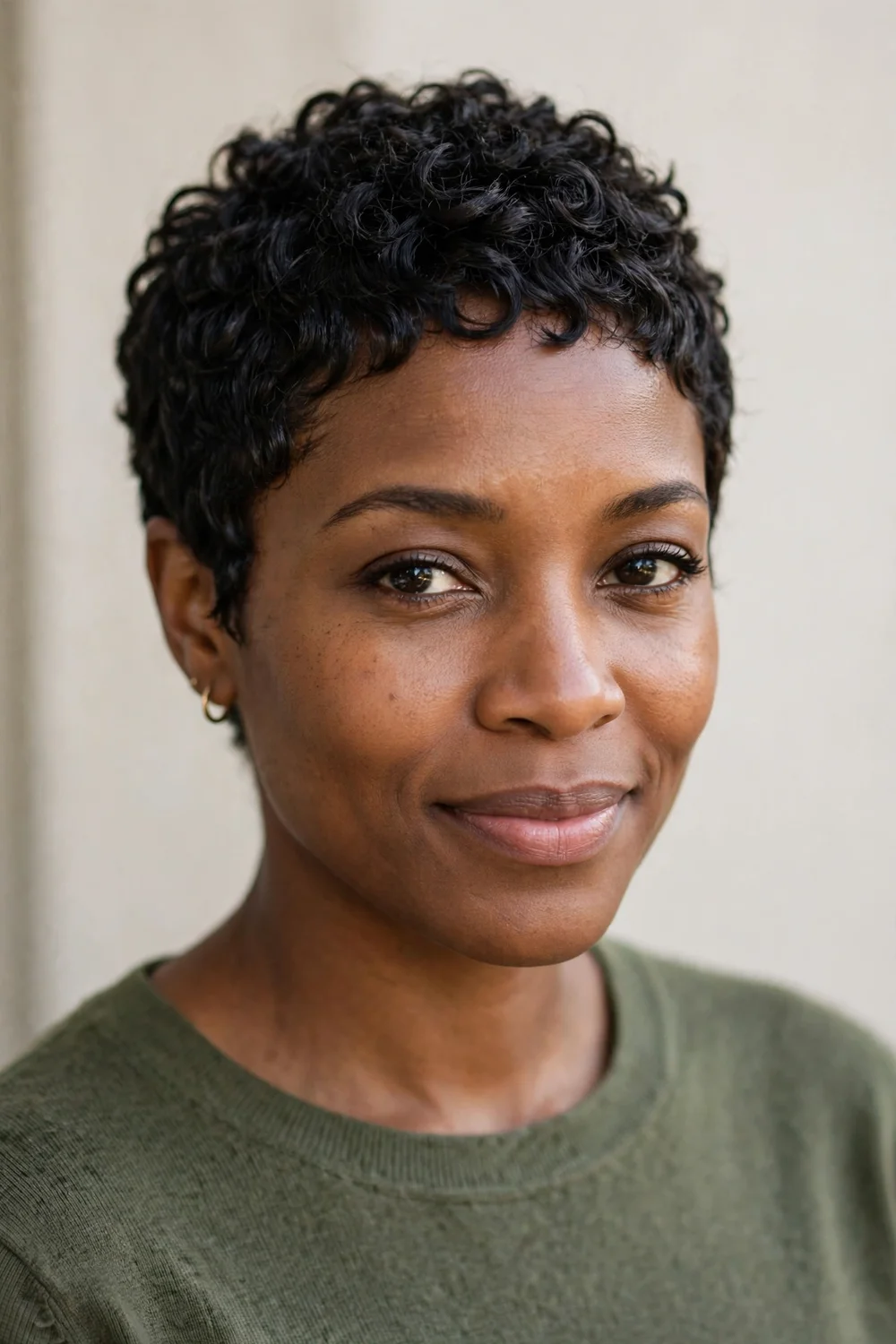
Natural curls and a pixie are a strong match. The short length stops curls from stretching under their own weight, so the spring stays where it belongs. Keep the sides tapered and leave enough length on top for the curl pattern to form; too short and curls read as frizz rather than definition. A curl cream worked through damp hair does most of the styling. The cut suits round and oval faces, and it grows out with soft edges instead of awkward stages. Trim the nape between appointments if it starts to bulk up.
For the full roundup, browse our curly short hairstyles for women over 60 with 42 cuts picked for mature curl patterns.
Try this: scrunch curl cream into soaking-wet hair, then diffuse on low heat or let it air dry untouched.
Difficulty: Low | Styling time: 8 minutes | Salon visits: every 6 to 8 weeks
9. Layered Bob with Side-Swept Bangs

A chin-length bob with layers through the ends and bangs swept to one side does quiet work on an aging face. The side-swept bangs cover forehead lines without the commitment of a full fringe, and they pull attention toward the eyes. The layers keep the bob from sitting flat, which matters once hair loses its youthful body. This cut suits straight to wavy textures and most face shapes. Style it with a round brush, rolling the ends under for a polished finish or out for a livelier one.
Try this: dry the bangs first, sweeping them across the forehead with a vent brush, then finish the rest of the bob.
Difficulty: Medium | Styling time: 15 minutes | Salon visits: every 6 to 8 weeks
10. Textured Bob

The textured bob is the wash-and-wear answer for straight or wavy hair. Internal layers are cut into the mid-lengths rather than along the outline, so the surface stays smooth while the inside holds air and movement. That hidden structure is what keeps thin hair from collapsing by midday. The ends are piecey, the silhouette is slightly tousled, and the whole cut looks finished with almost no effort. It pairs well with a center or side part and needs only a trim every 6 to 8 weeks.
Try this: spray dry texturizing spray through the mid-lengths and scrunch upward for instant body.
Difficulty: Low | Styling time: 8 minutes | Salon visits: every 6 to 8 weeks
11. Blunt Silver Bob

When hair is thick, a blunt cut turns density into an asset. The blunt silver bob cuts every strand to one jaw-length line, and that clean perimeter shows off the full weight of the hair. Icy silver or white makes the geometry of the cut visible: light reflects off the smooth surface and the straight edge reads as deliberate and current. The style needs a flat iron to stay sleek and regular trims to keep the line sharp. It suits oval and square faces and looks sharp with bold lipstick.
Try this: run a flat iron through in small sections, then finish with one drop of shine serum on the ends.
Difficulty: Medium | Styling time: 15 minutes | Salon visits: every 6 weeks
12. Stacked Bob

The stacked bob builds its volume into the back of the cut. Graduated layers pile up from the nape toward the crown, pushing the hair upward into a rounded shape that holds even on second-day hair. The front stays longer, framing the face while the back does the lifting. Straight to wavy textures show the graduation best. The shape needs a round brush to look its best, so it asks for a little more morning effort than a pixie. In return you get a cut that carries real dimension from every angle.
Try this: dry the back sections upward over a medium round brush, starting at the nape and working toward the crown.
Difficulty: Medium | Styling time: 15 minutes | Salon visits: every 6 weeks
13. Angled Bob

An angled bob runs longer at the front and shorter at the back, and that diagonal does useful work. The longer front pieces elongate a round face and draw the eye downward past the jawline, while the stacked back keeps volume high at the crown. It reads as modern without being edgy, and it suits straight hair best since the angle shows most clearly on smooth strands. Ask your stylist to keep the front no longer than the collarbone, or the angle starts to drag.
Try this: flat-iron the front pieces last, pulling them slightly forward so the angle stays visible.
Difficulty: Medium | Styling time: 12 minutes | Salon visits: every 6 weeks
14. Curly Bob

A curly bob lets natural texture do the heavy lifting. Kept above the shoulders, the curls keep their bounce instead of stretching flat, and the rounded shape reads as fullness from every side. Layering through the ends stops the triangle shape that one-length curly cuts can take. A curl cream and a diffuser are the whole routine. The cut suits heart-shaped and oval faces, and it hides sparse spots better than any straight style. Get the cut on dry curls when possible so the length is judged accurately.
Try this: rake curl cream through damp sections, then scrunch and diffuse with your head tilted for root lift.
Difficulty: Low | Styling time: 10 minutes | Salon visits: every 10 to 12 weeks
15. French Bob with Fringe

The French bob is short, chin-length, and slightly rounded, with a soft straight-across fringe. It is one of the few bobs that looks intentional without daily heat styling, since the shape is cut into the hair rather than styled into it. The fringe covers the forehead and balances a longer face, while the rounded sides soften a square jaw. Natural gray wears it well; the cut’s clean lines suit the honesty of undyed hair. Keep the fringe trimmed every 3 to 4 weeks or it starts to sit on the lashes.
Try this: blow dry the fringe straight down with a small round brush, then tousle the sides with your fingers.
Difficulty: Low | Styling time: 10 minutes | Salon visits: fringe trims every 3 to 4 weeks, cut every 6 to 8 weeks
16. Shaggy Silver Bob

The shaggy silver bob is the cut for women ready to stop fighting their gray. Heavy textured layers are cut through the whole shape, which keeps coarse silver strands from forming a harsh, blocky outline. The piecey finish and wispy bangs look relaxed rather than unkempt, and the layering gives thin gray hair movement it would not have on its own. A weekly purple shampoo keeps the silver bright instead of yellow. The messier it looks, the better it works, so this is a genuine wash-and-wear option.
Try this: scrunch a light curl or wave cream into damp hair and let it air dry for the natural texture to set.
Difficulty: Low | Styling time: 5 minutes | Salon visits: every 8 to 10 weeks
17. Short Shag

The short shag takes the bob’s layering and pushes it further. Short layers start high at the crown and fall in choppy pieces around the face, with curtain bangs blending into the sides. The heavy face-framing draws attention to the cheekbones, which gives the whole face a lifted look. It suits wavy and straight textures and flatters oval and square faces. The cut holds its shape for 8 to 10 weeks, longer than most short cuts, because the layers grow out evenly instead of losing their outline.
Try this: rough-dry with your fingers, flipping the hair back and forth across the forehead so no hard part forms.
Difficulty: Low | Styling time: 8 minutes | Salon visits: every 8 to 10 weeks
18. Wedge Cut

The wedge is a retro cut that still earns its place. Stacked layers graduate from a short nape to longer front pieces, forming a triangular silhouette that is full at the back and neat at the sides. That shape adds width through the crown, which flatters narrow faces and gives fine hair a built-in boost. It suits straight hair best; curls fight the smooth graduation. The cut needs a blow dryer and a round brush to hold its shape, so it asks for more effort than a pixie but delivers a polished, architectural finish.
Try this: dry the back sections with a round brush, rolling under to emphasize the stacked curve.
Difficulty: Medium | Styling time: 15 minutes | Salon visits: every 6 weeks
19. Swept-Back Crop

Sweeping short hair straight back from the forehead creates height at the crown and shows the whole face with confidence. The cut itself is a simple crop: short sides, textured top. The styling is what makes it: hair brushed back and held with a light product, no part, no fringe. It works on days when you want a polished look without fuss, and it keeps hair out of the way completely. The style suits oval and heart-shaped faces and looks sharp with glasses. A little root powder at the crown keeps the lift from falling flat by afternoon.
Try this: blow dry the top straight back with a vent brush, then press a small amount of light paste at the roots for hold.
Difficulty: Low | Styling time: 8 minutes | Salon visits: every 5 to 6 weeks
20. Salt-and-Pepper Bob

Letting gray grow in as salt-and-pepper is a color decision that doubles as a volume trick. The mix of dark and light strands creates natural dimension, and dimension is what makes hair look thicker. A chin-length bob shows off that blend better than a pixie, since there is enough length for the colors to mingle. Keep the shape soft with light layering, and skip harsh dye lines by blending the demarcation as the gray grows. The look needs almost no color maintenance, just regular trims and a brightening shampoo now and then.
Try this: use a purple shampoo once a week to keep the silver strands bright and the dark ones from looking dull.
Difficulty: Low | Styling time: 10 minutes | Salon visits: every 6 to 8 weeks
21. Short Perm for Volume

Modern perms create loose, soft waves that add lasting body to fine, straight hair. On a short cut, the wave pattern multiplies the hair’s visual width, which is exactly what thin hair needs. The result lasts 3 to 6 months and cuts daily styling down to scrunching in a little product. The trade-off is chemical processing on hair that may already be fragile, so get it done by a stylist experienced with mature hair and keep up with conditioning treatments. A consultation first is wise: the stylist can test how your hair takes the solution.
Try this: after a perm, switch to sulfate-free shampoo and a weekly deep conditioner to protect the curl pattern.
Difficulty: Medium | Styling time: 5 minutes daily | Salon visits: perm every 3 to 6 months
22. Wispy Lob with Gray Blending

The wispy lob sits between short and medium: long enough to pull back, short enough to hold volume. Wispy layers through the ends keep it light, and gray blending, where the colorist melts your natural silver into the dyed lengths, erases the harsh grow-out line. The style suits women growing out dye or transitioning to gray. It needs the least frequent salon schedule on this list, since the blended color hides regrowth completely. Style it with loose waves or wear it straight; the cut works both ways.
Try this: ask your colorist for a root melt in your natural gray tone so the grow-out stays seamless for months.
Difficulty: Low | Styling time: 10 minutes | Salon visits: every 10 to 12 weeks
Pixie vs Bob vs Crop: Which Short Cut Fits Your Life?
| Cut family | Best for | Daily styling | Salon visits |
|---|---|---|---|
| Pixies and crops | Thin hair, low-effort routines, glasses and hearing aids | 3 to 8 minutes | Every 4 to 6 weeks |
| Bobs | Versatility, face framing, gray blending | 8 to 15 minutes | Every 6 to 8 weeks |
| Shags and wedges | Texture, crown volume, longer grow-out | 8 to 15 minutes | Every 6 to 10 weeks |
What to Avoid When Going Short After 60
Going short is usually the right move, but a few choices work against you. Too many short layers through the crown can expose the scalp instead of covering it, which is the opposite of the fullness you want. Heavy razoring or thinning through the ends strips weight from exactly the place thin hair needs it. And a one-length cut worn past the shoulders shows every gap, since there is no layering to disguise sparseness.
None of that means playing it safe. It means choosing the detail that solves your specific problem: a stacked back for a flat crown, a deep side part for a thinning hairline, a fringe for a high forehead. If your face is on the rounder side, these low maintenance short haircuts for round faces narrow the field to the most flattering low-effort options. Bring photos to your appointment and point to the exact detail you want, since words like “layers” mean different things to different stylists.
Frequently Asked Questions
What is the best short hairstyle for a woman over 60?
There is no single winner, but stylists return to the same shortlist: a textured pixie or a layered bob. The pixie suits thin hair and low-maintenance routines, while the bob suits women who want face framing and styling options. The right choice depends on your hair texture, face shape, and how much daily styling you want to do.
Does short hair make you look younger after 60?
It can. Removing heavy length lifts the eye upward toward the cheekbones instead of dragging it down, and cuts with crown volume or face-framing layers soften the look of the jawline and neck. The effect comes from the shape, not the length alone, so a well-cut bob does more than simply cutting everything short.
What short haircut is best for thin hair over 60?
Cuts that build volume into the shape: choppy pixies, stacked bobs, and textured crops. Short disconnected layers lift away from the scalp and create the illusion of density, while blunt perimeters make the ends look thicker. Avoid heavy thinning or razoring, which removes the weight thin hair needs to look full.
How often should women over 60 get short hair trimmed?
Pixies and crops need trims every 4 to 6 weeks to hold their shape. Bobs can stretch to 6 to 8 weeks, and layered shags to 8 or 10. Fringes need attention every 3 to 4 weeks. Regular trims matter more after 60 because split ends make already-fine hair look thinner.
Can women over 60 wear short hairstyles with glasses?
Yes, and short cuts often suit glasses better than long hair does. Tapered sides keep frames sitting comfortably, and styles with height on top balance the frames visually. Tuck side pieces behind the ears or choose a crop with open sides so the arms of the glasses sit flat.
Final Thoughts
Short hair after 60 is not a compromise; it is a strategy. Pick the cut that solves your main problem, thin hair, gray grow-out, or styling time, and let the shape do the daily work. Start with the styles that match your routine, and bring a photo of the exact detail you love to your stylist.
Love the stacked shape? These short stacked bob hairstyles for women over 50 add volume exactly where mature hair needs it.

