



An A-line bob is shorter in the back and longer in the front, so the outline forms the shape of the letter A. It’s one of those cuts that stylists keep recommending because the geometry does the work: the forward angle frames the face, the shorter back creates volume at the crown, and the blunt perimeter keeps the ends looking full.
Below you will find 30 a line bob haircuts, from the textbook classic to bold color versions, plus the styling and trimming details that keep the angle sharp. I’ve spent years writing about bob haircuts, and the A-line keeps showing up in salon requests for a reason: it flatters more face shapes than almost any other short cut.
Quick answer: The best A-line bob is cut shorter at the nape and angles down toward the front, with the front pieces landing anywhere from chin to collarbone. Blunt versions suit fine hair, layered and stacked versions suit thick hair, and the angle itself flatters round, square, and oval faces. Trims every 6 to 8 weeks keep the shape crisp.
Quick Takeaways
- The A-line bob is cut shorter in the back and longer in the front, forming a letter-A outline.
- Blunt A-line bobs make fine hair look thicker; layered and stacked versions remove bulk from thick hair.
- The forward angle slims round faces and softens square jawlines.
- Curly, wavy, and straight textures can all wear an A-line with the right adjustments.
- Plan a trim every 6 to 8 weeks so the nape stays short and the angle stays visible.
Why the A-Line Bob Works on So Many People
The secret of the A-line bob is its diagonal line. A diagonal draws the eye downward and forward, which creates the illusion of length in the face and structure at the jawline. Round faces look slimmer, square faces look softer, and long faces get balance from the fullness at the back.
Texture is flexible too. Straight hair shows off the precision of the angle. Wavy and curly hair soften it into something more relaxed. The cut can be done blunt with no stacking, which is the classic A-line, or with graduated layers in the back for more volume. Your stylist can adjust the steepness of the angle, which makes one cut work for very different tastes.
Upkeep is moderate. The nape grows out faster than the front, so regular trims matter more here than with a one-length bob. Most people book every 6 to 8 weeks. Between visits, a round brush and a flat iron handle almost all styling.
1. The Signature Classic A-Line Bob
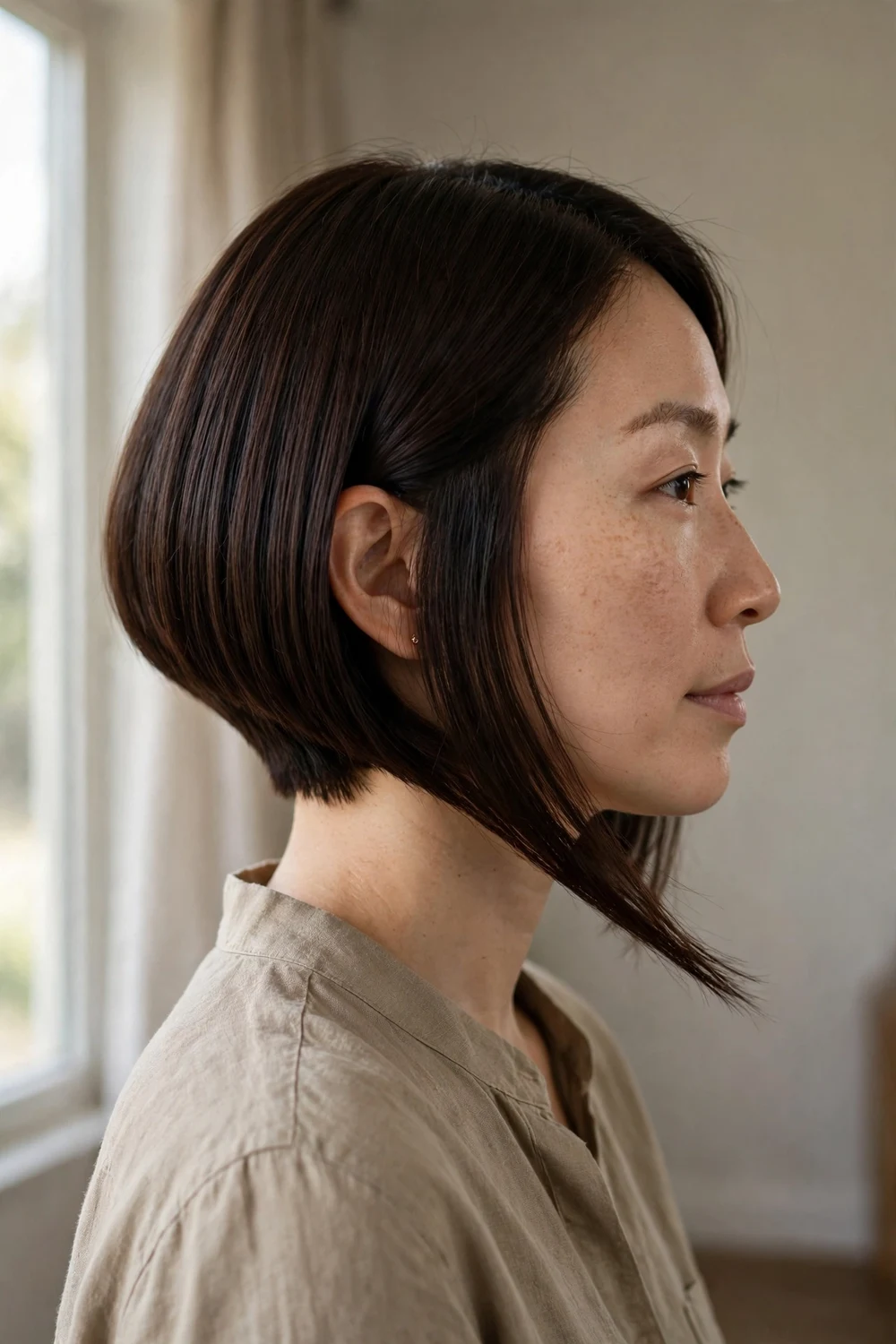
This is the textbook version: clean, precise, and cut with a single diagonal line from the nape to the front. No layers, no fringe, just the angle doing all the talking. It works best on straight or slightly wavy hair where the line reads clearly. The front pieces usually land around the chin, which frames the jawline and draws attention to the cheekbones. It suits oval, round, and square faces because the angle breaks up width and adds structure at the same time.
Try this: blow-dry the hair smooth with a paddle brush, then run a flat iron over the front pieces only to sharpen the line. Difficulty: Easy. Trim: every 6 weeks.
2. Blunt-Edge A-Line Bob
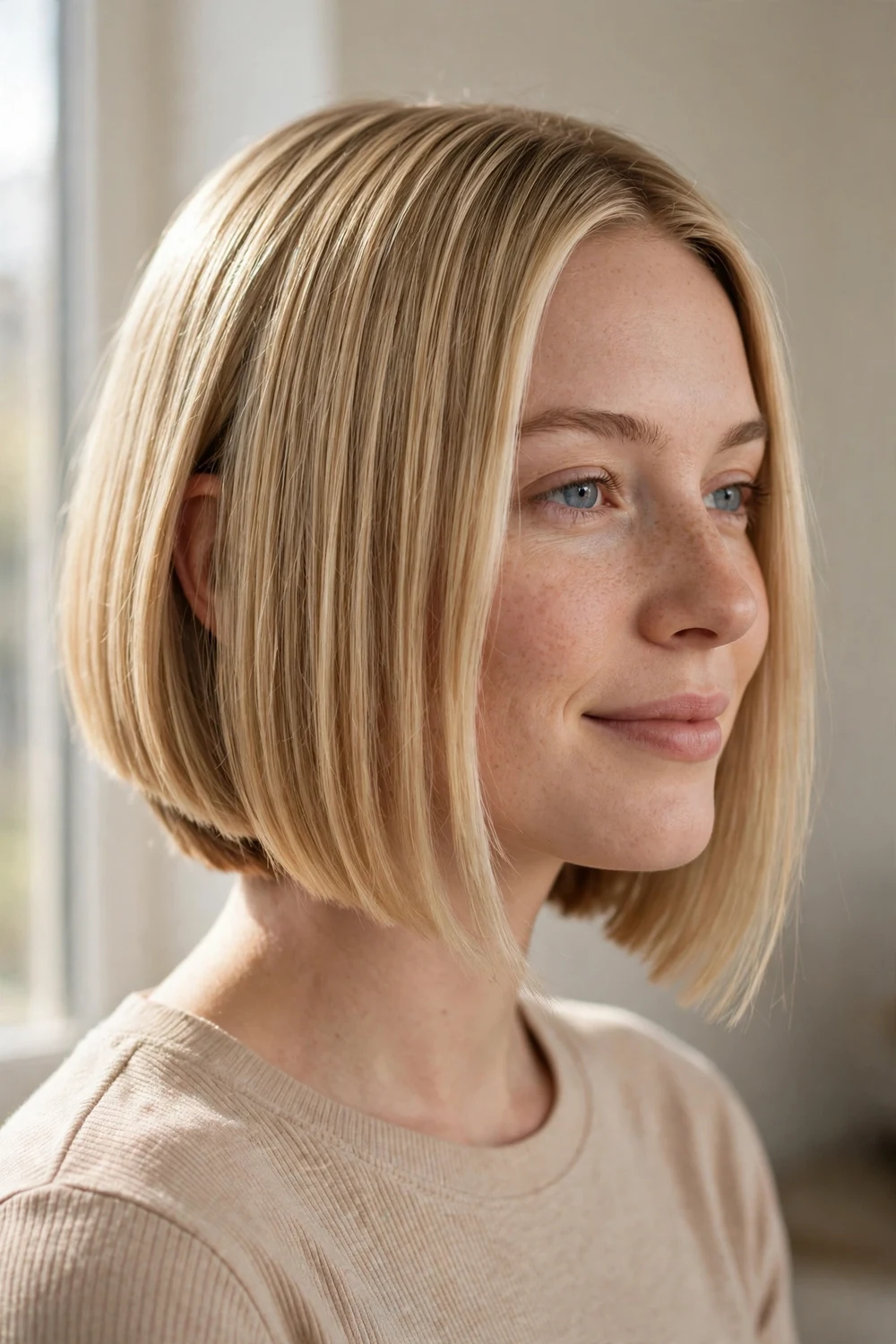
A blunt edge gives the A-line maximum density at the ends. Every strand is cut to the same length along the angle, so fine hair looks instantly thicker and healthier. The sharp perimeter is what makes this version read polished and intentional. It needs straight styling to show the line, and it photographs well because the edge is so defined. Square faces benefit from the softness the forward pieces add along the jaw. Keep the cut free of layers if fullness at the ends is your goal.
Try this: press a pea-sized amount of smoothing cream through the ends before flat-ironing for a glassy finish. Difficulty: Easy. Trim: every 6 weeks.
3. Layered A-Line Bob
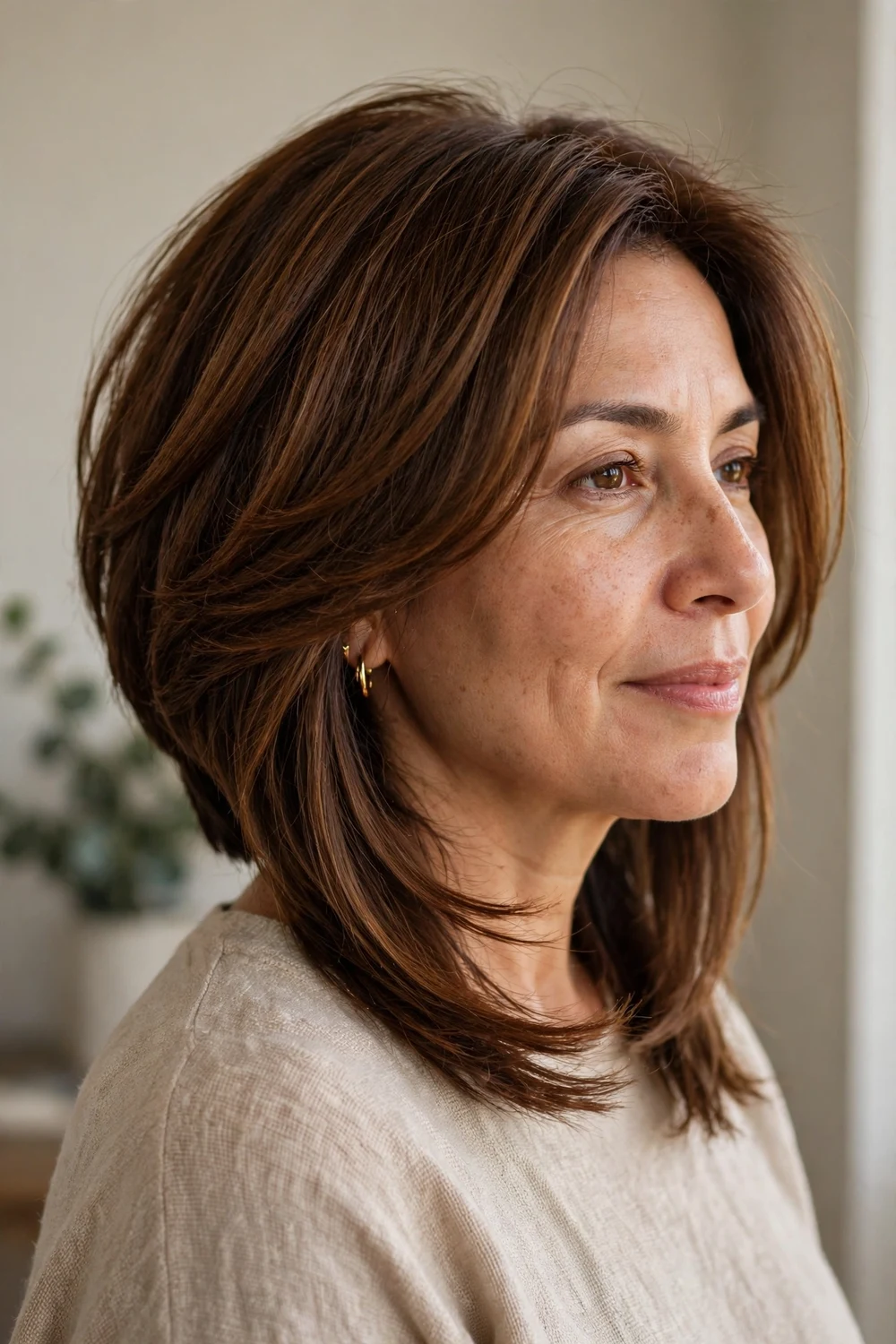
Layers inside an A-line bob remove weight and add movement without changing the outer shape. The layers follow the angle of the cut, so the silhouette stays clean while the interior gets lighter. Thick hair benefits most because the layers stop the cut from turning into a heavy triangle. Medium to thick textures get bounce and swing from the removed bulk. The result still reads as an A-line from the outside, but it moves more when you turn your head.
Try this: ask your stylist for internal layers only, keeping the perimeter intact so the A-line outline stays strong. Difficulty: Easy. Trim: every 7 weeks.
4. Stacked A-Line Bob
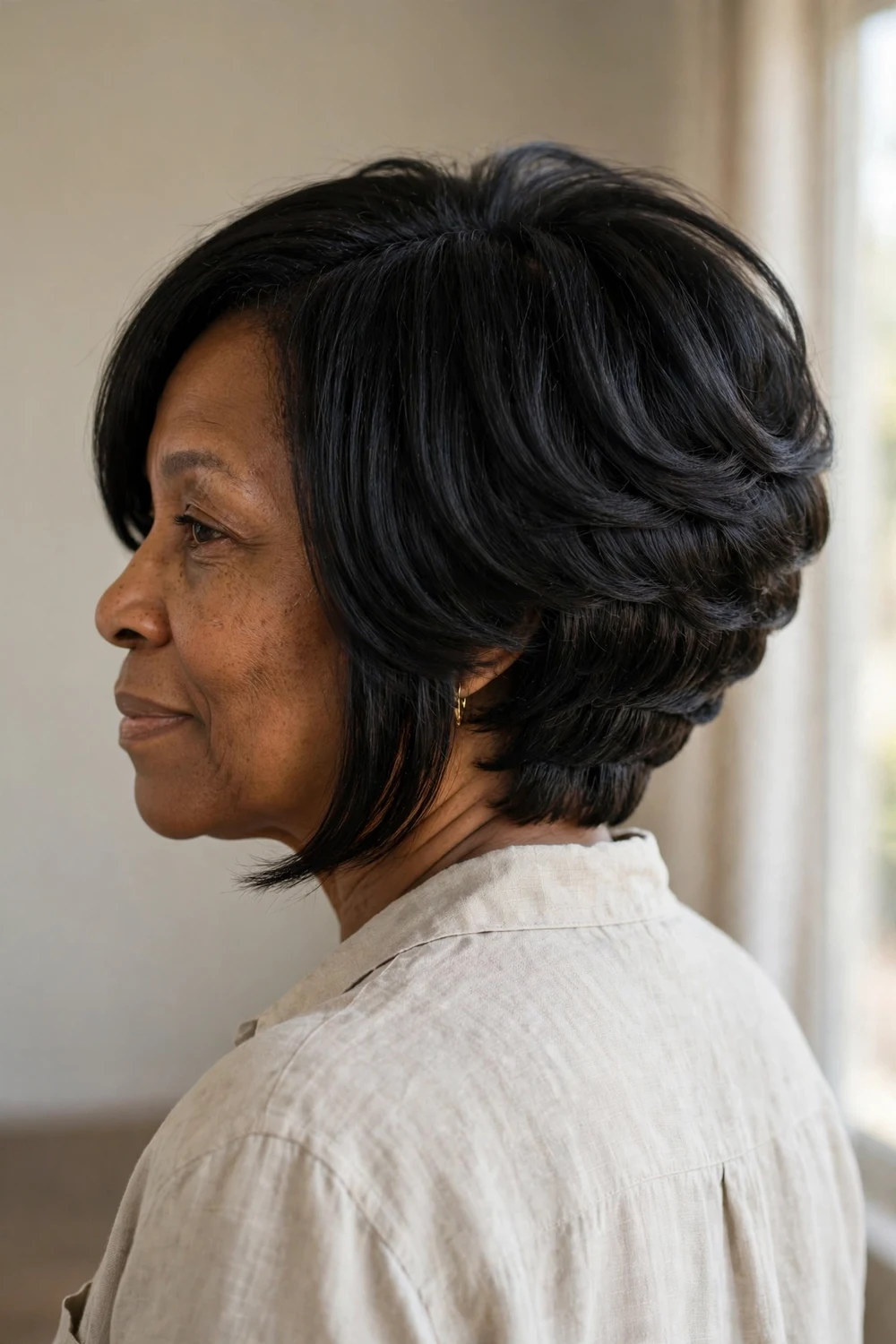
Stacking adds short graduated layers at the back of an A-line bob, building a rounded, lifted shape at the crown. The nape sits close to the head while the front keeps its length, which gives a bold contrast between back and front. Fine to medium hair gets real volume from the stacking. It is a higher-commitment version because the graduated back needs frequent shaping. The look reads polished and confident, especially styled smooth.
Try this: blow-dry the crown upward with a round brush to emphasize the stacked fullness at the back. Difficulty: Medium. Trim: every 5 to 6 weeks.
5. Choppy Textured A-Line Bob

Choppy ends give the A-line a relaxed, undone feel instead of a polished one. The texture is cut in with point cutting or a razor, which creates piece-y separation along the angle. Fine hair looks fuller because the texture adds width and movement. This version is forgiving as it grows out, since the uneven ends disguise regrowth. It suits straight to wavy hair and works for casual, everyday wear when you do not want to flat-iron every morning.
Try this: scrunch a small amount of texturizing paste into dry ends to define the piece-y pieces. Difficulty: Easy. Trim: every 7 weeks.
6. Sleek Glassy A-Line Bob
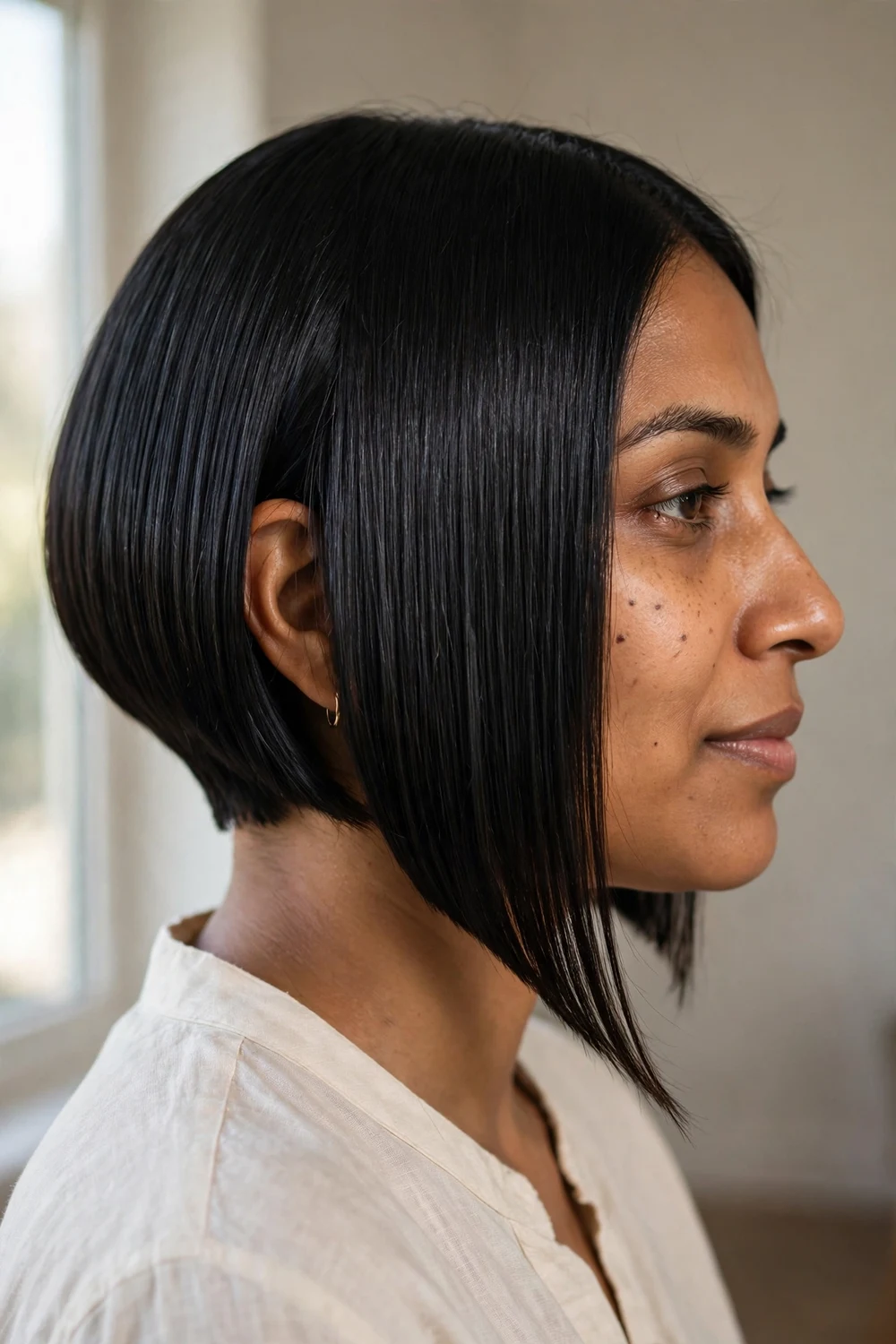
When the A-line is worn ultra-smooth, the angle becomes the whole statement. Hair is blow-dried straight and finished with shine products until it reflects light. The glassy finish makes the diagonal line impossible to miss, which is why this version photographs so well. It needs healthy, frizz-free hair to look its best, so a smoothing serum and heat protectant are part of the routine. Straight, medium-density hair holds this finish longest.
Try this: finish with a shine spray held 10 inches away so it mists evenly without weighing the hair down. Difficulty: Medium. Trim: every 6 weeks.
7. Blonde Highlighted A-Line Bob

Highlights trace the angle of the A-line and make the shape more visible. Lighter pieces along the front draw the eye down the diagonal, which emphasizes the cut’s structure. The contrast between the base color and the highlights adds dimension, so even fine hair looks fuller. Foil highlights or balayage both work; balayage gives a softer grow-out. This is a good option if you want the cut to look different from every angle.
Try this: ask for face-framing highlights that follow the front pieces to spotlight the angle. Difficulty: Easy. Trim: every 6 weeks. Color upkeep: every 8 to 10 weeks.
8. Copper A-Line Bob

Copper gives the A-line warmth and presence. The rich, warm tone catches light along the angle and makes the forward pieces glow. It flatters fair to medium skin tones and adds life to straight, smooth styling. The color works on the classic blunt version and the layered version alike. Copper fades faster than most shades, so a color-safe shampoo and cooler wash water keep it vivid longer between salon visits.
Try this: use a copper-depositing conditioner once a week to refresh the tone at home. Difficulty: Easy. Trim: every 6 weeks. Color upkeep: every 6 weeks.
9. Burgundy A-Line Bob with Bangs
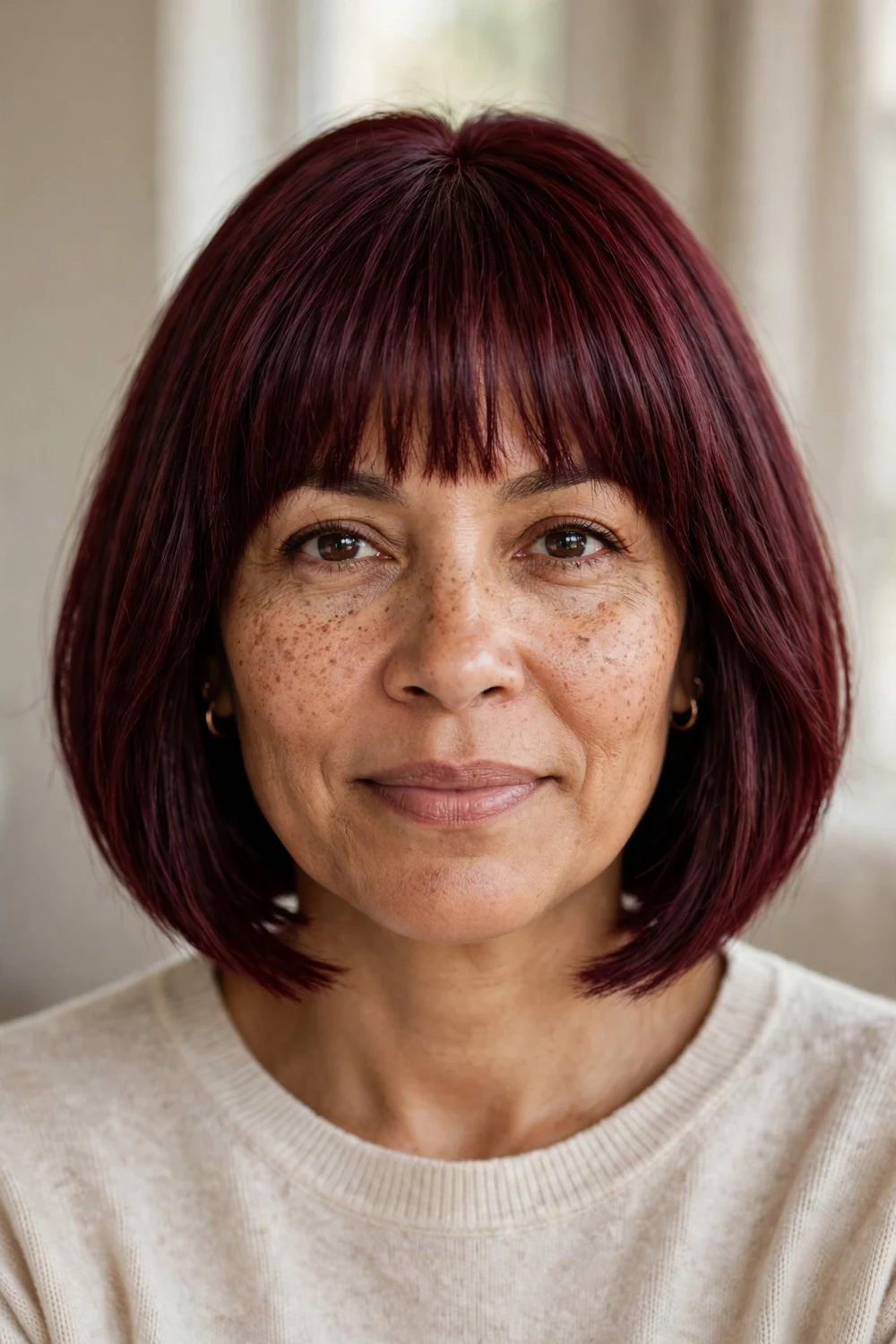
A full fringe pairs well with the A-line because the bangs fill in the top while the angle keeps the bottom interesting. The burgundy shade adds depth and richness, and the darker root to lighter end transition can make the hair look denser. This version suits oval faces well, since the fringe shortens the forehead and the angle lengthens the jaw. Straight hair shows both the fringe and the color at their best.
Try this: blow-dry bangs straight down with a flat brush, then tuck the sides behind the ears to show the angle. Difficulty: Medium. Trim: every 5 weeks. Color upkeep: every 8 weeks.
10. Brunette A-Line Bob with Warm Highlights
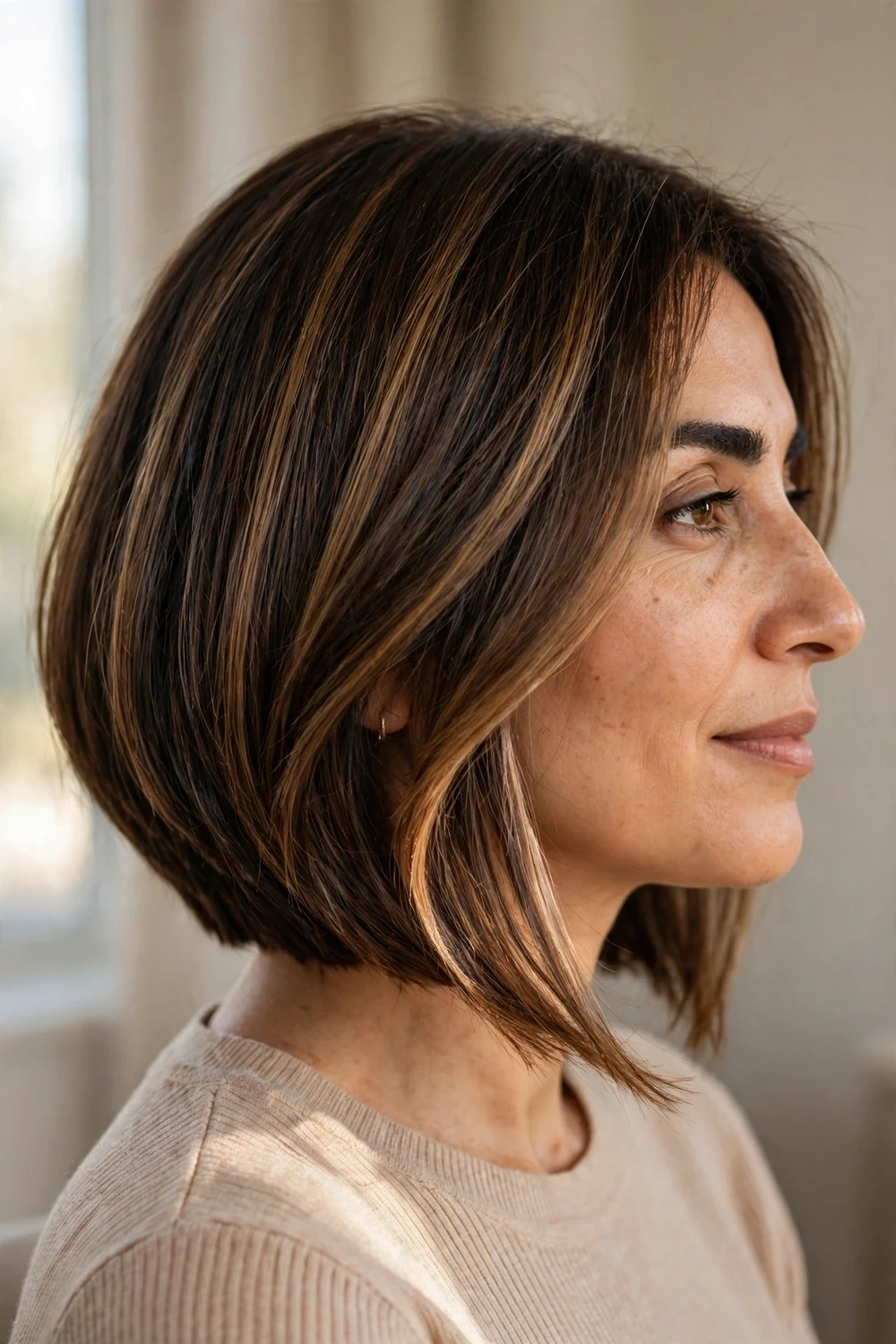
Warm highlights on a brunette base give the A-line softness and movement. The lighter ribbons follow the diagonal and add depth without a harsh contrast. This is a low-drama color choice that still makes the cut look considered. Medium-density straight to wavy hair carries this combination well. The warm tones flatter medium and olive skin. Grow-out is gentle, which makes it practical for people who do not want frequent salon color.
Try this: style with loose bends through the mid-lengths to show off the highlight placement. Difficulty: Easy. Trim: every 7 weeks. Color upkeep: every 10 to 12 weeks.
11. Jet-Black A-Line Bob

True black makes the A-line’s geometry impossible to miss. The dark, reflective color sharpens the diagonal line and gives the cut a bold, graphic quality. It suits strong personal style and works on straight hair best, where the color looks deepest. Layers can be added to keep heavy hair from looking flat, but the perimeter should stay clean. The contrast against the skin makes the jawline look more defined, which is part of the appeal.
Try this: smooth a drop of hair oil through the front pieces for extra shine and definition. Difficulty: Easy. Trim: every 6 weeks.
If the precision of a dark, sharp cut appeals to you, the guide to inverted bob hairstyles covers angled cuts with stacked backs in more detail.
12. Black A-Line Bob with Teal Highlights
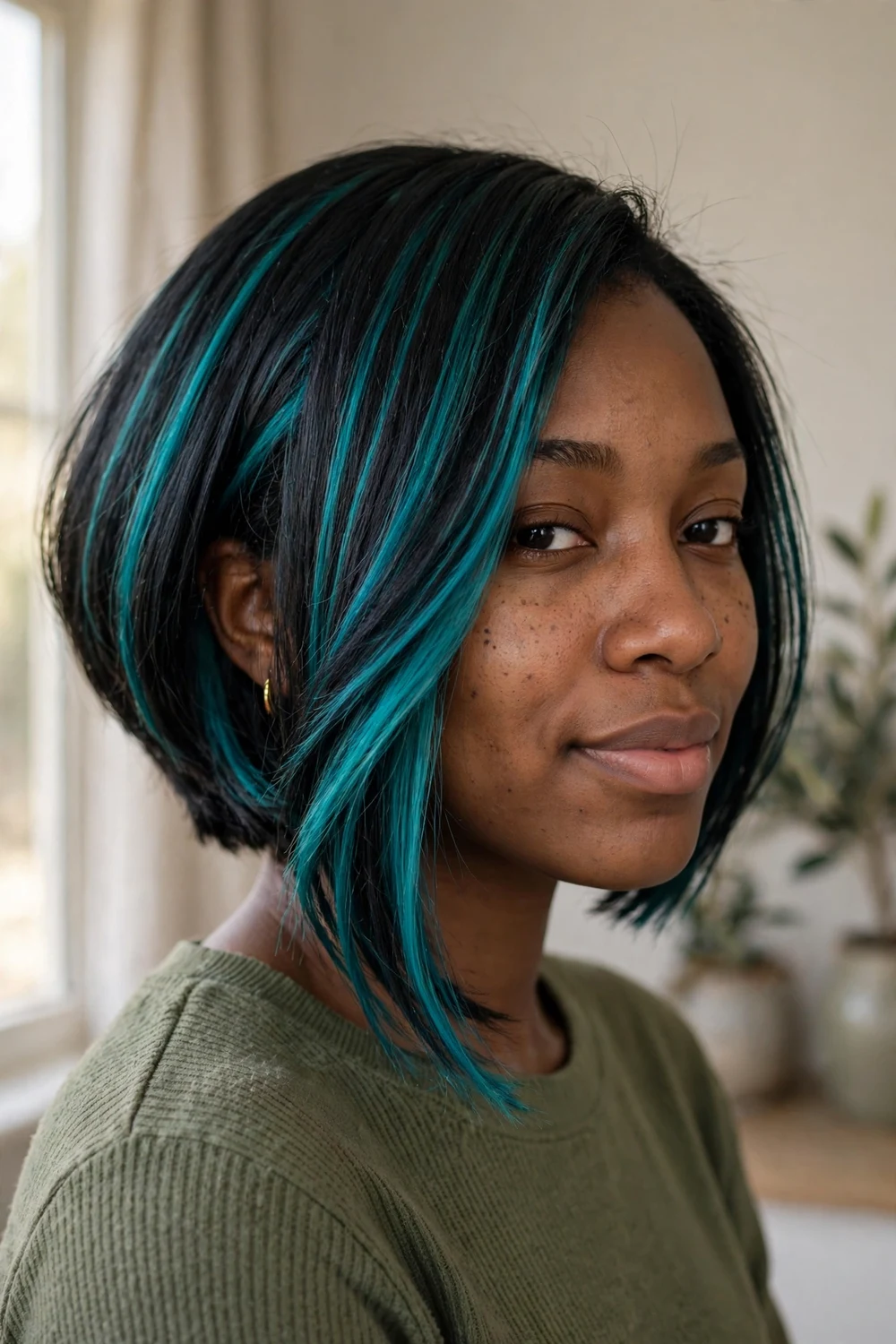
Teal highlights on a black base turn the A-line into a statement. The vivid streaks follow the forward pieces and draw attention along the angle. This is a high-commitment color that needs a stylist experienced with vivid dyes, since the base must be lifted carefully to hold the teal. Straight or slightly wavy hair shows the color placement best. Plan for regular salon visits because vivid shades fade faster than natural colors.
Try this: wash with cool water and a sulfate-free shampoo to slow fading of the teal. Difficulty: Medium. Trim: every 6 weeks. Color upkeep: every 5 to 6 weeks.
13. Curly A-Line Bob

An A-line works on curls when it is cut dry, so the stylist can see exactly where each curl lands. The back is kept shorter and the front longer, which lets the curl pattern shape the angle naturally. Curl cream and a diffuser keep the definition clean without frizz. This version suits 2C to 3B curl types that have enough length to show the forward slope. The result is soft and rounded rather than sharp, but the A-line shape is still clear.
Try this: scrunch curl cream into soaking-wet hair and diffuse on low heat for the most defined shape. Difficulty: Medium. Trim: every 8 weeks.
14. Beachy Wavy A-Line Bob

Loose waves relax the A-line into an easy, casual cut. The waves are bent through the mid-lengths with a curling iron or braids left overnight, then brushed out for softness. The angle is still visible but feels less severe. This is a good choice for medium-density wavy hair and for anyone who wants the A-line shape without daily flat-ironing. A sea salt spray adds grit and separation to the waves.
Try this: braid damp hair into two loose braids before bed and unravel in the morning for heat-free waves. Difficulty: Easy. Trim: every 7 weeks.
15. A-Line Lob

The A-line lob stretches the same idea to collarbone length. The back sits just above the shoulders while the front grazes the collarbone, so the angle is gentler but still clear. Longer length means more styling options: it can be worn straight, waved, or pulled into a low ponytail. It suits people growing out a shorter bob or anyone who wants the A-line shape with more versatility. All hair textures can wear this length.
Try this: bend the front pieces under with a large round brush to emphasize the forward length. Difficulty: Easy. Trim: every 8 weeks.
Readers who like longer bob lengths will also want to see long bob hairstyles, which covers more ways to wear extra length.
16. Graduated A-Line Bob with Bangs

This version combines a graduated back with a soft fringe, which gives height at the crown and fullness through the top. The graduation is horizontal rather than stacked, so the back stays smooth while the crown gets lift. Bangs can be blunt or wispy depending on the face shape. The fringe draws attention to the eyes, and the angle keeps the jawline defined. It is a good pick for fine hair that needs the illusion of volume.
Try this: lift the crown with a round brush while blow-drying to build the graduated fullness. Difficulty: Medium. Trim: every 6 weeks.
17. A-Line Bob for Women Over 50

The A-line is a strong choice after 50 because the forward pieces frame the face and draw the eye to the cheekbones. A softer angle works best here: the diagonal should be clear but not extreme. Face-framing layers around the front keep the look current instead of severe. This cut suits fine to medium hair and looks good with natural gray or blended color. It is polished without looking overdone, which is the balance most people want.
Try this: ask for a soft, blended angle rather than a sharp one for the most flattering effect. Difficulty: Easy. Trim: every 6 weeks.
18. Salt and Pepper A-Line Bob
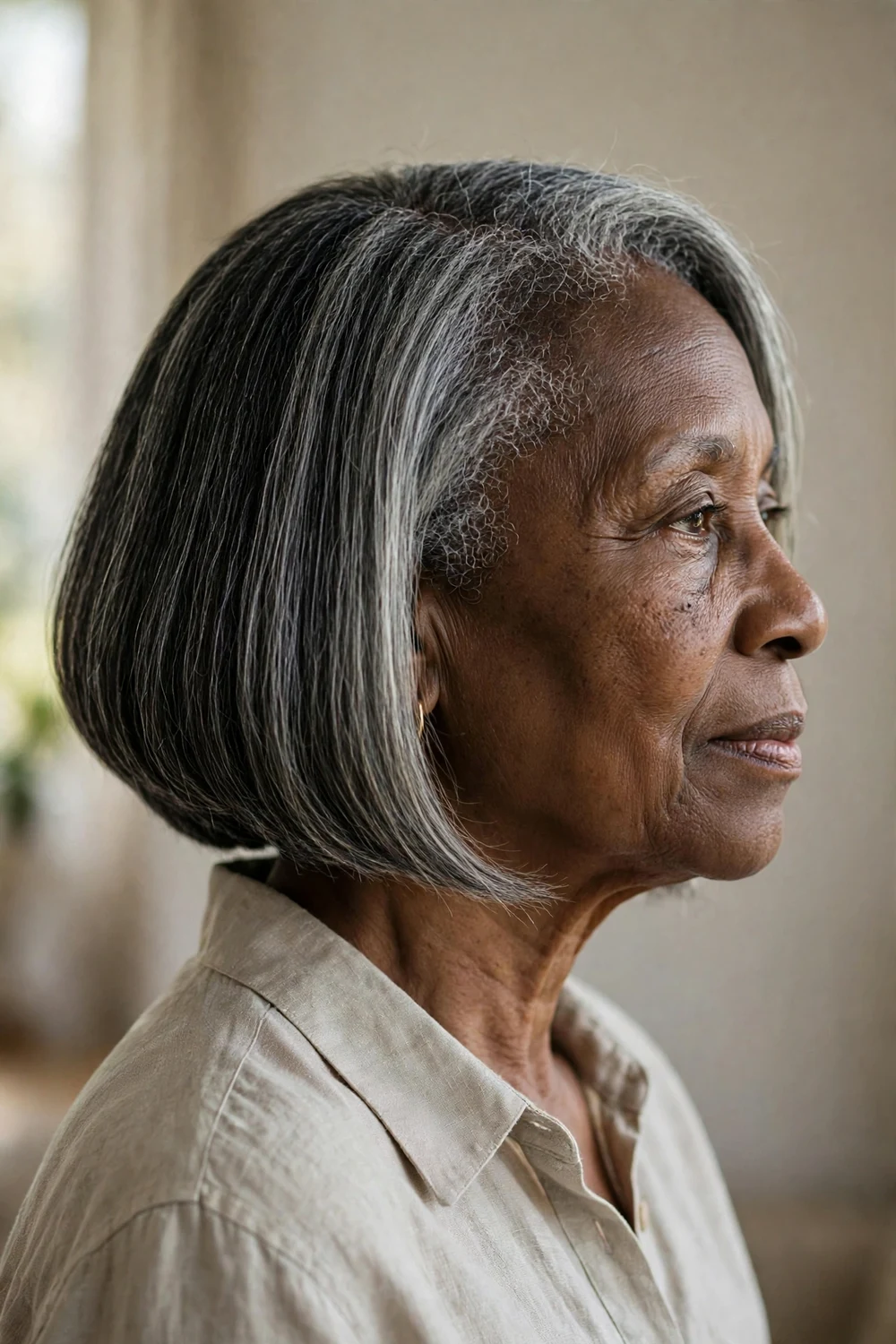
Natural gray grows into an A-line well because the cut is short enough to show the color transition cleanly. The blend of dark and silver strands adds dimension along the angle without any dye. This version suits people transitioning to gray who want a cut that looks intentional. The A-line shape keeps the grow-out looking neat as the color changes. A purple shampoo once a week keeps the silver tones bright instead of yellow.
Try this: add a small undercut at the nape for extra lift if the hair is fine. Difficulty: Easy. Trim: every 6 weeks.
19. Short A-Line Bob with Undercut
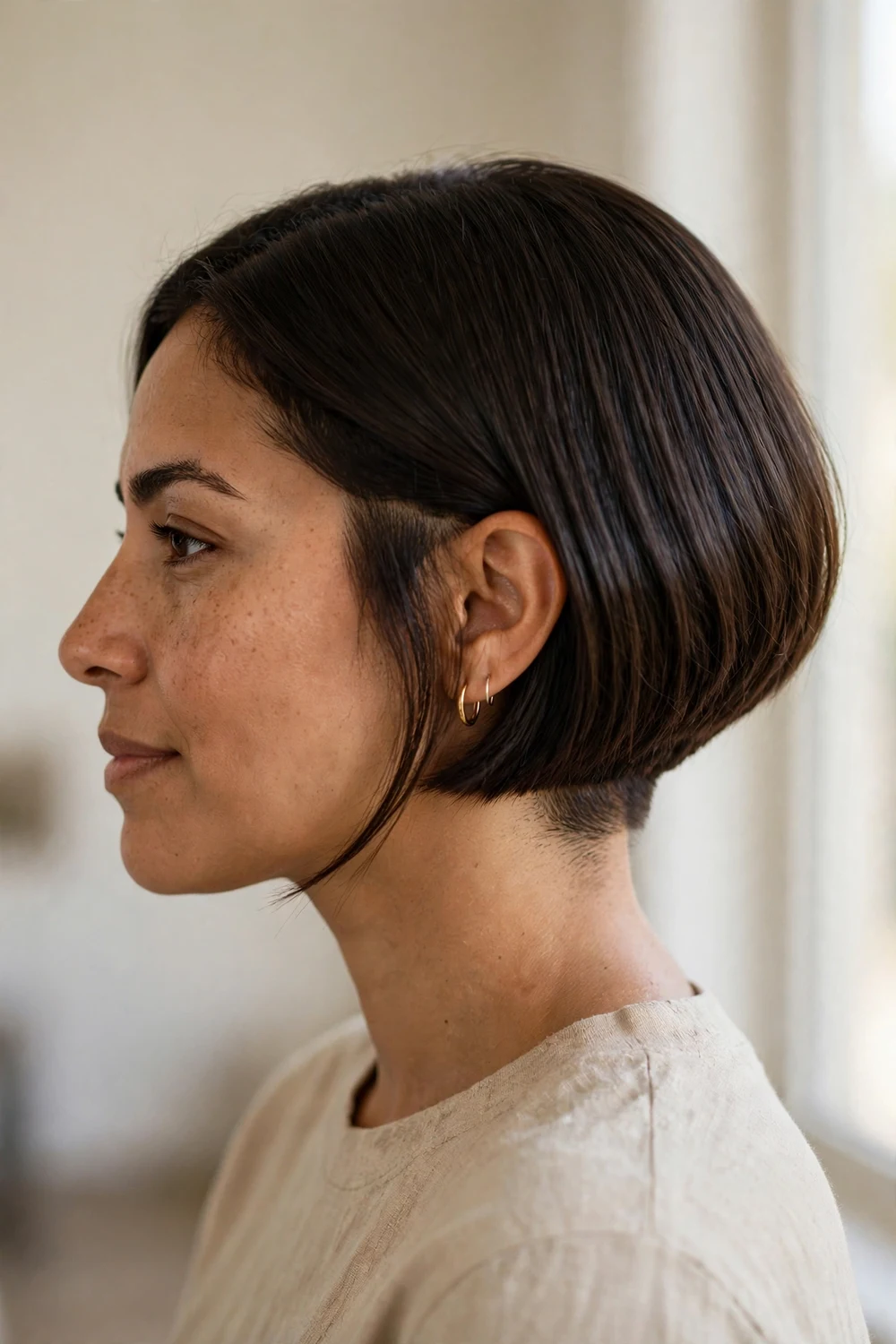
An undercut removes bulk from underneath the A-line, which makes thick hair far easier to manage. The nape is clipped short while the top keeps its length, so the outside still reads as a classic A-line. The undercut also makes the back lie flatter and dry faster. This is a practical choice for dense, straight hair that fights the shape. The undercut stays hidden unless the hair is lifted, so it works in conservative settings too.
Try this: ask for the undercut to stop at the occipital bone so it stays concealed under the top layer. Difficulty: Medium. Trim: every 5 weeks.
20. Purple A-Line Bob
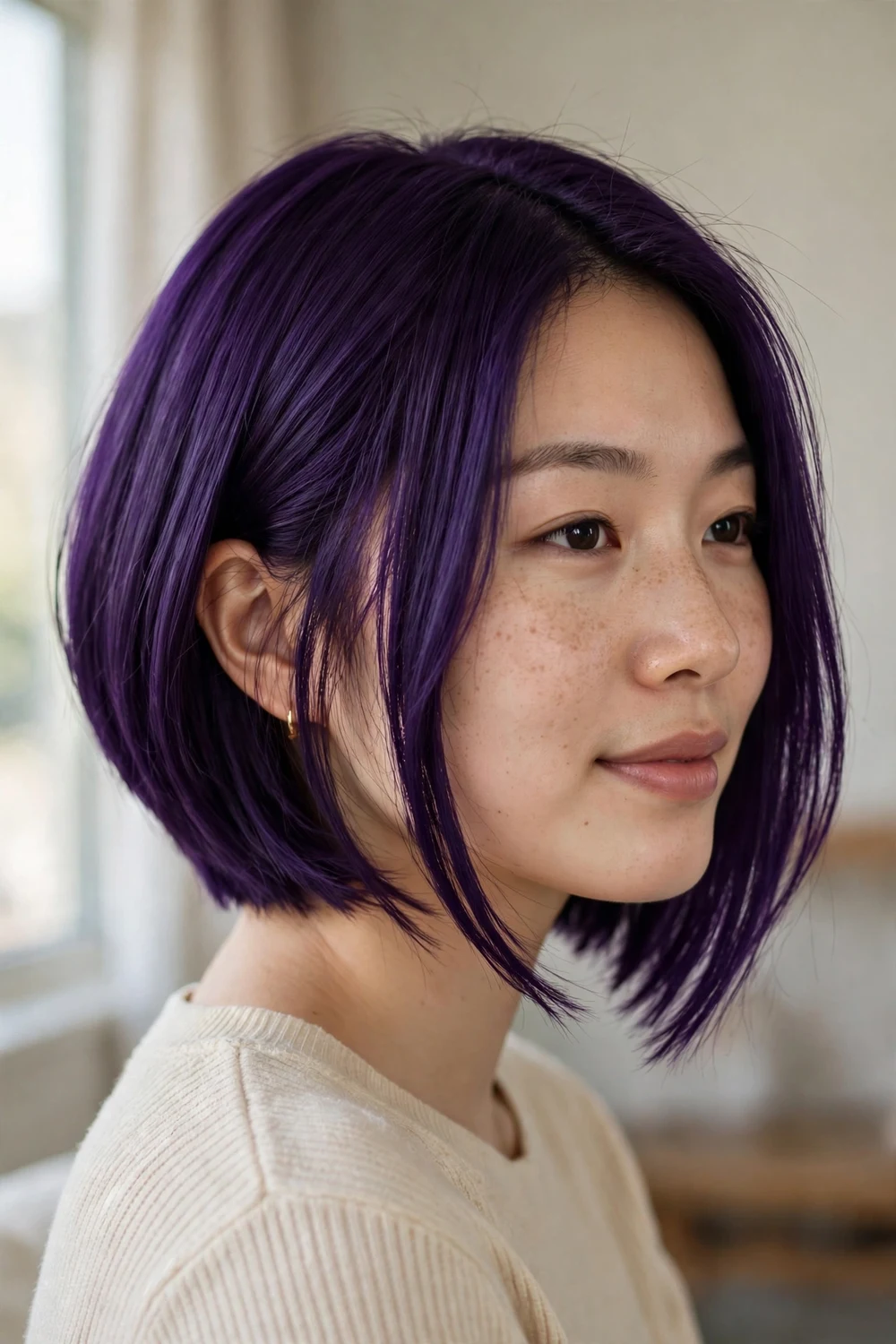
Purple gives the A-line an edgy, modern feel. The color can go deep and muted for a subtle effect or bright and vivid for a bold one. On straight hair, the shade makes the angle look even sharper. Purple suits cool skin tones best and needs regular refreshing because fashion colors fade. A color-depositing mask between salon visits keeps the tone from washing out. The cut itself stays classic, so the color carries the personality.
Try this: choose a deep violet rather than a bright purple if you want the color to last longer between appointments. Difficulty: Easy. Trim: every 6 weeks. Color upkeep: every 5 to 6 weeks.
For more guidance on textured angled cuts, the article on choppy bob hairstyles breaks down point-cutting and razor techniques in detail.
21. Cobalt Blue A-Line Bob

Cobalt blue is one of the boldest colors you can pair with an A-line. The saturated blue makes the diagonal line pop and turns the cut into a focal point. It works best on pre-lightened hair, so the color process is the commitment here, not the cut. Straight, fine to medium hair holds the sharp line and the color best. Oval and heart-shaped faces carry this look well. Expect salon visits every few weeks to keep the blue vivid.
Try this: sleep on a silk pillowcase to reduce friction that fades vivid color. Difficulty: Medium. Trim: every 6 weeks. Color upkeep: every 4 to 5 weeks.
22. Pastel Candy A-Line Bob

Pastel shades like lavender, pink, and mint soften the A-line’s sharp geometry. The playful color contrasts with the precise cut in a way that feels fresh and current. Pastels need very light hair underneath, so this is a bigger color commitment than it looks. The A-line shape itself keeps the style grounded so the color does not read childish. A color-safe shampoo and limited heat styling keep pastels from fading in a week.
Try this: rinse with the coolest water you can stand to lock pastel tones in longer. Difficulty: Medium. Trim: every 6 weeks. Color upkeep: every 4 weeks.
23. Dramatic Steep-Angle A-Line Bob
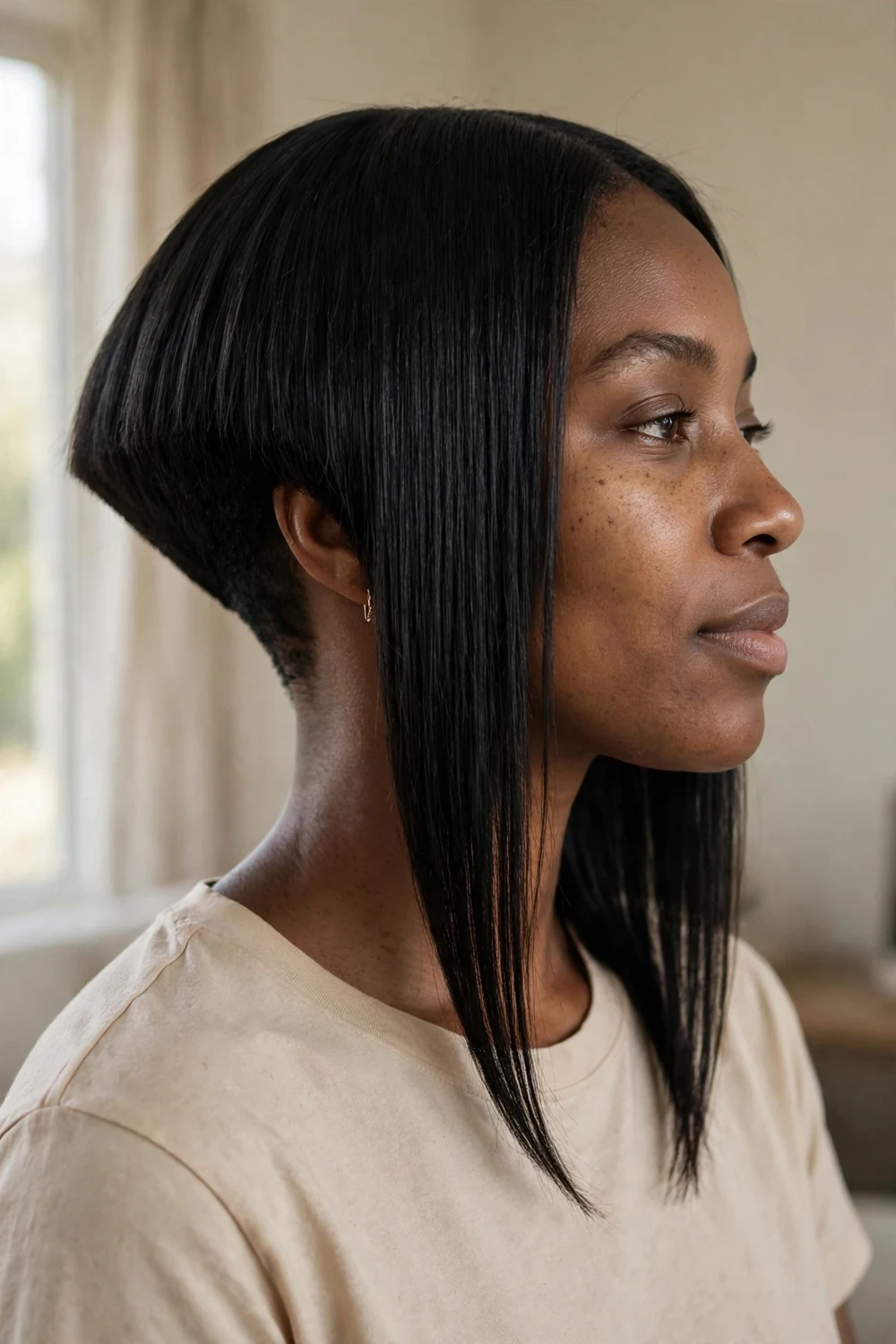
A steep angle means the back sits high at the nape while the front drops several inches lower. This is the boldest version of the A-line and it makes a strong statement. The contrast between back and front creates real drama, and the long front pieces elongate the face. It needs a confident wearer and a stylist who can cut a clean, even diagonal. Fine to medium hair shows the angle best; very thick hair can make it look bulky at the back.
Try this: keep the back smooth and tucked to show the full drop of the angle. Difficulty: Medium. Trim: every 5 weeks.
24. Soft Minimal-Angle A-Line Bob

A minimal angle is barely there: the front is only slightly longer than the back. This version suits people who want the A-line idea without the drama. The subtle diagonal still slims the face and adds shape, but it reads as a classic bob from most angles. It grows out gracefully, which makes it the lowest-maintenance A-line on this list. Fine hair benefits because the nearly even ends look thick. It is also the easiest version to style every day.
Try this: wear it with a center part for a clean, modern look that suits oval faces. Difficulty: Easy. Trim: every 8 weeks.
25. Asymmetrical A-Line Bob

Asymmetry takes the A-line further: one side is cut noticeably longer than the other. The imbalance creates movement and draws the eye diagonally across the face. It suits people who like their haircut to have an edge and works on straight hair where the length difference is clear. Round faces benefit because the asymmetry breaks up the symmetry of the face. Make sure your stylist knows which side you part on so the longer side falls naturally.
Try this: tuck the shorter side behind the ear to emphasize the length difference. Difficulty: Medium. Trim: every 5 to 6 weeks.
If you like cuts with extra fullness at the back, stacked bob hairstyles for fine hair explains how graduated layers build volume.
26. Side-Swept A-Line Bob
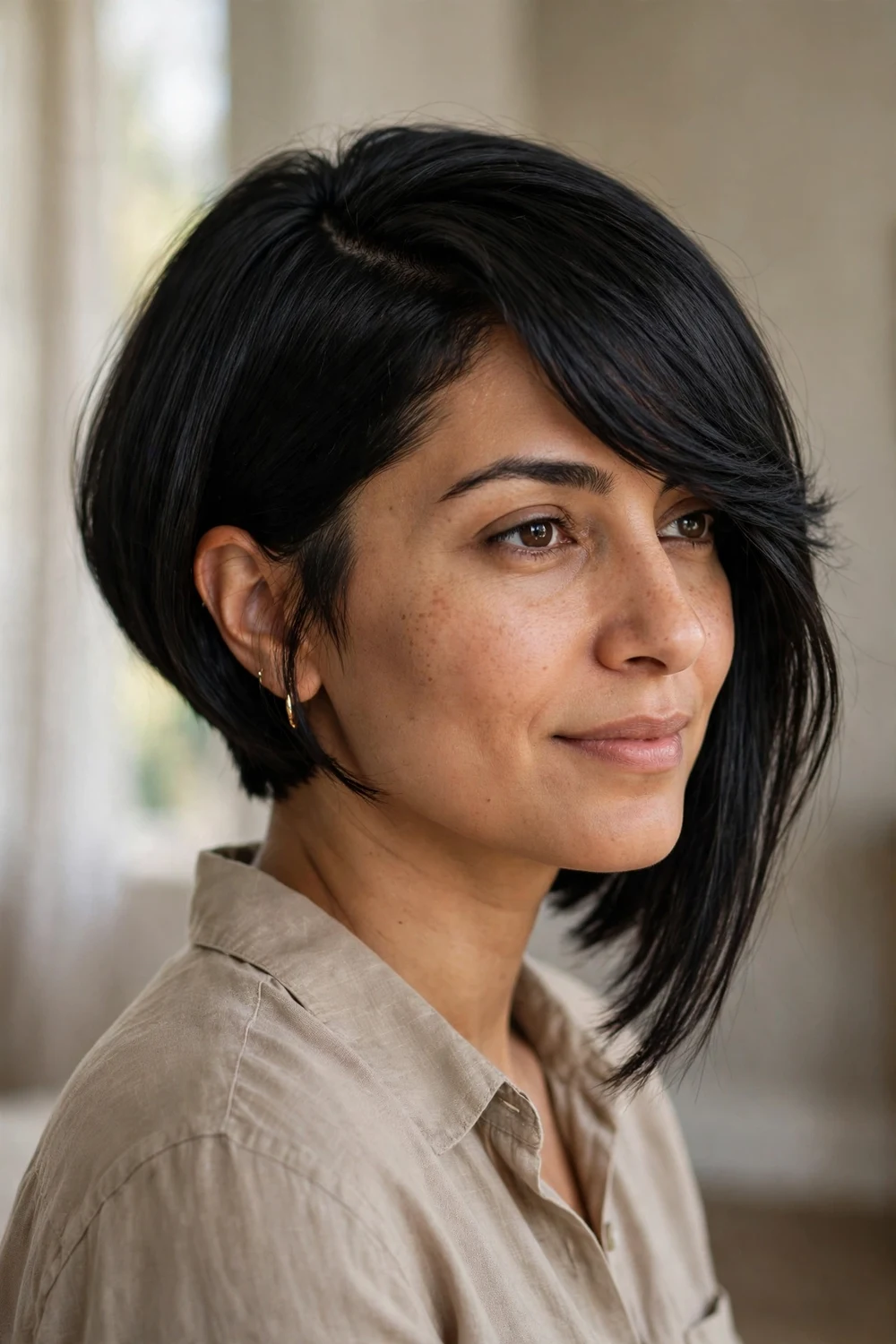
A deep side part changes the whole feel of the A-line. The hair sweeps across the forehead in a diagonal that echoes the cut’s angle, which doubles the slimming effect. This version suits round and square faces especially well. The side sweep adds volume at the roots on the heavier side, so fine hair looks fuller. It is easy to style: part deep while damp, blow-dry the front to the side, and the shape falls into place.
Try this: use a tail comb to set a clean deep part while the hair is still damp. Difficulty: Easy. Trim: every 6 weeks.
27. Middle-Part A-Line Bob

A center part gives the A-line symmetry and a clean, editorial feel. The hair falls evenly on both sides, which shows off the angle from the front. This version suits oval faces best, since the symmetry mirrors the face shape. Straight, smooth styling matters a lot here; frizz or uneven texture breaks the clean line. It reads modern and minimal, and it pairs well with simple, polished outfits. A light-hold serum keeps both sides lying flat without stiffness.
Try this: flat-iron in small sections from the part outward for a perfectly even finish. Difficulty: Medium. Trim: every 6 weeks.
28. Rounded Glossy A-Line Bob

This version softens the A-line into a rounded shape with a high-gloss finish. The outline curves instead of cutting straight, which makes it gentler on the face. Multi-tonal color adds depth and richness that flat color cannot. It suits fine hair that needs the illusion of fullness, since the rounded silhouette looks denser. The gloss comes from shine-enhancing products and smooth blow-drying with a round brush. Regular glossing treatments keep the reflective finish strong between salon visits.
Try this: curve the ends under with a large round brush to build the rounded shape. Difficulty: Medium. Trim: every 6 weeks.
29. Sheared A-Line Bob
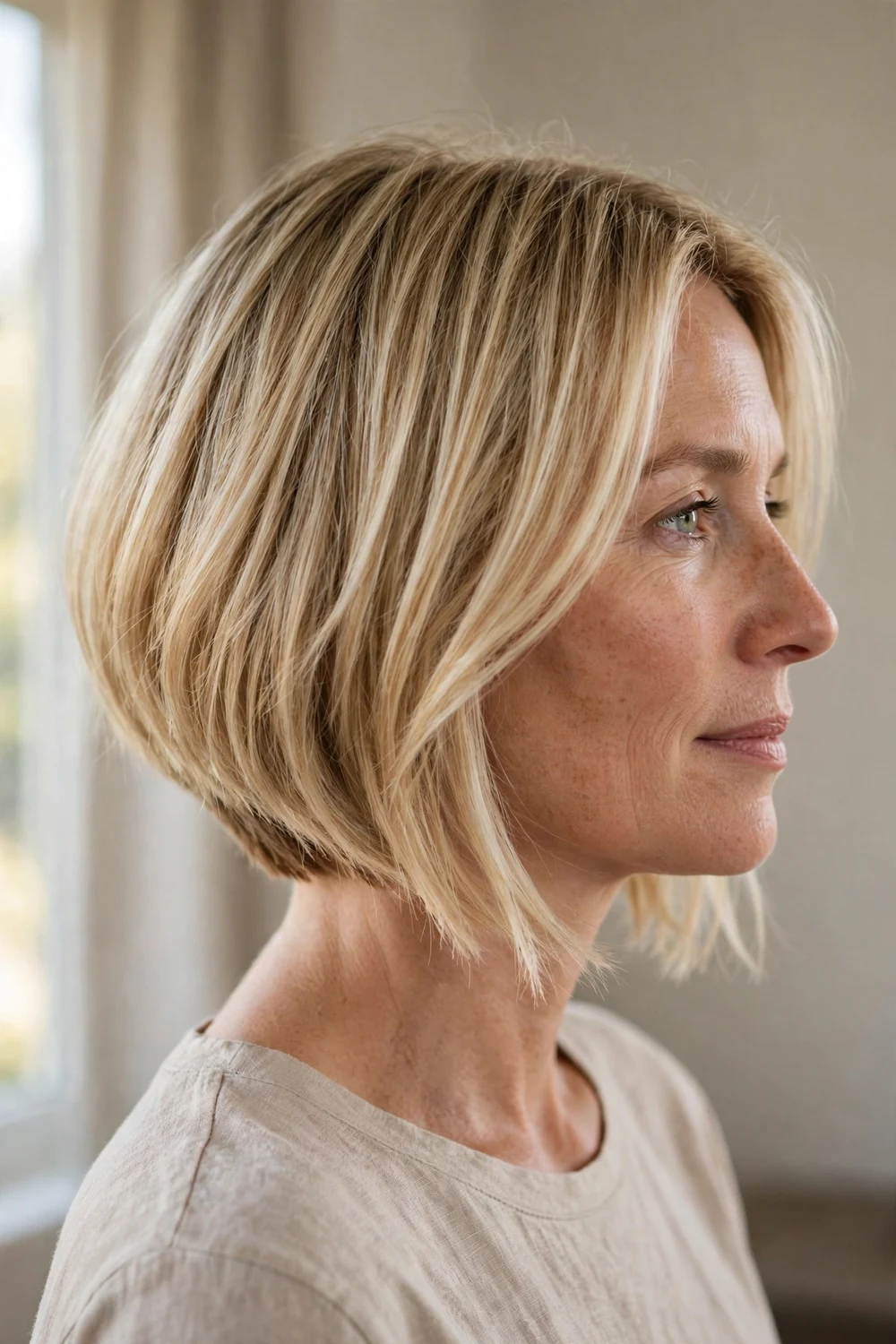
A sheared A-line is cut with shears or a razor for a shattered, feathered edge instead of a blunt one. The technique softens the perimeter and gives the cut a lighter, more casual feel. It accentuates the jawline because the feathered ends sit right along it. This version suits straight to slightly wavy hair and works when a blunt line feels too severe. The grow-out is softer than a blunt cut, so trims can stretch a little longer.
Try this: ask for razor cutting at the ends only, keeping the interior solid so the shape holds. Difficulty: Easy. Trim: every 7 weeks.
30. Pixie-Blended A-Line Bob
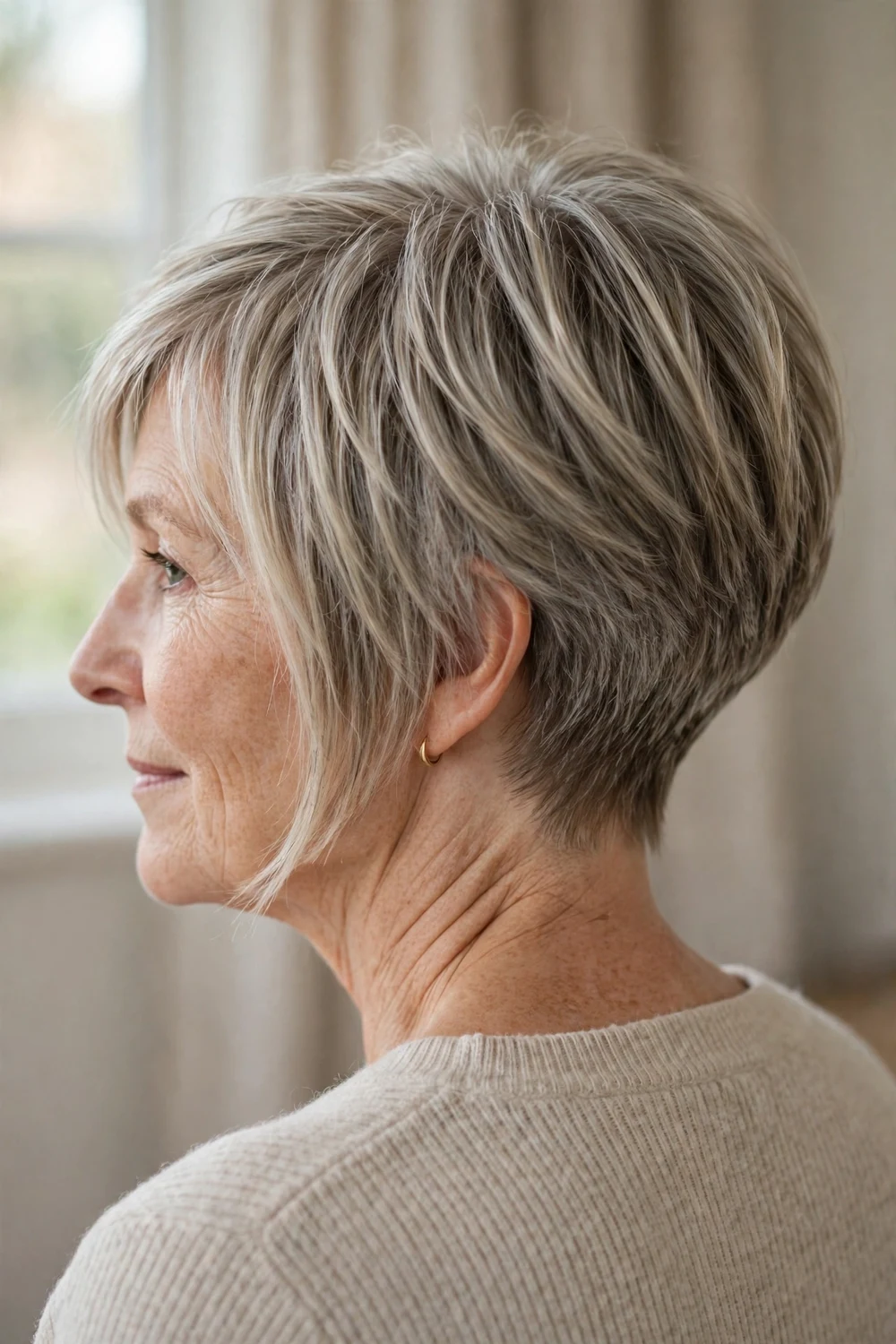
This cut blends a pixie-like short back with A-line length in the front. The nape is tapered close like a pixie while the front keeps bob length, which creates a striking contrast. It suits fine to medium hair and adds lift at the crown. Mature faces carry this well because the short back feels fresh while the longer front stays feminine. It needs regular trims to keep the tapered back neat, but daily styling is quick.
Try this: work a light mousse through the crown before blow-drying for lift that lasts. Difficulty: Medium. Trim: every 5 weeks.
Layered texture is a big part of this look, and layered bob hairstyles covers more ways to add movement to a bob.
A Line Bob Haircuts Comparison at a Glance
| Style | Best For | Difficulty | Trim Schedule |
|---|---|---|---|
| Signature Classic A-Line | Oval, round, square faces | Easy | Every 6 weeks |
| Blunt-Edge A-Line | Fine hair needing fullness | Easy | Every 6 weeks |
| Layered A-Line | Thick hair needing movement | Easy | Every 7 weeks |
| Stacked A-Line | Fine to medium hair, volume seekers | Medium | Every 5 to 6 weeks |
| Choppy Textured A-Line | Fine hair, casual styling | Easy | Every 7 weeks |
| Sleek Glassy A-Line | Straight, healthy hair | Medium | Every 6 weeks |
| Blonde Highlighted A-Line | Adding dimension to any texture | Easy | Every 6 weeks |
| Copper A-Line | Fair to medium skin tones | Easy | Every 6 weeks |
| Burgundy A-Line with Bangs | Oval faces, fringe lovers | Medium | Every 5 weeks |
| Brunette A-Line, Warm Highlights | Medium and olive skin | Easy | Every 7 weeks |
| Jet-Black A-Line | Bold, graphic styling | Easy | Every 6 weeks |
| Black A-Line, Teal Highlights | Statement color lovers | Medium | Every 6 weeks |
| Curly A-Line | 2C to 3B curl patterns | Medium | Every 8 weeks |
| Beachy Wavy A-Line | Wavy hair, low effort | Easy | Every 7 weeks |
| A-Line Lob | Growing out, styling variety | Easy | Every 8 weeks |
| Graduated A-Line with Bangs | Fine hair needing lift | Medium | Every 6 weeks |
| A-Line for Women Over 50 | Soft, flattering framing | Easy | Every 6 weeks |
| Salt and Pepper A-Line | Gray transition | Easy | Every 6 weeks |
| Short A-Line with Undercut | Very thick hair | Medium | Every 5 weeks |
| Purple A-Line | Cool skin tones, edge | Easy | Every 6 weeks |
| Cobalt Blue A-Line | Maximum statement | Medium | Every 6 weeks |
| Pastel Candy A-Line | Playful color, light hair | Medium | Every 6 weeks |
| Dramatic Steep-Angle A-Line | Bold wearers, fine to medium hair | Medium | Every 5 weeks |
| Soft Minimal-Angle A-Line | Subtle change, easy grow-out | Easy | Every 8 weeks |
| Asymmetrical A-Line | Round faces, edgy style | Medium | Every 5 to 6 weeks |
| Side-Swept A-Line | Round and square faces | Easy | Every 6 weeks |
| Middle-Part A-Line | Oval faces, minimal style | Medium | Every 6 weeks |
| Rounded Glossy A-Line | Fine hair needing density | Easy | Every 6 weeks |
| Sheared A-Line | Softer edge preference | Easy | Every 7 weeks |
| Pixie-Blended A-Line | Fine to medium hair, lift | Medium | Every 5 weeks |
How to Choose the Right A Line Bob for You
Start with your hair texture. Fine hair does best with blunt, stacked, or minimal-angle versions that keep the ends dense. Thick hair needs layers, an undercut, or a sheared edge to remove bulk. Curly and wavy hair suit the softer versions: beachy waves, the lob length, or a curly cut done dry.
Next, pick your angle. A steep angle makes a statement and elongates the face. A soft angle is easier to grow out and suits conservative settings. If you are unsure, start subtle. Your stylist can always take more off the back at your next visit.
Think about color honestly. Vivid shades like cobalt, teal, and pastel need frequent salon visits and careful home care. If you want low upkeep, stick with your natural color plus subtle highlights or a single-process shade close to your base.
Bring reference photos to your appointment. Show your stylist both the angle you want and the length of the front pieces. Mention your daily styling routine too, because the best A-line is one you will actually style. A cut that needs 20 minutes of flat-ironing is the wrong choice if you have 5 minutes in the morning.
Mistakes to Avoid
The most common mistake is cutting the angle too steep for the hair type. Very thick hair with an extreme angle can look bulky at the back instead of sleek. Layers or an undercut fix this, but it is better to discuss it before the cut.
Skipping trims ruins the shape faster than with most cuts. The nape grows out and the angle disappears, which leaves an uneven bob instead of an A-line. Book your next trim before you leave the salon.
Another mistake is styling against the cut. An A-line wants smooth, directional styling that follows the diagonal. Scrunching it randomly or letting it air-dry into frizz hides the line you paid for. Even five minutes with a round brush makes a difference.
Do not add heavy layers to a blunt A-line meant for fine hair. The whole point of the blunt version is density at the ends. Layers thin the ends out and undo the effect. Keep layers for the thick-hair versions where they belong.
Frequently Asked Questions
What is an A-line bob haircut?
An A-line bob is cut shorter in the back and longer in the front, so the outline forms the shape of the letter A. The perimeter is usually blunt and precise, with no stacking required. The angle can be subtle or dramatic depending on preference.
What is the difference between an A-line bob and an inverted bob?
An A-line bob is defined by its diagonal outline from a shorter back to a longer front, usually with a clean perimeter. An inverted bob uses stacked, graduated layers in the back to build a rounded, voluminous shape. The two overlap, but the inverted version emphasizes back volume while the A-line emphasizes the angle itself.
Does an A-line bob suit round faces?
Yes. The forward angle creates a diagonal line that makes round faces look slimmer and longer. Side parts and side-swept styling increase the effect. Avoid a rounded, chin-length version with the same length all around, since that mirrors the face shape instead of reshaping it.
How often should I trim an A-line bob?
Every 6 to 8 weeks is the standard. The nape grows out faster than the front, so the angle fades if you wait too long. Stacked and undercut versions need trims closer to every 5 weeks, while minimal-angle versions can stretch to 8.
Can I get an A-line bob with curly hair?
Yes, but it should be cut dry so the stylist can account for shrinkage. Curly A-line bobs are typically worn at a slightly longer length so the forward slope shows. Use curl cream and a diffuser to keep the definition clean, and find a stylist experienced with curly cutting.
Final Thoughts
The A-line bob has lasted this long because it adapts. Change the angle, change the color, change the texture, and it becomes a different cut for a different person. Pick the version that matches your hair and your mornings, find a stylist who cuts a clean diagonal, and keep up with trims. The cut does the rest.

