


Long hair with a fringe is really two decisions: the layer pattern through the length, and the bang shape at the front. When the two are cut to match, the fringe flows into the first layer and the whole cut moves as one shape. When they are cut apart, the bangs can look pasted on.
This guide gathers 25 long layered hairstyles with bangs, organized by layer pattern first: U-cuts, V-cuts, cascade, feathered, butterfly, shag, and two-tier layers, each paired with the fringe that suits it. If you want the wider fringe roundup without the layer focus, start with the guide to long hair bangs and come back here for the layer pairings.
Key Takeaways
- Choose the layer pattern first, then match the fringe weight to it: light layers take wispy bangs, sleek layers take blunt or rounded bangs.
- Curtain bangs blend into face-framing layers most easily and grow out into the layers.
- Fine hair keeps its fullness when layers start below the chin and ends stay blunt.
- Thick hair needs internal layering through the back, where the weight sits.
- Bangs need a trim every three to four weeks; long layers hold for eight to ten weeks.
| Layer pattern | Pairs with | Best for | Daily styling time |
|---|---|---|---|
| Shaped hemlines, U-cut and V-cut (ideas 1, 2) | Curtain and blunt bangs | Full back outline, very long hair | 10 minutes |
| Face-framing and feathered (ideas 3, 4, 5, 21, 23) | Wispy, side-swept and curtain bangs | Movement around the face | 8 to 12 minutes |
| Textured, shag, choppy and two-tier (ideas 6, 7, 13, 19) | Piecey, bottleneck and choppy bangs | Thick hair, broken piecey finish | 7 to 10 minutes |
| Long and soft (ideas 8, 9, 15, 16, 17) | Arched, full, side and wispy bangs | Fine hair fullness, thick hair weight control | 8 to 11 minutes |
| Wavy, curly and blowout finishes (ideas 10, 11, 12, 14, 18, 20, 22, 24, 25) | Split, curly, rounded, baby and parted bangs | Natural texture and styled finishes | 8 to 15 minutes |
1. Long U-Cut Layers with Curtain Bangs
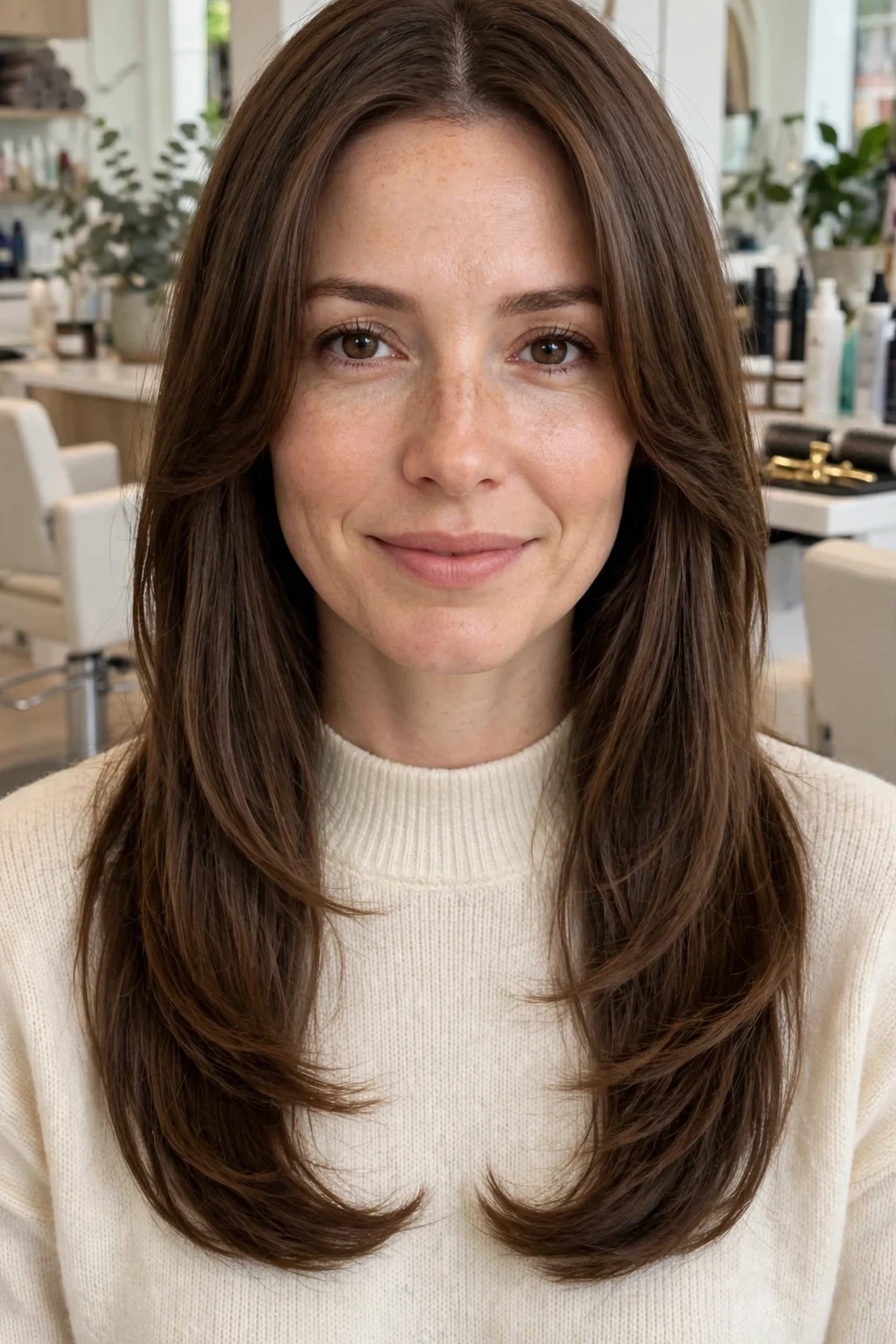
The U-cut curves the back hemline into a soft U while layers step down through the lengths, and curtain bangs part at the center and sweep to both sides. The curved hem keeps the back looking full while the front layers open around the face.
Ask for the shortest layer near the chin and the curtain pieces a touch longer, at cheekbone level. Trim the layers every eight to ten weeks and the curtain front every three weeks.
Try this: Dry the curtain pieces away from your face with a round brush, one side at a time. Let each side cool before touching it so the sweep holds.
Difficulty: Medium | Cost: $$ | Time: 10 minutes
2. Long V-Cut Layers with Blunt Straight Bangs

The V-cut points the back hemline into a V, which suits very long hair that feels heavy at one length. Blunt straight bangs give the long back a sharp, clear front to balance it.
This pairing works best on straight or smoothed hair with medium to thick density, since a blunt fringe needs weight to lie flat. Keep the point of the V soft rather than sharp, so the ends stay healthy.
Try this: Dry the bangs first with the nozzle pointing down and a paddle brush. A blunt fringe sets fast, so drying it first keeps the line straight.
Difficulty: Medium | Cost: $$ | Time: 10 minutes
3. Face-Framing Cascade Layers with Wispy See-Through Bangs
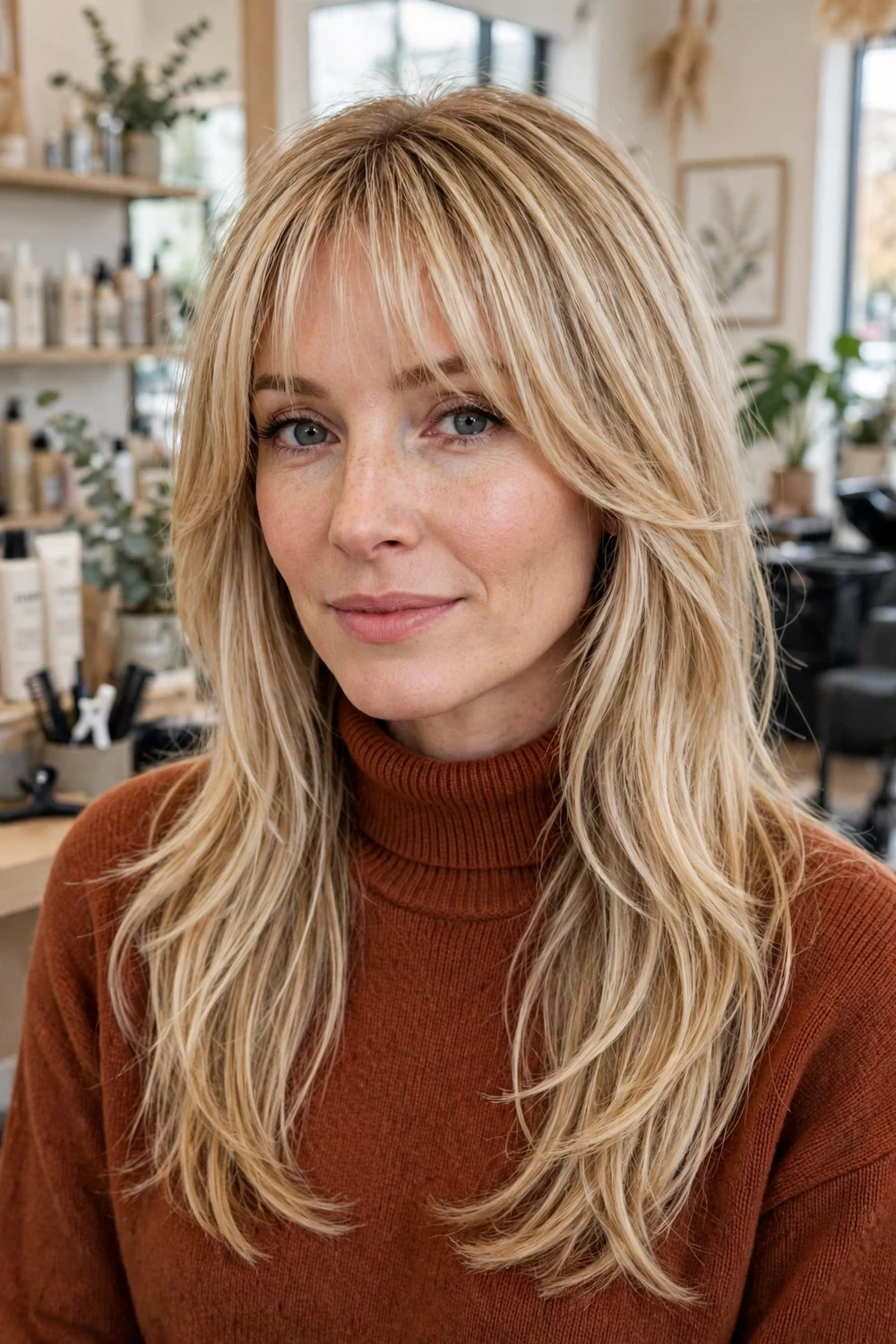
Cascade layers step down around the face in a waterfall pattern, each layer a little longer than the one above. Wispy see-through bangs match that lightness at the front, with small gaps that let the forehead show through.
This is a kind pairing for a first fringe, since the see-through cut is light and grows out without a hard line. Ask for the cascade to start at the cheekbones.
Try this: Scrunch a light mousse through the layers and dry the bangs with your fingers, side to side. Finger drying keeps see-through bangs airy rather than flat.
Difficulty: Easy | Cost: $ | Time: 8 minutes
4. Long Feathered Flip Layers with Side-Swept Bangs
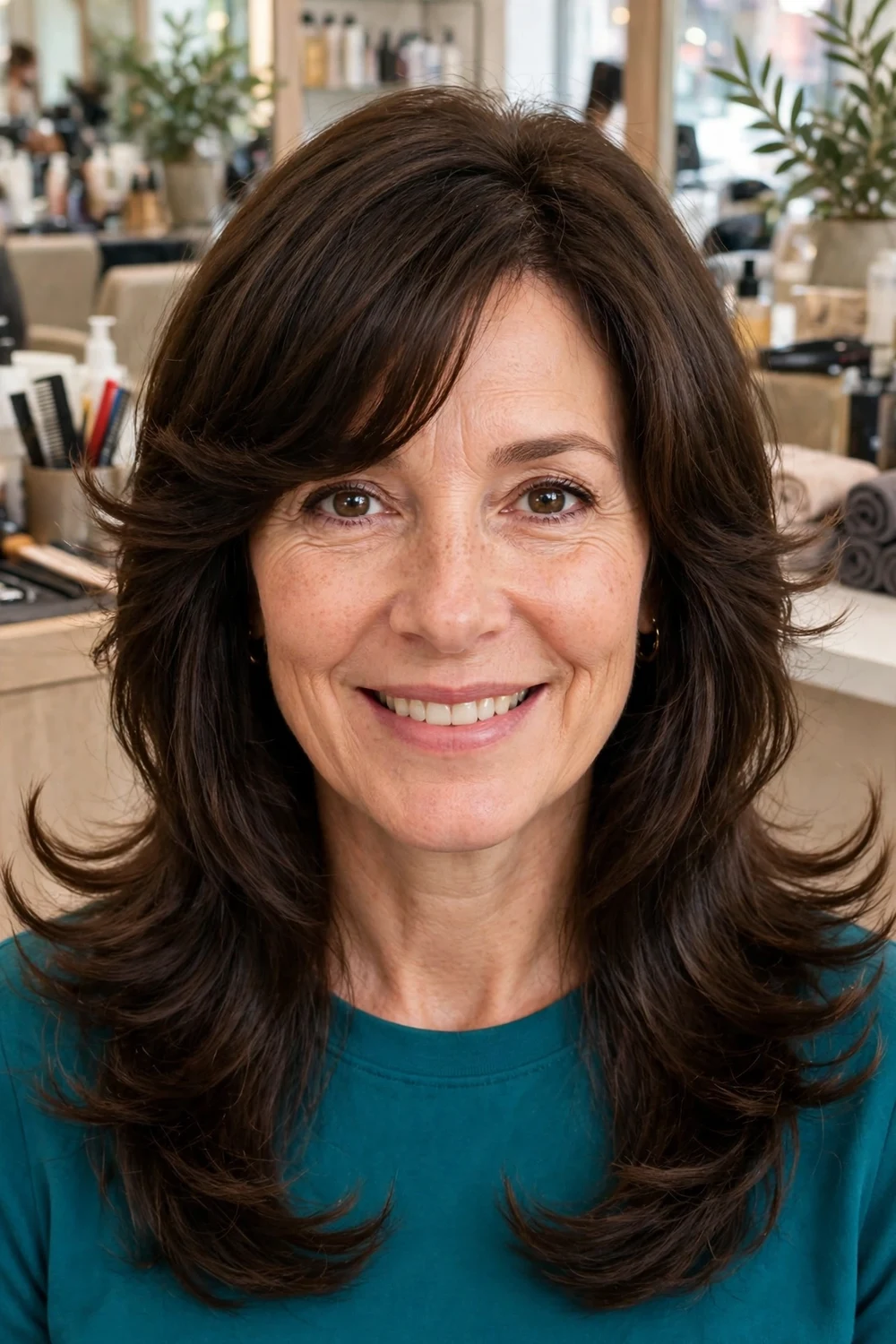
Feathered layers are cut to flick outward at the ends, and side-swept bangs continue that outward movement across the forehead. The whole cut has a blown-out, moving finish even before you style it.
Ask for feathering through the last few inches of each layer rather than through the full length, so the ends keep some weight. A round-brush blow-dry brings the flip out best.
Try this: Dry each layer turning the brush outward at the ends, and sweep the bangs in the same outward direction. Matching the direction is what makes the flip read as one shape.
Difficulty: Medium | Cost: $$ | Time: 12 minutes
5. Butterfly Layers with Long Curtain Bangs
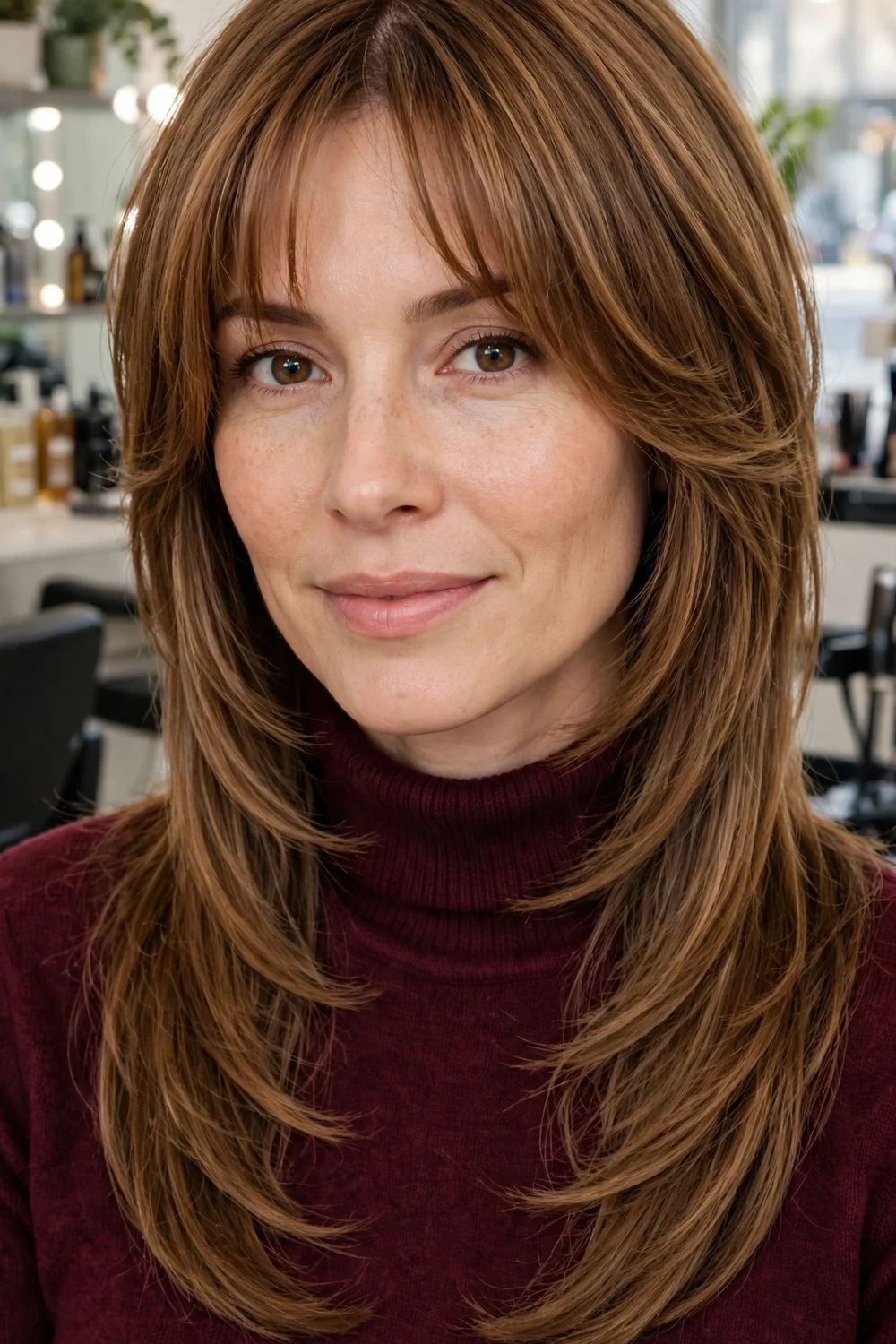
The butterfly cut pairs short layers around the crown and face with long layers through the back, so you get lift at the top and length at the bottom in one cut. Long curtain bangs blend straight into the short face layers.
The short top layers can also be pinned up while the back stays down, which gives a shorter look for a day without cutting your length. It suits oval, heart, and longer face shapes well.
Try this: Blow-dry the crown layers back and away from the face with a large round brush. The lifted crown is the signature of this cut, so spend your minutes there.
Difficulty: Medium | Cost: $$ | Time: 12 minutes
6. Long Choppy Shag Layers with Piecey Fringe

Choppy shag layers stack through the whole length with razored, broken ends, and a short piecey fringe keeps the front just as textured. The shape has movement at every level rather than only at the ends.
Thick hair carries a full shag well, while fine hair should ask for fewer, longer choppy layers so the ends stay full. Trim every eight weeks to keep the tiers clear.
Try this: Scrunch mousse into damp hair and diffuse or air-dry. A shag is meant to look a little undone, so skip careful smoothing.
Difficulty: Easy | Cost: $ | Time: 7 minutes
7. Two-Tier Long Layers with Bottleneck Bangs
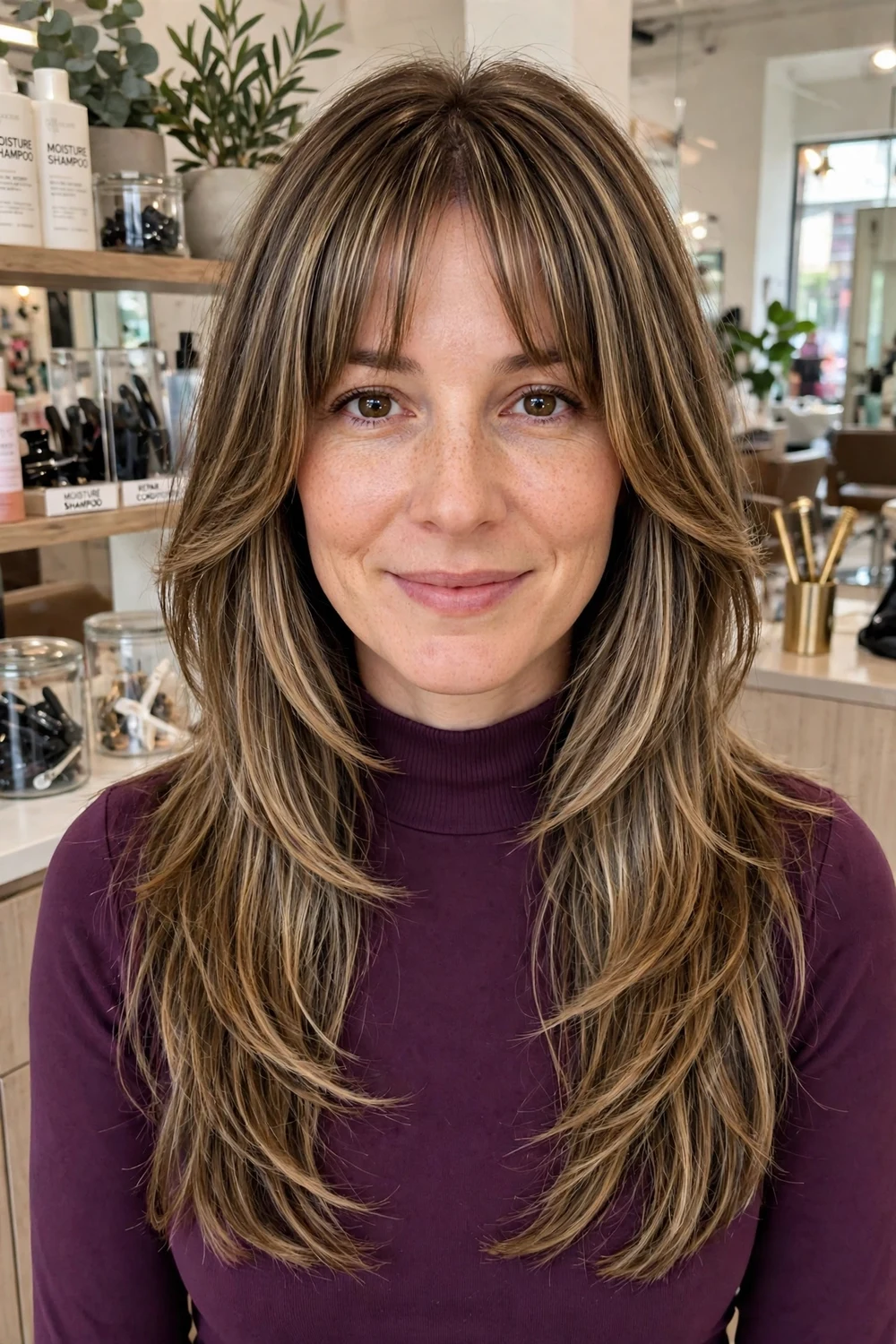
Two-tier layers split the length into two clear steps, a shorter tier around the shoulders and a longer tier below. Bottleneck bangs echo that shape, narrow at the top of the forehead and wider at the cheekbones.
The tier step shows best on straight and wavy hair worn at full length. Ask your stylist to soften the step with point cutting if you want the tiers blended rather than bold.
Try this: Dry the bottleneck bangs in three parts, center first, then each wide side section sweeping down. Drying in parts keeps the narrow-to-wide shape even.
Difficulty: Medium | Cost: $$ | Time: 10 minutes
8. Long Layers Starting Below the Chin with Arched Bangs
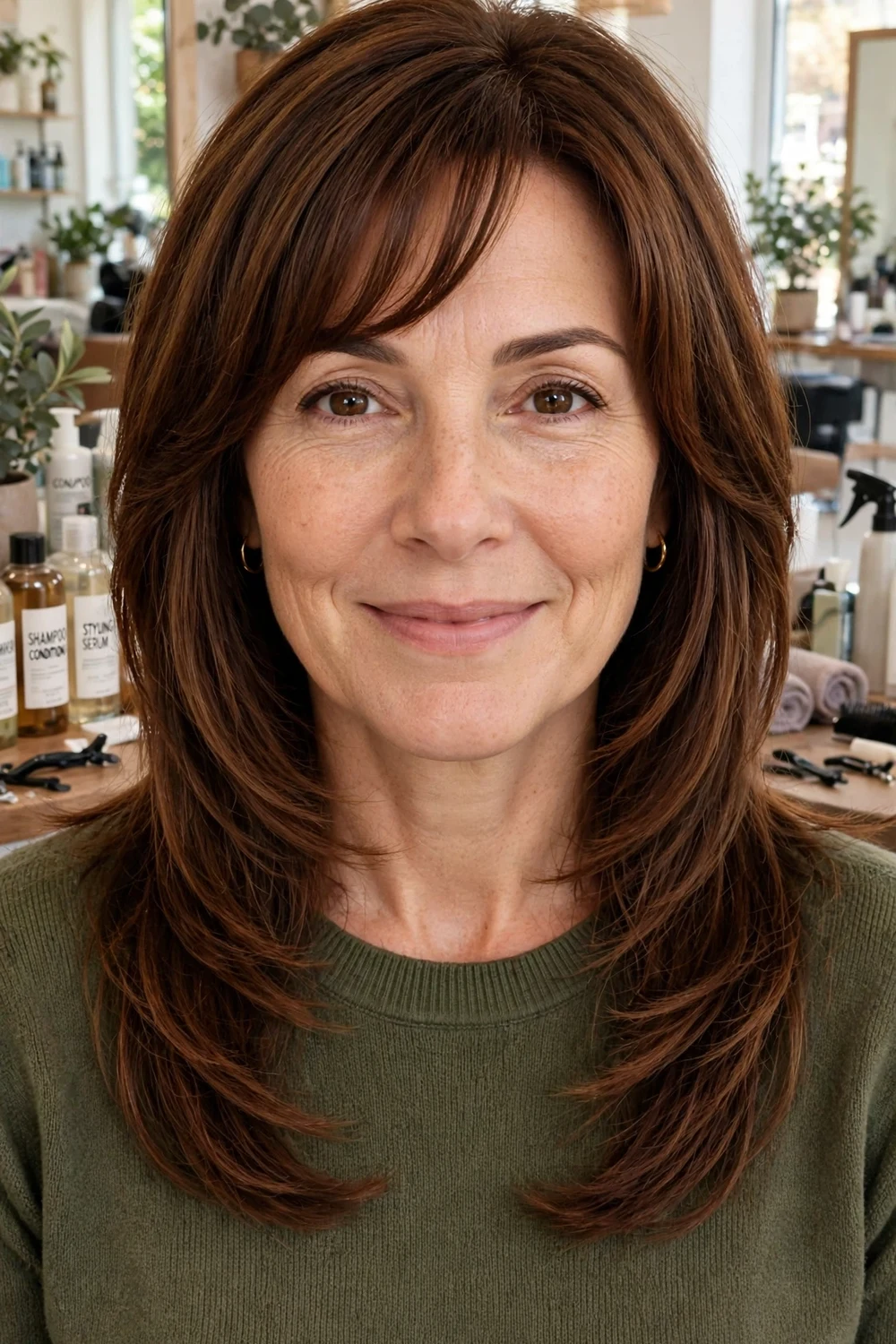
Keeping every layer below the chin protects fullness through the mid-lengths, which matters on fine or medium hair that turns thin when layers start too high. Arched bangs follow the brow curve and finish the front.
This is the safest layer pattern if you have been unhappy with short layers before, since nothing is taken from the top half of the length. The trade-off is less lift at the crown.
Try this: Lift the roots at the crown with your fingers and warm air while the lengths dry straight. With layers this long, crown lift has to come from drying rather than from the cut.
Difficulty: Easy | Cost: $ | Time: 9 minutes
9. Extra-Long One-Step Layers with Soft Full Bangs

One-step layers add a single step near the ends of extra-long hair, so the length keeps its weight and swing while the bottom edge gains movement. Soft full bangs give the very long back a finished front.
Ask for the bangs point-cut so the full coverage still reads soft. This pattern suits hair past the chest that feels plain at one length but does not need a full layered cut.
Try this: Dry the lengths in two large sections with a paddle brush, then round the bangs under. Sectioning keeps extra-long hair smooth without endless passes.
Difficulty: Medium | Cost: $$ | Time: 12 minutes
10. Long Wavy Layers with Bardot-Style Split Bangs

Bardot-style bangs split at the center and sweep to both sides, longer at the edges than in the middle. On long wavy layers the split front melts into the first wave, so fringe and layers share one rhythm.
Keep the center of the fringe at brow level and the edges at the cheekbones. If the split keeps closing, your stylist can take a small triangle section out at the center part.
Try this: Dry the fringe in two halves, each swept away from the center with a small round brush. Drying the halves apart is what holds the split open.
Difficulty: Medium | Cost: $$ | Time: 10 minutes
11. Long Curly Layers with Curly Front Fringe

Long curly layers are shaped to stack curls without a triangle outline, and a curly front fringe is cut curl by curl across the forehead. Worn together, the fringe and layers share the same curl pattern from front to back.
Have both the layers and the fringe shaped dry, in their natural state, so the lengths are judged as you actually wear them. Long layers with few steps keep curls from puffing at the bottom.
Try this: Apply curl cream to soaking wet hair, scrunch once, and keep your hands off the fringe until it is fully dry. Hands-off drying keeps the front curls defined.
Difficulty: Easy | Cost: $ | Time: 8 minutes
12. Sleek Long Layers with Rounded Full Bangs

Sleek long layers lie smooth with only a slight step through the ends, and rounded full bangs curve under in a soft arc. The pairing reads polished and tidy, with the rounded front balancing the straight lengths.
Ask for the layers to be cut long and close together, so the surface stays smooth rather than choppy. A light smoothing cream and a paddle brush keep the sleek finish.
Try this: Dry the bangs under with a medium round brush, rolling slowly toward your face. The roll builds the rounded curve as the hair cools.
Difficulty: Medium | Cost: $$ | Time: 11 minutes
13. Long Razored Layers with Birkin-Style Bangs
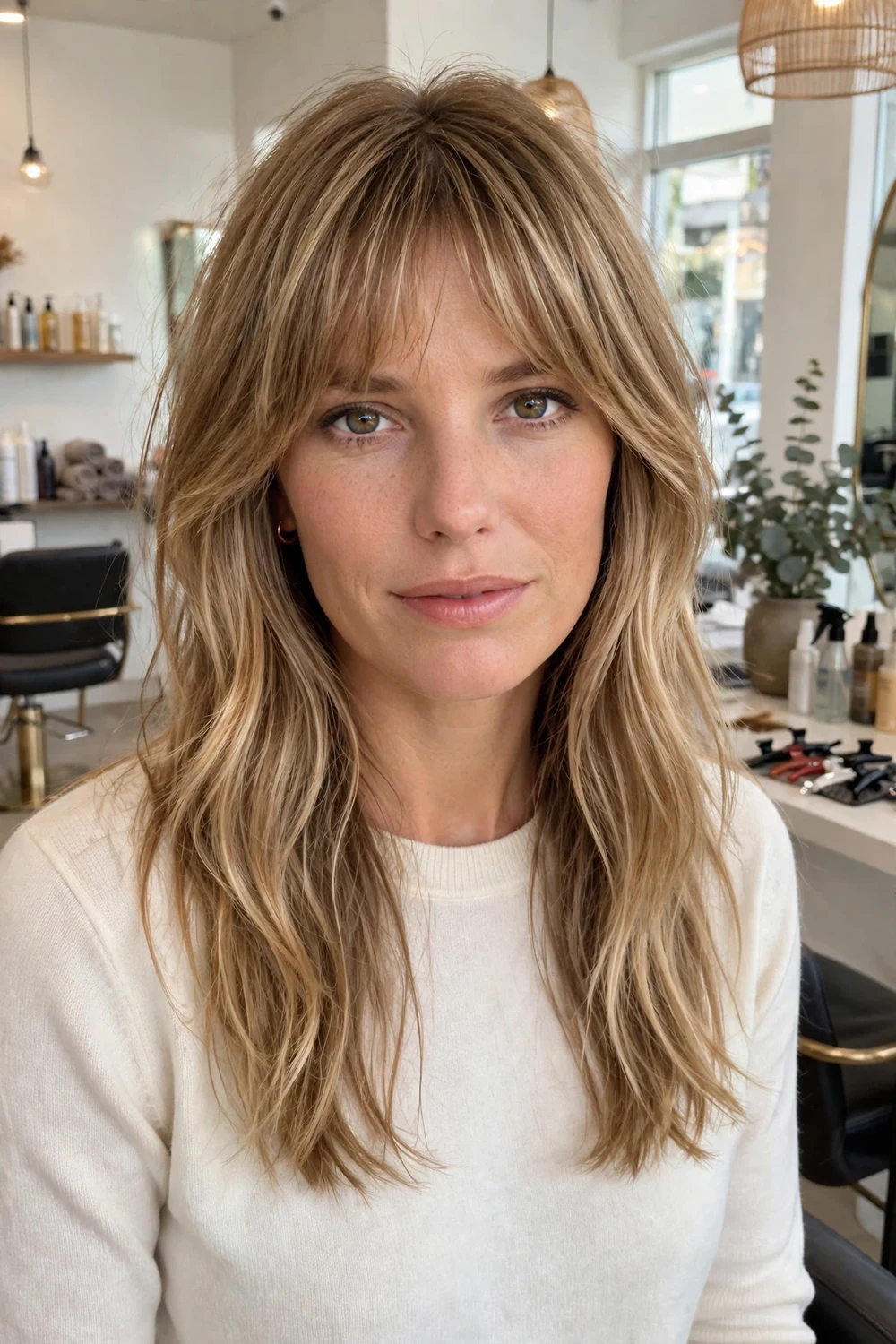
Razored layers taper each end to a soft point, which gives long hair a light, wispy outline. Birkin-style bangs match that finish, cut straight across with tapered, uneven ends and a relaxed feel.
Razor work suits straight and wavy hair best; very curly hair is usually better with shears, so raise it at the consultation. Grow-out is soft on both the layers and the fringe.
Try this: Tousle the ends with a fingertip of styling cream on dry hair. Razored layers look best a little separated, so skip heavy smoothing.
Difficulty: Easy | Cost: $ | Time: 7 minutes
14. Balayage Long Layers with Highlighted Curtain Fringe

Balayage lightens the mid-lengths and ends of long layers, and the curtain fringe carries the same lighter pieces at the front. Each layer catches light at a different level, so the cut shows its steps clearly.
Ask for the lightest pieces to sit on the top layer and through the fringe, with deeper tones underneath for contrast. Balayage grows out softly, so color visits can stretch further than foil highlights.
Try this: Dry the curtain fringe first while it is wet, sweeping each side away from the face. The highlighted front pieces frame best when they are dried into place rather than left to air-dry flat.
Difficulty: Medium | Cost: $$$ | Time: 11 minutes
15. Long Layers with Grown-Out Fringe Blended to the Cheekbones

Every fringe reaches the grown-out stage, and this cut plans for it. Bangs are blended down to the cheekbones and cut straight into the first layer, so the in-between length looks like a face frame rather than an accident.
It is the practical pick if you like bangs for a season and then want a break without months of pinning. The wider roundup of long hair bangs shows the fuller fringe shapes this style grows from.
Try this: Sweep the grown-out front pieces back with the round brush as you dry the first layer. Drying them together keeps the blend line invisible.
Difficulty: Easy | Cost: $ | Time: 8 minutes
16. Thick-Hair Long Layers with Long Side Bangs

Thick long hair needs layers that remove real weight, and long side bangs cut on a diagonal take bulk off the front at the same time. The diagonal front also suits round faces, since it adds an angled line.
Ask for internal layering through the back, where thick hair holds the most weight, and keep the surface layer long so the outline stays smooth. Trim every eight to ten weeks.
Try this: Blow-dry the side bangs across the forehead in the direction of the sweep, then finish with a cool shot. The angled dry keeps a long fringe lying flat on thick hair.
Difficulty: Medium | Cost: $$ | Time: 11 minutes
17. Fine-Hair Long Soft Layers with Airy Wispy Bangs

Fine long hair keeps its fullness with soft, long layers and airy wispy bangs, since short layers and a heavy fringe both show thin ends quickly. The wispy front has small gaps, so it reads light even as it grows.
Keep the shortest layer below the chin and the ends blunt. For fringe shapes cut for fine strands, the guide to soft wispy bangs for fine hair covers the same front at shorter lengths.
Try this: Dry the bangs with your fingers and a low heat setting, moving them side to side. Fine bangs dry in about a minute and can turn flat under a heavy brush.
Difficulty: Easy | Cost: $ | Time: 8 minutes
18. Long Layers with Baby Bangs and Straight Lengths

Baby bangs sit high above the eyebrows and make a bold front for long straight layers. The contrast between the very short fringe and the long lengths is the whole look, so both parts stay simple.
This fringe needs thick enough front hair to hold a clean short line, and it grows fast, so plan a fringe trim every two to three weeks. The layers themselves can go eight to ten weeks.
Try this: Smooth the baby bangs down with a mini brush and the nozzle pointing straight down. Short bangs show every bend, so one careful pass matters more than product.
Difficulty: Medium | Cost: $$ | Time: 9 minutes
19. Long Layers with Textured Ends and Choppy Full Bangs
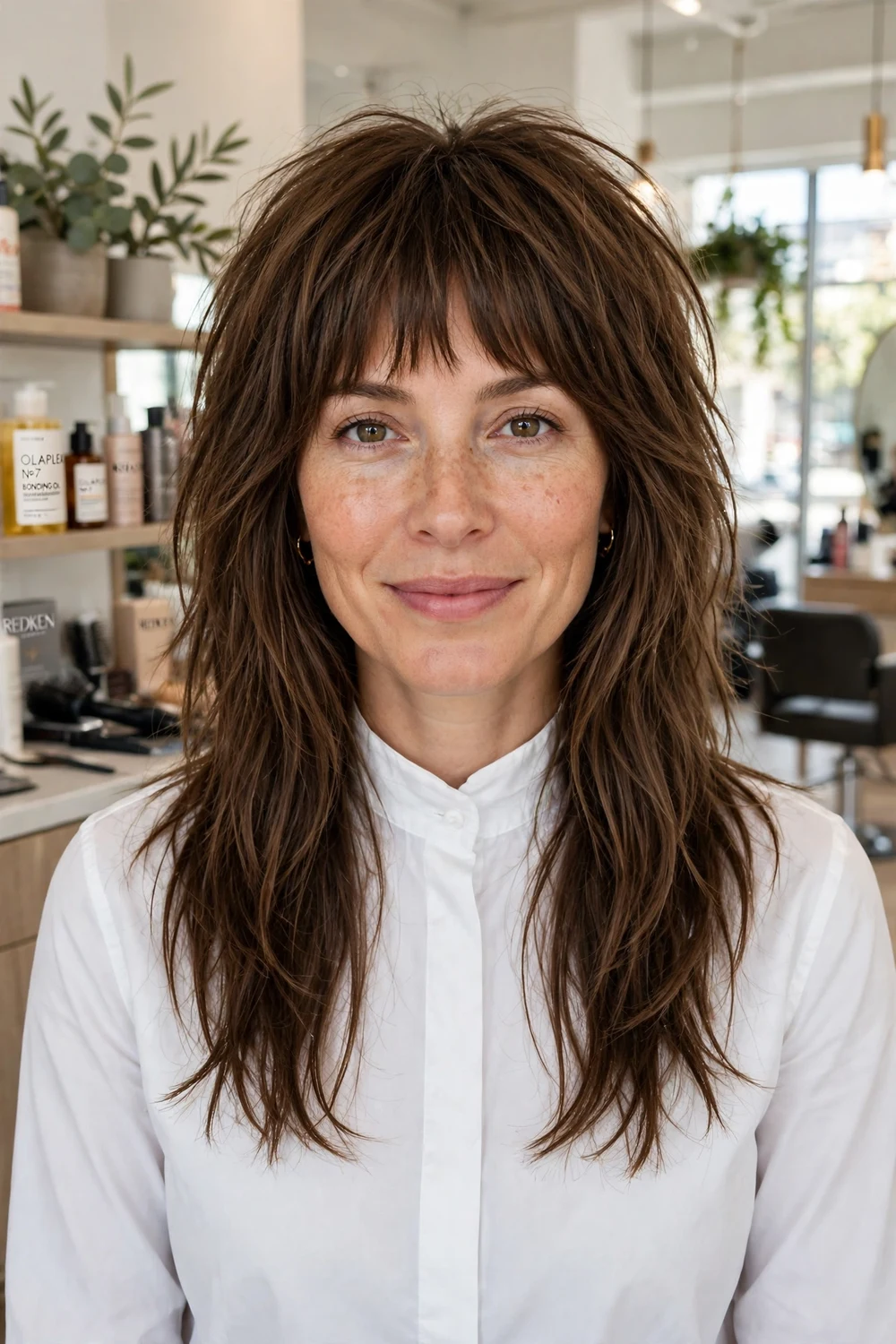
Textured ends break up the bottom edge of long layers so the hair moves in pieces rather than in one sheet. A choppy full fringe carries the same broken finish across the forehead.
Ask for point cutting and a light razor finish at the ends rather than heavy thinning, which keeps the pieces clear without turning them wispy. It suits medium and thick hair best.
Try this: Pinch a small amount of matte paste through the ends and the fringe on dry hair. Piecey definition is the finish here, so work on dry hair only.
Difficulty: Easy | Cost: $ | Time: 7 minutes
20. Beach-Wave Long Layers with Middle-Parted Bangs
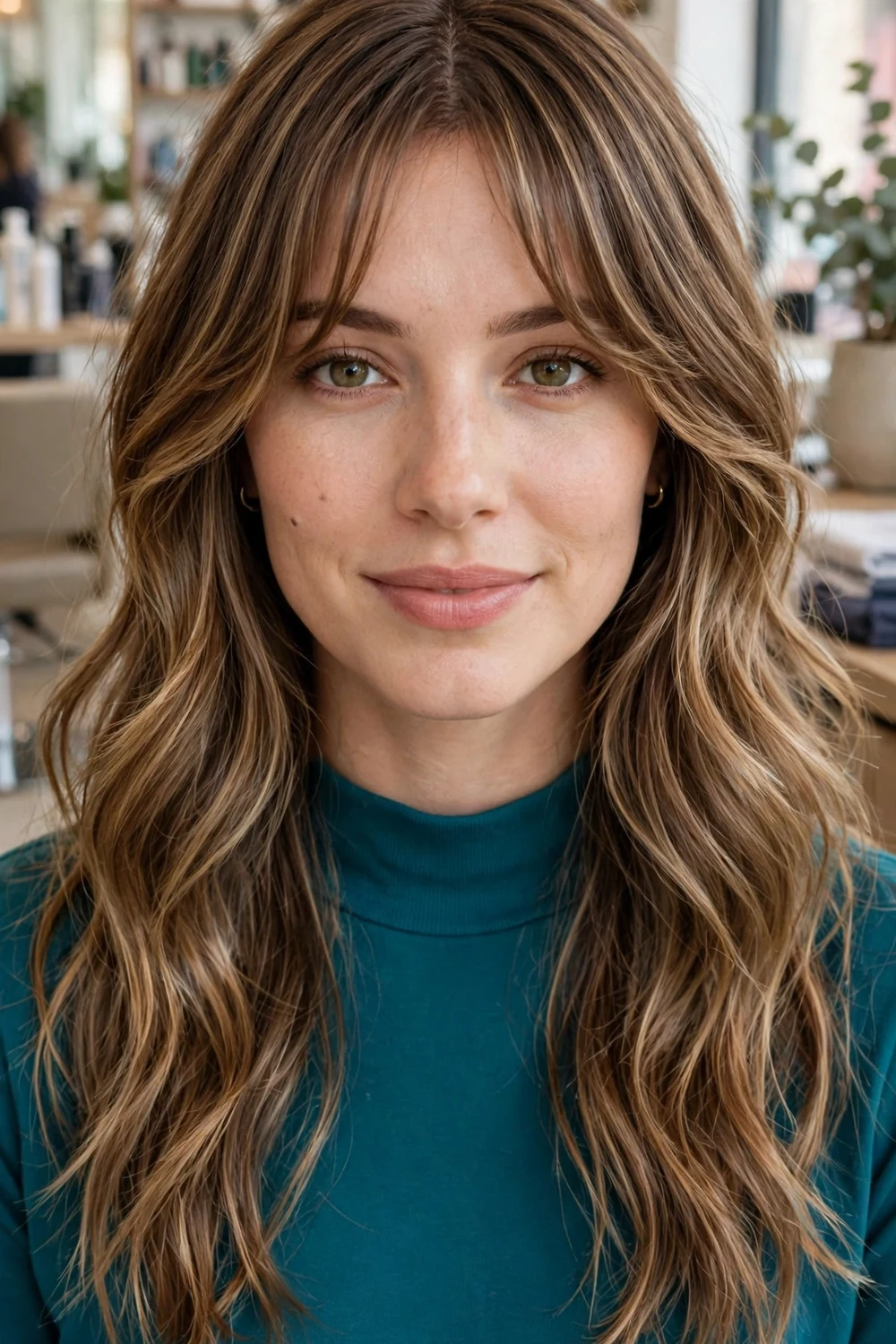
Loose beach waves through long layers pair with bangs parted in the middle and flowing into the waves on both sides. The parted front and the waves share the same loose bend, so nothing looks sharply cut.
Salt spray on damp hair and two loose braids overnight give a heat-free version of the waves. Keep the parted bangs at cheekbone length so they join the first wave cleanly.
Try this: Shake the waves out with your fingers in the morning and re-set the part with a fingertip of cream. Brushing beach waves turns them frizzy, so fingers only.
Difficulty: Easy | Cost: $ | Time: 8 minutes
21. Long Layers with Feathered Front Sections and Soft Bangs

Feathered front sections turn outward from the cheekbones down, while the back layers stay longer and smoother. Soft bangs grazing the eyebrows finish the front without a hard line.
This pattern puts the movement where it frames the face and keeps the back easy to tie up. Ask for the feathering to start at the cheekbones rather than at the jaw for the clearest effect.
Try this: Dry the front sections with a round brush, turning each one outward as you reach the ends. The outward turn is the feather, so spend your time on the front.
Difficulty: Medium | Cost: $$ | Time: 11 minutes
22. Glossy Long Layers with Voluminous Blowout Bangs

A blowout lifts long layers into bouncy, glossy sections, and voluminous bangs dried with a round brush match that fullness at the front. The layers are cut long so they hold the blown-out curve.
This is a styling-led look, so allow the most time of any idea in this list on wash days. A large round brush and a blow-dry cream with heat protection give the gloss and the lift together.
Try this: Dry the bangs up and back with the largest round brush you have, lifting at the root, then let them fall forward as they cool. The lift-then-fall order is what creates the volume.
Difficulty: Hard | Cost: $$ | Time: 15 minutes
23. Long Swoop Layers with Deep Side-Part Bangs

A deep side part sends long layers sweeping across the top and down one side in a single swoop, and the bangs form the top of that sweep. The diagonal line suits round and square faces, and it adds crown height on flat hair.
Keep the layers longest on the heavy side of the part so the sweep has weight. For more diagonal fringe shapes at other lengths, see hairstyles with asymmetric bangs.
Try this: Set the part about an inch deeper than your natural part and dry the sweep across your forehead first. Drying the front first locks the diagonal in place.
Difficulty: Medium | Cost: $$ | Time: 10 minutes
24. Long Layers with Feathered Bangs and Cascading Waves
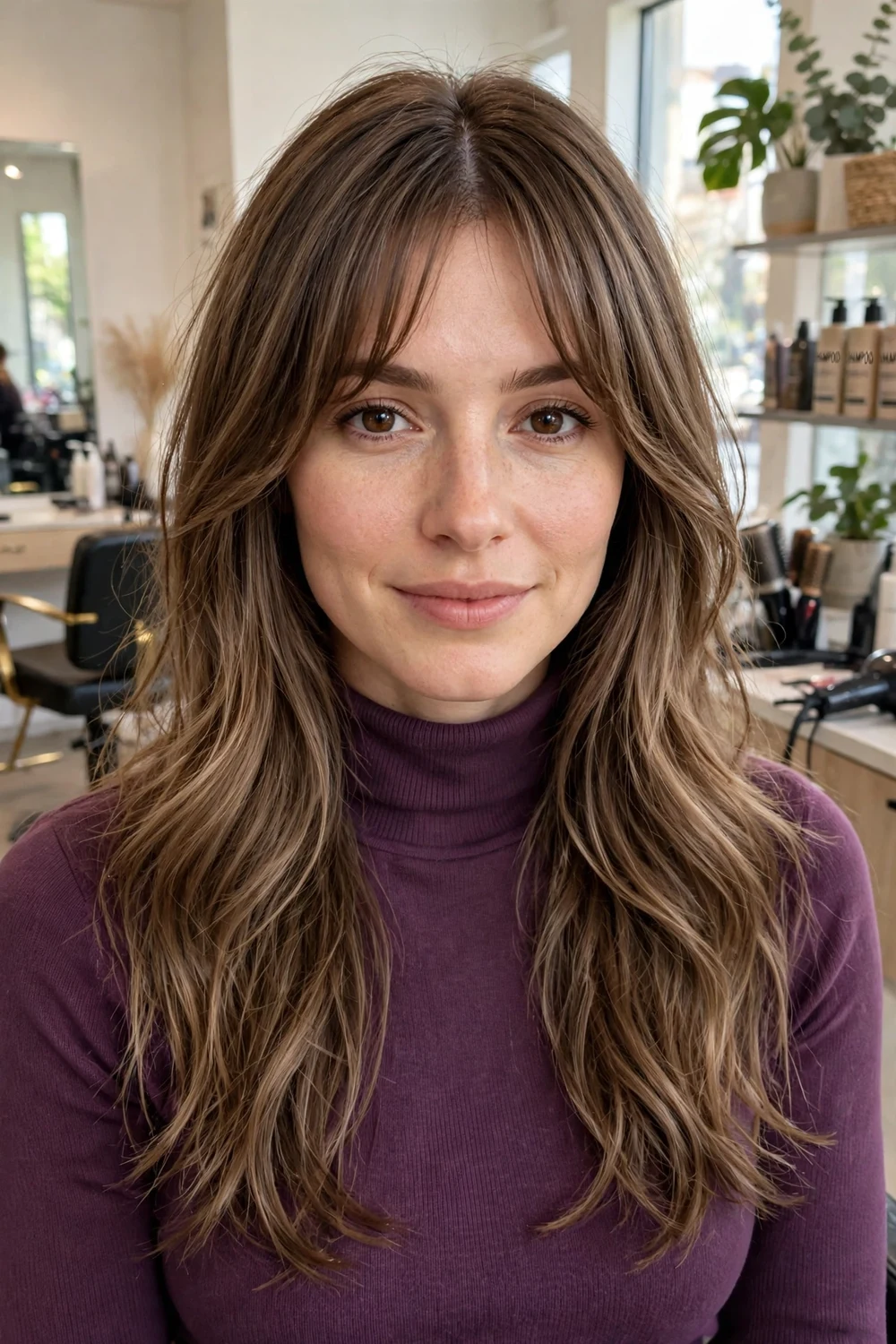
Feathered bangs parted softly at the center sit above cascading waves that fall in large, even bends through the layers. The feathered front is light at the edges, so it joins the waves without a step.
Ask for the feathering to be cut into the ends of the bangs rather than through their full thickness. Large-barrel waves or overnight braids both give the cascading bend.
Try this: Curl the lengths in large sections away from the face and leave the feathered bangs smooth. The smooth front against the waves is the contrast that makes this pairing work.
Difficulty: Medium | Cost: $$ | Time: 12 minutes
25. Long Layered Blowout with Flicked Ends and Curtain Bangs
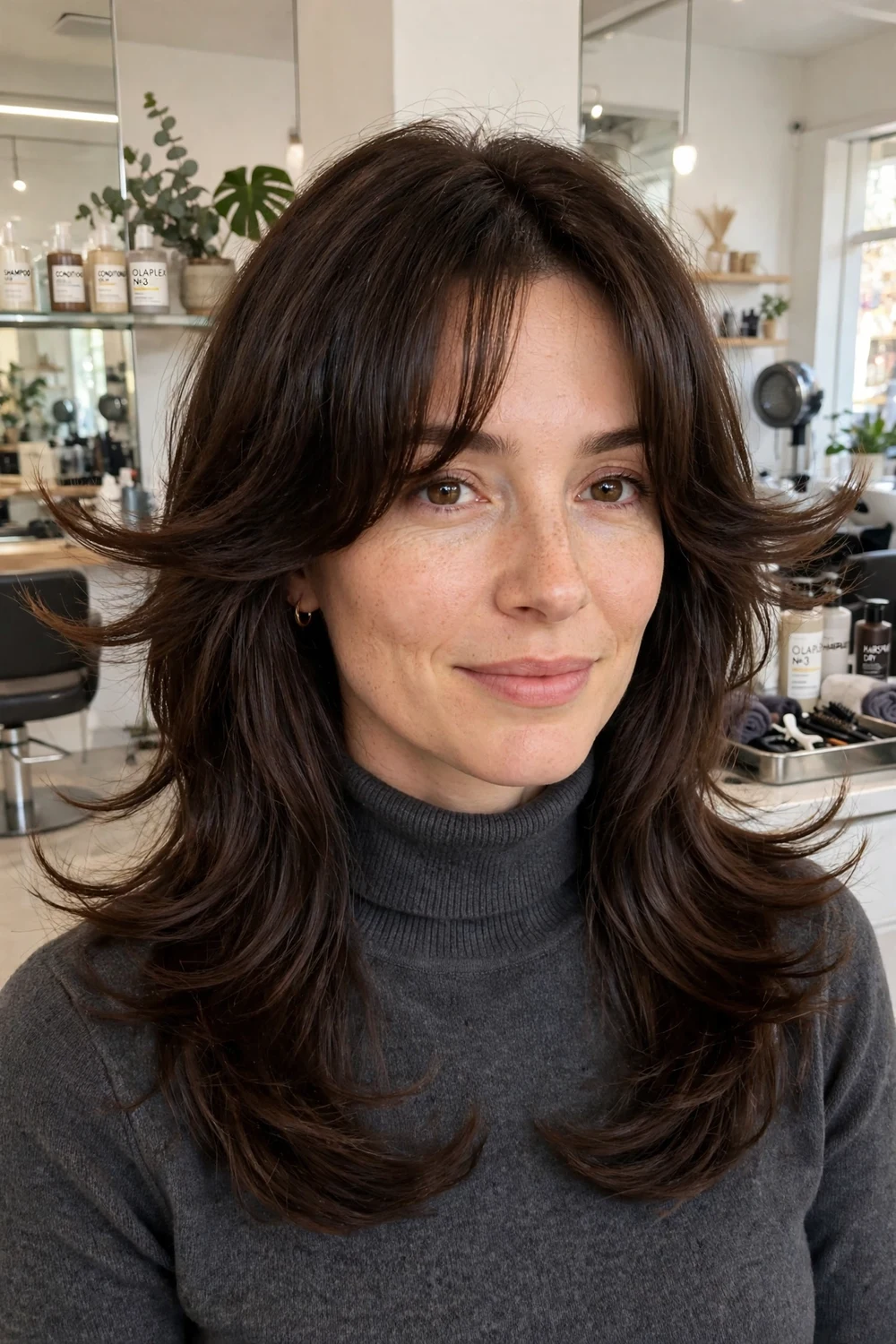
This blowout flicks every layer outward at the ends while curtain bangs dry away from the face, so the whole cut moves outward and back. It is a finished, salon-style version of the everyday layered cut.
It works on most long layered cuts you may already have, since the difference is in the drying rather than the cutting. Keep the curtain pieces at cheekbone length so they flick with the first layer.
Try this: Dry in sections, flicking the brush outward at the last two inches of each layer. Finish the curtain bangs last, sweeping them away from the face so they join the flick.
Difficulty: Hard | Cost: $$ | Time: 15 minutes
Frequently Asked Questions
What is the difference between long layered hair with bangs and long hair with bangs?
Long hair with bangs can be one length through the back with a fringe added at the front. Long layered hair with bangs has steps cut through the length as well, and the fringe is chosen to match the layer pattern, so curtain bangs join face layers, blunt bangs balance a V-cut, and wispy bangs match soft long layers.
Which bangs suit long layered hair best?
Curtain bangs are the most flexible, since they blend into face-framing layers and grow out into them. Wispy and see-through bangs suit fine hair and soft layers, blunt and rounded bangs suit straight sleek layers, and side-swept bangs suit feathered and swoop layers. Match the weight of the fringe to the weight of the layers.
Where should layers start on long hair with bangs?
For most hair types, the first layer should start between the chin and the collarbone. Fine hair keeps more fullness with layers starting below the chin, as in ideas 8 and 17. Thick hair can start layers higher, since it has weight to spare, as in idea 16.
How often do long layers and bangs need trimming?
Bangs need a tidy trim every three to four weeks, and baby bangs every two to three weeks since they grow past their short line fast. Long layers hold their shape for eight to ten weeks. Many salons will trim the fringe between full appointments.
Can long layered hair with bangs work on curly hair?
Yes. Ask for the layers and the fringe to be shaped dry, curl by curl, in their natural state, as in idea 11. Keep the layers long and few, since short layers can make long curly hair widen at the bottom. Wet cutting often leaves curly bangs shorter than planned once they spring up.
Final Thoughts
Pick the layer pattern that fits your hair type first, then let the bangs follow its weight and direction. Bring a photo of the full pairing to your appointment, since a fringe that looks right on its own can sit oddly against the wrong layers. Keep the fringe trims regular, let the layers run their eight to ten weeks, and the two parts will keep reading as one cut.

