



Grey hair past 50 has its own texture, its own light, and its own rules. The cut that showed it off at 35 won’t do it justice now, and that’s good news. Short hair gives silver, salt-and-pepper, and white tones the shape and movement they need to look intentional instead of neglected.
This list pulls the strongest short hairstyles for grey hair over 50 from the top stylist-backed sources, merges the overlaps, and adds the gaps they missed. I’ve spent years helping friends and family find cuts that work with changing hair, and the same principle holds every time: a deliberate short cut flatters grey hair more than length ever will.
Quick answer: The best short hairstyles for grey hair over 50 add volume at the crown, keep the neckline clean, and use texture to show off silver dimension. Classic textured pixies, stacked bobs, and shaggy crops top the list because they make fine or thinning hair look fuller while keeping grey bright.
Quick Takeaways
- Short cuts make grey hair look fuller because shorter strands lift away from the scalp instead of lying flat.
- Purple shampoo once or twice a week keeps silver and white tones from turning yellow or brassy.
- Texture is more important than length: layers, razored ends, and piecey crowns flatter changing hair.
- Most of these styles need a trim every 6 to 8 weeks to hold their shape.
- A deep side part or side-swept fringe can hide thinning at the crown better than a center part.
Why Grey Hair Over 50 Loves a Short Cut
Grey hair rarely behaves like the hair you had before. It can turn coarser and wirier, or finer and more fragile, and the oil glands in the scalp slow down, so strands feel drier. A short cut removes the oldest, most weathered ends and leaves hair that actually reflects light. That’s why silver looks brighter in a pixie than in a long, tired length.
There’s a practical side too. Short styles dry faster, need less product, and hold a shape through the day without constant fussing. And because stylists recommend trims every 6 to 8 weeks anyway, maintenance stays predictable. If you’re still growing out old color, a shorter cut also gets you to full natural grey months sooner.
1. Classic Textured Silver Pixie
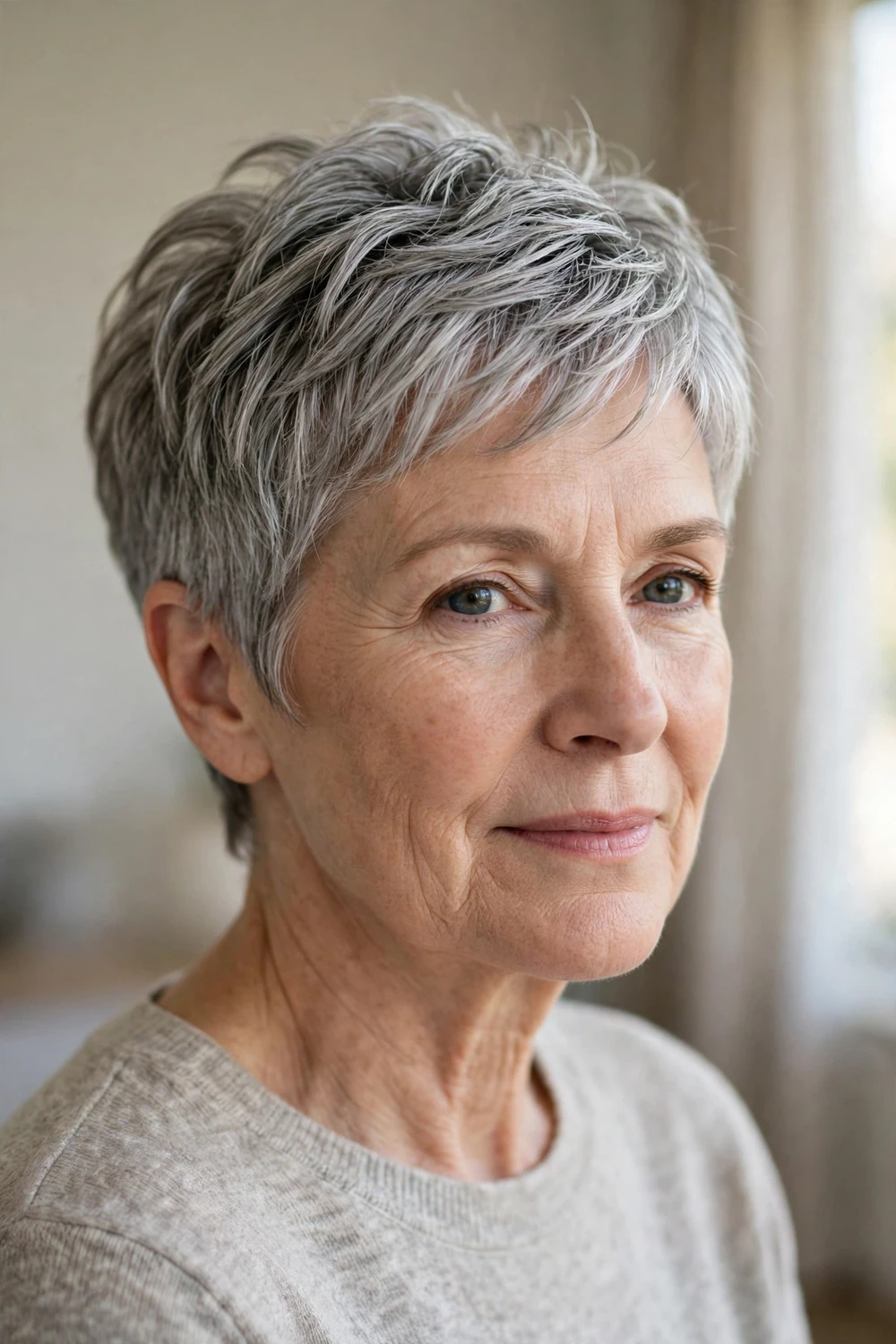
Ask any stylist and this cut comes up first. Short through the back and sides with longer, piecey layers on top, it puts silver tones right where the light hits. The texture does the heavy lifting: it creates the illusion of density even when hair is fine, and it keeps the shape from collapsing by midday. It suits oval, heart, and square faces, and a matte paste gives the layers separation without stiffness.
Try this: Work a pea-sized amount of matte texturizing paste through dry hair, lifting at the crown with your fingertips for 30 seconds. Difficulty: Easy
2. Long Gray Pixie
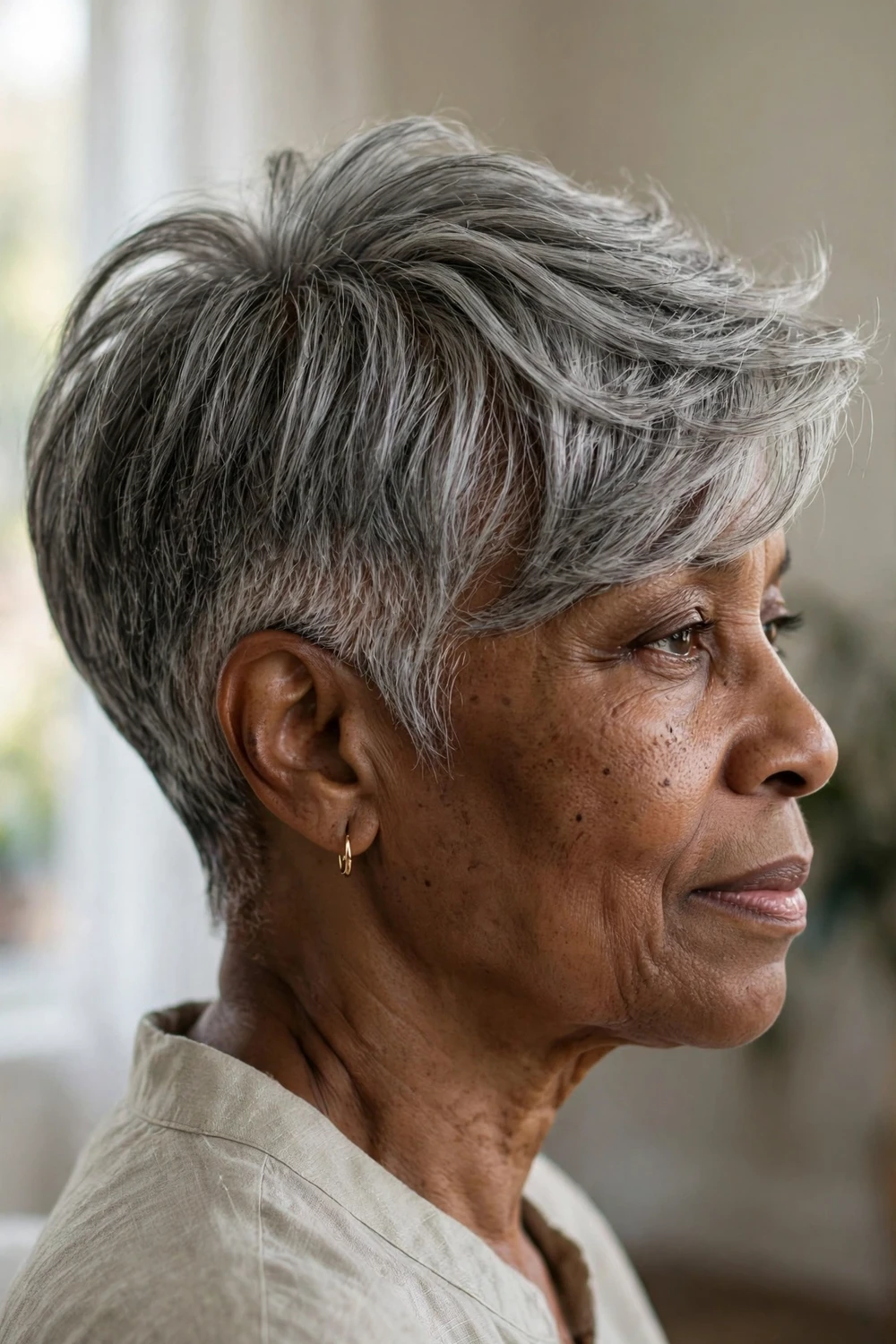
Not ready for a crop? The long pixie keeps the classic shorter back and tapered sides but leaves the top long enough to sweep, slick back, or tuck behind one ear. You get two or three looks out of one cut, which is why it’s a favorite during the grow-out phase. The longer top also softens stronger jawlines and gives fine hair more styling options than a close crop allows.
Try this: Blow-dry the top with a small round brush, directing it to one side for a deep sweep that adds asymmetry and width. Difficulty: Easy
3. Wispy Pixie with Crown Volume
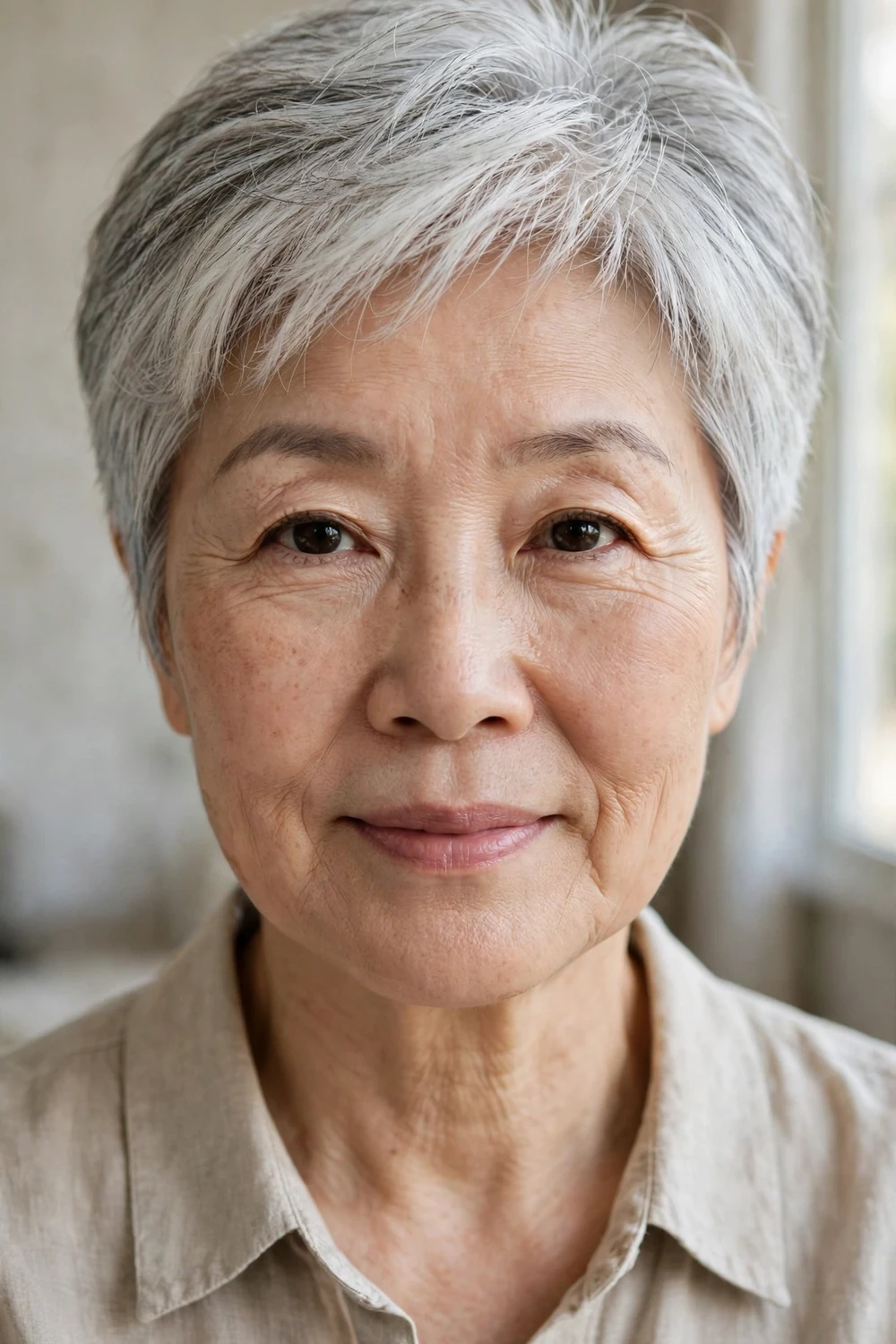
Flat hair at the crown is the most common complaint after 50, and this cut is built to fix it. Feathered, wispy layers are concentrated through the top while the sides stay neat and tapered. The result is lift that looks natural, not teased. Blow-drying upside down for the first minute does most of the work, and a root-lifting spray keeps it up through the day.
Try this: Flip your head forward and blast roots with the dryer for 60 seconds before styling upright; the volume sets as it cools. Difficulty: Easy
4. Spiky Silver Pixie

Short spikes through the crown and top give grey hair an edge that reads confident, not costume. The cut stays close at the sides and back, so the spikes become the focal point and draw the eye upward, which flatters the whole face. A tiny amount of strong-hold wax pinched into the tips creates definition; too much product makes it look wet, so start with less than you think you need.
Try this: Rub a rice-grain amount of wax between your palms, then pinch random sections upward and outward for lived-in spikes. Difficulty: Easy
5. Sophisticated Layered Bob
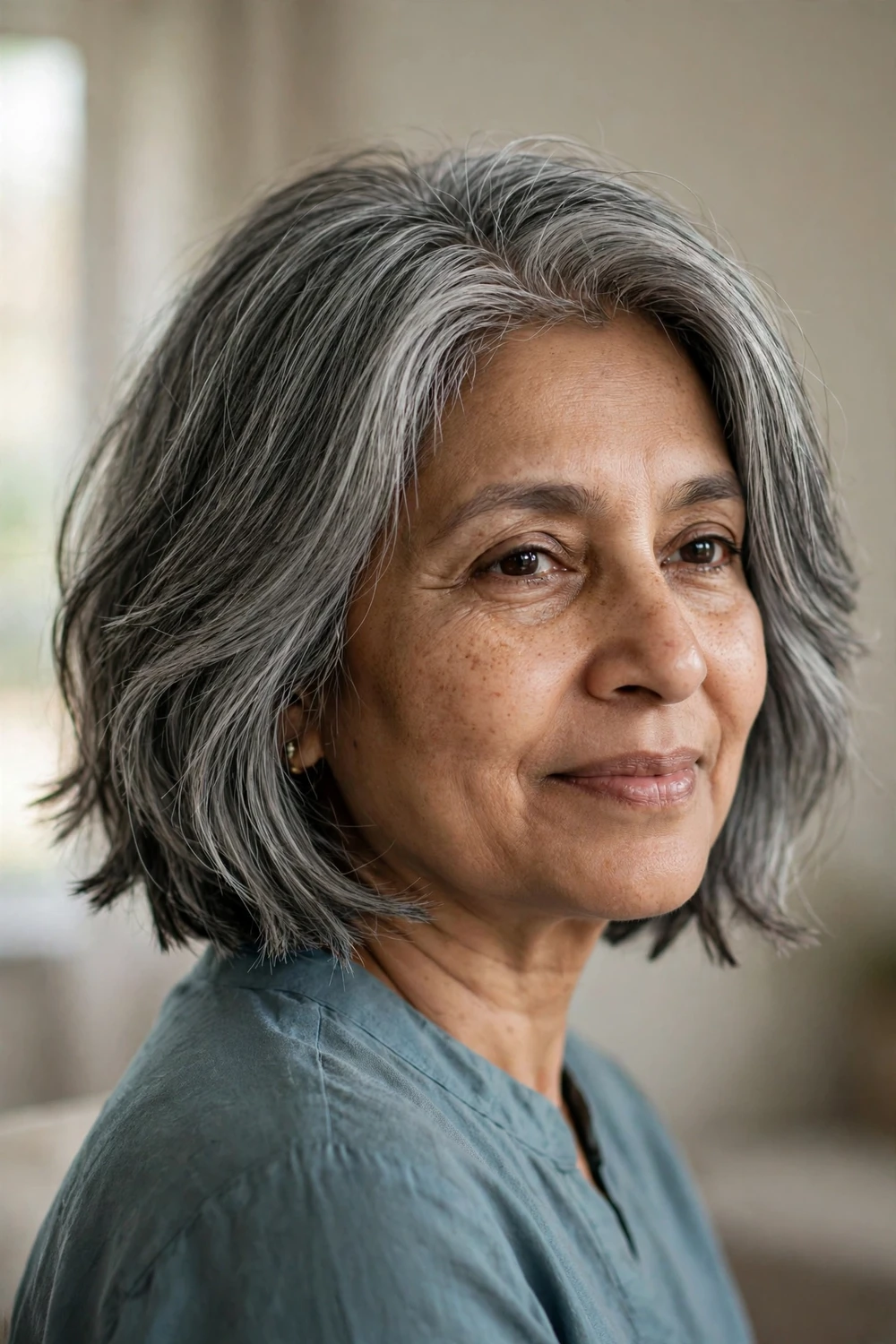
The layered bob is the workhorse of short grey hairstyles. Cut around the jaw or just below, with layers that remove weight and let the hair move, it frames the face without hiding it. Point-cut ends keep it from looking blunt and heavy, which matters when grey hair turns coarse. It works for straight, wavy, and relaxed textures and styles in under ten minutes with a round brush.
Try this: Dry with a medium round brush, rolling sections under at the ends for a smooth, curved finish that shows off the layers. Difficulty: Easy
6. Feathered Bob with Soft Layers

Feathering means the layers are cut at an angle so the ends taper into soft, airy points instead of a hard line. On grey hair this creates movement and a lighter feel that blunt cuts can’t match. It’s especially kind to fine hair because the feathered ends don’t expose thinness the way a solid edge does. A quick pass with a flat iron on the top layer gives it a polished finish.
Try this: Smooth only the top layer with a flat iron and leave the underlayers natural for contrast between sleek and soft. Difficulty: Easy
7. Sleek Silver Blunt Bob

A chin-length blunt cut with a sharp, even edge makes grey hair look dense and deliberate. There’s nowhere to hide, which is the point: the clean line emphasizes the color itself, and silver with a mirror-shine finish looks striking. This one demands straight or straightened hair and regular trims, because the blunt edge shows growth faster than layered cuts.
Try this: Flat-iron in thin sections with one slow pass each, then finish with a drop of shine serum on the mid-lengths and ends. Difficulty: Medium
8. Classic Gray Bob with Bangs
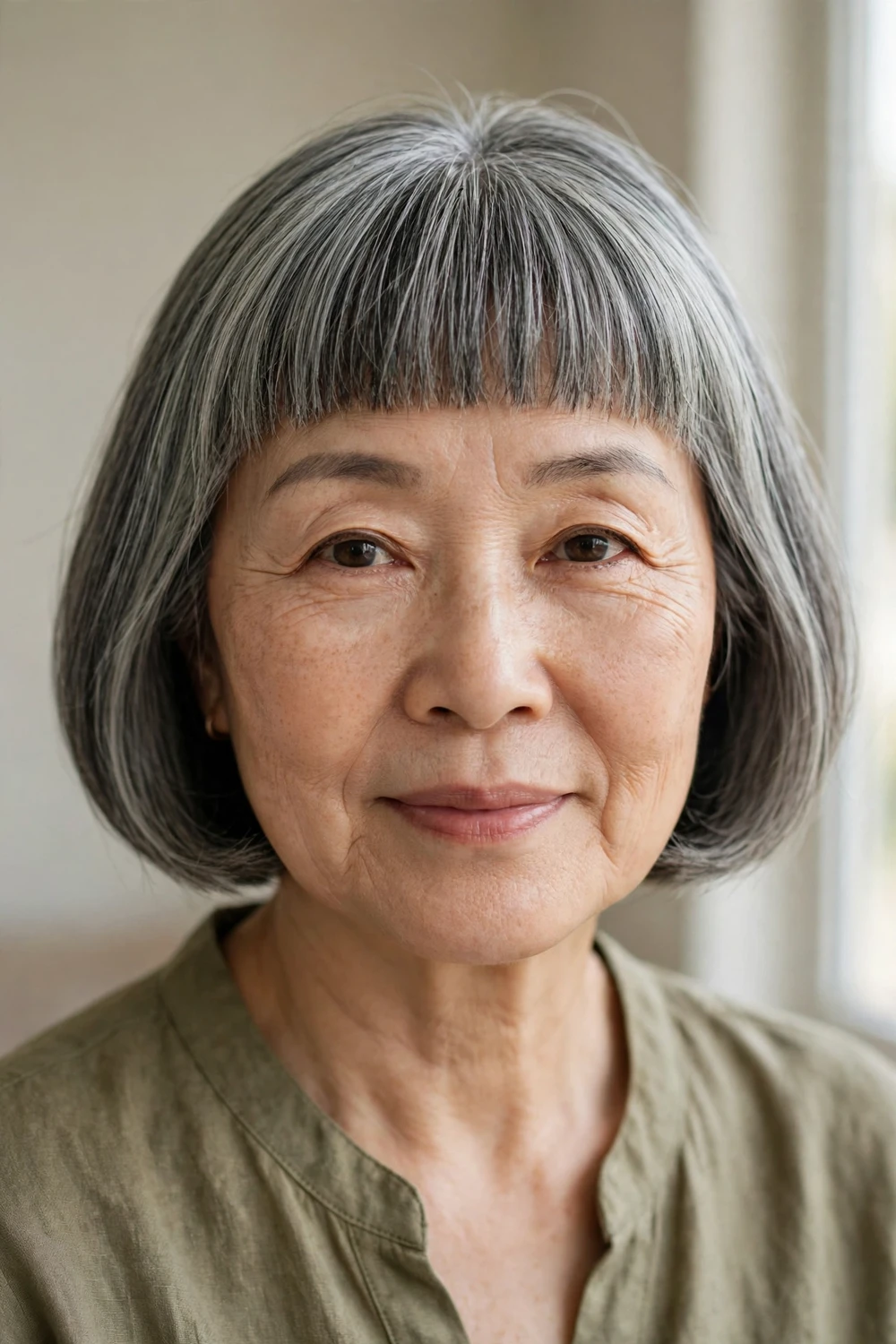
Adding bangs to a classic bob changes the whole geometry of the cut. They cover a high forehead, soften fine lines, and give grey hair a frame that feels youthful without trying too hard. Straight-across bangs suit oval and long faces; a slightly curved edge works better for round faces. Keep them trimmed every three to four weeks, since bangs grow out of proportion faster than the rest of the cut.
Try this: Dry bangs first with a small round brush, rolling them under gently so they sit softly instead of sticking straight down. Difficulty: Medium
9. Layered Gray Bob with Wispy Fringe
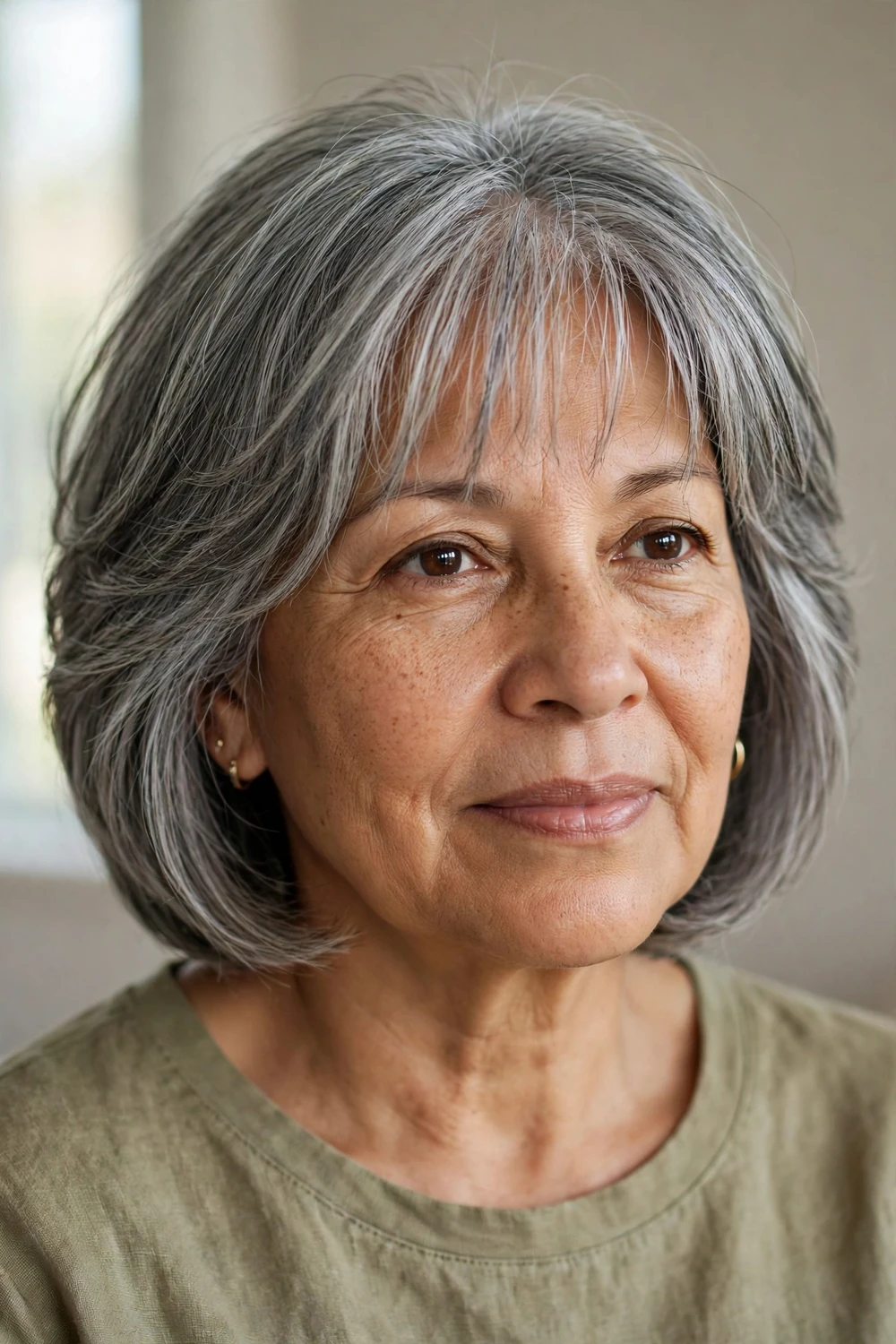
Where straight bangs make a statement, a wispy fringe just suggests one. Thin, eyebrow-grazing strands blend into a layered bob and add softness around the eyes, which is exactly where most women over 50 want it. The wispy texture also makes fine hair look thicker, because broken-up ends reflect light in more directions. It’s the most forgiving fringe if you’re growing bangs out or trying them for the first time.
Try this: Let the fringe air-dry, then separate the pieces with your fingers instead of a comb for a natural, piecey fall. Difficulty: Easy
10. Sleek Angled Bob
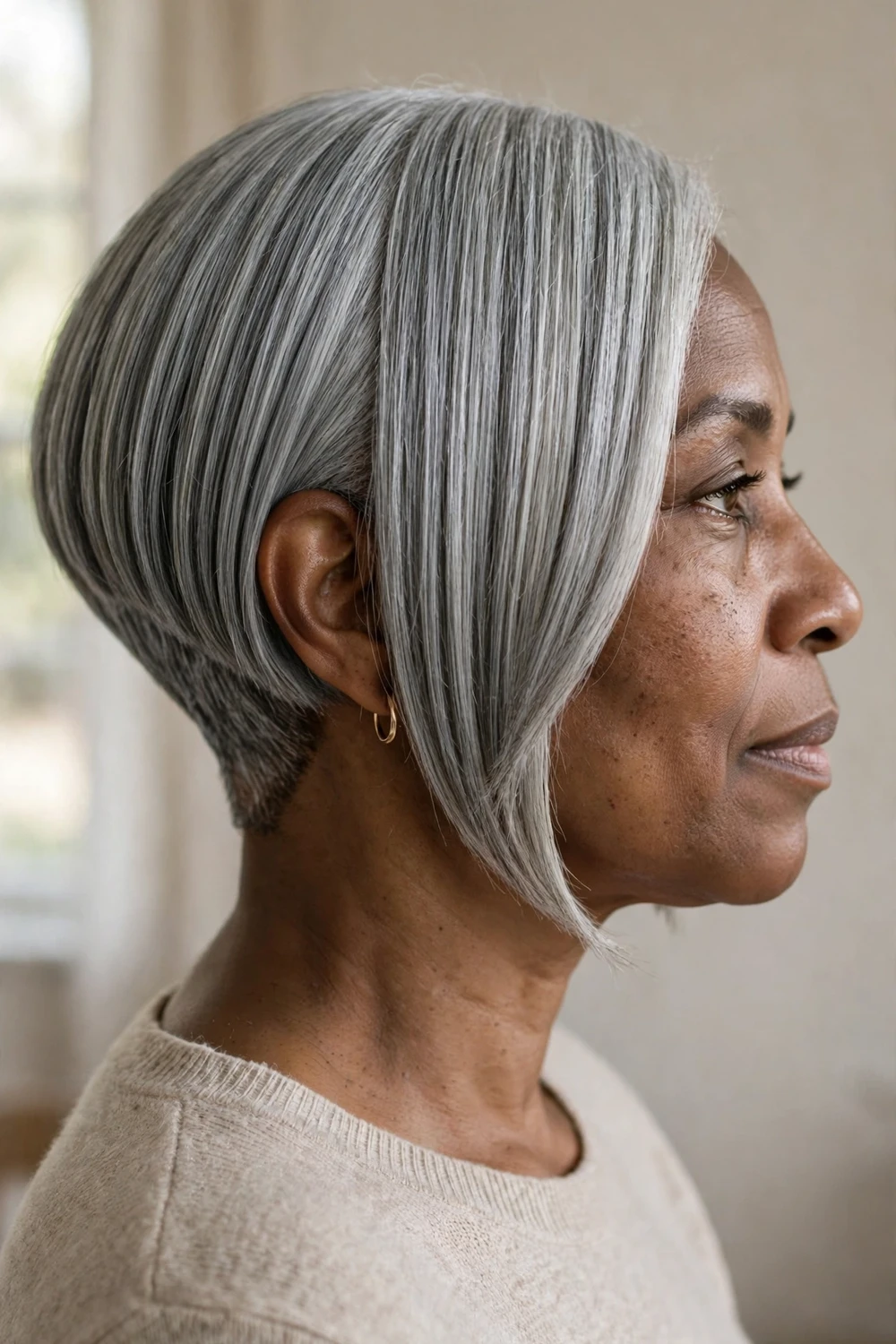
Longer in front and shorter in back, the angled bob creates a diagonal line that slims the face and sharpens the jawline. On grey hair the angle catches light along its edge, which shows off silver dimension to full effect. It’s a stronger look than a classic bob, so it suits women who want polish with a bit of attitude. A flat iron is your main tool here; the cut does the rest.
Try this: After flat-ironing, tuck one side behind your ear to create asymmetry and show off an earring or glasses. Difficulty: Medium
11. Soft Wavy Bob
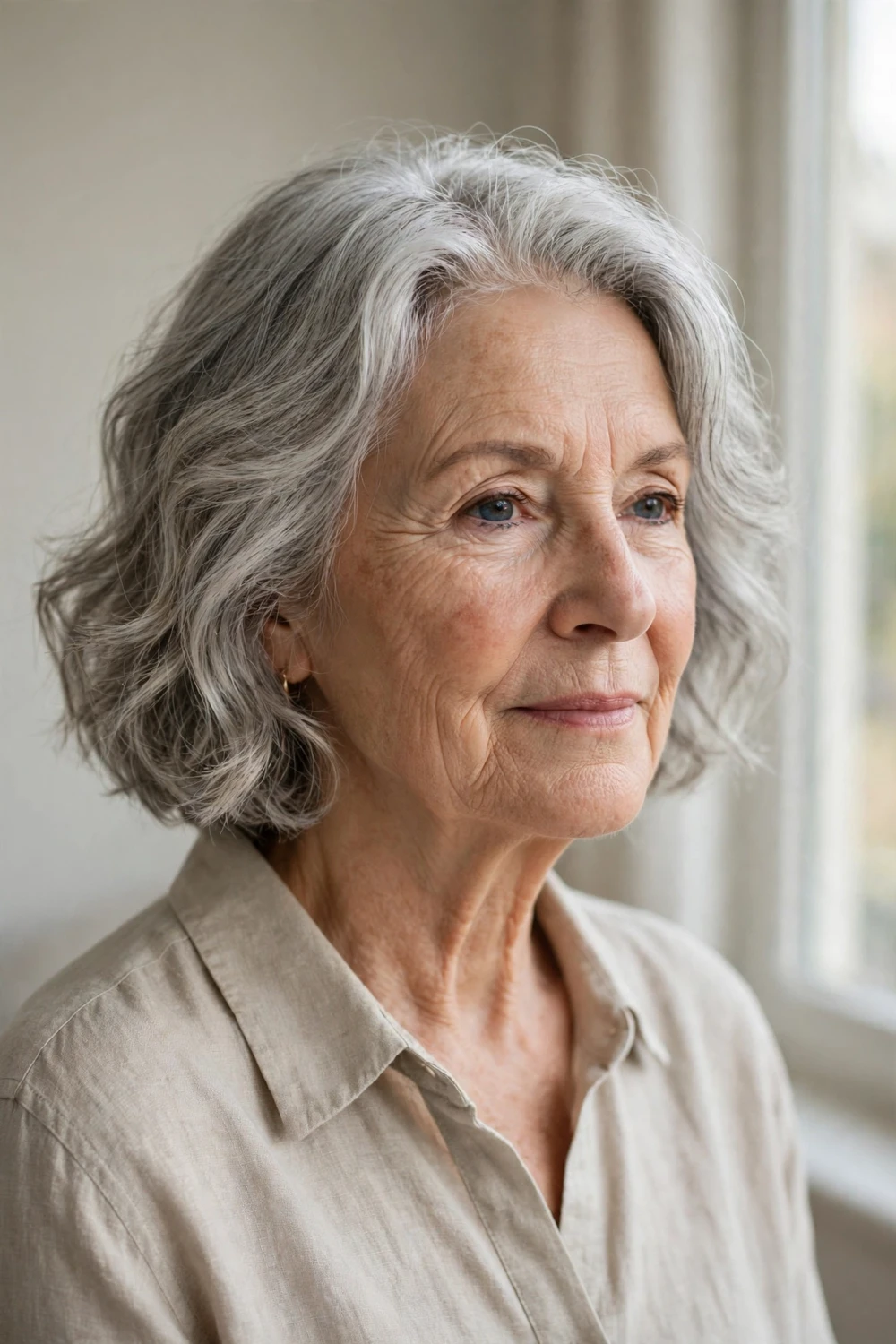
Loose waves in a bob give grey hair body and movement that straight styles can’t touch. The waves don’t need to be uniform; slightly irregular bends look more modern and hold longer on coarse grey hair, which grips texture well. A large-barrel curling iron or even overnight braids can create the shape. This is one of the easiest bobs to dress up or down.
Try this: Wrap 2-inch sections around a 1.25-inch barrel, alternating directions, then break the waves up with your fingers. Difficulty: Medium
12. Choppy Textured Bob
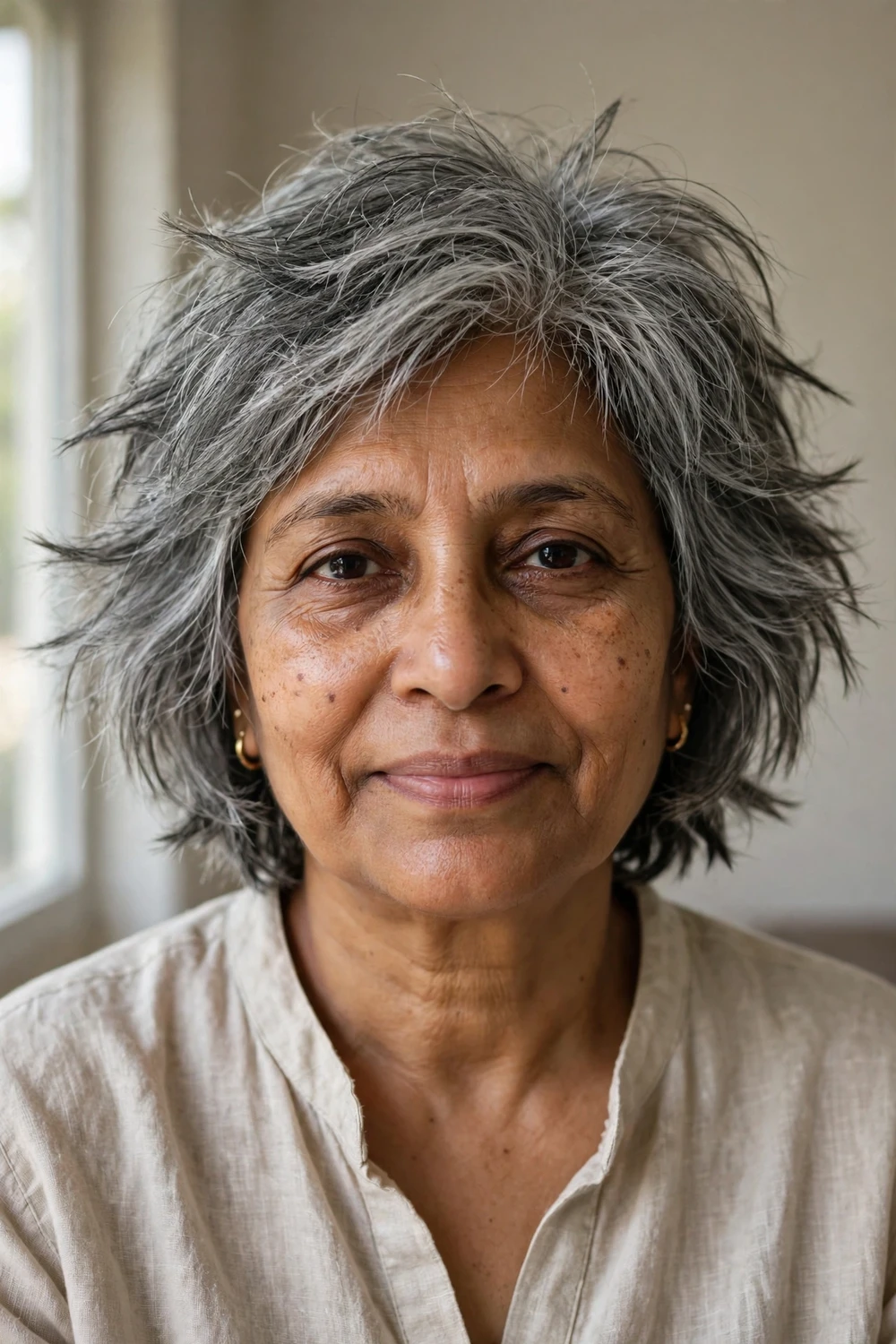
Choppy ends are cut at varied lengths so the bob’s edge looks broken up and lived-in instead of precise. On grey hair this texture hides thin spots and frizz while giving the cut a casual, current feel. It works best on straight to wavy hair; very curly hair needs the choppiness cut dry so the length doesn’t spring up unevenly. A salt spray enhances the piecey finish.
Try this: Mist damp hair with sea salt spray, scrunch, and let it air-dry for texture you didn’t have to work for. Difficulty: Easy
13. Modern Asymmetrical Crop
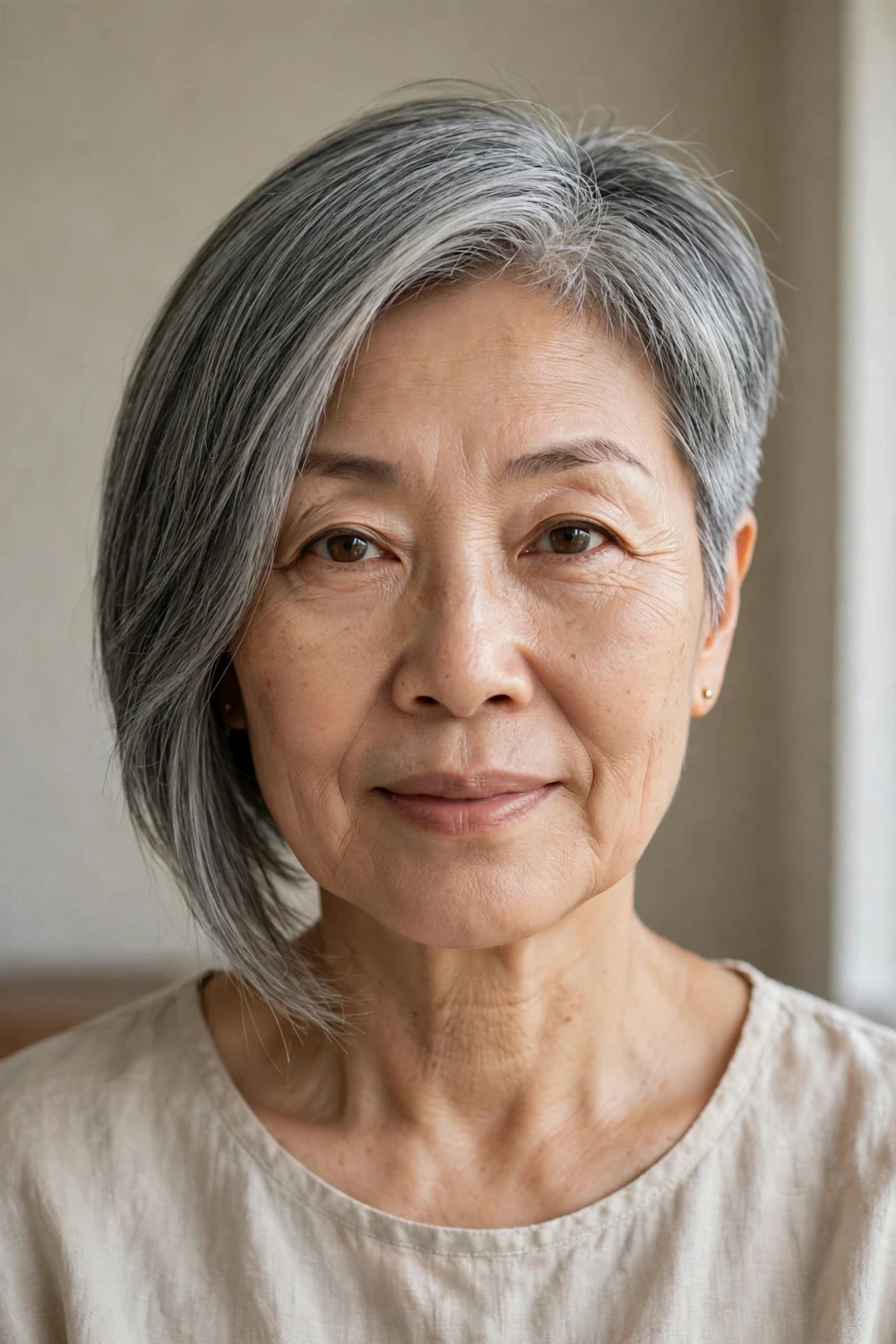
One side longer than the other sounds dramatic, but a half-inch to one-inch difference is enough to make this crop feel modern. The uneven line creates a slimming diagonal across the face and adds movement that symmetrical cuts lack. It’s particularly good for fine hair because the asymmetry disguises thinness better than an even perimeter. Ask your stylist to adjust the difference to your face shape.
Try this: Style the longer side forward over the cheek and sweep the shorter side back for a shape that shifts through the day. Difficulty: Medium
14. Black-and-Silver Ombré Bob

Keeping dark roots that melt into silver ends turns the grow-out phase into a deliberate style. The dark-to-light gradient adds depth that all-over grey sometimes lacks, and the bob length keeps it chic rather than grungy. It’s also practical: root regrowth blends in, so salon visits stretch further apart. A clear gloss treatment every few weeks keeps both tones bright.
Try this: Ask your colorist for a soft, diffused transition rather than a hard line so the grow-out looks seamless for months. Difficulty: Medium
15. Silver Bixie with Side Bangs

The bixie splits the difference between a bob and a pixie: tapered like a pixie, with the length of a bob through the top. Side bangs complete the shape, adding glamour and a diagonal line that flatters nearly every face. On grey hair the bixie’s layers catch light at multiple lengths, which makes silver look dimensional instead of flat. It suits straight to coarse textures and grows out gracefully.
Try this: Sweep the bangs across the forehead while blow-drying for a side part that hides thinning at the temples. Difficulty: Medium
16. Silver Side-Parted Pompadour
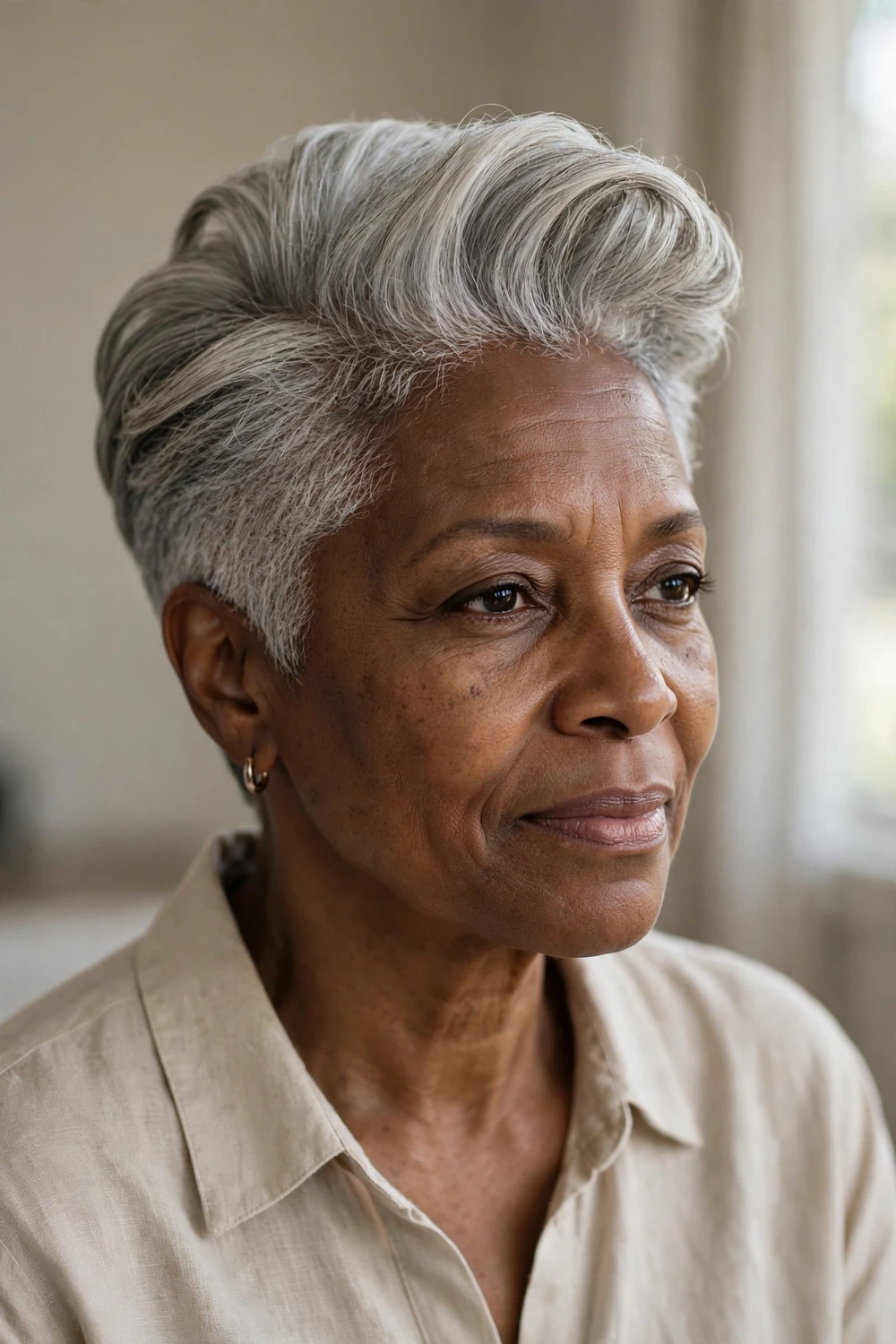
Volume swept up and back from the forehead, held with a deep side part, this style gives grey hair height and drama. The pompadour shape lifts the face and makes silver hair gleam under light, while the side part covers thinning at the crown better than a center part. A round brush and a strong-hold mousse build the shape; the look stays surprisingly wearable for everyday.
Try this: Blow-dry the front section up and over a round brush, then set the lift with a cool shot from the dryer. Difficulty: Hard
17. Side-Parted Precision Cut

Unlike the pompadour’s height, the precision cut is about a clean, deliberate part and a smooth, controlled shape. Hair is cut to fall neatly from a deep side part, with crisp lines around the ears and neckline. On grey hair the orderliness reads as confidence; every silver strand looks placed. It’s a low-fuss morning routine once the cut is in, since the part does most of the work.
Try this: Comb the part in while hair is damp and let it set as it dries so the line stays sharp all day. Difficulty: Easy
18. Textured Crop with Side-Swept Bangs

Short all over with texture through the top and bangs swept to one side, this crop is the definition of easy. The side-swept bangs soften the forehead and add a diagonal that flatters round and square faces. Grey hair’s natural coarseness actually helps here, giving the texture grip without much product. It’s one of the fastest styles on this list to get out the door with.
Try this: Rough-dry with your fingers, then smooth just the bangs with a brush so they lie flat while the top stays tousled. Difficulty: Easy
19. Sleek Tapered Cut
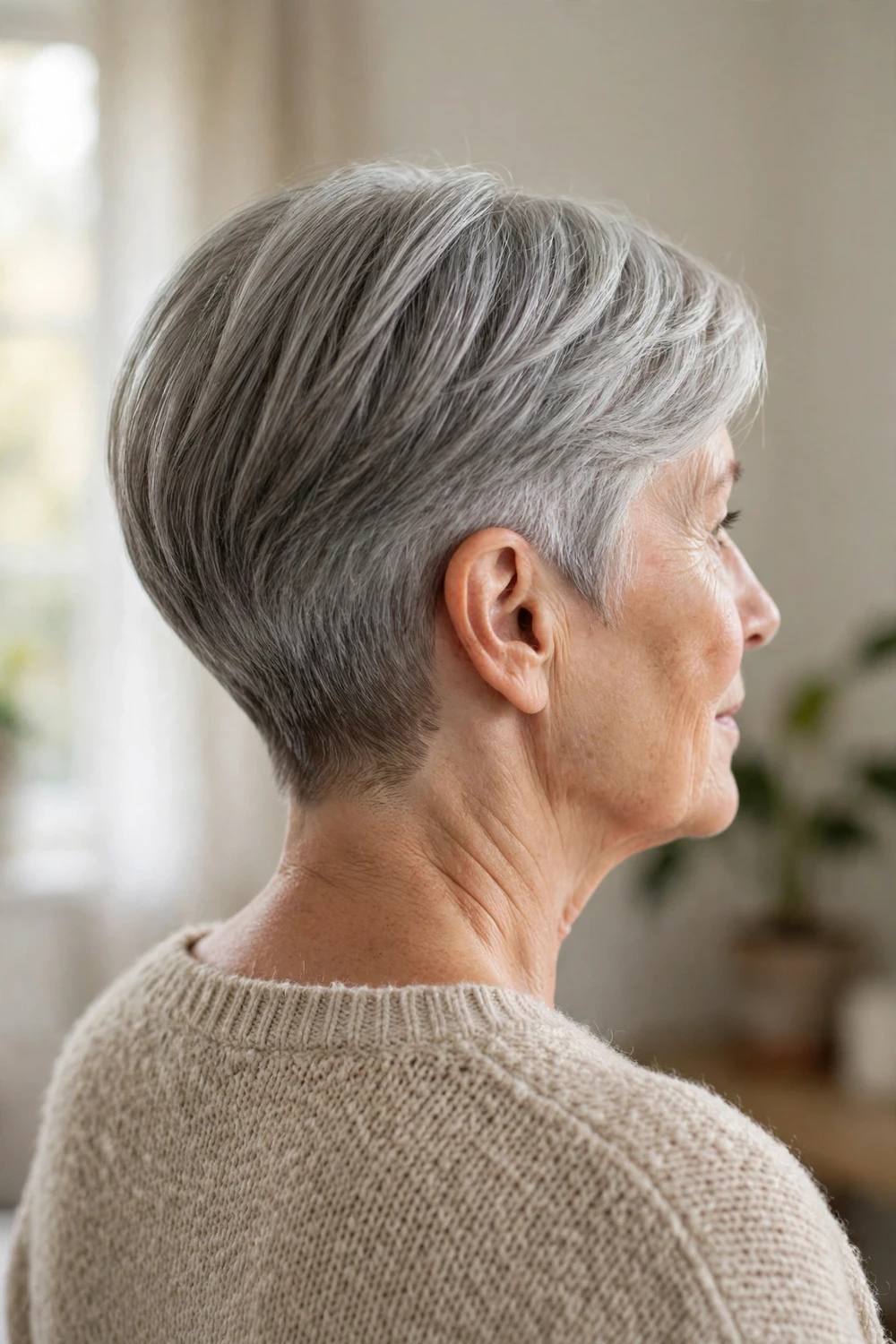
The taper is the quiet hero of this cut: hair shortens gradually toward the neckline, creating a clean silhouette that makes the neck look longer. The top stays long enough to smooth or add slight volume. On grey hair the tapered nape keeps the whole style looking crisp between trims, and it grows out more gracefully than a blunt neckline. It suits women who want polish without fuss.
Try this: Smooth the top with a flat iron once a week and leave the tapered back natural for a cut that stays neat with minimal effort. Difficulty: Easy
20. Stacked Salt-and-Pepper Bob

Graduated layers stacked at the back create a rounded shape that builds instant volume where grey hair often goes flat. The front stays longer to frame the face, and the salt-and-pepper mix of tones stands out in the stacked layers. This cut does more for fine hair than almost any other bob, but it needs trims every four to six weeks to keep the stacking crisp.
Try this: Dry the back sections with a round brush, lifting at the roots to emphasize the stacked shape. Difficulty: Medium
21. Voluminous Salt-and-Pepper Layers
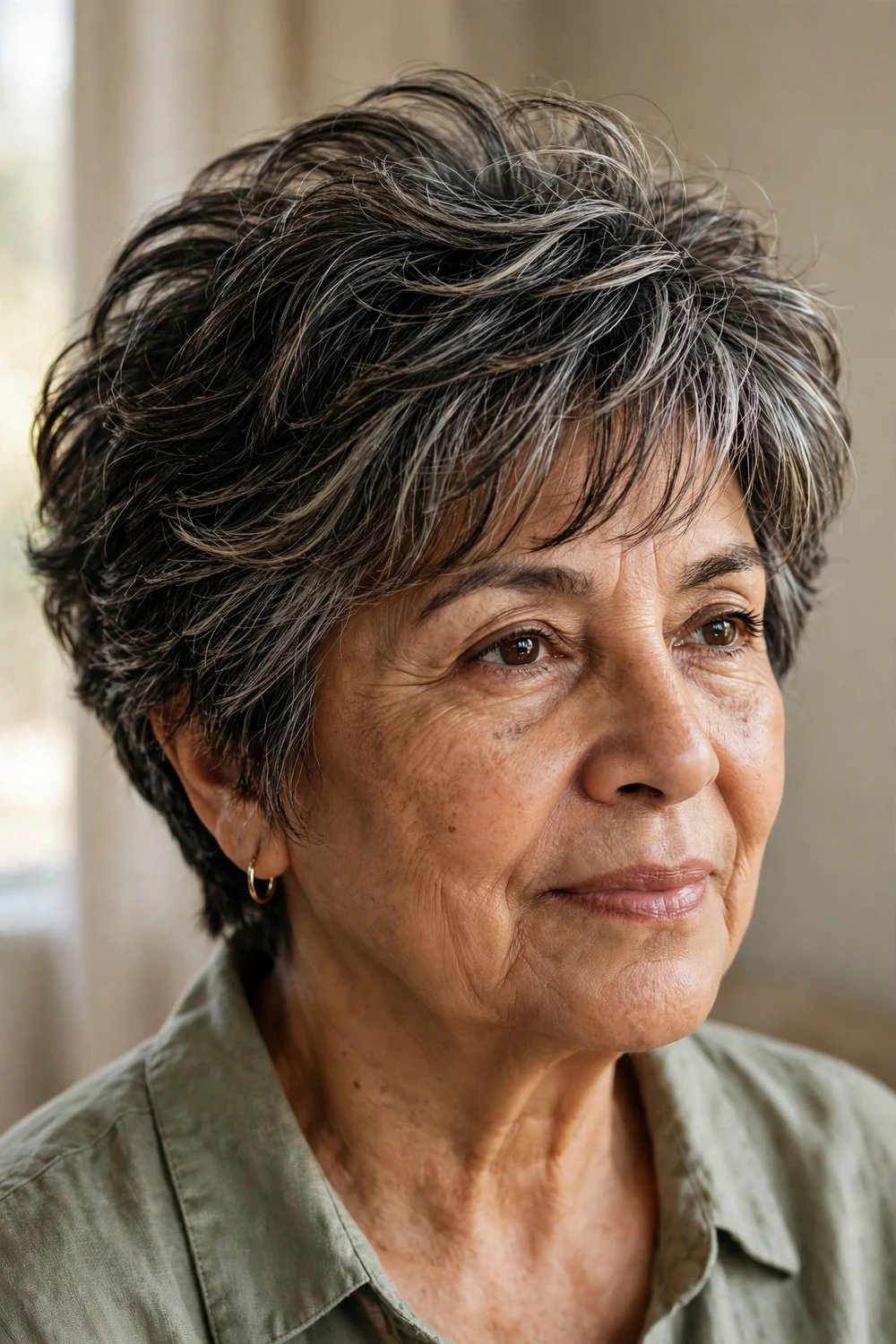
Where the stacked bob builds volume through graduation, this cut builds it through layers cut at multiple lengths all over. The mix of dark and silver strands separates visually, so hair looks thicker than it is. It’s less structured than a stacked bob, which means it grows out softly and suits wavy textures well. A volumizing mousse at the roots is the one product that matters here.
Try this: Apply mousse to damp roots only, then diffuse or air-dry to keep the ends from puffing out. Difficulty: Easy
22. Shaggy Silver Layers with Curtain Bangs
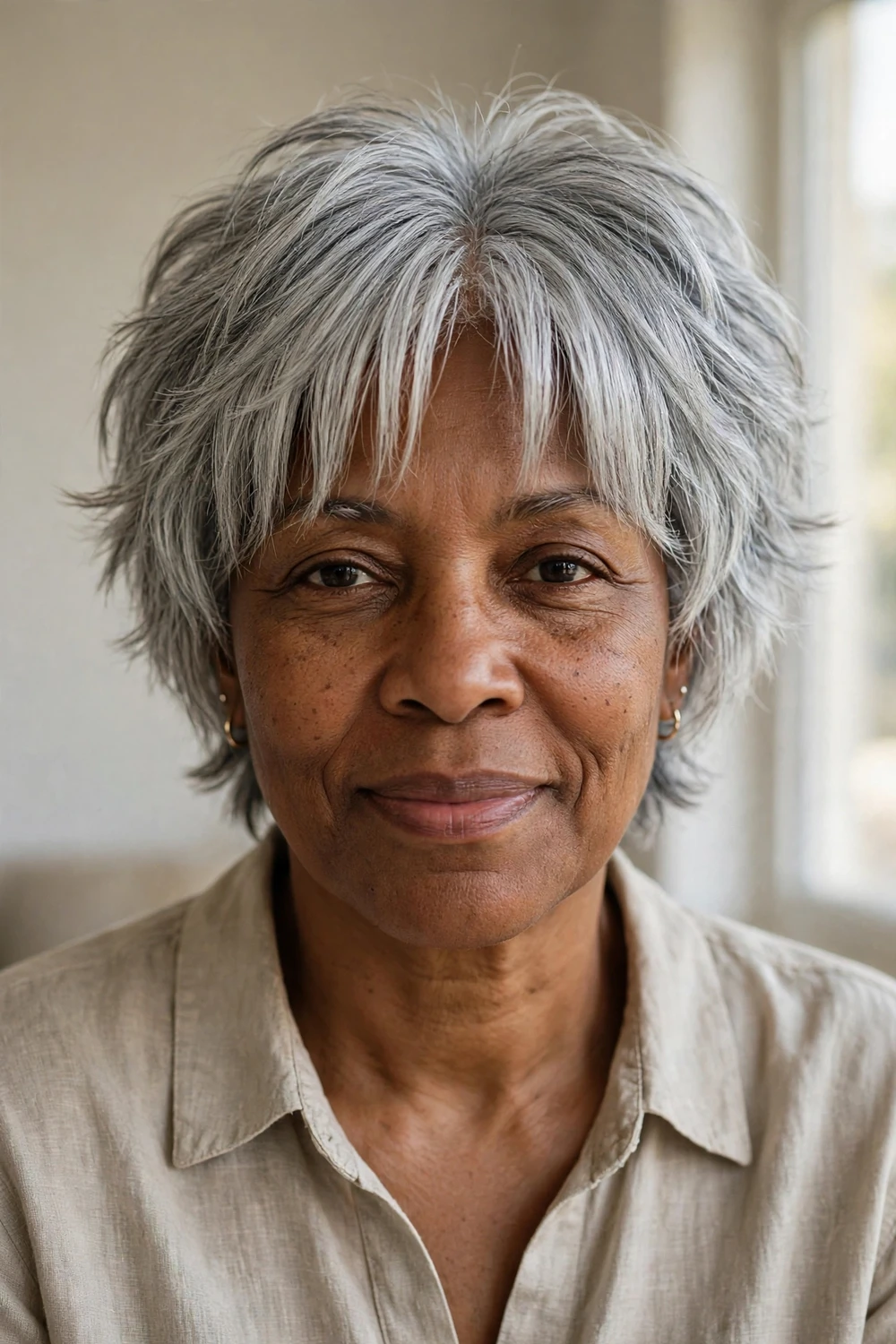
The shag’s choppy layers and the curtain bang’s center part are a natural pair on grey hair. Layers through the crown add fullness, while the curtain fringe opens up the face instead of closing it off. Silver’s dimension shows in every uneven layer, and the cut’s messiness means second-day hair looks as good as wash day. It’s the most forgiving style on this list for thick or coarse grey hair.
Try this: Part the fringe in the center and bend the ends outward with a round brush for the classic curtain shape. Difficulty: Easy
23. Feathered Gray Wispy Crop

Shorter than a bob and softer than a pixie, the wispy crop uses feathered ends all over to create a light, airy shape. Nothing sits heavy or blunt, so fine grey hair looks fuller and coarser hair looks tamed. The feathering around the ears and neckline keeps the grow-out soft, which stretches the time between trims. A light styling cream is all you need to define the feathers.
Try this: Emulsify a pea-sized amount of cream in your palms and pinch the ends to define the feathering without weighing it down. Difficulty: Easy
24. Curly Silver Pixie

Natural curls and a pixie are a strong combination that most lists skip. Kept close at the sides with length on top, curls form their own texture and volume with almost no styling. Grey curls reflect light from every angle, so the color looks rich and dimensional. The key is a stylist who cuts curls dry or understands shrinkage; a curl-by-curl cut keeps the shape even as it grows.
Try this: Scrunch a curl cream into soaking-wet hair and let it air-dry or diffuse for defined curls that last for days. Difficulty: Medium
25. Gray Pixie with Dark Roots

Letting dark roots show through a silver pixie isn’t a grow-out accident anymore; it’s a coloring technique. The darker base adds contrast and the illusion of density at the scalp, which flatters thinning hair, while the silver lengths stay bright on top. Root shadowing lasts eight to twelve weeks, so it cuts salon visits nearly in half compared to full grey blending.
Try this: Ask for a root shadow in a soft charcoal or dark ash rather than black for a blend that looks natural as it grows. Difficulty: Easy
26. Sleek Silver Undercut Crop

An undercut removes bulk from the sides and back while the top stays sleek and longer, creating a striking contrast that shows off silver’s shine. It’s a bold choice that reads modern at any age, and it makes thick grey hair far easier to manage by cutting the volume where it matters. The top can be worn smooth or textured, so one cut gives you two personalities.
Try this: Keep the undercut tight with trims every three to four weeks while letting the top grow for contrast. Difficulty: Medium
27. Longer Bob for Growing Out Gray
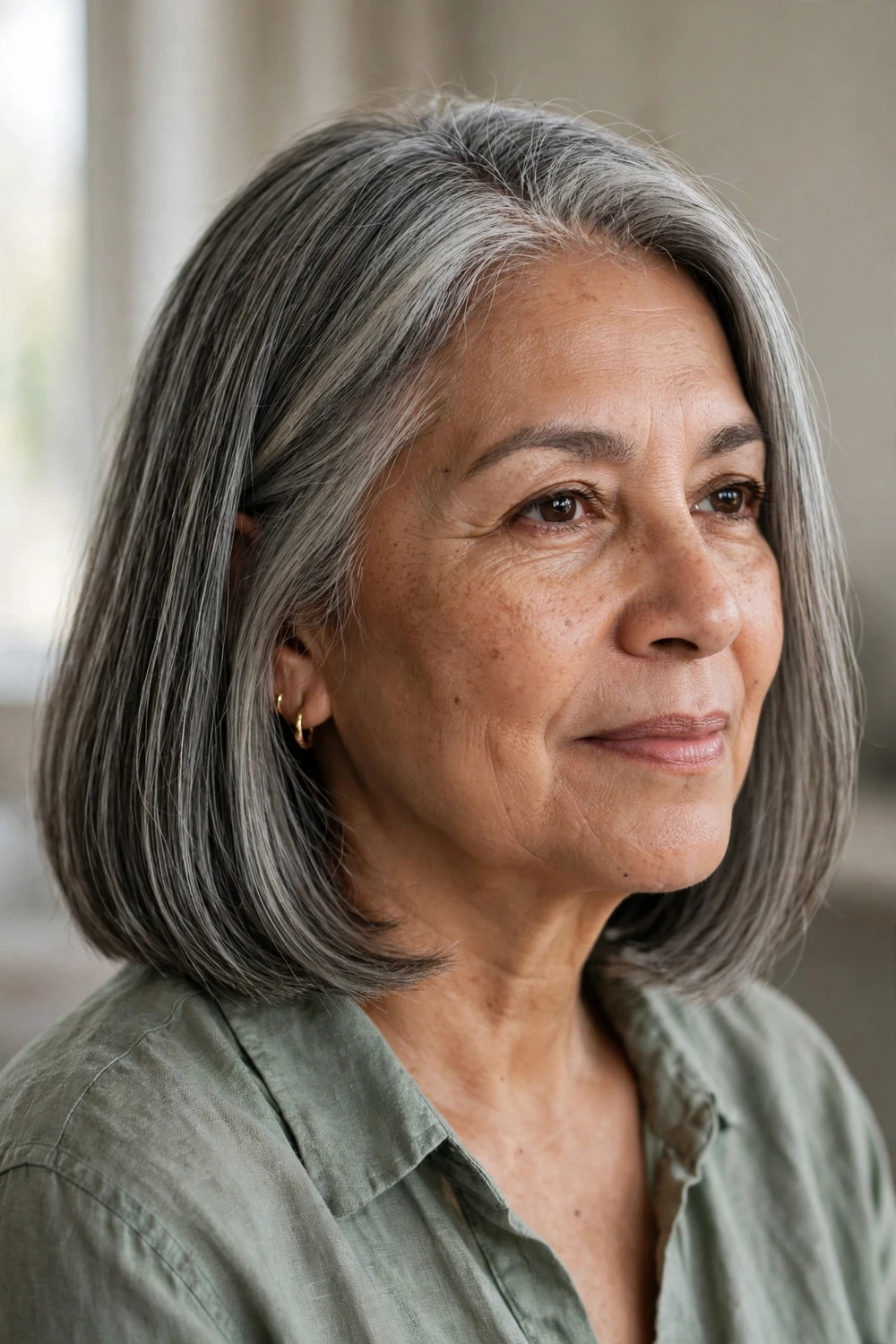
If you’re transitioning to natural grey, a longer bob is the kindest cut you can choose. The extra length gives you room to trim off old color gradually while the shape still looks finished, and the weight of the length helps the two textures blend. Ask your stylist to keep the ends blunt so the line between colored and natural hair stays clean as you cut it away over several appointments.
Try this: Schedule trims every eight weeks and take off half an inch to an inch each time until the old color is gone. Difficulty: Easy
Short Grey Hairstyles Comparison at a Glance
| Style | Best For | Styling Time | Upkeep |
|---|---|---|---|
| Classic Textured Silver Pixie | Fine hair needing fullness | Easy (5 min) | Trim every 6 weeks |
| Long Gray Pixie | Versatility, grow-out phase | Easy (5-10 min) | Trim every 6-8 weeks |
| Wispy Pixie with Crown Volume | Flat crown, fine hair | Easy (5 min) | Trim every 6 weeks |
| Spiky Silver Pixie | Bold looks, thick hair | Easy (5 min) | Trim every 5-6 weeks |
| Sophisticated Layered Bob | Most face shapes | Easy (10 min) | Trim every 6-8 weeks |
| Feathered Bob with Soft Layers | Fine hair, soft finish | Easy (10 min) | Trim every 6-8 weeks |
| Sleek Silver Blunt Bob | Straight hair, dense look | Medium (15 min) | Trim every 5-6 weeks |
| Classic Gray Bob with Bangs | High foreheads | Medium (10 min) | Bangs every 3-4 weeks |
| Layered Gray Bob with Wispy Fringe | First-time bangs | Easy (5 min) | Trim every 6-8 weeks |
| Sleek Angled Bob | Slimming the face | Medium (15 min) | Trim every 6 weeks |
| Soft Wavy Bob | Adding movement | Medium (15 min) | Trim every 6-8 weeks |
| Choppy Textured Bob | Hiding thin spots | Easy (5 min) | Trim every 6-8 weeks |
| Modern Asymmetrical Crop | Fine hair, modern edge | Medium (10 min) | Trim every 5-6 weeks |
| Black-and-Silver Ombré Bob | Growing out color | Medium (10 min) | Gloss every 6-8 weeks |
| Silver Bixie with Side Bangs | Most textures | Medium (10 min) | Trim every 6 weeks |
| Silver Side-Parted Pompadour | Drama, height | Hard (20 min) | Trim every 6 weeks |
| Side-Parted Precision Cut | Polished minimalism | Easy (5 min) | Trim every 6 weeks |
| Textured Crop with Side-Swept Bangs | Fast mornings | Easy (5 min) | Trim every 6 weeks |
| Sleek Tapered Cut | Clean neckline lovers | Easy (5 min) | Trim every 6-8 weeks |
| Stacked Salt-and-Pepper Bob | Maximum back volume | Medium (10 min) | Trim every 4-6 weeks |
| Voluminous Salt-and-Pepper Layers | Wavy texture | Easy (10 min) | Trim every 6-8 weeks |
| Shaggy Silver Layers with Curtain Bangs | Thick, coarse hair | Easy (5 min) | Trim every 8 weeks |
| Feathered Gray Wispy Crop | Soft, light shape | Easy (5 min) | Trim every 6-8 weeks |
| Curly Silver Pixie | Natural curls | Medium (10 min) | Trim every 8 weeks |
| Gray Pixie with Dark Roots | Thinning hair, low salon cost | Easy (5 min) | Shadow every 8-12 weeks |
| Sleek Silver Undercut Crop | Thick hair, bold style | Medium (10 min) | Undercut every 3-4 weeks |
| Longer Bob for Growing Out Gray | Color transition | Easy (10 min) | Trim every 8 weeks |
How to Choose the Right Short Grey Hairstyle for You
Start with your hair’s actual behavior, not the photo you like. Fine, slippery hair needs texture and layering to fake fullness; coarse, wiry grey needs weight removal and smoothing so it doesn’t expand. Your stylist can tell you which camp you’re in within seconds, so bring that question to the consultation, not just the picture.
Face shape matters, but less than most guides claim. A good short cut works with your bone structure by adding volume where you want width and keeping it close where you don’t. Round faces benefit from height at the crown and asymmetry; long faces do better with width at the sides and a fringe. If you wear glasses, bring them to the appointment so the cut is shaped around the frames.
Be honest about maintenance. A blunt bob and a precision cut look effortless but need frequent trims to stay sharp. A shaggy crop or textured pixie forgives an extra two weeks. Pick the cut that matches the schedule you’ll actually keep, because a neglected sharp cut looks worse than a well-kept casual one.
Mistakes to Avoid
The biggest mistake is cutting grey hair like it’s still your old hair. Grey strands are drier and more fragile, so razor-thin layering that worked at 40 can turn wispy at 55. Ask for weight removal with shears or point cutting instead of aggressive thinning shears, which can shred delicate grey ends.
Skipping purple shampoo is the second mistake. Silver and white hair picks up yellow from sun, heat, and even minerals in water. A purple or silver-depositing shampoo once or twice a week neutralizes it; daily use can leave a lavender cast, so don’t overdo it.
Finally, don’t fight your texture. Straightening naturally wavy grey hair every day causes breakage that short hair can’t hide. Choose a cut that works with the texture you wake up with, and save the heat tools for occasions.
If you like this list, you’ll find more age-specific ideas in our guide to short hairstyles for women over 50, which covers cuts for every hair type in this decade.
For readers dealing with finer strands, our roundup of short hairstyles for thin hair focuses on cuts that build the illusion of density.
If your grey hair has natural curl, don’t miss short curly hairstyles for women over 50 for curl-specific cutting and styling advice.
And if you’re considering a fringe with any of these cuts, see hairstyles for short hair with bangs to find the bang style that suits your face.
Frequently Asked Questions
What is the best short haircut for grey hair over 50?
The most flattering choice for most women is a textured pixie or a layered bob. Both add volume where grey hair tends to go flat, frame the face without hiding it, and keep silver tones bright. Your best pick depends on your texture: fine hair does better with a pixie, while coarse or wavy hair often suits a layered bob.
Does short hair make grey hair look thicker?
Yes, in most cases. Shorter strands have less weight pulling them down, so they lift at the roots and look fuller. Layered and textured short cuts multiply this effect by creating separation that the eye reads as density. Very fine hair can still look thin if the cut is one-length, so texture matters as much as length.
How do I keep grey hair from turning yellow?
Use a purple or silver-toning shampoo once or twice a week to neutralize yellow tones caused by sun, heat styling, and minerals in water. Limit heat styling, wear a hat in strong sun, and ask your stylist about a clear gloss treatment every couple of months. If your water is hard, a shower filter helps too.
How often should I trim a short grey hairstyle?
Most short cuts need a trim every six to eight weeks to hold their shape. Precision cuts like blunt bobs and undercuts need attention every three to six weeks, while shaggy and textured cuts can stretch to eight weeks. Bangs usually need a quick trim every three to four weeks between full appointments.
Should I grow out my grey hair with a pixie or a bob?
A bob is usually the easier grow-out cut because the length gives you room to trim off old color gradually while the style still looks finished. A pixie gets you to full natural grey faster but shows the color line more clearly during the transition. Either way, ask your colorist about blending or a root shadow to soften the line while you grow it out.
Final Thoughts
Grey hair over 50 isn’t something to work around; it’s the feature these cuts are built to show off. Pick the style that matches your texture and your real routine, keep up with trims and toning, and let the silver do the talking. I’ve watched the right short cut change how women carry themselves, and it never takes much more than the right shape.
