


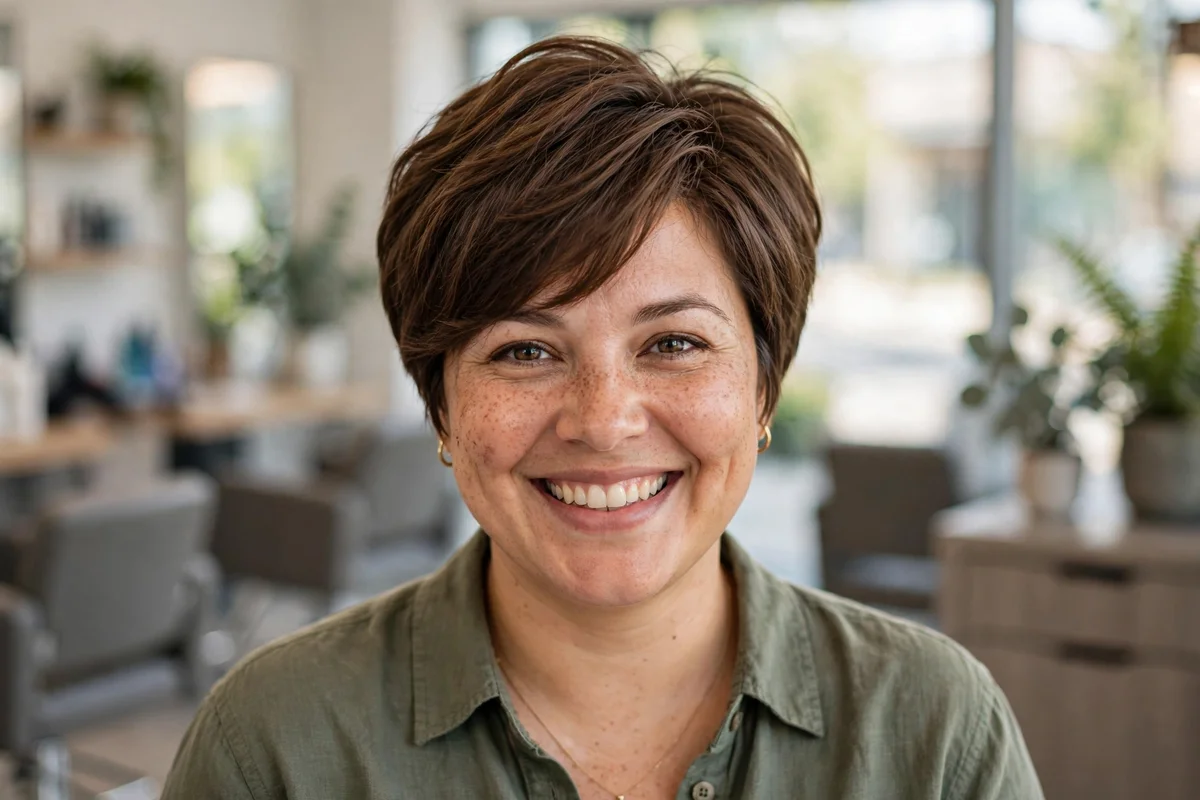
Can a pixie bob flatter a round face? Yes, when the cut follows three rules: height on top, sides kept close, and a diagonal line somewhere near the face. A pixie bob sits between a cropped pixie and a chin-length bob, so it gives you the cheek-slimming coverage of a bob with the crown lift of a pixie. Below are 20 short pixie bob haircuts for round faces, each chosen for how it lengthens, angles, or softens fullness.
Quick Takeaways
- Crown height is the fastest slimming trick. Even one inch of lift on top makes a round face read longer.
- Diagonal lines beat straight ones. Side-swept bangs, deep side parts, and asymmetry all break up roundness.
- Keep volume off the cheeks. Width at ear level widens the face; tucked or tapered sides do the opposite.
- Longer front pieces are your safety net. Ends that fall past the cheekbone create a slimming frame.
- Most of these need a trim every 5 to 7 weeks to keep the shape from growing out wide.
1. Side-Swept Bangs Pixie Bob

A long fringe swept across the forehead cuts a diagonal line right where roundness shows most. The rest of the cut stays close at the sides with soft texture through the crown, so the face looks narrower without losing softness. Ask your stylist to keep the bangs long enough to tuck behind one ear. Blow-dry the fringe with a flat brush directed to the side, then set it with a light-hold spray.
Try this: part the bangs on the opposite side of your natural part once a month to train new direction and add root lift.
Difficulty: Easy · Cost: $45–$70
2. Deep Side Part Pixie Bob

Moving the part two inches off center instantly builds asymmetry, and asymmetry is what makes round faces look slimmer. One side falls longer past the cheek while the other stays cropped close to the head. This version works best on straight or slightly wavy hair where the part line stays crisp. Use a fine-tooth comb to set the part while hair is damp, then blow-dry flat for a polished finish.
Try this: switch the deep part to the other side every few weeks so roots don’t go flat on one side.
Difficulty: Easy · Cost: $40–$65
3. Crown Volume Pixie Bob

Height on top is the single most reliable way to lengthen a round face, and this cut is built around it. Layers graduate shorter toward the crown so the top naturally stands up, while the sides and nape stay tapered and flat. A round brush and a volumizing mousse at the roots give you the lift in about ten minutes. If your hair is fine, ask for point cutting at the crown rather than blunt layers.
Try this: flip your head upside down for the last minute of blow-drying to lock in root lift without teasing.
Difficulty: Medium · Cost: $50–$75
4. Asymmetrical Pixie Bob

One side ends at the cheekbone and the other grazes the jaw, which pulls the eye along a diagonal instead of around a circle. The uneven hemline does the slimming work for you, so styling can stay simple. Keep the longer side sleek so the line reads clean, and let the shorter side show some texture. This cut photographs well because the asymmetry gives the face instant structure.
Try this: flat-iron only the longer side for contrast; leave the short side textured with a dab of paste.
Difficulty: Medium · Cost: $55–$80
5. Tapered Nape Pixie Bob

A closely tapered nape removes bulk where a round face needs it least, while the longer top keeps styling options open. The contrast between the neat back and the fuller crown creates an elongated silhouette from every angle. Ask your barber or stylist to taper with clippers at the nape and blend upward with scissors. Touch up the nape every three weeks to keep the line crisp.
Try this: style the top forward and slightly to the side on wash days when you want a softer, less severe look.
Difficulty: Easy · Cost: $40–$65
6. Curtain Fringe Pixie Bob

A curtain fringe that parts in the middle and falls past the cheekbones frames a round face like parentheses, narrowing the widest point. The rest of the pixie bob stays light and piecey so the overall shape never looks heavy. This suits wavy hair especially well because the fringe bends naturally around the face. Dry the fringe with a round brush curving away from the face on each side.
Try this: twist each curtain section once while damp, then release when dry for a soft bend without heat.
Difficulty: Easy · Cost: $45–$70
7. Textured Choppy Pixie Bob

Choppy, broken-up layers stop the eye from tracing a smooth circle around the face, which is exactly what you want. The uneven texture adds angles and movement, and a little height at the crown comes free with the layering. Work a pea-sized amount of texturizing paste through dry hair, pinching ends to separate them. If the idea of a shorter pixie-bob hybrid appeals to you, our short pixie cuts roundup shows how much texture a cropped cut can carry.
Try this: sleep on it and revive day-two texture with dry shampoo at the roots instead of washing daily.
Difficulty: Easy · Cost: $50–$75
8. Long Front Pieces Pixie Bob

When the front sections reach the jawline while the back stays pixie-short, you get a slimming curtain around the cheeks. This is the most forgiving option on the list because the longer front hides fullness even on days you don’t style it. Keep the back tapered so the shape doesn’t turn into a full bob. A flat iron pass on just the front pieces keeps the frame crisp.
Try this: tuck one front piece behind your ear when you want to show off earrings; the asymmetry still flatters.
Difficulty: Easy · Cost: $45–$70
9. Wispy Fringe Pixie Bob

A sheer, see-through fringe softens the forehead without the heaviness of a blunt bang, which can shorten a round face. The wisps draw attention to the eyes and break up the forehead into a narrower shape. Ask for the fringe to be point-cut so it falls in soft pieces rather than a solid line. This version grows out gracefully, so you can stretch trims to eight weeks.
Try this: sweep the wisps slightly to one side with your fingers while damp for an effortless angled effect.
Difficulty: Easy · Cost: $40–$60
10. Quiff Pixie Bob

A quiff pushes all the volume straight up and back, adding two or more inches of visual height above the forehead. Sides stay sleek and flat against the head, which keeps width away from the cheeks. Blow-dry the front section upward with a round brush, then lock it with a strong-hold pomade. This is a confident evening look that pairs well with statement earrings.
Try this: backcomb just the underside of the quiff section for lift that lasts through a long night out.
Difficulty: Medium · Cost: $50–$75
11. Stacked Pixie Bob

Stacked layers at the back build a rounded, lifted shape that adds height where a round face needs it, while the front stays longer to frame the cheeks. The graduation does the volumizing work, so even fine hair looks fuller. Dry with a round brush, rolling sections upward at the back to emphasize the stack. For more short styles built around face shape, see our short haircuts for round faces guide.
Try this: ask for the stack to start at the occipital bone so the lift sits high enough to lengthen the face.
Difficulty: Medium · Cost: $55–$80
12. Off-Center Part Tousled Pixie Bob

A slightly off-center part plus airy, undone texture keeps the look casual while the asymmetry quietly slims the face. The tousled finish stops the cut from looking severe, which suits anyone who wants a relaxed daytime style. Scrunch a lightweight mousse into damp hair and let it air-dry, then shake out the roots with your fingers. No round brush needed.
Try this: flip the part to the other side on day two for instant root volume without washing.
Difficulty: Easy · Cost: $45–$65
13. Soft Undercut Pixie Bob

A soft undercut removes weight from underneath while the top stays long enough to sweep across the face in a slimming diagonal. The hidden shortness keeps the silhouette narrow at the sides, which is the whole point for round cheeks. Wear the top smooth for work or piece it out for weekends. Grow-out is gentle because the undercut hides under the longer top layer.
Try this: keep the undercut area moisturized and trimmed every four weeks so the grow-out stays neat.
Difficulty: Medium · Cost: $55–$85
14. Feathered Pixie Bob

Feathered layers that flip outward at the ends create movement away from the face instead of hugging it, which opens up a round shape. The light, airy ends keep the cut from looking bulky at the jawline. Blow-dry with a round brush, turning ends outward, and finish with a flexible-hold spray so the feathers stay soft. This cut suits medium to thick hair best.
Try this: flip only the front layers outward and keep the crown smooth for a modern take on the classic feathered look.
Difficulty: Medium · Cost: $50–$75
15. Wavy Side-Sweep Pixie Bob

Natural waves swept to one side give you diagonal movement and cheek coverage in a single style. The wave pattern adds width only at the top, never at the ears, so the face reads longer. Enhance waves with a curl cream on damp hair and diffuse on low heat for definition. If your hair is naturally straight, a 1-inch curling iron on the top layer creates the same effect. Remember to use a heat protectant before any hot tool touches your hair.
Try this: pin the swept side loosely while it cools to train the wave direction for the whole day.
Difficulty: Medium · Cost: $50–$75
16. Sleek Polished Pixie Bob

Sleek and tucked close to the head, this version minimizes width everywhere it matters. A side part adds the one diagonal line the style needs, and glossy smoothness keeps it office-ready. Flat-iron small sections and finish with a shine serum, pressing the sides flat behind the ears. This is the lowest-volume option on the list, ideal if your hair is thick and tends to puff out.
Try this: run a few drops of serum over the surface as a final step to tame flyaways without weighing hair down.
Difficulty: Easy · Cost: $40–$60
17. Piecey Fringe Pixie Bob

A fringe separated into distinct pieces lets skin show through in vertical strips, which reads as length rather than width across the forehead. The separated texture continues through the cut for a cohesive, modern finish. Rub a tiny amount of wax between your fingertips and pinch the fringe into pieces after styling. For curly-haired readers, our curly pixie haircuts collection shows how piecey texture works on coils and curls.
Try this: cut the fringe slightly longer at the outer corners so it blends into the face-framing layers.
Difficulty: Easy · Cost: $45–$65
18. Voluminous Blowout Pixie Bob

A bouncy blowout with lifted roots and curved-under ends gives a round face the tall, full silhouette that slims it most. The volume sits high on the head while the ends tuck in at the jawline, creating an oval outline. Use a medium round brush and a volumizing spray, drying each section upward and away from the face. Set the style with a cool shot from the dryer.
Try this: wrap the top section in two large Velcro rollers while you do your makeup, then release for extra lift.
Difficulty: Medium · Cost: $55–$80
19. Shaggy Textured Pixie Bob

Choppy shag layers with a tousled fringe scatter the eye in every direction except around the cheeks. The lived-in texture adds edge while the longer pieces around the face keep it flattering. This cut air-dries well on wavy hair; on straight hair, a salt spray scrunched into damp ends builds the texture. Trim every six weeks so the shag keeps its shape instead of growing into a triangle.
Try this: flip your part to the deeper side on days you want a dressier version of the shag.
Difficulty: Easy · Cost: $50–$75
20. Tucked-Behind-Ear Pixie Bob

Tucking one side behind the ear removes width from the widest part of the face in one move, and it shows off earrings at the same time. The untucked side keeps its longer length to balance the look. This works as a styling variation on almost any pixie bob, which makes it the most versatile trick on this list. A small bobby pin behind the ear keeps the tuck secure all day.
Try this: tuck the side opposite your part for the strongest slimming diagonal.
Difficulty: Easy · Cost: $0 (styling trick)
How to Choose the Right Pixie Bob for Your Round Face
Start with your hair texture. Fine hair needs stacked or graduated shapes that build volume mechanically, since it won’t hold teased height for long. Thick hair does best with thinned-out, tapered cuts that remove bulk at the sides. Wavy or curly hair gets natural lift for free, so focus on keeping the sides controlled.
Next, think about maintenance. Undercuts and tapered napes need touch-ups every three to four weeks. Layered and shaggy versions stretch to seven or eight weeks between appointments. If you heat-style daily, pick a cut with a fringe you can refresh quickly, like the wispy or piecey fringe.
Avoid three things: blunt straight-across bangs that cut the face in half horizontally, one-length bobs that end right at the widest part of the cheek, and rounded cuts with volume concentrated at ear level. Every one of those adds visual width exactly where you don’t want it. If you love bobs generally, our bob hairstyles for round faces guide covers longer options with the same slimming principles.
Pixie Bob Comparison at a Glance
| Style | Slimming trick | Best hair type | Upkeep |
|---|---|---|---|
| Side-swept bangs | Diagonal fringe line | Straight, wavy | Low |
| Crown volume | Height on top | Fine, medium | Medium |
| Asymmetrical | Uneven hemline | Straight | Medium |
| Tapered nape | Narrow silhouette | Thick, straight | High (3-week touch-ups) |
| Curtain fringe | Cheek-framing parentheses | Wavy | Low |
| Stacked | Lifted back, longer front | Fine | Medium |
| Quiff | Vertical height | Thick, coarse | Medium |
| Sleek polished | Flat, tucked sides | Thick, straight | Low |
Frequently Asked Questions
Does a pixie bob suit a round face?
Yes. A pixie bob suits a round face when it adds height at the crown, keeps the sides close or tucked, and includes a diagonal element like side-swept bangs or an off-center part. Those three features visually lengthen the face. Cuts that add width at cheek level or end in a blunt line at the jaw are the ones to avoid.
Should round faces get bangs with a pixie bob?
Side-swept, curtain, wispy, or piecey bangs all flatter round faces because they create diagonal or vertical lines. Avoid heavy blunt bangs cut straight across, since a horizontal line emphasizes width. Longer bangs that reach past the cheekbone are the safest choice.
How short can a pixie bob go on a round face?
The back and nape can go very short, even tapered with clippers, as long as the top keeps enough length for crown volume and the front keeps pieces that fall past the cheek. Shortness at the back is not the problem; shortness all over without any framing is.
What is the difference between a pixie bob and a bixie?
The terms overlap heavily. A pixie bob generally keeps more bob-like length through the front and sides, while a bixie leans shorter and more textured like a grown-out pixie. For round faces, either works as long as the cut follows the height-on-top, close-at-the-sides rule.
How often should I trim a pixie bob to keep it flattering?
Most pixie bobs need a trim every five to seven weeks. Tapered napes and undercuts need attention every three to four weeks, while shaggy or layered versions can stretch to eight weeks. Once the shape grows wide at the sides, the slimming effect fades, so don’t skip appointments.
Final Thoughts
A round face and short hair are not enemies. Pick the pixie bob whose slimming trick matches your hair texture and your styling patience, then keep the shape trimmed so it stays narrow where it counts. If you want more inspiration, start at the PrimeHairPicks homepage and browse the face-shape guides from there.
