


Fulani box braids pair two well-known shapes in one set: cornrows in the Fulani pattern at the front, and square-parted box braids behind the crown. The front gives you the design, a center row, curved side rows, or a patterned part, and the back gives you loose braids you can style like any box braid set. This guide covers only that box braid version, in lengths from a bob to the waist.
Every idea below notes the braid size, where the pattern sits, and what the finish needs from you during the wear. If you want the wider family first, our general Fulani braids hairstyles guide covers curls, sew-ins, and loose ends too, and our different types of braids roundup shows where this style sits among other braid families.
Key Takeaways
- The Fulani part is at the front: a center row, side rows, or a drawn pattern in cornrows.
- The body of the style is box braids, so size and length choices work like any box braid set.
- Knotless starts and jumbo parts are the gentlest and fastest options in this list.
- Beads and cuffs are finishing details. Keep them light, and keep heavy beads on shorter sets.
- Cost bands only: $ is an own-hair or short set, $$ a standard salon install, $$$ a long, small, or detailed set.
1. Classic Center-Part Fulani Box Braids
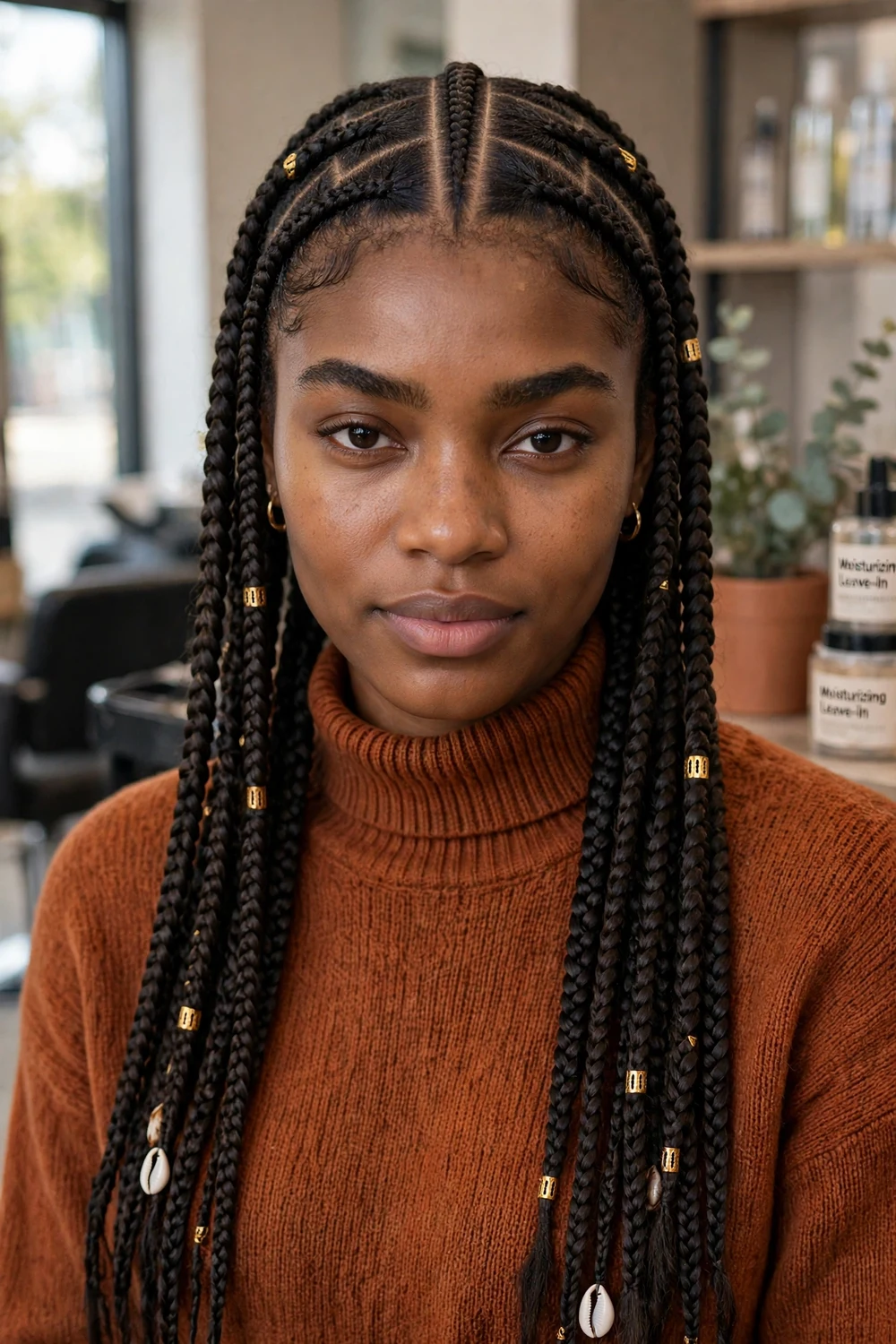
A single cornrow runs down the center of the head, with neat rows braided back from the hairline on each side. From the crown down, the hair changes into square-parted box braids that hang loose to mid-back or the waist.
This is the pattern to choose when you want the clearest Fulani shape with a box braid body. The parts stay visible from every angle, and the loose braids can be worn down, half up, or gathered into a low bun.
Try this: Ask for the center row to sit exactly on your natural center line, and check it in a mirror before the braider moves on to the sides.
Difficulty: Medium | Cost: $$ | Time: 5 to 7 hours
2. Side-Part Fulani Box Braids with Curved Rows

A deep side part sends curved cornrows sweeping across the front of the head instead of straight back. Behind the crown, medium box braids take over and fall mostly to one side when worn loose.
The curved rows soften the front and suit women who find a center part too severe. Because the box braids carry the length, you still get the same styling range as a standard set.
Try this: Bring a photo that shows the part depth you want. Side parts read very differently at the temple and at the crown.
Difficulty: Medium | Cost: $$ | Time: 5 to 6 hours
3. Medium Fulani Box Braids to the Chest

Medium box braids in back, a center or side cornrow pattern in front, and a length that stops at the chest. This middle size keeps the braids fine enough to move well without turning the install into an all-day job.
Chest length is a practical sweet spot. The braids are long enough for ponytails and buns, and light enough that they do not drag on the neck by evening.
Try this: Count on medium parts at the hairline even if the back goes slightly larger. The front is where the weight is felt most.
Difficulty: Medium | Cost: $$ | Time: 4 to 6 hours
4. Shoulder-Length Fulani Box Braids

The same Fulani front pattern, finished with box braids that end just past the shoulders. Shorter braids show the cornrow work at the front more clearly because there is less length pulling the eye down.
This length suits first-time braid wearers and anyone who works in a warm setting. The braids dry faster after washing and sit clear of most collars and straps.
Try this: Ask for the ends to be cut and sealed at one even line. Even ends make a shorter set look planned rather than unfinished.
Difficulty: Easy | Cost: $$ | Time: 3 to 5 hours
5. Waist-Length Fulani Box Braids with Lightweight Beads

Long box braids reach the waist, the front follows the classic center-row Fulani pattern, and a small number of lightweight beads sit at the very ends. The beads move and click softly as the braids swing.
Keep the bead count modest on a long set. A few beads per side give the sound and detail without adding real weight at the ends of already long braids.
Try this: Choose plastic or hollow wooden beads for length. Solid heavy beads belong on shorter sets only.
Difficulty: Hard | Cost: $$$ | Time: 6 to 8 hours
6. Fulani Box Braids with Wooden Beads on Short Ends

Short box braids, curved Fulani rows at the front, and wooden beads stacked two or three high on the braid ends. The shorter length carries the bead weight well and frames the face with detail.
Wood tones sit well with black and dark brown braiding hair. Stacking the beads at the front braids only is another option if you want less noise when you move.
Try this: Slide a small silicone band under each bead stack. It stops beads slipping off tapered ends during the wear.
Difficulty: Medium | Cost: $$ | Time: 4 to 5 hours
7. Fulani Box Braids with Gold Cuffs and Rings

Small gold cuffs and rings are clipped along the front rows and scattered through the box braids behind the crown. The metal detail replaces beads for women who want shine without anything hanging at the ends.
Cuffs go on after the install and come off just as easily, so you can wear them for an event and remove them for the rest of the week. Place most of them where light catches them, along the front and sides.
Try this: Buy cuffs in two sizes. Front rows are thinner than the box braids in back, and one size rarely fits both well.
Difficulty: Medium | Cost: $$ | Time: 5 to 6 hours
8. Knotless Fulani Box Braids

The front keeps the Fulani cornrow pattern, and the box braids in back are started knotless, with extension hair fed in a little at a time. There is no tight knot at the root, so each braid lies flatter from day one.
A knotless start is the comfortable route for a tender hairline. If you like the look of the live knotless braids hairstyles but want a patterned front, this set joins the two.
Try this: Tell your braider the front two rows matter most for comfort, and ask for those to be fed in the lightest.
Difficulty: Medium | Cost: $$ | Time: 5 to 7 hours
9. Jumbo Fulani Box Braids

Large cornrows at the front feed into jumbo box braids in back. Fewer, wider parts mean a shorter appointment, a bolder outline, and braids you can count at a glance.
Jumbo sets loosen sooner than smaller ones because each braid holds more hair, so plan a shorter wear window. The payoff is speed, both in the chair and at take-down.
Try this: Keep jumbo braids at or above mid-back. Jumbo parts plus waist length is a heavy mix for most scalps.
Difficulty: Easy | Cost: $$ | Time: 3 to 4 hours
10. Small Fulani Box Braids with a Center Row

Small box braids give the fullest finish in this list. The front follows the classic pattern with one center row and fine side rows braided toward the ears.
Small braids take the longest to install and to remove, and they reward that time with the longest neat wear. They also style the most like loose hair, from buns to half-up looks.
Try this: Book this size when you can protect a full day. Rushing small braids shows in uneven parts at the back.
Difficulty: Hard | Cost: $$$ | Time: 7 to 9 hours
11. Boho Fulani Box Braids with Curls Along Each Braid
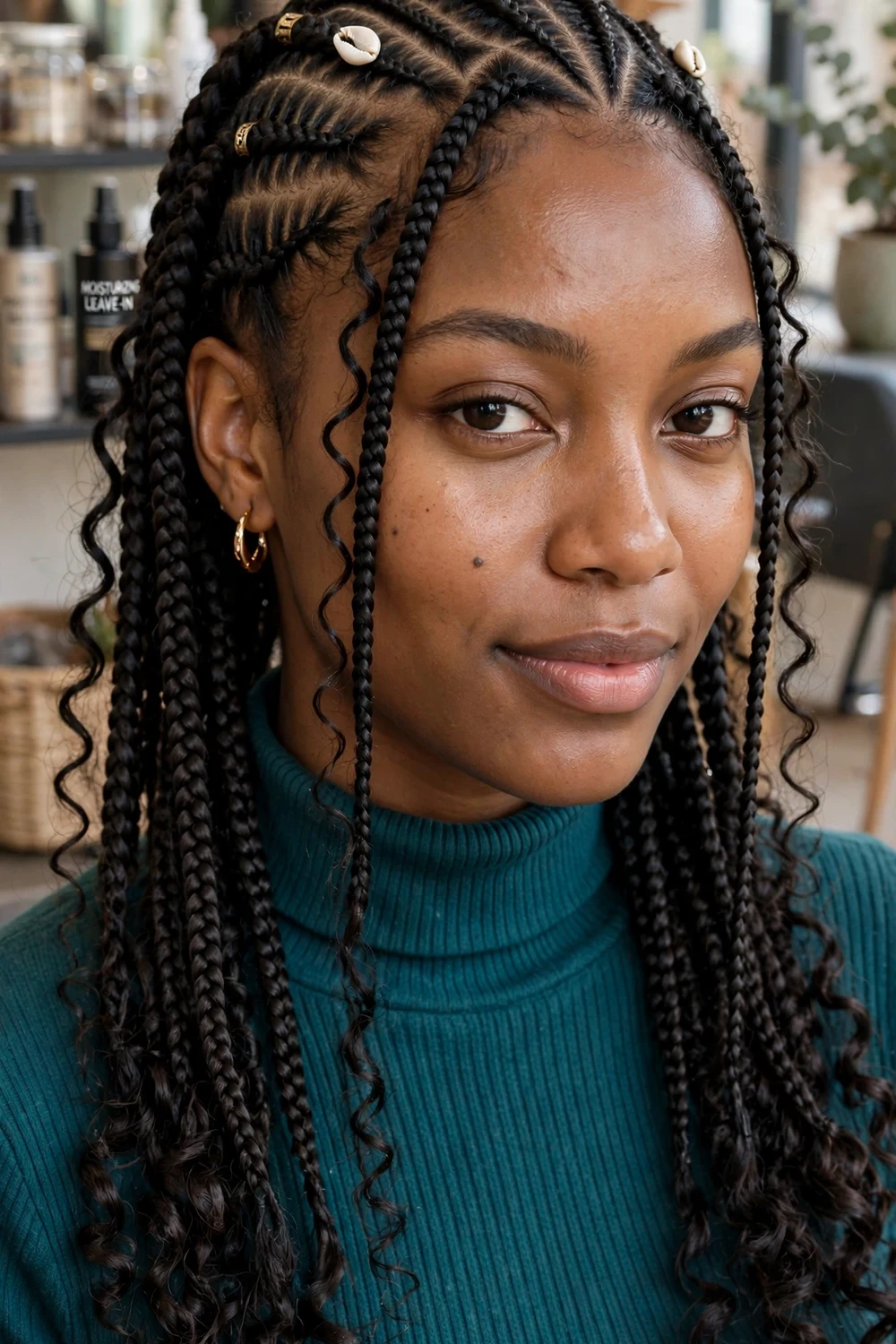
Curly pieces are left out along the length of each box braid, so the set looks soft and full from the first day. The front stays in neat Fulani rows, which keeps the hairline tidy while the back carries the curls.
Loose curl pieces need more care than the braids themselves. A light mousse worked through the curls every few days keeps them defined and stops them tangling against the braids.
Try this: Ask which curl hair your braider uses and how it behaves when wet. Curl pieces vary a lot between brands.
Difficulty: Hard | Cost: $$$ | Time: 6 to 8 hours
12. Goddess Fulani Box Braids with Curly Ends

Here the box braids stay smooth for most of their length and open into loose curls only at the ends. You get the neat lines of a standard set with a softer finish at the bottom.
Ends-only curls are easier to keep than full-length curls, because there is far less loose hair to separate each morning. Chest to mid-back lengths show the curl finish best.
Try this: Trim the curly ends lightly if they start to mat together. A small trim midway through the wear refreshes the whole set.
Difficulty: Medium | Cost: $$$ | Time: 5 to 7 hours
13. Fulani Box Braids with Copper Curls at the Ends

Black box braids finish in copper-toned curls, and a few rows at the front are braided straight back in the Fulani pattern. The color sits low, so the rows at the hairline stay black and the copper shows when the braids move.
Copper ends are a low-commitment way to wear color, since none of it touches your own hair. The shade suits warm skin tones well and reads clearly against black braids.
Try this: Match the copper to one item you wear often, a bag or a lip color. Worn color always looks more settled than color picked alone.
Difficulty: Medium | Cost: $$$ | Time: 5 to 7 hours
14. Flip-Over Fulani Box Braids

The front rows are braided so the whole set can be flipped from one side to the other, with no fixed part locking the braids in place. The box braids behind are kept even in length so the flip looks full on either side.
This is the set for women who change their part often. One install gives you a left part, a right part, and a middle fall across a single week.
Try this: Ask your braider to keep the rows near the front shallow and close together. Wide front rows gap when the set is flipped.
Difficulty: Hard | Cost: $$$ | Time: 6 to 8 hours
15. Fulani Box Braids Gathered into a High Ponytail

The braids themselves follow the standard Fulani front and box braid back, and the styling does the work here: the set is gathered high so the cornrow pattern reads from the front and the braids fall from one point.
A high ponytail keeps braids off the neck and shoulders for sport, travel, and warm days. Alternate high days with loose days so the same front braids are not pulled up every day.
Try this: Wrap the base with two or three of the braids themselves instead of a tight band. It looks finished and spreads the hold.
Difficulty: Medium | Cost: $$ | Time: 5 to 6 hours
16. Fulani Box Braids in a Half-Up Bun

The top half of the set is coiled into a bun at the crown while the rest of the box braids hang loose down the back. The Fulani rows at the front lead straight into the bun, so the pattern stays on show.
Half-up styling is a quick change that needs no extra install time, and it suits medium and long sets best. Shorter sets may not leave enough length hanging once the top is up.
Try this: Leave the two temple braids loose when you put the top up. Soft pieces at the front stop the bun looking severe.
Difficulty: Medium | Cost: $$ | Time: 5 to 6 hours
17. Zigzag-Part Fulani Box Braids
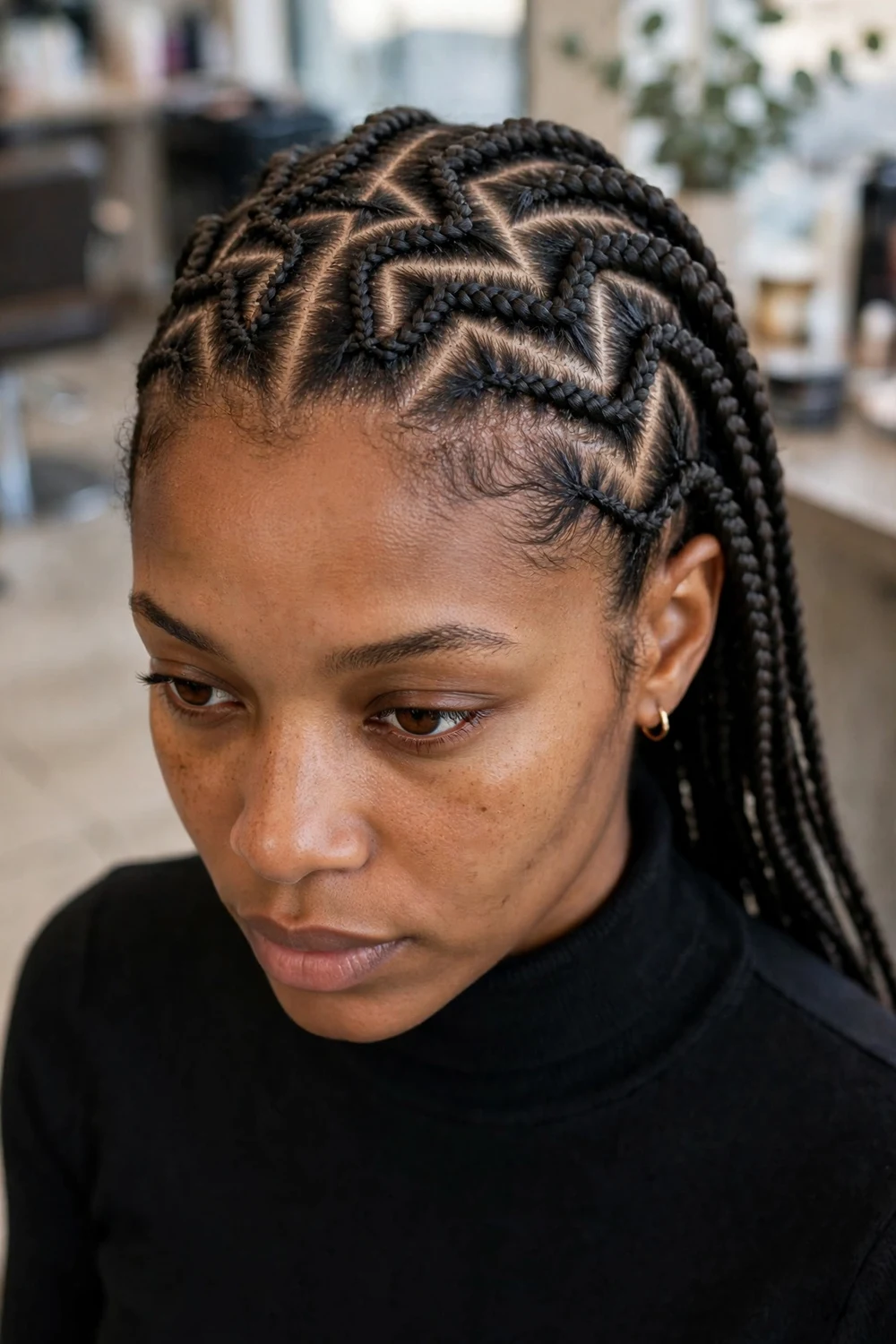
The front rows follow zigzag parts instead of straight lines, cutting sharp angles across the crown before the box braids begin behind. The pattern is drawn with the comb first, then braided row by row.
Zigzag parts suit women who want the design to be the detail, with no beads or cuffs needed. Keep the braids themselves plain black so the parts carry the look.
Try this: Ask to see the part map drawn before any braiding starts. Zigzags are hard to correct once two or three rows are in.
Difficulty: Hard | Cost: $$$ | Time: 6 to 7 hours
18. Criss-Cross Fulani Box Braids
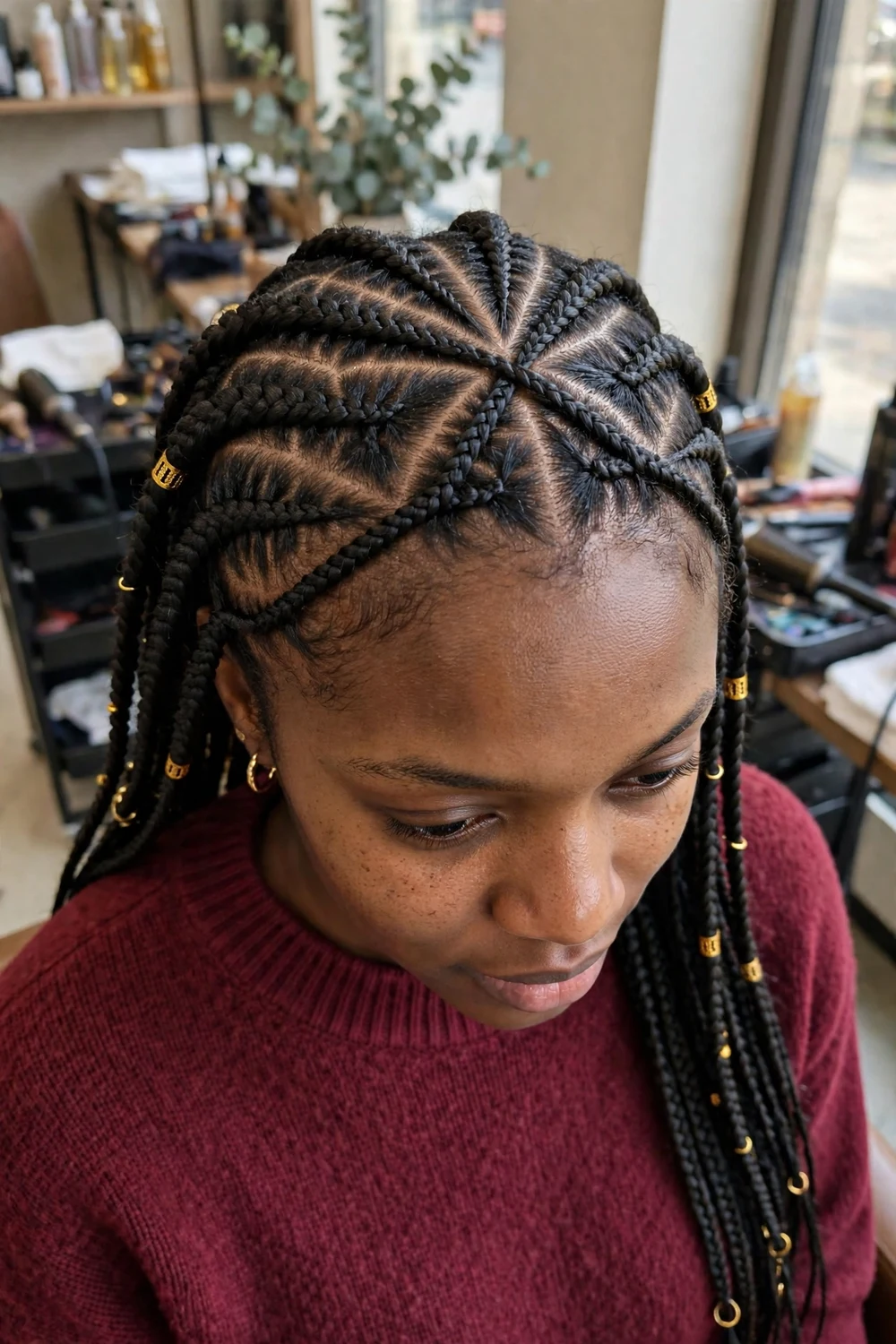
Front rows cross over each other in an X pattern at the crown, held with small clear bands at each crossing, before the hair drops into box braids at the back. The crossings sit flat and read clearly from above and from the front.
This pattern takes a braider who plans the whole map first, because each row has to land in the right place for the crosses to line up. Bring a clear reference photo to the appointment.
Try this: Keep the bands at the crossings snug rather than tight, and check them weekly. Bands that bite into the row below it will show as a kink.
Difficulty: Hard | Cost: $$$ | Time: 6 to 8 hours
19. Fulani Box Braids with Heart-Shaped Parts

A heart shape is parted and braided into the rows at one side of the crown, with standard Fulani rows around it and box braids behind. The heart can sit over the ear or higher at the temple.
One heart is usually enough. A single clear shape reads as a design, while several small ones can blur together once the braids settle.
Try this: Choose the side you photograph most for the heart placement. It only shows well from that side and from above.
Difficulty: Hard | Cost: $$$ | Time: 6 to 7 hours
20. Fulani Box Braids with a Swirl Crown Design

Curved rows loop and swirl across the crown in a freestyle pattern, then straighten into box braids behind. The back and top views carry this design, so it suits women who wear their braids up often.
Swirl work is drawn freehand, which makes braider choice matter more here than in any other idea in this list. Look at the braider’s own photos of curved work before booking.
Try this: Keep the swirls in the crown area only and the front rows simple. A calm hairline keeps the design comfortable to wear.
Difficulty: Hard | Cost: $$$ | Time: 6 to 8 hours
21. Snake-Pattern Fulani Box Braids

The front cornrows wave side to side in a snake pattern instead of running straight back. Each row mirrors the one beside it, and the box braids behind stay plain so the wavy rows stand out.
Snake rows take longer than straight rows of the same size because the braider changes direction constantly. Medium rows show the wave most clearly; very small rows can blur it.
Try this: Ask for the waves to be wide and even. Tight, narrow waves read as uneven straight rows from a distance.
Difficulty: Hard | Cost: $$$ | Time: 6 to 7 hours
22. Fulani Box Braid Bob

Box braids are cut into a bob that ends between the chin and the shoulders, with a short Fulani row pattern at the front. The bob line is blunt, and the front braids can be left slightly longer to frame the face.
A braided bob gives the shape of a haircut with none of the daily heat styling. It is also one of the lightest long-wear options here, which suits fine hairlines well. For more short braid shapes, compare the sets in our box braids hairstyles for Black women guide.
Try this: Have the bob cut after the install, on dry braids, while you sit upright. Cutting braids while they hang in sections can leave one side longer.
Difficulty: Medium | Cost: $$ | Time: 4 to 5 hours
23. Honey-Blonde Fulani Box Braids

Honey-blonde braiding hair runs through the box braids in back, mixed with black so the set reads warm rather than fully blonde. The Fulani rows at the front can stay black or carry one blonde row each side.
Blonde mixed through black braids shows the square parts clearly, which makes this a good color choice if neat parting is your favorite part of the style.
Try this: Keep the blonde share near a third of the braids. Past half, the set starts to read as blonde braids with black mixed in, which is a different look.
Difficulty: Medium | Cost: $$$ | Time: 5 to 7 hours
24. Ombre Fulani Box Braids in Dark Brown to Copper

Each box braid starts dark brown at the root and fades to copper toward the end, while the front rows stay dark so the Fulani pattern reads clean. The fade lands around shoulder height on a mid-back set.
Ombre braiding hair does the color work, so your own hair keeps its shade. Because the front stays dark, new growth at the hairline blends in for longer.
Try this: Check the fade point on one finished braid before the set continues. Fades that land at different heights look untidy across a full head.
Difficulty: Medium | Cost: $$$ | Time: 5 to 7 hours
25. Fulani Box Braids on Natural Hair Without Extensions

The whole set is braided from your own hair: Fulani rows at the front and small box braids behind, with no extension hair added. The length is whatever your hair gives you, usually at or above the shoulders.
With no added hair there is no extra weight and take-down is quick. The trade is a shorter wear window, since own-hair braids soften and frizz sooner than extension sets.
Try this: Stretch and fully detangle your hair the night before. Own-hair box braids show every tangle as a bump along the braid.
Difficulty: Easy | Cost: $ | Time: 2 to 4 hours
26. Fulani Box Braids with Two Face-Framing Temple Braids
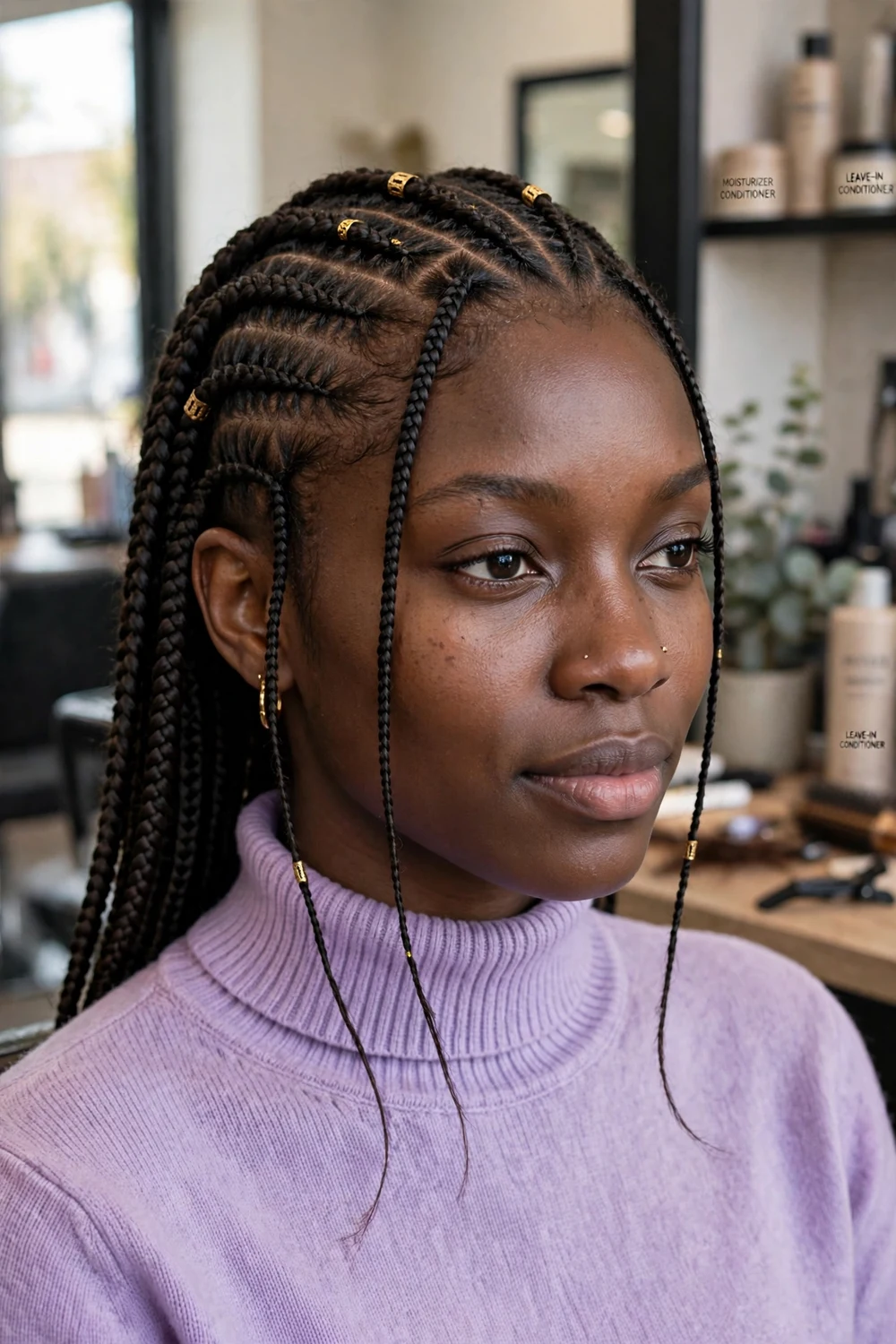
Two thin braids are brought forward in front of each ear to frame the face, while the rest of the set follows the standard pattern: Fulani rows on top and box braids behind. The temple braids can carry a single cuff or small bead each.
Those two forward braids change how the whole set sits on the face, softening the pulled-back look that braids can have. Keep them thin so they move like loose strands.
Try this: Decide the temple braid length before the install. Chin length frames the jaw; cheekbone length frames the eyes, and the two read very differently.
Difficulty: Medium | Cost: $$ | Time: 5 to 6 hours
At a Glance: Compare the Main Fulani Box Braid Choices
| Style | Best for | Install time | Typical wear |
|---|---|---|---|
| Classic Center-Part Fulani Box Braids | A first Fulani set | 5 to 7 hours | 6 to 8 weeks |
| Knotless Fulani Box Braids | A tender hairline | 5 to 7 hours | 6 to 8 weeks |
| Jumbo Fulani Box Braids | The fastest install | 3 to 4 hours | 4 to 6 weeks |
| Fulani Box Braid Bob | Low weight and easy drying | 4 to 5 hours | 5 to 7 weeks |
| Boho Fulani Box Braids with Curls Along Each Braid | Fullness and loose curl texture | 6 to 8 hours | 5 to 7 weeks |
| Fulani Box Braids on Natural Hair Without Extensions | No added hair at all | 2 to 4 hours | 3 to 4 weeks |
| Small Fulani Box Braids with a Center Row | The longest neat wear | 7 to 9 hours | 7 to 8 weeks |
Frequently Asked Questions
How long do Fulani box braids take to install?
Most sets take between four and eight hours. Jumbo and shoulder-length sets sit at the short end, while small braids, boho curls, and detailed patterns such as swirls and criss-cross rows take the longest.
What makes box braids Fulani box braids?
The front pattern. Regular box braids are parted in squares across the whole head, while Fulani box braids add cornrows at the front in the Fulani pattern, usually a center row or curved side rows, with box braids behind the crown.
How long can you keep Fulani box braids in?
Plan on six to eight weeks at most for extension sets, and less for jumbo braids and own-hair sets, which loosen sooner. If the front rows start to pull or feel sore, take the set down earlier rather than pushing through.
Can you wash Fulani box braids?
Yes. Cleanse the scalp gently between the rows, rinse well, and let the braids dry fully before tying them up. Keeping wash days simple helps the rows stay neat for more of the wear.
Do beads and cuffs damage the braids?
Lightweight beads and smooth cuffs used in small numbers sit fine on finished braids. Heavy beads on long braids add pull at the ends, so keep beaded sets shorter or the bead count low.
Final Thoughts
Start with the front pattern you like most, then choose braid size and length around your schedule and your hairline. A classic center-part set in medium braids is the safest first install, knotless starts are the kindest at the edges, and the patterned sets reward a braider whose own photos show clean part work. Pick one set, wear it well, and let the next install carry the next pattern.

