

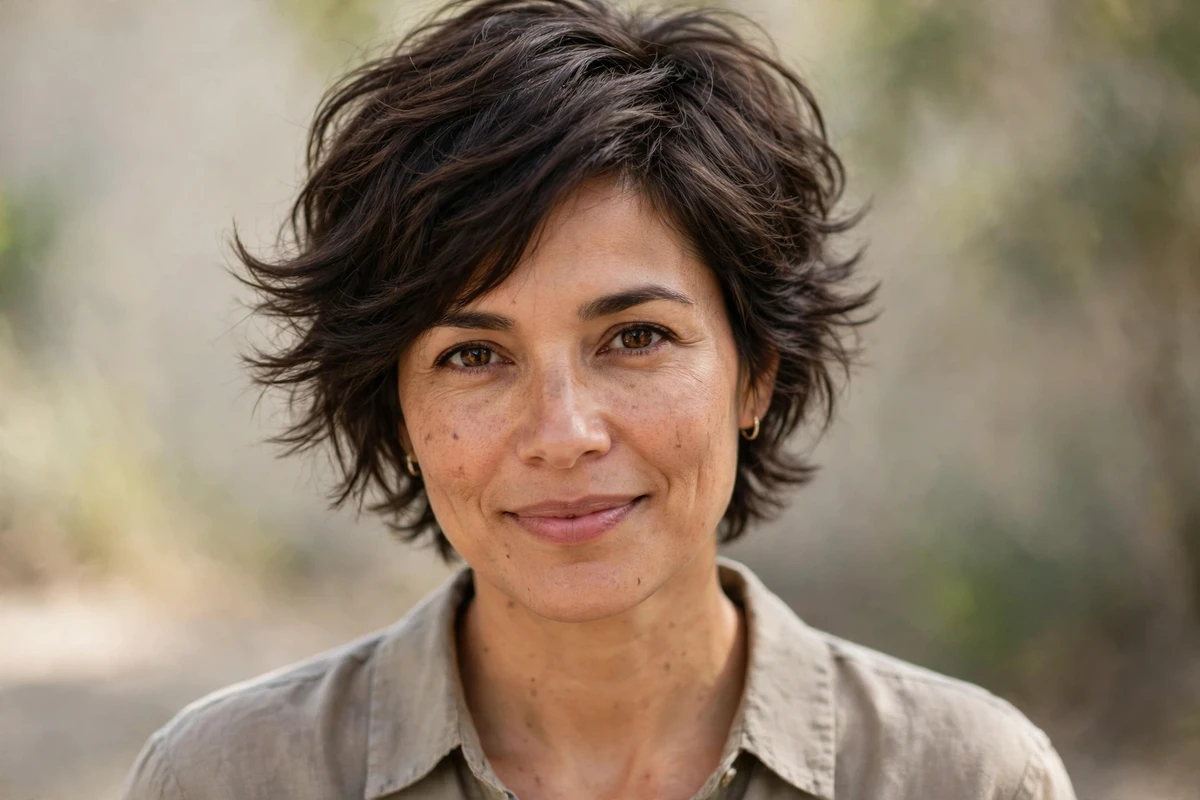
Thick hair is a gift that comes with conditions. In a pixie bob, extra density can either become sculptural shape or turn into a triangle that puffs outward by noon. The difference is not how much hair you have, it is how the cut is engineered. Interior weight removal, stacked backs, undercuts, and tapered perimeters turn bulk into structure, so the bixie sits close, moves freely, and grows out gracefully.
This list rounds up 23 pixie bob haircuts for thick hair, each built around a specific density-solving technique. These are not general-audience bixies that happen to work on thick hair. Every cut here is engineered for density first, so you get a shape that behaves from the first wash. I’ve spent years watching short-hair trends cycle, and the bixies that survive are the ones cut to work with a person’s thickness rather than against it.
Quick Takeaways
- Every cut here solves the same three problems: debulking, de-poufing, and shaping the perimeter so it does not mushroom.
- Interior weight removal matters more than thinning the ends, which is why stacked backs and undercuts anchor this list.
- Tapered napes and undercuts are the two strongest moves for hair that swells at the bottom.
- Trims every four to six weeks keep the silhouette from turning blocky as density grows in.
- Ask your stylist to name the technique, like point cutting or interior layering, so you know the bulk is being cut out on purpose.
1. Stacked Back Bixie

The stacked back is the classic answer to thick hair at pixie bob length. Graduated layers are cut shorter at the nape and longer through the crown, which collapses bulk into a smooth, curved shape instead of letting it flare outward. Your stylist sculpts the back of the cut to hug your neck, and that shaping is what stops the dreaded triangle silhouette. The front keeps enough length to frame the face, so you still get the bob side of the bixie.
It suits straight to wavy thick hair and most face shapes, with round faces getting extra benefit from the height it builds at the crown. Blow-dry the back with a round brush angled toward the nape to reinforce the curve, and the shape holds for days. A smoothing cream through the mid-lengths keeps the graduation looking seamless between appointments. A quick pass with a flat iron over the very back on day three smooths any pieces that have lifted as the layers settle.
Try this: ask for the nape cut as close as your thickness allows, since a tight nape is what locks the stack in place.
Difficulty: Medium · Cost: $$ (salon)
2. Undercut Bixie

Nothing removes bulk from a pixie bob as decisively as an undercut. The hair underneath is clipped short along the nape and lower sides, while the longer top layers fall over it to hide the shaved section. Thick hair can swell to twice its intended volume at the bottom edge, and the undercut simply deletes that whole layer of density. What is left is a bixie that looks light and moves freely, even in humid weather that normally makes thick hair expand.
It works on straight, wavy, and curly thick hair, and the hidden undercut grows out without an awkward stage because the top layers cover it. Ask your stylist how high to take the undercut, since a conservative nape-only version is office-friendly while a higher version reads edgier. A dab of matte paste through the top layers keeps them separated and moving over the undercut. Ask your stylist to keep the undercut slightly longer if you wear high collars that rub against the nape.
Try this: start with a nape-only undercut at your first appointment, and go higher only if you want more bulk removed.
Difficulty: Medium · Cost: $$ (salon)
3. Tapered Bixie

The taper is the subtler cousin of the undercut, and many women with thick hair prefer it. Instead of clipping underneath away entirely, your stylist gradually shortens the hair along the sides and nape so density fades into the head shape. The technique removes just as much lower bulk as an undercut but keeps a soft, blended edge rather than a hard line. The longer textured top contrasts against the tight sides, which is exactly the bixie balance of pixie edge and bob length.
It suits straight to slightly wavy thick hair and flatters square and oval faces particularly well, since the close sides slim the lower face. Maintenance is straightforward: the taper needs refreshing every four to five weeks to stay crisp, but the top grows out with minimal drama. Blow-drying the crown with lift and keeping the sides smoothed down preserves the contrast that makes the cut work. A touch of light-hold wax along the hairline keeps the close sides looking tidy through humid afternoons.
For more short cuts that rely on a clean, close nape for easy upkeep, these short pixie haircuts for older women gather flattering low-maintenance options.
Try this: ask your stylist to blend the taper with shears rather than clippers for the softest grow-out on thick hair.
Difficulty: Medium · Cost: $$ (salon)
4. Ear-Length Crop Bixie

When thick hair needs maximum weight removal, the ear-length crop bixie goes as short as the bixie family allows while staying out of true pixie territory. Cutting everything to ear length deletes the weight that pulls a longer bixie downward and outward, and the shattered texture breaks the surface so density reads as movement rather than mass. There is simply less hair left to swell, which makes this the most humidity-proof cut on this list.
It suits bold personalities and strong jawlines, and it works on straight, wavy, and coarse textures alike. The short length means styling takes minutes: a pea-sized amount of texturizing paste roughed through with your fingers is usually enough. Because short thick hair grows out into visible bulk faster, plan on trims every four weeks to keep the shape sharp. Thick hair grows out evenly at this length, so the cut keeps its character right up until the next appointment.
Try this: have your stylist remove weight from underneath first, then cut the length, so the texture stays intentional.
Difficulty: Low · Cost: $ (salon)
5. Jaw-Length Soft Layer Bixie

Sitting at the longer end of the bixie spectrum, the jaw-length version keeps the bob side of the hybrid fully visible. Soft blended layers are the density tool here: instead of blunt weight at one level, the length is distributed across graduated layers so thick hair drapes rather than sits. The jaw length also skims past the widest point of many faces, which softens the overall effect of a full, thick cut. It is the most versatile bixie for anyone easing down from longer hair.
It suits nearly every face shape and works on straight, wavy, and thick curly hair that has been stretched or blown out. Air-drying works surprisingly well because the layers are cut to fall into place, and a quick smoothing pass with a flat iron polishes the ends for evenings out. Ask for interior layering rather than thinning shears alone, so the bulk comes out of the body of the hair and not just the ends.
Try this: part it on the side for a week, then the middle, since this length supports both parts well.
Difficulty: Low · Cost: $$ (salon)
6. Choppy Textured Bixie

Chunky, broken-up layers are one of the most effective ways to debulk thick hair without an undercut. The choppy textured bixie cuts the surface into irregular pieces of varying lengths, so the eye reads movement and air instead of a solid mass of hair. Each chunk is cut to sit on the one below it, which lets the interior layers support the shape while the surface looks undone. On thick hair, this is the texture that turns weight into style.
It suits wavy and straight thick hair best and flatters oval and square faces, since the broken edges soften strong jawlines. Styling is delightfully low-effort: a texturizing paste worked through dry hair defines the chunks, and second-day hair often looks better than freshly washed. The trade-off is maintenance, because choppy ends blur as they grow, so trims every four to five weeks keep the edges intentional. Between appointments, a salt spray on damp roots revives the chunky separation without a full restyle.
Try this: twist small sections while blow-drying to exaggerate the choppy separation on thick hair.
Difficulty: Medium · Cost: $$ (salon)
7. Wispy Bangs Bixie

Bangs on thick hair can go wrong fast, turning into a heavy shelf that overwhelms the face. Wispy bangs solve that by keeping the fringe light and see-through at the ends while the bixie behind them does the heavy lifting. The fringe is thinned and point-cut so it moves, and because the ends are feathered, the bangs blend into the face-framing layers instead of sitting apart from them. You get the face-framing effect without the extra weight.
It suits straight to wavy thick hair and flatters high foreheads and long faces especially well. Ask your stylist to cut the bangs longer than you think you want, since thick fringe springs up and shorter bangs can look severe. A round brush flicked through the bangs in the morning keeps them airy, and they need only a tiny amount of product to stay separated. Blot the bangs with a tissue midday if your forehead gets oily, since thick fringe picks up shine faster.
Try this: thin the bangs from underneath rather than over the top, which keeps the surface looking full but light.
Difficulty: Medium · Cost: $ (salon)
8. Curtain Bangs Bixie

Curtain bangs are the smartest fringe for thick hair because they distribute the fringe weight across both sides of the face instead of stacking it across the forehead. On a bixie, the center-parted bangs open out and melt into the face-framing layers, which means no thick fringe wall and no daily battle to keep it in place. The open center also lets the cut show off the textured top, which is where a bixie gets its character.
It suits wavy and straight thick hair and flatters nearly every face shape, with round faces gaining extra benefit from the vertical lines the parted bangs create. Blow-dry the bangs forward with a round brush, then split them at the center so they sweep outward. Because they grow out into face-framing layers, curtain bangs on a bixie are one of the most forgiving fringe choices you can make. If one side resists the sweep, a quick blast with the dryer in the right direction retrains it in seconds.
Try this: dry the curtain bangs while they are almost dry, not sopping wet, so thick hair does not puff at the roots.
Difficulty: Low · Cost: $ (salon)
9. Micro Fringe Bixie

A micro fringe is a bold move, and on thick hair it only works when the weight is managed. The trick is cutting the short fringe with internal thinning so it lies flat instead of standing away from the forehead, which dense hair loves to do. Behind the fringe, the bixie carries the classic balance: cropped, textured top with enough length around the ears and jaw to read as a bob. The contrast between the short fringe and the longer sides is what makes this cut editorial.
It suits straight thick hair best and flatters oval and long faces, where the short fringe visually widens the face and adds drama. Commit to fringe trims every three weeks, because a micro fringe on thick hair grows out of shape faster than any other version here. A mini flat iron keeps the fringe sitting flat on humid days, and the rest of the cut can be left rough. Keep a mini flat iron in your bag for midday touch-ups, since thick micro fringe shows movement by afternoon.
Try this: ask your stylist to texturize the fringe ends so thick hair does not make them kick outward.
Difficulty: High · Cost: $$ (salon)
10. Side-Swept Deep-Part Bixie
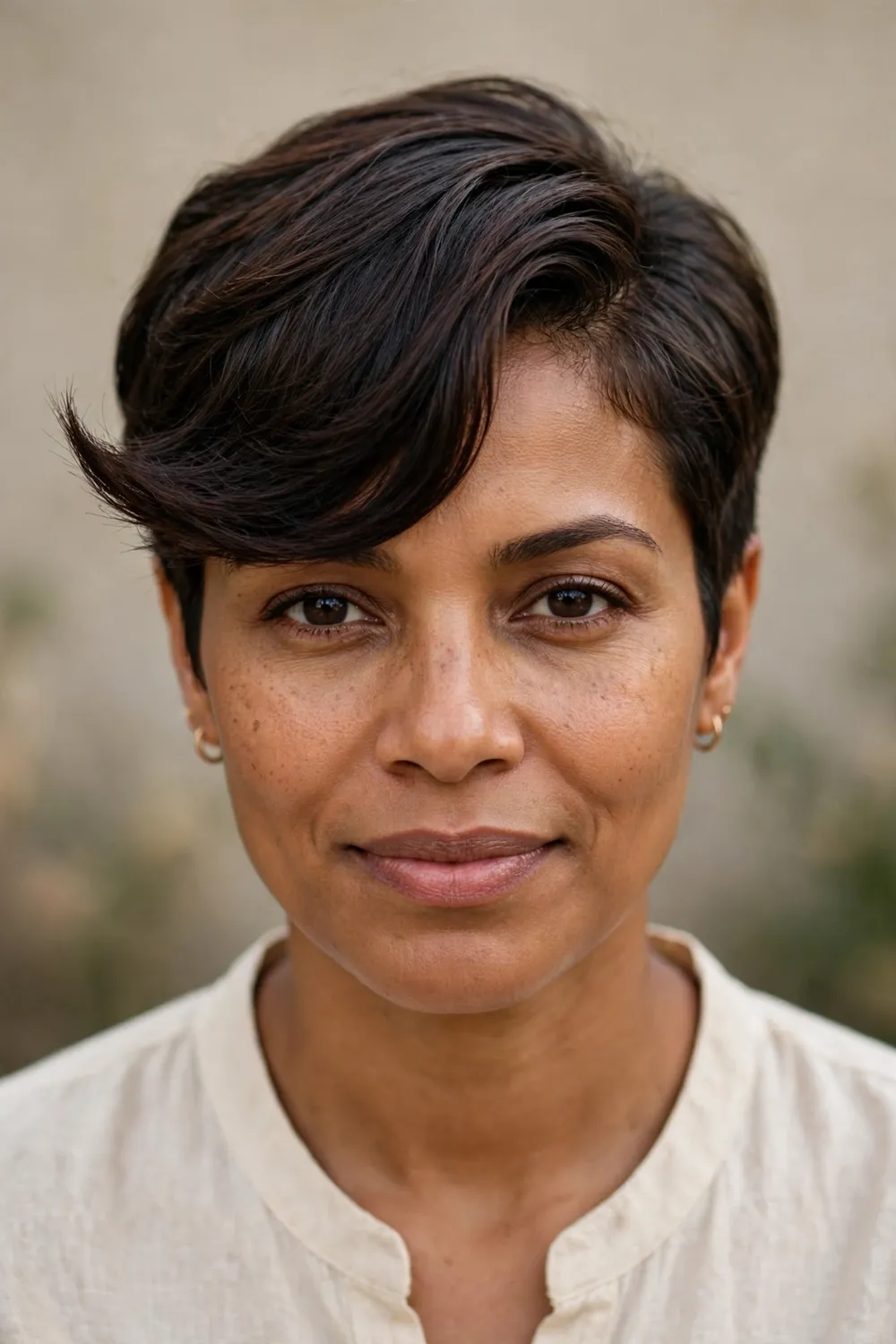
A deep side part is one of the simplest styling tricks for managing thick hair, and this bixie is cut to make the most of it. The cut carries extra length on the heavy side so the sweep has substance, while the under-side is kept closer to the head. Flipping thick hair to one side redistributes its weight away from the part line, which prevents the flat-crown-plus-puffy-sides effect that plagues center-parted thick bobs. The asymmetry also gives the face a dynamic, intentional look.
It suits straight to wavy thick hair and flatters round and heart-shaped faces, where the diagonal sweep adds angles and balance. Styling takes minutes: blow-dry the roots in the direction of the part to train them, then sweep the length over. A light pomade through the ends keeps the heavy side from separating into flyaways, and the cut looks equally good polished or tousled. On extra humid days, pin the heavy side behind your ear for a few minutes to set the sweep in place.
Try this: flip your part to the other side once a month to keep volume at the roots instead of letting it flatten.
Difficulty: Low · Cost: $$ (salon)
11. Asymmetrical Bixie

The asymmetrical bixie builds the bulk management into its architecture. One side is cut shorter and closer, often with an undercut or tight taper, while the other side keeps bob length sweeping toward the chin. Thick hair that would puff into a uniform helmet instead gets two different stories: sleek and short on one side, full and sweeping on the other. The imbalance is the whole point, and it keeps a dense cut from ever looking one-note.
It suits straight to wavy thick hair and flatters oval and square faces, drawing the eye across the face rather than up and down. Ask your stylist to cut the short side with the bulk removed underneath so it hugs the head, because any leftover density there ruins the contrast. The long side can be styled sleek for contrast or textured to blend, which gives this cut more styling range than most.
Try this: keep a little extra length difference between the sides than feels safe, since the drama softens as it grows.
Difficulty: High · Cost: $$ (salon)
12. Inverted Bixie
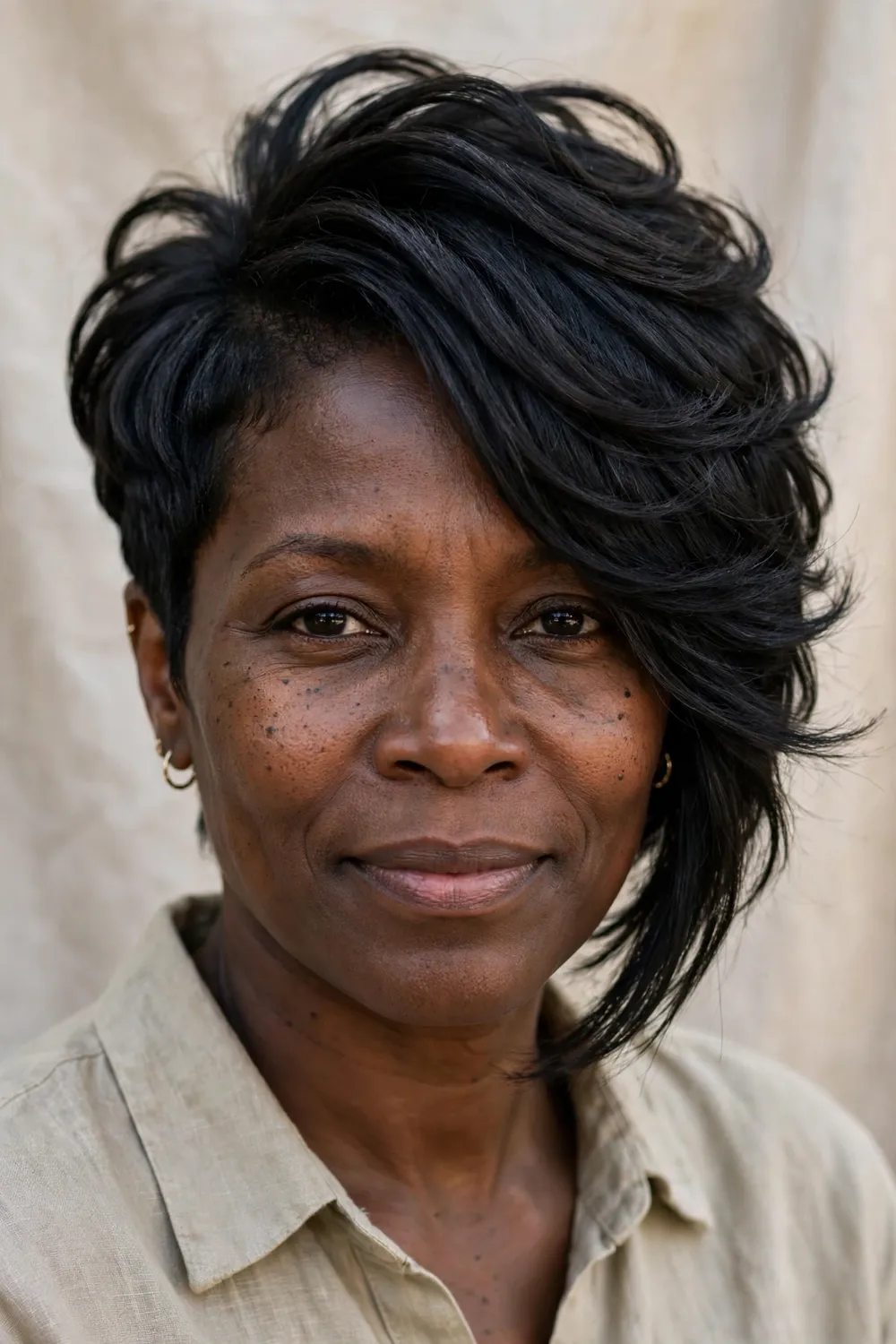
The inverted bixie angles longer in front and shorter in back, combining the graduation of a stacked cut with face-framing bob length. For thick hair, the inversion does double duty: the shorter back removes the bulk that collects at the neckline, and the longer front pieces carry their weight gracefully because they have length to distribute it. The angled perimeter also keeps the cut from flaring at the bottom edge, which is where thick hair tends to misbehave.
It suits straight to wavy thick hair and flatters round faces especially well, since the long front pieces elongate the jawline. Blow-dry the front pieces forward and under to emphasize the angled line, and let the back air-dry since the graduation does its own work. Ask for gentle layering rather than aggressive thinning so the volume stays controlled without looking wispy at the ends. Let the front pieces air-dry once a week to check the true angle, since blow-drying can hide how the layers actually fall.
If you like the way angled lines flatter at this length, these short french bobs show how a shorter classic bob handles different textures.
Try this: angle the front pieces to hit just below the jaw for the most slimming effect on thick hair.
Difficulty: Medium · Cost: $$ (salon)
13. Shaggy Bixie

The shaggy bixie lets thick hair do what it wants, then frames the result. Feathered layers cut at multiple lengths break up density so completely that the cut reads as texture first and volume second. Crown layers remove the weight that makes thick hair sit heavy on the head, while the shaggy ends keep the perimeter from forming a solid, puffy line. It is the most forgiving bixie here for hair that refuses to be tamed by precision cuts.
It suits wavy and straight thick hair with natural movement and flatters round and heart-shaped faces by softening their contours. Style it with a styling cream scrunched into damp hair and let it air-dry, since the cut is designed to look best when you do not fuss. The shaggy layers grow out gracefully, stretching trims to six or seven weeks, which thick-haired women who dread the salon will appreciate. A light texturizing spray on the crown layers adds extra air when thick hair starts to sit heavy between washes.
If shaggy texture appeals to you at even shorter lengths, these short shag hairstyles for women show how the cut works across different hair textures.
Try this: style with your fingers instead of a brush, since the whole point is roughness, not smoothness.
Difficulty: Low · Cost: $$ (salon)
14. Wavy Bixie

Natural waves and thick hair are a combination that needs diffused layering to stay pretty. The wavy bixie cuts the layers long enough for waves to form their shape, but short enough that the weight cannot pull the wave flat at the roots or puff it at the ends. Diffused, blended layers let the wave pattern run uninterrupted from root to tip, which prevents the frizz halo that thick wavy hair gets when layers are cut too short or too choppy. The result moves when you move.
It suits naturally wavy thick hair and flatters most face shapes, since the wave softens everything it touches. Scrunch a light curl cream or sea salt spray into damp hair and diffuse or air-dry; avoid heavy oils, which weigh waves down on dense hair. Trims every six weeks keep the diffused ends from splitting, and the grow-out stays soft because the layers are blended, not stepped. Refresh second-day waves with water and a small amount of curl cream scrunched through the ends.
Try this: sleep in a loose satin bonnet to keep the diffused layers from puffing overnight.
Difficulty: Low · Cost: $ (salon)
15. Curly Bixie

Thick curly hair in a bixie is a power move, and it works when the cut respects how curls shrink and spring. The curly bixie is cut dry, curl by curl, so the length lands exactly where intended once the curls bounce up. Interior layers are carved into the thickest zones to let curls nest into each other instead of stacking into a round mass. Without that interior work, thick curls at this length turn into a sphere; with it, you get a defined, sculpted shape with real movement.
It suits thick curly and coily textures and flatters faces that carry volume well at the sides, like oval and heart shapes. A leave-in conditioner under a curl cream defines the curls without crunch, and diffusing on low heat keeps the shape compact. Ask your stylist to cut the curls dry and to leave the perimeter slightly longer than feels safe, since shrinkage is always more dramatic than expected. A satin pillowcase cuts down on overnight friction, which keeps the curl pattern intact between wash days.
Try this: pineapple your curls loosely at night to keep the bixie shape intact until wash day.
Difficulty: Medium · Cost: $$ (salon)
16. Sleek Straight Thick Bixie

Some women with thick hair want polish, not texture, and the sleek straight bixie delivers it without the bulk. The secret is internal thinning you cannot see: the stylist removes weight from the middle layers while keeping the surface smooth and intact. From the outside you see a clean, glossy bixie with a defined silhouette; underneath, there is simply less hair. This is the cut for anyone whose thick hair tends to frizz the moment texture is introduced.
It suits straight or straightened thick hair and flatters oval and square faces, where the clean lines add definition. A flat iron pass and a heat protectant keep the surface glassy, and a light smoothing serum tames any frizz at the ends. Because thick hair grows out into visible weight quickly, book shaping trims every five to six weeks to keep the internal thinning balanced with the length. Sleep with the cut wrapped in a silk scarf to extend the smooth finish through day two and three.
Try this: flat-iron in small sections and let each cool before moving on, which gives thick hair a longer-lasting smooth finish.
Difficulty: Medium · Cost: $$ (salon)
17. Voluminous Crown Bixie

This bixie redistributes thick hair’s volume instead of fighting it. Shorter layers at the crown are cut to stand up and create impressive height, while the sides are kept tapered and close so the overall silhouette stays slim. Thick hair holds crown volume better than any other hair type, so this cut plays to your natural strength: the density that puffs outward at the wrong lengths becomes dramatic, intentional lift at the crown. It is one of the most striking bixies on this list.
It suits straight to wavy thick hair and flatters round faces especially well, since the height elongates the whole head shape. Blow-dry the crown with a round brush lifting at the roots, or set it with a large roller while you do your makeup. A light volumizing mousse at the roots gives the crown layers their staying power, and the tapered sides keep the cut from widening. Skip conditioner at the crown on wash days, since even light residue can weigh the lifted layers down.
Try this: back-comb just the roots at the crown on day two to refresh the height without restyling everything.
Difficulty: Medium · Cost: $$ (salon)
18. Flipped-Ends Bixie

The flipped-ends bixie is the most retro cut on this list, and the technique behind it is quietly clever for thick hair. Layers are cut so the ends kick outward instead of curling under, which means the bottom edge of the cut never has a chance to form that dense, puffy shelf. The outward flip also opens up the neckline and keeps thick hair off the neck, which feels lighter in warm weather. A side part completes the vintage-leaning shape and directs the sweep.
It suits straight to slightly wavy thick hair and flatters heart and oval faces, where the outward ends balance narrower chins. Use a round brush to flick the ends outward while blow-drying, then set them with a cool shot so the flip holds. Ask your stylist to point-cut the ends, since blunt ends on thick hair resist flipping and curl under instead. Velcro rollers on just the front pieces while you do your makeup set the flip without extra heat.
Try this: flip the ends outward the night before and sleep on them, since thick hair often holds the flip by morning.
Difficulty: Medium · Cost: $$ (salon)
19. Texturized Ends Bixie

Thick hair gets its width from blunt, heavy ends, so this bixie attacks exactly that. The overall shape stays a classic bob-leaning bixie, but the bottom two inches are heavily texturized with point cutting and slide cutting until they feather apart. Removing that end weight lets the rest of the cut collapse inward by a full centimeter, which is the difference between a bixie that sits close and one that billows. It is a subtle-looking cut with a big structural payoff.
It suits straight and wavy thick hair and flatters most face shapes, since the texturized perimeter keeps the silhouette slim all the way around. The ends will feel thinner than you are used to, which is the point; trust the process. A light wax worked through the ends emphasizes the feathered separation, and the cut air-dries well because the weight is already gone. Check the ends in natural light before you leave the salon, since overhead lighting can hide how thick hair reads.
Try this: ask your stylist to show you the texturized ends dry before you leave, since thick hair hides how much weight was removed when wet.
Difficulty: Medium · Cost: $$ (salon)
20. Swept-Back Bixie

Sweeping the bixie back off the face is a styling choice, but this version is cut for it: the top and front are left long enough to push back, while the sides are kept close so the sweep has something to contrast against. On thick hair, the swept-back direction pulls density away from the face and stacks it at the crown, where volume reads as intentional rather than puffy. It is a confident, grown-up take on the bixie that works as well in a boardroom as at dinner.
It suits straight to wavy thick hair with enough length on top to grip, and it flatters faces that can carry hair off the forehead, like oval and square shapes. Blow-dry back with a vent brush for direction, then smooth a medium-hold pomade over the top to keep it in place. The contrast between the long swept top and the close sides is what keeps the cut from looking like it is simply growing out.
Try this: use a blow-dryer concentrator nozzle aimed backward to train thick hair to stay swept back all day.
Difficulty: Medium · Cost: $$ (salon)
21. Razor-Cut Bixie

A razor does something shears cannot: it carves hair into wispy, tapered strands that remove weight while leaving a soft, feathered edge. The razor-cut bixie uses this tool through the mid-lengths and ends, so thick hair loses its solidity without losing its length or looking thinned. The result is a bixie with an almost smoky edge, where every strand seems to dissolve into the next. On coarse thick hair, the razor edge also prevents the blunt, heavy line that can make a bixie look severe.
It suits straight to wavy thick and coarse hair and flatters oval and heart-shaped faces, where the soft edge keeps the cut feminine. Ask for the razor work on dry or nearly dry hair, since a razor on soaking wet thick hair can take off more than intended. Style with a light cream to keep the feathered ends moving, and expect trims every five weeks since razor edges grow out into fuzz faster than shear cuts.
Try this: tell your stylist if your hair is coarse, since a razor behaves differently on coarse strands and needs a lighter hand.
Difficulty: High · Cost: $$ (salon)
22. Blunt-End Bixie with Internal Thinning

Blunt ends and thick hair sound like a recipe for a heavy shelf, but this bixie cheats: the perimeter is cut blunt for a strong, graphic line, while the interior is thinned so aggressively that the ends sit close anyway. You get the bold look of a blunt bob with the wearability of a thinned one. The trick only works when the thinning is hidden deep in the interior layers, leaving the surface untouched, so the cut looks solid from every angle but feels dramatically lighter.
It suits straight thick hair that can hold a clean line and flatters oval and square faces, where the blunt edge adds definition. A flat iron pass keeps the perimeter sharp, and the hidden thinning means you rarely need to do more than that. This cut demands a stylist who is confident with interior thinning, so ask directly whether they are comfortable removing significant weight without touching the surface. The hidden thinning usually needs refreshing at every other appointment, so mention it when you book.
Try this: run your fingers up under the surface layers to feel the thinned interior, which tells you the bulk work was actually done.
Difficulty: Medium · Cost: $$ (salon)
23. Tousled Piecey Bixie

The last cut on this list is the most lived-in. The tousled piecey bixie cuts thick hair into distinct, separated pieces that are meant to move independently, which breaks up density visually better than any smoothing technique. Point cutting through the top and crown creates the piecey separation, and the slightly longer bob-length pieces around the face keep it from reading as a pure pixie. It is the bixie for thick hair that wants to look like it was never trying too hard.
It suits wavy and straight thick hair with natural body and flatters oval and square faces, where the piecey movement softens strong features. A matte paste worked through dry hair defines the pieces in about a minute, and this is one of the few cuts here that genuinely improves on day two. Trims every five to six weeks keep the pieces distinct instead of blurring into general thickness. Rough-dry the roots with your head flipped forward for extra lift, then flip back and separate the pieces.
If you like short cuts built on piecey movement, these short layered hairstyles for women over 60 show flattering layered options with similar face-framing shapes.
Try this: apply paste only to the ends of the pieces, never the roots, so thick hair stays lifted at the crown.
Difficulty: Low · Cost: $$ (salon)
At a Glance: 23 Thick-Hair Pixie Bobs Compared
| Cut | Best for | Thick-hair perk | Upkeep |
|---|---|---|---|
| Stacked Back Bixie | Straight to wavy thick hair | Graduation collapses nape bulk into a curve | Round-brush blow-dry the back |
| Undercut Bixie | All thick textures | Deletes the bottom density layer entirely | Matte paste on top layers |
| Tapered Bixie | Straight to slightly wavy hair | Density fades into the head shape | Refresh the taper every 4 to 5 weeks |
| Ear-Length Crop Bixie | Bold wearers, strong jawlines | Less hair left to swell in humidity | Trims every 4 weeks |
| Jaw-Length Soft Layer Bixie | Every face shape | Blended layers make length drape | Air-dry or quick smoothing pass |
| Choppy Textured Bixie | Wavy and straight thick hair | Chunky layers read as movement, not mass | Texturizing paste on dry hair |
| Wispy Bangs Bixie | Long faces, high foreheads | Feathered fringe adds no heavy shelf | Round-brush flick through bangs |
| Curtain Bangs Bixie | Nearly every face shape | Fringe weight splits across both sides | Blow-dry forward, split at center |
| Micro Fringe Bixie | Straight thick hair | Internally thinned fringe lies flat | Fringe trims every 3 weeks |
| Side-Swept Deep-Part Bixie | Straight to wavy thick hair | Weight redistributes away from the part | Blow-dry roots toward the part |
| Asymmetrical Bixie | Oval and square faces | Two densities keep the cut from puffing evenly | Style long side sleek or textured |
| Inverted Bixie | Round faces | Short back removes neckline bulk | Blow-dry front pieces forward |
| Shaggy Bixie | Wavy, textured thick hair | Feathered layers break up all density | Scrunch with cream, air-dry |
| Wavy Bixie | Naturally wavy thick hair | Diffused layers prevent the frizz halo | Curl cream, diffuse or air-dry |
| Curly Bixie | Thick curly and coily textures | Dry-cut interior layers let curls nest | Leave-in plus curl cream |
| Sleek Straight Thick Bixie | Straight or straightened hair | Invisible internal thinning, smooth surface | Flat iron plus heat protectant |
| Voluminous Crown Bixie | Round faces | Density becomes intentional crown lift | Root mousse, round-brush lift |
| Flipped-Ends Bixie | Straight to slightly wavy hair | Outward flip stops the bottom shelf | Round-brush flick, cool shot |
| Texturized Ends Bixie | Straight and wavy thick hair | Feathered bottom two inches slim the line | Wax through the ends |
| Swept-Back Bixie | Straight to wavy thick hair | Density stacks at the crown, not the face | Blow-dry back, medium-hold pomade |
| Razor-Cut Bixie | Straight to wavy coarse hair | Razor carves weight out softly | Light cream, trims every 5 weeks |
| Blunt-End Bixie with Internal Thinning | Straight thick hair | Strong line outside, light inside | Flat-iron the perimeter sharp |
| Tousled Piecey Bixie | Wavy, body-heavy thick hair | Separated pieces break density visually | Matte paste on ends only |
How to Choose Your Thick-Hair Pixie Bob
Start with how much bulk you are willing to remove permanently. If you want maximum de-poufing with minimal daily effort, pick a cut with a structural answer built in: the undercut, the stacked back, or the tapered nape. These three do the work inside the cut itself, so styling can stay simple. If you would rather keep your options open, choose a technique that removes weight without commitment, like interior layering, choppy texture, or texturized ends, which all grow out softly.
Next, match the cut to your texture. Straight thick hair holds the precision cuts here best: sleek straight, blunt-end with internal thinning, and the razor-cut bixie. Wavy thick hair shines in the diffused cuts: wavy, shaggy, and tousled piecey bixies. Curly thick hair has one clear home, the dry-cut curly bixie, and coarser textures do well with the razor-cut bixie that softens heavy strands. Bring photos to your consultation and ask your stylist which density technique they would use on your specific thickness, since a confident answer tells you they have done this before.
Finally, be honest about your trim schedule. Pixie-leaning cuts with tapers, undercuts, and micro fringes need attention every four weeks or so. Bob-leaning versions with blended layers can stretch to six or eight. Pick the silhouette you will actually maintain, because a grown-out undercut looks worse than a fresh shaggy bixie every time.
Styling and Care Tips for Thick Pixie Bobs
Washing. Thick hair in a short cut dries faster than long hair, but it also shows product buildup faster. Wash with a lightweight volumizing shampoo rather than a heavy moisturizing one, which can make dense short hair go flat at the roots and puffy at the ends. Condition only the mid-lengths and ends, and rinse thoroughly, since residue weighs a bixie down.
Drying. Rough-drying with your fingers first, then refining with a brush, is the fastest routine for thick bixies. Blow-drying soaking wet thick hair from the start takes forever and encourages puffiness. Get it about 80 percent dry with your hands, then finish the shape with a round or vent brush. For wavy and curly versions, diffuse on low heat or air-dry with curl cream instead.
Products. Lightweight is the rule. Matte pastes, light mousses, and texturizing sprays add definition without heaviness, while heavy oils and thick serums flatten thick bixies at the roots and make the ends look stringy. A heat protectant is non-negotiable before flat irons, since thick hair needs more heat passes and more passes mean more damage risk. Finish with a flexible-hold spray rather than a stiff one, so the cut keeps its movement.
Frequently Asked Questions
Is a pixie bob good for thick hair?
Yes, the pixie bob is one of the best short cuts for thick hair because its short length removes a huge amount of weight on its own, and the standard techniques, interior layering, stacked backs, and undercuts, are designed to manage density. The cut only fails on thick hair when it is cut blunt with no interior work, which creates the blocky shelf that gives short thick cuts a bad name. Ask for the weight removal by name and the bixie becomes a low-effort cut.
How do I stop my pixie bob from poufing out?
Poufing happens when density is evenly distributed from root to end, so the fix is always removing weight from the right places. An undercut or stacked back takes bulk out of the bottom edge, interior layering removes it from the middle, and tapered perimeters keep the outline slim. At home, blow-dry the roots in the direction you want them to lie and finish with a smoothing cream on the ends. If your cut poufs despite all that, it probably needs the interior thinned at your next trim.
How often should I trim a pixie bob on thick hair?
Every four to six weeks is the standard for thick hair, since density grows back into the shape faster than fine hair does. Tapers, undercuts, and micro fringes sit at the four-week end, while blended and shaggy versions can stretch to six or eight. The sign you waited too long is the cut widening at the bottom instead of holding its silhouette. Regular shaping trims keep the bulk management working instead of letting it grow out of balance.
Should thick hair get thinning shears in a pixie bob?
Thinning shears have their place, but they should not be the only tool. Good thick-hair bixies rely on interior layering, point cutting, and slide cutting first, with thinning shears used sparingly to refine. Overusing thinning shears alone creates frizz and wispy ends that puff, which is the opposite of what you want. Ask your stylist how they plan to remove the weight, and listen for layering techniques, not just thinning.
Can I wear a pixie bob if my thick hair is curly?
Yes, and the curly bixie is one of the most flattering versions on this list. The key is a dry cut, curl by curl, so the length is accurate once the curls spring up, plus interior layers that let curls nest instead of stacking into a ball. Avoid cuts that rely on blunt ends or heavy tapering, which fight the curl pattern. With a leave-in and curl cream routine, a curly bixie on thick hair needs very little daily work.
Final Thoughts
Thick hair does not need to be fought into a pixie bob, it needs a pixie bob cut with the right tools for the job. Whether you choose an undercut that deletes the bulk, a stacked back that sculpts it, or interior layering that thins it invisibly, the winning move is always the same: remove the weight on purpose instead of letting it decide your shape. Pick the technique that fits your texture and your trim schedule, and your density becomes the best thing about the cut.

