


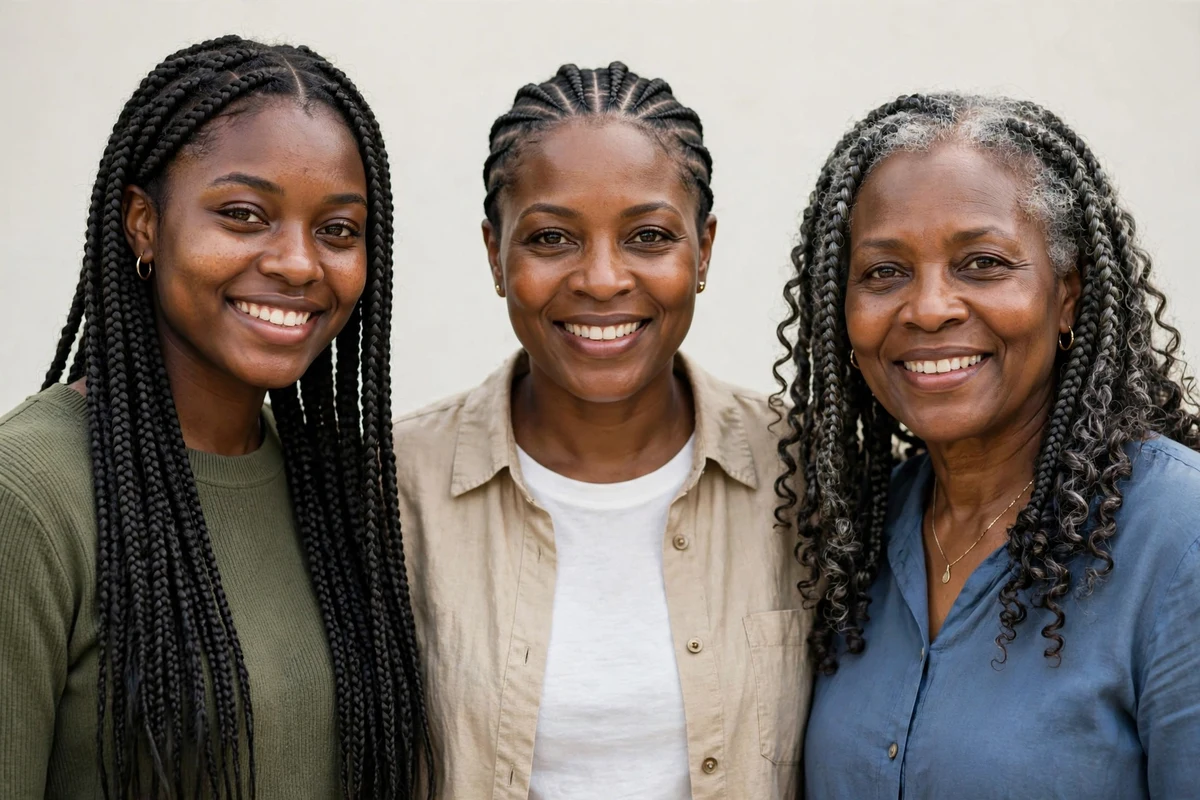
Braids remain one of the most practical choices in Black hair care. They protect your ends, cut daily styling down to minutes, and hold their shape for weeks at a time. The hard part is choosing between them: box braids, knotless, cornrows, twists, and locs each come with a different install time, price tag, and lifespan.
This guide rounds up 20 braided hairstyles for Black women across every length and budget, with straight answers on how long each style lasts and how to keep your scalp comfortable while you wear it. The rule is simple: if your edges hurt on day one, the braids are too tight. Comfort is part of the style.
Every idea below tells you what to ask for in the chair, how long the appointment takes, and what it usually costs, so you can book with confidence.
Quick Takeaways
- Most braided styles last 4 to 8 weeks. Micro braids and well-kept twists can stretch to 8 to 12 weeks.
- Pain is a warning sign, not a rite of passage. Tight braids can cause traction alopecia, so speak up in the chair.
- Wash your scalp every 1 to 2 weeks with diluted sulfate-free shampoo, and sleep in a satin bonnet or scarf.
- Knotless braids usually cost more, but they pull less at the roots, which makes them kinder to thin or fragile edges.
- Take a 2 to 4 week break between long-term installs so your hair and scalp fully recover.
20 Braided Hairstyles for Black Women
1. Classic Medium Box Braids

The original protective style and still the most booked. Hair is parted into neat squares and braided from root to tip with added kanekalon hair. Medium width at mid-back length suits almost everyone and gives you endless styling options: buns, ponytails, half-up styles.
Ask your braider for clean, even parts and medium tension at the hairline. The most common mistake is going too small on the parts while adding too much hair, which puts real weight on your roots. A full head takes 4 to 6 hours in the chair.
Try this: dip the ends in hot water for 10 seconds after braiding to seal them, then apply a light mousse to smooth flyaways.
Difficulty: Salon install · Cost: $150–$300 · Lasts: 6–8 weeks
2. Waist-Length Knotless Braids

Knotless braids start with your natural hair and feed extension hair in gradually, so there is no tight knot at the root. The result lies flatter, hurts less on day one, and is noticeably kinder to edges. Waist length is the popular choice, but the technique works at any length.
Because each braid is built strand by strand, expect 5 to 7 hours in the chair, longer than traditional box braids. Most salons charge a premium for the method. If your edges are thin or you have had tension headaches from braids before, this is the style to ask for.
Try this: keep the first two inches of each braid oiled during week one while your scalp adjusts to the new parts.
Difficulty: Salon install · Cost: $200–$400 · Lasts: 6–8 weeks
3. Goddess Braids (Boho Braids)

Goddess braids are knotless or box braids with loose curly pieces left out along the length and at the ends. The curls soften the whole look and hide new growth as the style ages, which buys you extra weeks of wear. Human hair curls last longer and tangle less than synthetic.
This is a high-maintenance protective style by braid standards: the loose curls need detangling every few days and a curl mousse to stay defined. Budget 5 to 8 hours for the install. Sleep with the curls gathered loosely on top of your head to slow matting.
Try this: refresh the curls with a spray bottle of water and leave-in conditioner instead of re-curling with heat.
Difficulty: Salon install · Cost: $250–$450 · Lasts: 4–6 weeks
4. Lemonade Braids

Named for the famous side-swept look, lemonade braids are neat cornrows braided from one side of the head to the other, usually falling past the shoulder on a single side. The asymmetry flatters round and square faces, and the style photographs well from every angle.
Small to medium cornrows give the cleanest result. Because all the hair pulls in one direction, tell your braider immediately if you feel pinching at the temples. Most installs take 3 to 5 hours. Add cuffs or thread wraps near the ends for a finished detail.
Try this: edge control along the sweep keeps the style sharp for the first two weeks.
Difficulty: Salon install · Cost: $120–$250 · Lasts: 4–6 weeks
5. Stitch Braids

Stitch braids are feed-in cornrows with razor-sharp horizontal stitch lines between each row, created by threading the pinky through as the braid feeds. The precision is the whole point: from a distance the scalp pattern reads almost like embroidery.
This technique demands an experienced braider, so look at healed photos, not just fresh installs, before you book. Straight-back is the classic layout, but curved and geometric partings are common. Expect 3 to 5 hours depending on row count.
Try this: a thin layer of styling foam pressed along each stitch line keeps the pattern crisp between washes.
Difficulty: Salon install · Cost: $120–$280 · Lasts: 4–6 weeks
6. Straight-Back Cornrows

The foundation every braider learns first. Hair is braided flat against the scalp in straight rows from hairline to nape, with or without added hair. On natural hair alone it is one of the cheapest and fastest protective styles you can get.
Ten to twenty rows is typical; more rows mean a longer appointment but a neater grow-out. Without extensions the style lasts 2 to 3 weeks, with feed-in hair it stretches to 4 or 5. Keep the first row off your edges if your hairline is fragile.
Try this: tie the front rows down with a silk scarf for 15 minutes after styling to lay everything flat.
Difficulty: Easy salon or home · Cost: $80–$180 · Lasts: 3–5 weeks
7. Ghana Braids

Ghana braids, also called banana braids, start thin at the hairline and get chunkier as extension hair feeds in, tapering back down at the ends. The graduated thickness gives them a sculpted look that plain cornrows do not have.
They work in straight-back layouts, updos, and curved designs. Because each braid carries more hair, they feel heavier than standard cornrows, so medium chunkiness is the sweet spot for most people. Plan on 3 to 5 hours in the chair.
Try this: ask for the ends to be left slightly tapered rather than blunt for a softer finish.
Difficulty: Salon install · Cost: $120–$250 · Lasts: 4–6 weeks
8. Fulani Braids

Rooted in West African Fulani tradition, this style pairs a center-part cornrow with braided singles falling on either side, usually finished with beads, cuffs, or cowrie shells. It is one of the most decorative braid styles, and the accessories do half the visual work.
Bead weight adds up, so keep them to the mid-lengths and ends rather than near the roots. Wooden and clay beads are lighter than metal. A full install runs 4 to 6 hours, and repositioning a slipped bead takes seconds at home.
Try this: thread beads onto the braid before sealing the ends so they sit exactly where you want them.
Difficulty: Salon install · Cost: $150–$300 · Lasts: 4–6 weeks
For bead placement charts and pattern variations, browse our fulani braids hairstyles guide.
9. Senegalese Twists

Two strands twisted rope-style from root to tip, using silky braiding hair for a smooth finish. Senegalese twists are lighter than most braids of the same length and put less daily stress on the scalp. Shoulder to mid-back length is the easiest to manage.
The twist must be sealed well or it unravels: most braiders finish with hot water or a small knot. Twists frizz faster than braids, so a satin bonnet at night is non-negotiable. Expect 4 to 6 hours for a full head.
Try this: re-twist the first inch of the most visible twists at week four to extend the style two more weeks.
Difficulty: Salon install · Cost: $150–$300 · Lasts: 6–8 weeks
10. Passion Twists

Passion twists use wavy water-wave hair twisted loosely for a springy, textured finish that reads softer than Senegalese twists. They are the twist world’s answer to boho braids: romantic, full, and deliberately undone.
The looser twist means a shorter lifespan than tighter rope twists, usually 4 to 8 weeks depending on upkeep. They also tangle more, so keep a detangling spray nearby. Medium length keeps the weight comfortable for daily wear.
Try this: separate the twists gently with oiled fingers instead of a comb to keep the wave pattern intact.
Difficulty: Salon install · Cost: $150–$300 · Lasts: 4–8 weeks
11. Bantu Knots

Small sections of hair twisted and coiled into knots across the head. Worn as-is they make a bold sculptural statement; unraveled after a day they leave defined spiral curls known as a Bantu knot-out, which is how many people actually wear them.
As a style the knots last 1 to 2 weeks, but as a curl method they take one evening. Keep sections even and do not coil so tightly that the scalp puckers. This is one of the few styles on this list that works well as a home project.
Try this: apply setting foam before coiling if you plan to unravel them into a knot-out the next day.
Difficulty: Easy home or salon · Cost: $60–$150 · Lasts: 1–2 weeks
12. Halo Braid (Crown Braid)

A single thick braid wrapped around the head like a crown and pinned in place. It keeps every strand off the neck, which makes it a strong pick for hot weather, workouts, and formal events alike. It also works well on gray and silver hair.
You need enough length for the braid to circle the head, or your stylist can add a braided extension piece. Because it is one braid under tension all day, keep it snug but not headache-tight. It typically holds 1 to 2 weeks with nightly scarf protection.
Try this: pin the braid in a slightly imperfect circle rather than a perfect ring for a softer, more natural line.
Difficulty: Easy home or salon · Cost: $60–$120 · Lasts: 1–2 weeks
13. Jumbo Box Braids

Fewer, thicker braids on large square parts. Jumbo braids cut install time nearly in half compared to medium box braids, which is their main selling point. They make a bolder statement and show off parting patterns clearly.
The trade-off is weight: each braid carries more hair, so keep the length at mid-back or shorter to protect your roots. They also reveal new growth faster, which shortens the neat-looking window to about 4 to 6 weeks. A high ponytail or top bun is the classic way to wear them.
Try this: ask for large parts but medium hair volume per braid to get the look without the heaviness.
Difficulty: Salon install · Cost: $100–$220 · Lasts: 4–6 weeks
14. Micro Braids

Hundreds of pencil-thin braids that move almost like loose hair. Micro braids offer the most styling freedom of any braid on this list: you can flat-iron them, curl them, and part them anywhere. They also last the longest, often 8 to 12 weeks.
The cost is time and money: 6 to 10 hours in the chair and the highest price tag here. Never combine micro size with added length and heavy hair, since the tiny parts cannot support much weight. Take them out carefully, section by section, with conditioner to avoid breakage.
Try this: schedule removal as its own appointment and do not rush it; most damage from micro braids happens during takedown.
Difficulty: Salon install · Cost: $250–$500 · Lasts: 8–12 weeks
15. Peekaboo Braids

Standard braids on top with a vivid color hidden in the underlayer that flashes when the hair moves. Burgundy, honey blonde, and copper are the most requested shades. It gives you the fun of color without dyeing your own hair.
Colored braiding hair fades faster than black, so expect the hidden shade to soften after a month. Keep the top layer in your natural color for a professional look that turns playful when you pull the braids up. Install takes 4 to 7 hours.
Try this: part the braids down the middle on wash day so the color layer gets fully rinsed and does not bleed.
Difficulty: Salon install · Cost: $180–$350 · Lasts: 6–8 weeks
16. French Curl Braids

Braided firmly at the roots with the last several inches left as loose spiral curls. French curl braids give you the neatness of braids at the scalp and the softness of curls at the ends, in a single install. They suit oval and heart face shapes especially well.
The curly ends tangle if ignored, so nightly pineapple-ing and a curl refresher spray are part of the routine. Human hair curls cost more but survive the full 4 to 6 weeks far better than synthetic. Plan on 5 to 7 hours in the chair.
Try this: trim any curls that straighten out at week three instead of fighting them; the style still reads correctly.
Difficulty: Salon install · Cost: $200–$380 · Lasts: 4–6 weeks
17. Invisible Locs

A hybrid technique: hair starts in a flat two-strand twist at the root, then transitions into a wrapped loc look down the length using Marley or Cuban hair. From a few feet away they read as fresh retwisted locs, without the long-term commitment.
They are lighter than faux locs and put less pull on the roots. Shoulder length keeps them office-friendly; longer lengths lean bohemian. Most installs take 4 to 6 hours and hold 6 to 10 weeks with regular palm-rolling of new growth.
Try this: wrap a silk scarf around the roots nightly to slow frizz where the twist meets the loc.
Difficulty: Salon install · Cost: $180–$350 · Lasts: 6–10 weeks
18. Crochet Braids

Your natural hair goes into cornrows first, then pre-looped hair is pulled through with a crochet needle. The method is fast (2 to 4 hours), affordable, and endlessly versatile: curls, twists, faux locs, and straight textures all come pre-looped.
Because the base is cornrows, scalp access for washing is limited, so keep installs to 4 to 6 weeks. Curly crochet hair mats at the nape first; a weekly detangle of that zone prevents one solid knot. This is a smart first protective style if you are new to braids.
Try this: ask for the cornrow base to follow your usual part so the finished style falls naturally.
Difficulty: Easy salon or home · Cost: $80–$200 · Lasts: 4–6 weeks
19. Tribal Braids

A freestyle mix: stitch cornrows at the front flowing into knotless singles at the back, sometimes with triangle parts or crisscross details. No two sets look alike, which is the appeal. Bring reference photos, because “tribal braids” means something slightly different to every braider.
The mixed technique means mixed grow-out: the cornrow section loosens faster than the singles. Budget 4 to 7 hours and discuss the exact layout before the first braid goes in. This is a style where a consultation photo saves real disappointment.
Try this: photograph the parting pattern on day one so your braider can replicate or adjust it next time.
Difficulty: Salon install · Cost: $150–$320 · Lasts: 4–6 weeks
20. High Braided Ponytail

Feed-in braids pulled into a high, sleek ponytail, often with the ponytail itself braided or wrapped. It is dramatic, gym-friendly, and one of the quickest salon styles on this list at 2 to 3 hours. A deep side part or swooped baby hairs change the whole attitude.
The tension sits at the hairline, so this is not the style to wear back-to-back. Alternate it with looser installs, and never sleep in a tight ponytail without loosening it first. Expect 3 to 4 weeks of clean wear.
Try this: wrap a small braid around the ponytail base to hide the elastic and any extension tracks.
Difficulty: Salon install · Cost: $80–$180 · Lasts: 3–4 weeks
If you like your braids at a shorter length, these short braided hairstyles for Black women keep the same techniques at chin to shoulder length.
Braided Styles Compared
| Style | Typical lifespan | Chair time | Typical cost |
|---|---|---|---|
| Classic box braids | 6–8 weeks | 4–6 hours | $150–$300 |
| Knotless braids | 6–8 weeks | 5–7 hours | $200–$400 |
| Goddess / boho braids | 4–6 weeks | 5–8 hours | $250–$450 |
| Cornrows | 3–5 weeks | 2–4 hours | $80–$180 |
| Senegalese twists | 6–8 weeks | 4–6 hours | $150–$300 |
| Crochet braids | 4–6 weeks | 2–4 hours | $80–$200 |
| Micro braids | 8–12 weeks | 6–10 hours | $250–$500 |
| Bantu knots | 1–2 weeks | 1–3 hours | $60–$150 |
Braid Care That Keeps Your Hair Healthy
Braids protect your hair only when the install and the upkeep respect your scalp. These are the rules that matter most.
Watch the tension. Headaches, tiny bumps along the hairline, or pain when you smile mean the braids are too tight. Ask your braider to redo the painful sections on the spot. Repeated tight installs can cause traction alopecia, which is hair loss from constant pulling, and it is much harder to reverse than to prevent.
Wash the scalp. Every 1 to 2 weeks, work diluted sulfate-free shampoo into your scalp with your fingertips, rinse thoroughly, and let the braids dry completely. Damp braids left bundled up can develop mildew and odor. A hooded dryer on low speeds things up.
Protect them at night. A satin bonnet or scarf every night reduces frizz and keeps edges smooth. Cotton pillowcases create friction that roughs up the hairline and dulls the style.
Handle the itch. Itching usually comes from dry scalp or the coating on synthetic hair. A braid spray or light oil calms the scalp; an apple cider vinegar rinse before install removes the coating that makes many people itch. Never scratch with combs or sharp objects.
Do not overstay. Most braids look tired after 6 to 8 weeks as new growth loosens the roots. Pushing past that invites matting and breakage at the line where new growth meets the braid. Take a 2 to 4 week break between long installs.
Between installs, these natural hairstyles for Black women give your hair a full rest while keeping it styled.
Frequently Asked Questions
How long do braided hairstyles last?
It depends on the style and your upkeep. Short-term styles like halo braids and Bantu knots last 1 to 2 weeks. Most braids, including box braids, knotless, cornrows, and twists, last 4 to 8 weeks. Micro braids can last 8 to 12 weeks. Regular scalp washing and nightly satin protection add weeks to any style.
Do braids help your hair grow?
Braids do not make hair grow faster; growth happens at the scalp no matter the style. What braids do is protect your ends from daily manipulation, heat, and breakage, so you keep more of the length you grow. That length retention is why protective styles are linked with longer hair over time.
Why do my braids itch, and how do I stop it?
The two common causes are a dry scalp and the chemical coating on synthetic braiding hair. Calm the scalp with a braid spray or light oil, and never scratch with anything sharp. If synthetic hair always makes you itch, rinse it in diluted apple cider vinegar before your appointment to strip the coating.
Can braids damage my hair?
Braids damage hair when they are too tight, too heavy, or left in too long. The main risk is traction alopecia, hair loss caused by constant pulling at the roots. A comfortable install, sensible weight, removal at 6 to 8 weeks, and breaks between installs keep braids safe.
How much do braids cost at a salon?
Expect $80 to $500 depending on the style, size, and length. Cornrows and crochet braids sit at the lower end, while knotless, goddess, and micro braids cost the most because of the extra hours involved. Longer lengths and human-hair curls raise the price.
For a chin-to-shoulder take on these same techniques, see our bob braids hairstyles roundup.
For the curly-ended braid look, see our french curls braids hairstyles collection.
Looking specifically for cornrows? Our natural cornrow hairstyles for black women guide covers 25 styles done on natural hair.
Final Thoughts
The right braid is the one that fits your schedule, your budget, and your scalp. Start with how many weeks you want it to last, then pick the style whose chair time and upkeep you can honestly commit to. And remember the only rule that matters in the chair: comfortable braids are good braids.

