

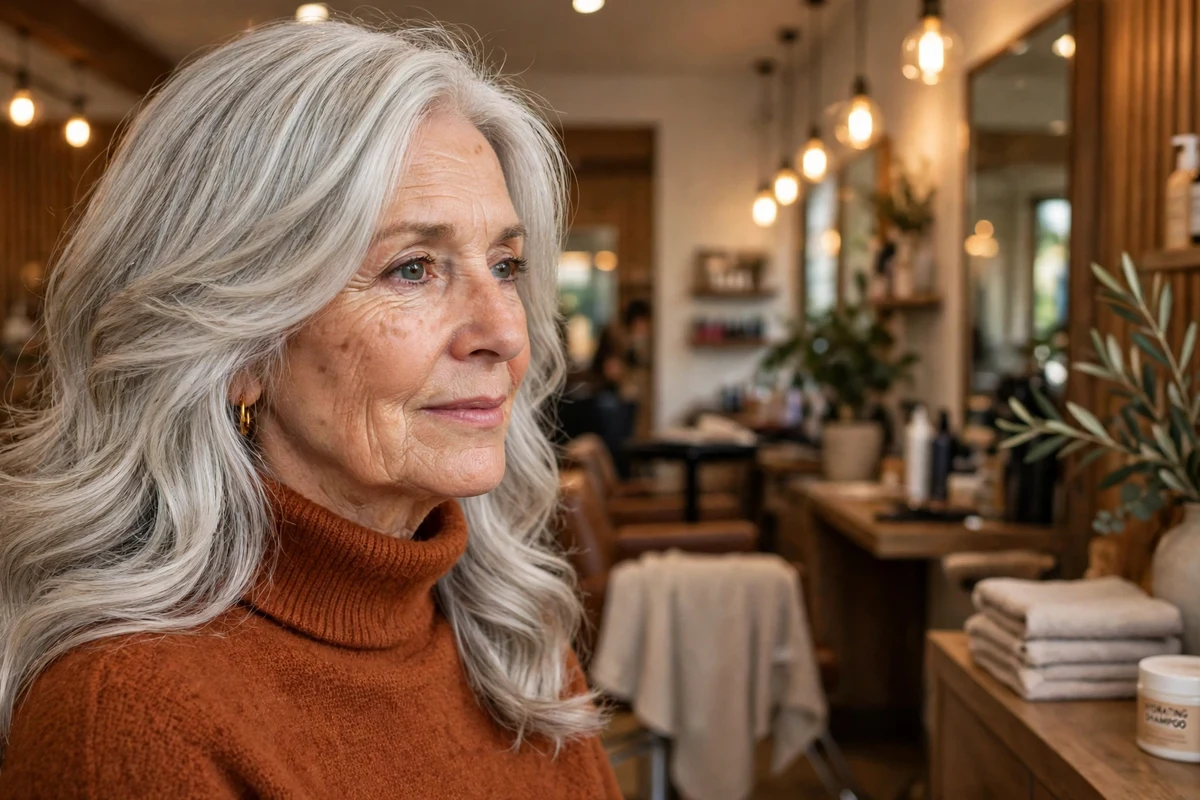
If you have kept your hair long into your fifties, sixties, or seventies, you already know the comments. People ask when you plan to cut it, as if length came with an expiry date. I keep mine long because I like how it feels and how many ways it can be worn, and this list is for anyone who feels the same and wants fresh ways to wear it well.
Below are 26 hairstyles for older women with long hair, gathered from the cuts and styles that rank and work best right now. You will find layered cuts, silver-friendly shapes, braids, ponytails, and updos, each with a clear tip and a simple difficulty and cost guide. Shape and healthy ends matter far more than age, and every idea here keeps the length you have worked to grow.
Key Takeaways
- Face-framing layers starting at the cheekbones are the single most flattering change for long hair at any age.
- Silver and grey hair looks polished with a side part, weekly purple shampoo, and conditioner kept on the ends.
- Low ponytails, low buns, and loose braids protect the hairline better than high, tight styles worn daily.
- A dusting trim every eight to twelve weeks keeps long ends full and stops splits from travelling upward.
- Bangs still work: curtain bangs and wispy fringes pair well with glasses and grow out softly.
1. Cheekbone Face-Framing Layers
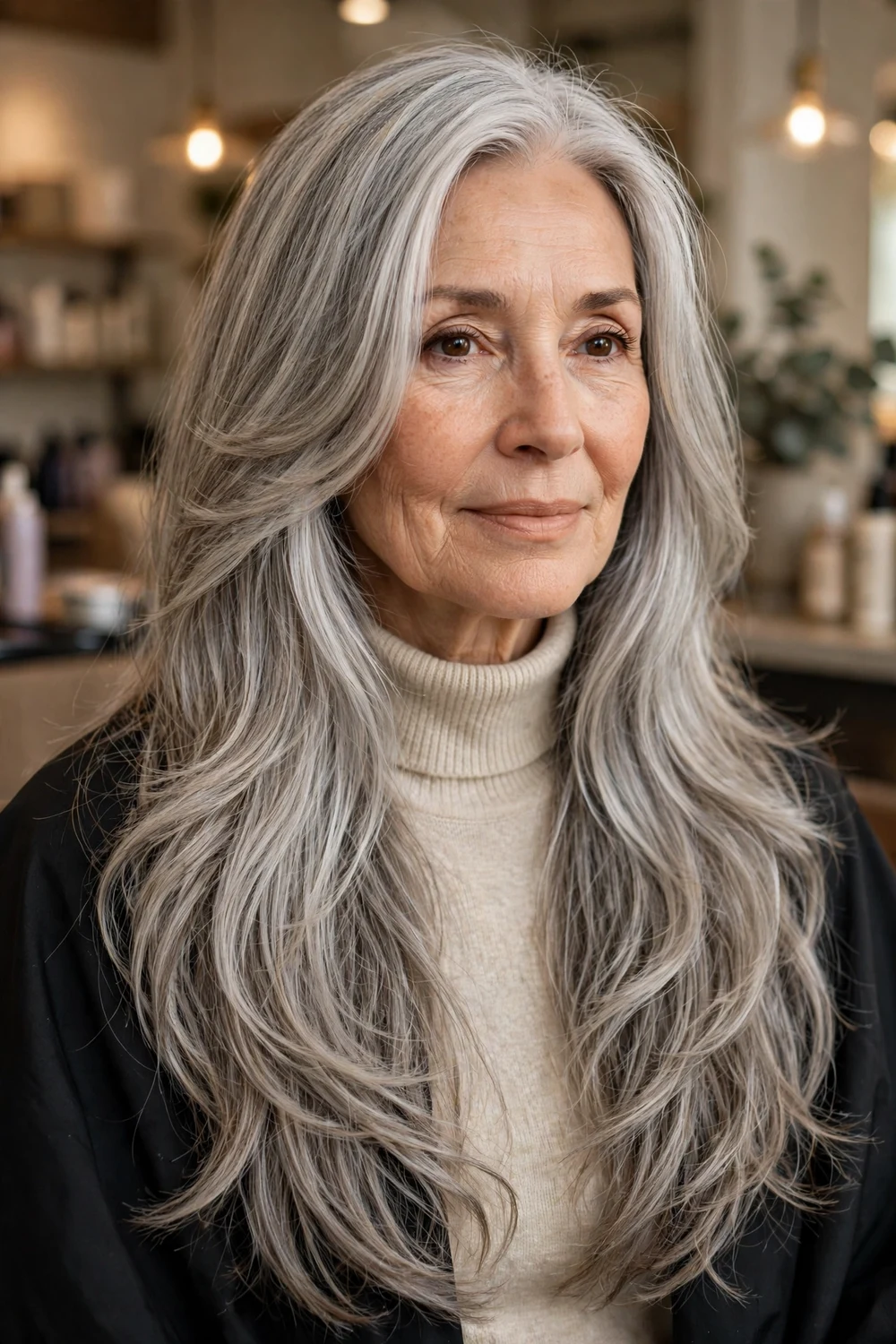
The shortest layers start at the cheekbones and step down in long, soft pieces toward the ends. That first short piece lifts the eye upward and gives the front of the haircut shape, while the length below stays full and smooth.
Ask for point-cut ends rather than a hard blunt line through the front. The softer edge blends better on fine hair and grows out without a heavy shelf at the jaw.
Try this: Blow-dry the front pieces away from the face with a medium round brush for two minutes. The rest can air-dry.
Difficulty: Easy · Cost: $
2. Long Silver Waves with a Soft Side Part
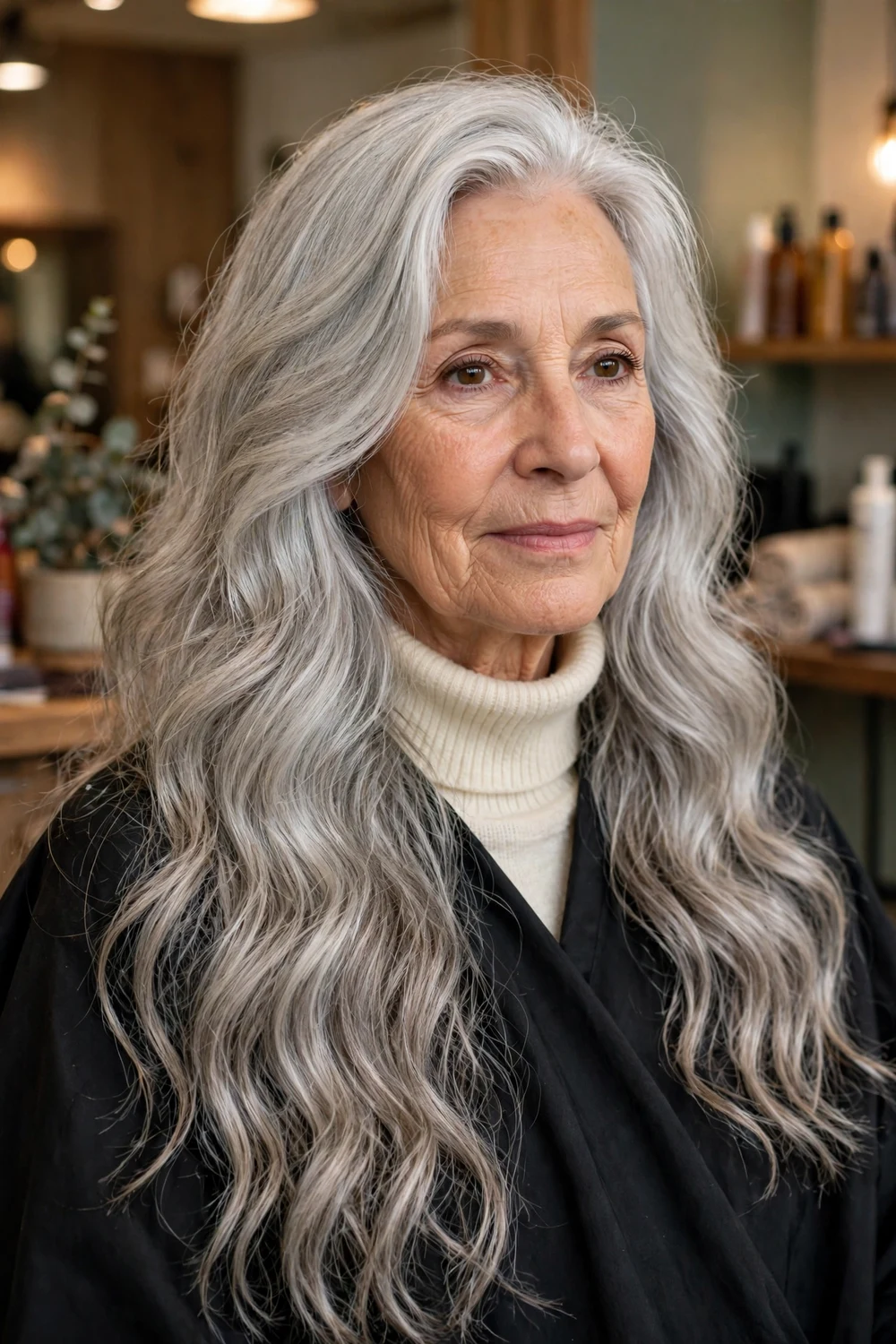
Natural silver hair looks polished when the waves are loose, brushed through, and kept glossy. A soft side part adds lift at the root and stops long silver hair from sitting flat against the scalp.
Use a purple shampoo once a week to keep yellow tones away, and keep conditioner on the ends only. Silver hair tends to feel dry, so a light oil on the last few inches helps the waves catch light.
Try this: Part the hair while it is damp, clip the top section up for ten minutes, then release it for natural root lift.
Difficulty: Easy · Cost: $
3. Sleek One-Length Straight with a Center Part

One even length, worn straight with a center part, reads clean and deliberate. It suits thicker long hair best, because the weight through the ends keeps the line smooth from root to tip.
The cut lives or dies on the ends, so book a dusting trim every eight to ten weeks. A heat protectant before flat ironing keeps the surface shiny and helps prevent breakage along the front.
Try this: Run the flat iron only through the mid-lengths and ends. Leave the roots alone to keep a little natural body.
Difficulty: Easy · Cost: $$
4. Long Airy Shag with Razored Ends
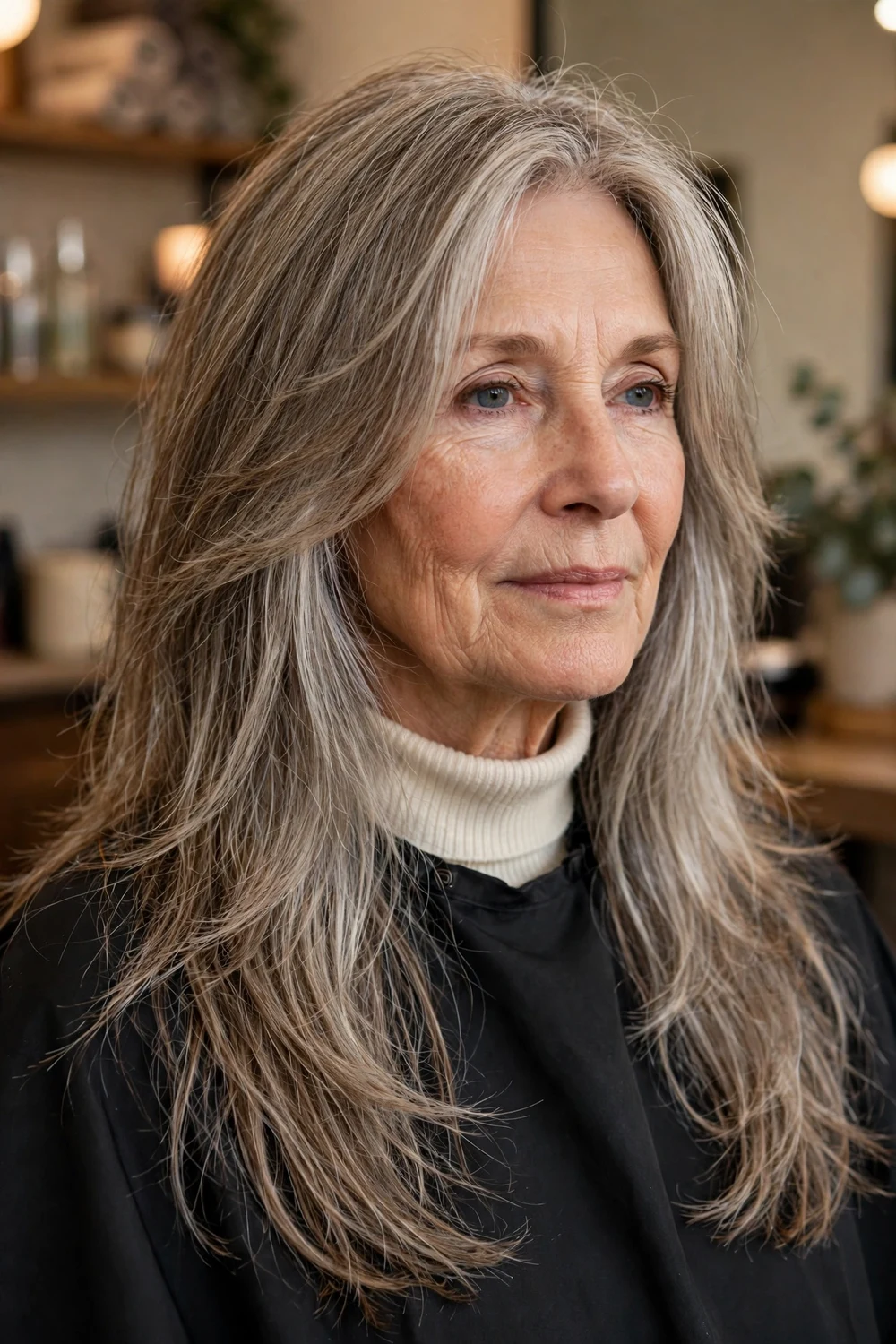
A long shag removes weight through the mid-lengths with razored, broken-up layers. The crown gets lift, the ends move freely, and the whole shape feels lighter on the head and on the shoulders.
This cut suits wavy hair especially well because the layers let the natural bend show. If you like a looser, lived-in finish, our guide to shaggy hairstyles for older women shows shorter versions of the same idea.
Try this: Scrunch a pea-size amount of mousse into damp hair and let it air-dry. Skip heavy oils, which weigh the layers down.
Difficulty: Medium · Cost: $$
5. Feathered Layers with Blowout Volume

Feathered layers are cut to sweep back from the face and stack lightly through the sides. Blow-dried with a round brush, they give long hair height at the sides and a soft flip at the ends.
The style holds best on medium to thick hair. On very fine hair, keep the feathering only around the face so the ends keep enough weight to look full.
Try this: Blow-dry in sections, rolling the brush under at the ends, then set each section for a few seconds with the cool setting.
Difficulty: Medium · Cost: $$
6. Long Layers with a Wispy Fringe

A wispy fringe sits light and broken across the forehead, paired with long layers below. It softens the forehead, draws focus to the eyes, and grows out into the face-framing layers without an awkward stage.
Keep the fringe thin. A heavy fringe on fine hair can look sparse within a few weeks, while a wispy one can be trimmed at home between salon visits with small, careful snips. More fringe shapes are covered in hairstyles with bangs for older women.
Try this: Blow-dry the fringe side to side with a small brush first, before styling the rest, so it sits flat and even.
Difficulty: Easy · Cost: $$
7. Long Layers with Curtain Bangs
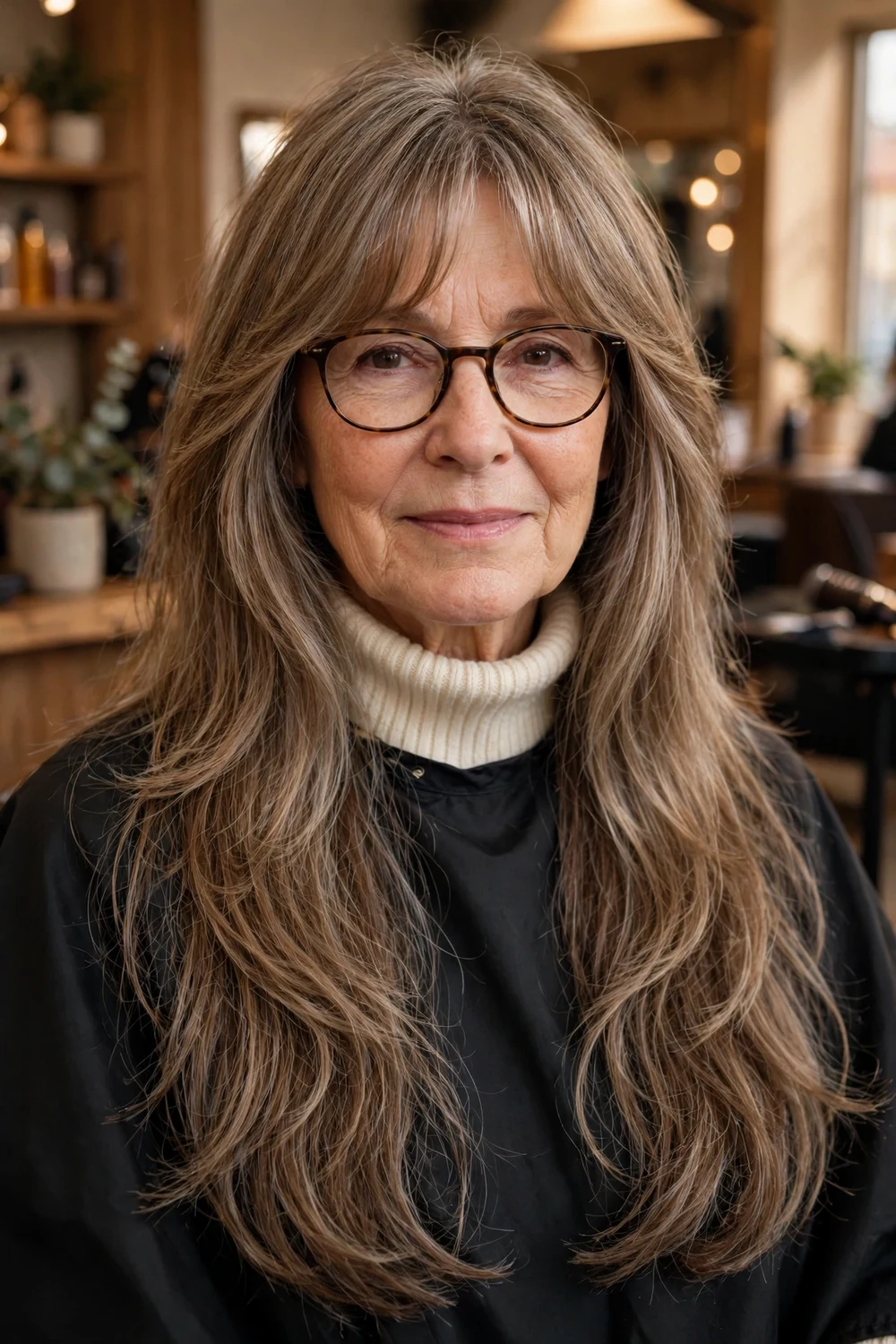
Curtain bangs part in the middle and sweep to each side, blending into long layers at the cheekbones. The shape opens up the face and works well with glasses, because the sides stay smooth where frames sit.
For more parting and length combinations, see the collection of long hairstyles with curtain bangs. The key detail here is length: the bangs should clear the cheekbone so they tuck behind the ears on busy days.
Try this: Dry the curtain bangs forward first, then split and sweep each side back. That order gives the soft bend at the part.
Difficulty: Easy · Cost: $$
8. Deep Side Part with Long Loose Waves
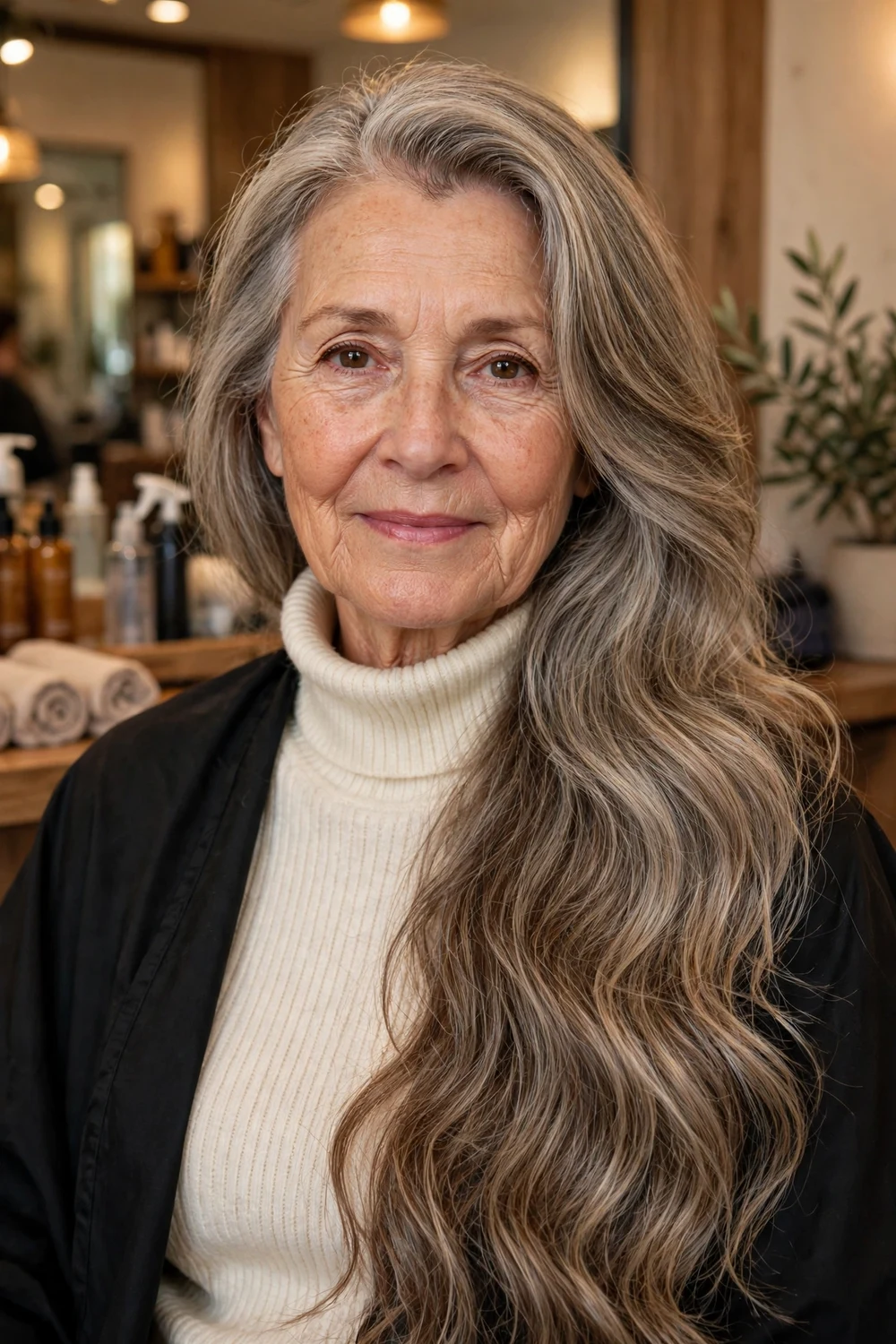
Moving the part far to one side changes long hair in under a minute. The heavy side gets instant height, the waves fall in one direction, and the face looks more open on the lighter side.
Loose waves can come from a large-barrel iron, from overnight braids, or from your natural texture brushed through gently. The deep part does most of the work, so the waves can stay relaxed.
Try this: Flip your part to the opposite side from your usual one. Hair that has trained the other way lifts higher at the root.
Difficulty: Easy · Cost: $
9. Soft Low Chignon with Face-Framing Pieces

A low chignon gathers long hair at the nape and twists it into a soft knot, with two thin pieces left loose at the front. It keeps hair off the neck, feels secure all day, and suits lunches, weddings, and photos alike.
Keep the knot loose. A tight chignon pulls at a tender scalp and looks severe, while a soft one with a little height above the knot reads relaxed and flattering.
Try this: Use large comfort pins instead of many small grips. Two crossed pins hold a low chignon with far less pulling.
Difficulty: Medium · Cost: $
10. Classic French Twist for Long Hair

The French twist sweeps long hair up into a vertical roll at the back of the head. It is a strong choice for formal events because it shows the neck and jaw line while keeping every strand in place.
Long hair needs the roll pinned in stages: smooth one side, roll, pin the seam, then tuck the ends down into the top. A light mist of hairspray at the end is enough. Heavy spray makes the twist look stiff in photos.
Try this: Practice the twist once on a quiet day and note how many pins you need. On the day itself, work with day-old hair, which grips better.
Difficulty: Hard · Cost: $$
11. Half-Up Crown Twist with Length Down

Two small sections above the ears are twisted back and pinned at the crown, while the rest of the length stays down. The front stays tidy, the length stays on show, and the style takes about five minutes.
This is a kind option for thinning at the temples, because the twists cover that area softly. Keep the twists loose so they add a little width at the sides.
Try this: Twist each side away from the face and cross the pins in an X shape at the back. Crossed pins hold far longer than parallel ones.
Difficulty: Easy · Cost: $
12. Loose Braided Crown over Flowing Length

A loose braid runs along the hairline from one ear to the other, and the remaining length flows free below it. The braid keeps the front neat on windy days and adds detail without any heat styling.
Work with a three-strand braid and pull each loop gently outward after pinning. That loosening step, called pancaking, makes the braid look wider and softer.
Try this: Start the braid on your stronger side and work toward the weaker side. The finish, where hands tire, lands on the easier side to fix.
Difficulty: Medium · Cost: $
13. Side Braid over One Shoulder

All the length is brought over one shoulder and braided loosely to the ends. It is practical for gardening, cooking, and travel, and it protects the ends from rubbing against collars and chair backs.
A side braid also doubles as an overnight wave setter. Sleep in a loose version and undo it in the morning for soft bends, a method covered in heatless hairstyles for long hair.
Try this: Leave the last three inches unbraided and secure with a small clear elastic. The tassel end looks softer and tangles less.
Difficulty: Easy · Cost: $
14. Textured Low Ponytail with Crown Volume

The crown is lifted and lightly teased, or set with a root powder, before the length is gathered low. That small height at the top stops a ponytail from looking flat and keeps the profile balanced.
Waves through the ponytail itself add width, which helps fine hair look thicker. One pass with a large iron, or braiding the ponytail for an hour before going out, both work.
Try this: Wrap a thin strand of hair around the elastic and pin it underneath. The covered base looks finished in seconds.
Difficulty: Easy · Cost: $
15. Low Sleek Ponytail Wrapped at the Base

Brushed smooth and gathered at the nape, this ponytail is the tidy end of the ponytail range. The hair lies flat at the sides, the length hangs in one clean line, and a wrapped section hides the elastic.
It suits straight and relaxed hair best. The American Academy of Dermatology notes that tight ponytails worn daily can stress the hairline, so keep this one low and loose rather than high and tight.
Try this: Smooth the sides with a soft brush and a drop of serum on your palms. Avoid gel at the hairline, which can flake.
Difficulty: Easy · Cost: $
16. Long Natural Curls with Defined Shine

Natural curls worn long need moisture and a gentle hand more than they need length taken away. Defined, shiny curls come from conditioning well, applying product on wet hair, and leaving the curls alone while they dry.
Ask for a dry cut or a curl-by-curl trim if your salon offers one, so each curl is shaped at the length it actually sits. If your hair is fine as well as curly, the volume methods in hairstyles for older women with fine hair pair well with this shape.
Try this: Refresh day-two curls with a spray bottle of water plus a drop of conditioner. Scrunch upward and let the curls reset as they dry.
Difficulty: Easy · Cost: $
17. Side-Swept Curls over One Shoulder

All the curls are swept to one side and held with two pins behind the opposite ear. The exposed side shows the neck and earrings, while the full side carries the volume. It is a reliable evening shape for long curly or waved hair.
Keep the pins hidden under the top layer of hair on the bare side. A small section twisted back from the hairline gives the pins something firm to hold.
Try this: Set the curls first, sweep second. Sweeping unset hair and then curling tends to flatten the side that sits underneath.
Difficulty: Medium · Cost: $$
18. Smooth Blowout with Lift at the Crown

A smooth blowout with the roots lifted at the crown gives long hair a polished finish without curls. The sides fall straight with a slight bend at the ends, and the top keeps height for hours.
Blow-dry the crown section upward and forward first, while it is fully damp. Roots set their direction early, and trying to lift them after the rest is dry rarely holds.
Try this: Use a concentrator nozzle and a large round brush, and finish the crown with a blast of cool air before moving the brush away.
Difficulty: Medium · Cost: $$
19. Straight Length with a Soft U-Shape Hemline

The back of the hemline curves in a shallow U, longest at the center and slightly shorter at the sides. That curve removes the heavy corners that make one-length hair swing like a curtain, while keeping almost all the length.
A U-shape also helps long hair sit better in ponytails and braids, because the sides reach the elastic without pulling. It is a small change that most people notice as softness rather than as a haircut.
Try this: Ask your stylist to show you the back with a hand mirror before you leave. The curve should be gentle, with no sharp V point.
Difficulty: Easy · Cost: $$
20. Long Hair with Full Soft Bangs
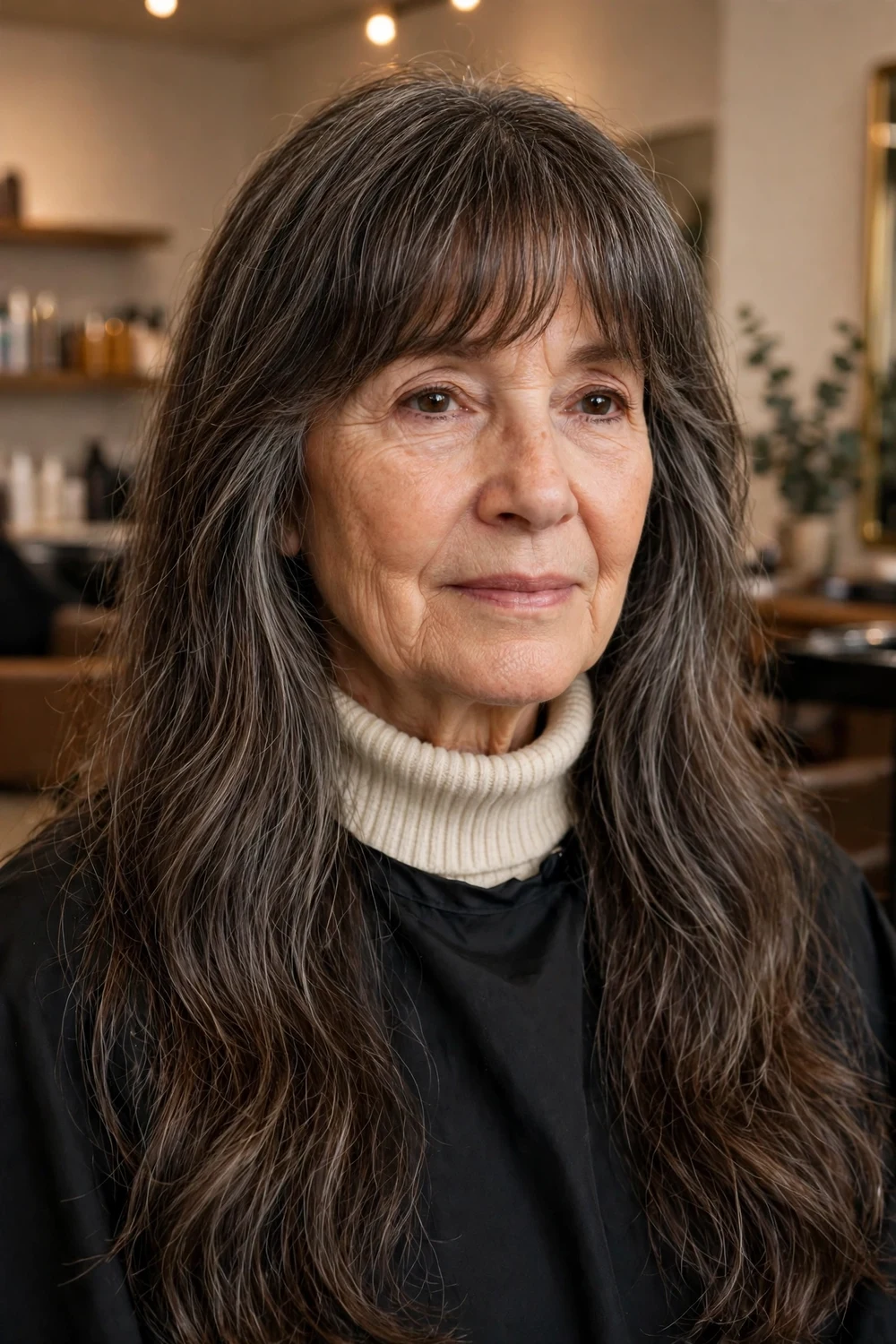
Full bangs cut just above the brows, with softened corners, change the balance of long hair at once. They bring focus to the eyes and cover forehead lines, and the long sides frame the cheeks below them.
Keep the edges feathered rather than blunt if your hair is fine. A hard horizontal line can look thin at the corners within weeks, while softened corners blend as they grow.
Try this: Trim only the center of the bangs between salon visits if you trim at home, and leave the corners to your stylist.
Difficulty: Medium · Cost: $$
21. Glossy Length with Dark Silver Streaks

Dark silver and charcoal streaks placed through lighter grey or white hair add depth and shine. The contrast makes long hair look thicker in photos and gives flat grey tones a clearer pattern.
Placement matters more than quantity. A few streaks around the face and through the top layer carry the effect, and the grow-out stays soft because the tones sit within the grey family.
Try this: Ask for a clear gloss at the same appointment. Gloss smooths the surface so the dark and light streaks reflect light at the same rate.
Difficulty: Medium · Cost: $$$
22. Half-Up Half-Down with a Pulled-Back Front

The front and top sections are pulled back into a small ponytail or clip at the crown, and the rest of the length falls free. Hair stays out of the eyes and off the face, while the long back keeps the look soft.
This shape is kind to the hairline because the pulled-back section sits loose. Use a fabric-covered elastic or a flat clip rather than a tight band, and vary the position slightly each day.
Try this: Leave two fine strands loose at the temples. Those small pieces stop the pulled-back front from looking severe.
Difficulty: Easy · Cost: $
23. Loose Low Bun for Everyday Wear

A loose low bun twists the length into a soft knot at the nape that can be done in under five minutes. It is the everyday answer for hot days, exercise classes, and any morning when loose hair feels in the way.
Keep the bun low rather than high. A low position puts less pull on the front hairline and sits comfortably against a collar or a headrest.
Try this: Form the bun from a low ponytail first. The elastic base means two pins are usually enough to hold the knot all day.
Difficulty: Easy · Cost: $
24. Bubble Braid Ponytail for a Playful Day

A ponytail is sectioned with small elastics every few inches, and each section is tugged gently outward to form a rounded bubble. The result looks detailed but needs no braiding skill and no heat.
It works on straight, wavy, and curly ponytails alike. On fine hair, use smaller sections so each bubble holds its round shape instead of sliding flat.
Try this: Use elastics that match your hair color. Matching bands disappear and the bubbles read as the hairstyle itself.
Difficulty: Easy · Cost: $
25. Long Hair with Grey-Blending Highlights

Fine highlights in ash, pearl, and soft beige are woven through long hair to blend incoming grey with colored lengths. The line between dyed hair and new growth fades, and salon visits can stretch much further apart.
This is a gap many long-hair lists skip, yet it suits this age group directly. Bring photos of your hair in daylight to the consultation, because grey blending is matched to your own pattern of grey rather than to a shade chart alone.
Try this: Ask for finer weaves around the part and hairline, where grey shows first. Finer pieces blend longer than chunky ones.
Difficulty: Medium · Cost: $$$
26. Loose Overnight Plait for Heatless Waves

One loose plait worn overnight sets long hair into even, soft waves by morning, with no heat at all. It also keeps long hair from tangling against the pillow, which cuts down on breakage at the ends.
Plait the hair when it is dry or barely damp. A wet plait can stay damp at the center until morning and the waves drop out fast, while a dry plait holds its bend through the day.
Try this: Undo the plait with your fingers and shake the roots. Brushing would pull the waves flat and create frizz at the surface.
Difficulty: Easy · Cost: $
Quick Comparison: Pick by Your Morning Time
| Style | Best for | Styling time | Cost band |
|---|---|---|---|
| Cheekbone Face-Framing Layers | Fine or flat long hair | 10 minutes | $ |
| Long Silver Waves with a Soft Side Part | Natural silver or grey hair | 5 minutes | $ |
| Soft Low Chignon with Face-Framing Pieces | Events and photos | 10 minutes | $ |
| Smooth Blowout with Lift at the Crown | A polished finish | 20 minutes | $$ |
| Long Hair with Grey-Blending Highlights | Growing out color | Salon visit | $$$ |
| Loose Overnight Plait for Heatless Waves | Heat-free waves | 5 minutes at night | $ |
Use the table as a starting point, then read the full idea above for the cut details and the tip that makes it work. Most of the low-cost styles on this list need only pins, a brush, and a fabric-covered elastic.
Frequently Asked Questions
Can older women wear long hair without it pulling the face down?
Yes. Long hair pulls the face down when it hangs in one heavy, unlayered piece. Face-framing layers starting at the cheekbones, a deep side part, or lift at the crown break up that weight and draw the eye upward, so the length can stay.
How often should long hair be trimmed after 50?
Every eight to twelve weeks works for most long hair. Ask for a dusting that removes only the dry tips if you want to keep gaining length. Waiting much longer lets split ends travel upward and the hemline starts to look thin.
Do bangs work with long hair and glasses?
Yes, with the right shape. Curtain bangs and wispy fringes sit well with glasses because the sides stay smooth where the frames rest. Keep the bangs long enough to clear the cheekbone so they can tuck behind the ears when needed.
How can I add volume to fine long hair?
Start with the cut: long layers that keep weight at the ends, plus a side part, add visible lift. Style with mousse at the roots only, blow-dry the crown upward, and avoid heavy oils through the mid-lengths, which pull fine hair flat.
What is the easiest long style for everyday wear?
A loose low bun and a textured low ponytail are the easiest everyday options. Both take under five minutes, keep hair off the face and neck, and stay gentle on the hairline when the elastic sits low and loose.
Final Thoughts
Long hair after fifty, sixty, or seventy works when the shape is deliberate: layers that lift the face, ends that get trimmed on schedule, and styles that stay gentle on the hairline. Pick two or three ideas from this list that match your texture and your mornings, try the low ponytail or the overnight plait this week, and book the cheekbone layers at your next salon visit. Your length is worth keeping, and it deserves a shape that shows it off.

