

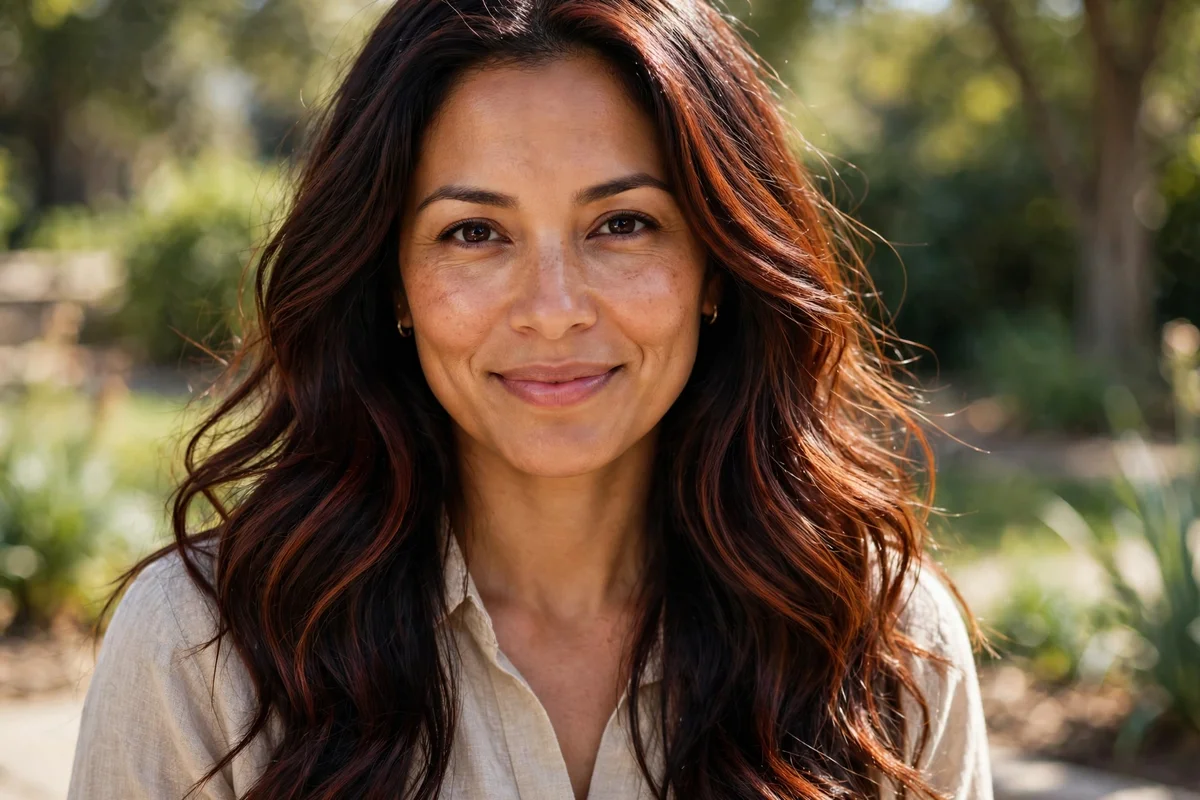
If you have typed as Deep Autumn (Dark Autumn, if you prefer that name), your coloring has two non-negotiable demands: depth and warmth. Go too light and your face loses its contrast; go too cool and your skin turns grayish. The colors that work live at levels 1 through 4, with golden, red, or copper undertones doing the quiet work of harmonizing with your skin.
This list collects 26 deep autumn hair colors, from espresso and warm black-brown through auburns, mahoganys, and deep coppers, plus dimensional techniques that add movement without stealing your depth. Every shade here respects what Deep Autumn coloring needs, and none of them drift into soft or true autumn territory.
Quick Takeaways
- Stay at level 4 or darker for all-over color; levels 1 to 4 keep your natural contrast.
- Every shade needs warmth: golden, red, or copper undertones, never ash or cool.
- Ask your colorist for R, C, W, or RR tone codes; skip anything labeled ash, cool, or blue-black.
- Keep highlights subtle: no more than about 20% of the hair lifted, and never past level 6 to 7.
- Warm-toned glosses every 4 to 6 weeks stop auburn and copper from fading flat.
1. Espresso Brown

Espresso brown is the darkest brunette that still reads brown instead of black, sitting around level 2 to 4 with a warm roast undertone. It matches the natural depth of many Deep Autumns so closely that it often looks like the hair you were born with, just richer. In sunlight it shows warm brown glints; indoors it reads as an intense dark brown.
It suits anyone whose natural hair is dark brown or darker and wants a change that is obvious but never jarring. Because it is a single-process color, root grow-out stays soft for six to eight weeks. Ask your colorist to add a warm filler if your hair is previously lightened, so the espresso does not go muddy.
Try this: add a warm clear gloss at your gloss appointment to deepen the roast tones without going darker.
Difficulty: Low · Cost: $$ (salon)
2. Warm Black-Brown

Warm black-brown sits at level 2, the point where brown nearly becomes black but keeps golden or auburn undertones. That warmth is what separates it from blue-black, which reads cool and harsh on Deep Autumn skin. This shade keeps your full contrast, which is the whole point of your coloring.
It flatters fair through deep skin tones, as long as your undertones lean warm. Maintenance is simple since the color is nearly opaque, though sun exposure can pull out the warmth over time. For more dark, rich seasonal shades, these winter hair color ideas include deep tones that also suit high-contrast coloring.
Try this: wear bronze or gold accessories near your face to echo the warm undertone in the hair.
Difficulty: Low · Cost: $$ (salon)
3. Dark Chocolate Brown

Dark chocolate brown, around level 3 to 4, is the classic Deep Autumn brunette: rich, slightly warm, and endlessly wearable. It is dark enough to preserve your contrast but soft enough that it never looks severe. The subtle warmth keeps it from reading flat, which is the risk with any dark brown.
It suits every skin tone in the Deep Autumn range and most natural base colors, which makes it one of the easiest shades to adopt. Ask for a shade with “warm” in the name rather than neutral, since neutral browns can cool down on warm skin. It grows out gently because the depth is close to most natural bases.
Try this: request a demi-permanent formula so the color fades on tone instead of exposing brass.
Difficulty: Low · Cost: $$ (salon)
4. Dark Chocolate with Red Tones

This is the moodier version of dark chocolate: a level 3 base with red tones that stay hidden in indoor light and come alive in sunlight. You get a conservative brunette at the office and a warm red-brown reveal outdoors. It is the best of both worlds if you want red without committing to a full auburn.
It flatters fair to medium Deep Autumn skin especially, since the red brings life to lighter warm complexions. Red molecules fade faster than brown ones, so expect the hidden red to need refreshing every five to six weeks. A red-depositing conditioner between appointments stretches the effect.
Try this: stand in natural daylight before your appointment and note how the red shows, then ask your colorist to match that exact reveal.
Difficulty: Medium · Cost: $$ (salon)
5. Deep Chestnut

Deep chestnut is a level 3 to 4 reddish brown, named for the shell of an actual chestnut: brown with an unmistakable red cast. It sits right between chocolate and auburn, giving you visible warmth without going full red. The red reads as warmth rather than color, which keeps it natural-looking.
It suits Deep Autumns who want warmth that is obvious but tasteful, and it works across skin depths. It is also a friendly transition shade if you are growing out darker color or coming down from a lighter one. For more shades in this autumn family, these fall hair colors round up warm seasonal brunettes and reds.
Try this: keep a warm-tinted hair gloss at home to revive the red cast between salon visits.
Difficulty: Low · Cost: $$ (salon)
6. Warm Chestnut

Warm chestnut lightens the formula to about level 4, trading deep chestnut’s red for golden undertones. It is the golden sister in the chestnut family, still deep enough for Deep Autumn but a touch brighter around the face. Think warm brown sugar rather than dark roast.
It suits golden and olive warm skin best, and anyone whose natural base is already a level 4 brown, since the colorist lifts less. Keep it at level 4 rather than lighter; pushing past level 5 starts borrowing from true autumn territory and costs you contrast. Root touch-ups every six weeks hold the golden tone.
Try this: ask for the golden tone to be concentrated through the mid-lengths so roots keep their natural depth.
Difficulty: Low · Cost: $$ (salon)
7. Rich Auburn

Rich auburn, around level 4 to 5, is the signature Deep Autumn red: a balanced red-brown with copper tones that shimmer in the sun. It is warm without tipping into bright orange and deep without reading as plain brown. In colorist codes, think 4R to 5RR.
It flatters fair warm skin especially, since the copper echo brings out a glow, but it works on medium warm skin too. Auburn fades faster than brown, so plan on a gloss or refresh every four to six weeks. Wash with cool water and color-safe shampoo to slow the fade.
Try this: bring a photo taken in sunlight, since auburn shifts a lot between indoor and outdoor light and your colorist needs to see the true target.
Difficulty: Medium · Cost: $$ (salon)
8. Dark Auburn

Dark auburn goes one level deeper than rich auburn, to about level 3 to 4. In most lighting it reads as a rich brown, and you have to catch it in the right light to see the red. That subtlety makes it the safest red for anyone nervous about going bold.
It suits high-contrast Deep Autumns whose skin can carry near-black depth. It is also a strong choice for conservative workplaces, since the red stays discreet until sunlight finds it. Like all reds it fades, so a red-tinted conditioner keeps it lively between appointments.
Try this: ask your colorist to keep the red concentrated toward the ends so your roots maintain maximum depth.
Difficulty: Medium · Cost: $$ (salon)
9. Copper Auburn

Copper auburn leans orange-red rather than red-brown, around level 5 to 6. It is the most expressive shade in the auburn family, with real copper fire that shows even in flat indoor light. It stays Deep Autumn-appropriate because the depth never drops below level 5.
It flatters golden and peachy warm undertones best, since the orange echo harmonizes with the skin. This is a statement shade that fades fast, so commit to gloss refreshes every four weeks and a hat in strong sun. Ask your colorist to anchor it with a deeper root so the grow-out stays intentional.
Try this: mix a copper color-depositing mask into your routine once a week to keep the orange tones from washing out.
Difficulty: High · Cost: $$ (salon)
10. Dark Mahogany

Dark mahogany is a level 3 to 4 brown with burgundy warmth rather than copper: deeper and more refined than auburn, with a wine-like undertone that stays warm. Think of it as auburn’s more polished sibling. The warmth is unmistakable but never loud.
It suits olive and bronze warm skin especially well, since the burgundy echo plays nicely with olive. It is office-friendly and evening-ready in the same appointment. Choose a warm mahogany formula rather than a cool burgundy, which pulls violet and fights your undertones.
Try this: confirm with your colorist that the formula has red, not violet, bases so it stays on the warm side.
Difficulty: Medium · Cost: $$ (salon)
11. Copper Mahogany

Copper mahogany blends mahogany’s depth with copper’s fire, landing around level 4. It is richer and more red than standard auburn, with a luxurious warm glow that reads in every kind of light. Colorists often code it 4RB.
It flatters golden and bronze skin tones best, since the copper tones echo that warmth directly. This is a high-maintenance shade: the copper component fades within weeks, so plan regular glosses. If you are still curious about lighter options, these fall blonde hair colors show the closest warm territory, but blondes wash out Deep Autumn contrast.
Try this: schedule your gloss refresh on the same cycle as your trim so the color always looks fresh at the ends.
Difficulty: High · Cost: $$ (salon)
12. Copper Bronze

Copper bronze is antique copper penny, not bright new penny: around level 5 to 6 with a brown base grounding the copper. It is the most wearable copper for Deep Autumns who want obvious copper without losing depth. The brown underlayer keeps your contrast intact.
It suits fair to medium warm skin and works well as a first copper for someone coming from brown. The brown base means grow-out looks softer than on a true copper. Ask for a level 6RC-type formula so the copper stays deep rather than going bright.
Try this: ask for the copper tone to deepen toward the ends, which keeps the color from looking flat at the crown.
Difficulty: Medium · Cost: $$ (salon)
13. Deep Copper

Deep copper sits at level 5 to 6, a saturated copper with real depth behind it. It is bolder than copper bronze and lighter than copper auburn, a true middle-weight copper that still honors Deep Autumn’s need for richness. It glows in sunlight and stays grounded indoors.
It flatters medium to deep warm skin especially, since the depth keeps the contrast relationship between skin and hair. It is also the shade many colorists use as a base before painting copper balayage over it. Fading is the tradeoff: refresh with a copper gloss monthly.
Try this: protect it from chlorine and salt water, which strip copper tones faster than anything else.
Difficulty: High · Cost: $$ (salon)
14. Deep Russet

Deep russet is a reddish brown with orange undertones, around level 5: think autumn leaves rather than bright copper. It is warmer than auburn and less pink-toned, giving an earthy, distinctive result. Colorists may code it 5R or 5RO.
It suits warmer, more golden skin tones best, since the orange echo matches that warmth. It is a less common shade, so bring reference photos and talk through whether your colorist’s red line can hit that orange-brown exactly. Like all warm reds it needs regular glosses.
Try this: describe it as “autumn leaf brown, not copper” so your colorist aims at the earthy tone, not the bright one.
Difficulty: High · Cost: $$ (salon)
15. Bronze & Burnt Sienna

Bronze and burnt sienna are deep, earthy reds with brown undertones, sitting between auburn and copper. They are less overtly red than copper but warmer than auburn, creating a sophisticated warmth that catches light well. The brown base keeps them firmly in Deep Autumn depth.
It suits Deep Autumns who want warmth without the upkeep drama of true copper, since the brown base masks fading. It is also one of the more natural-looking warm reds, reading as “rich brunette” to most eyes. A warm gloss every six weeks keeps the sienna tones from going flat.
Try this: ask for a demi-permanent application so the earthy tone builds gradually and fades gracefully.
Difficulty: Medium · Cost: $$ (salon)
16. Deep Walnut

Deep walnut is a level 4 brown with bronze and golden undertones rather than red, for Deep Autumns who want warmth without an obviously auburn result. It reads as a rich, sophisticated brown with a metallic warmth that shows in movement. Think warm chestnut without the red.
It suits anyone who works in a conservative setting or simply prefers brown over red. The golden-bronze undertone keeps it warm, so check that your formula does not drift neutral. It is one of the lowest-maintenance shades here, growing out softly over eight weeks.
Try this: ask your colorist to avoid the letter A in the formula code, since ash walnuts exist and they would cool the shade down.
Difficulty: Low · Cost: $$ (salon)
17. Bronze Brown

Bronze brown is brown with strong golden-copper undertones, around level 5 to 6: the lightest natural-looking brown on this list. The metallic warmth catches light with every movement, giving fine hair a sense of depth it would not otherwise have. It is still dark enough to keep your contrast.
It suits golden and olive skin tones and Deep Autumns with naturally lighter bases. Stay at level 6 at most; pushing lighter starts borrowing blonde territory and costs you the depth your coloring depends on. A warm gloss refresh every five weeks keeps the bronze from fading to plain brown.
Try this: style with a shine spray on dry hair, since bronze tones need reflective light to show their metallic character.
Difficulty: Medium · Cost: $$ (salon)
18. Warm Chocolate

Warm chocolate is milk chocolate, not dark chocolate: a level 4 to 5 brown with soft reddish undertones that show in direct light. It is gentler than the dark chocolate on this list, making it the friendliest shade for a first all-over color. It reads warm and approachable without losing richness.
It suits most Deep Autumn skin tones and natural bases, since level 4 to 5 covers the most common natural hair colors. It is also the most professional, low-drama option here. Keep the formula warm rather than neutral, since neutral chocolate can cool down on warm skin.
Try this: if your natural hair is already level 5, ask for a gloss-only application so the change is gentle and commitment-free.
Difficulty: Low · Cost: $$ (salon)
19. Deep Toffee Gloss
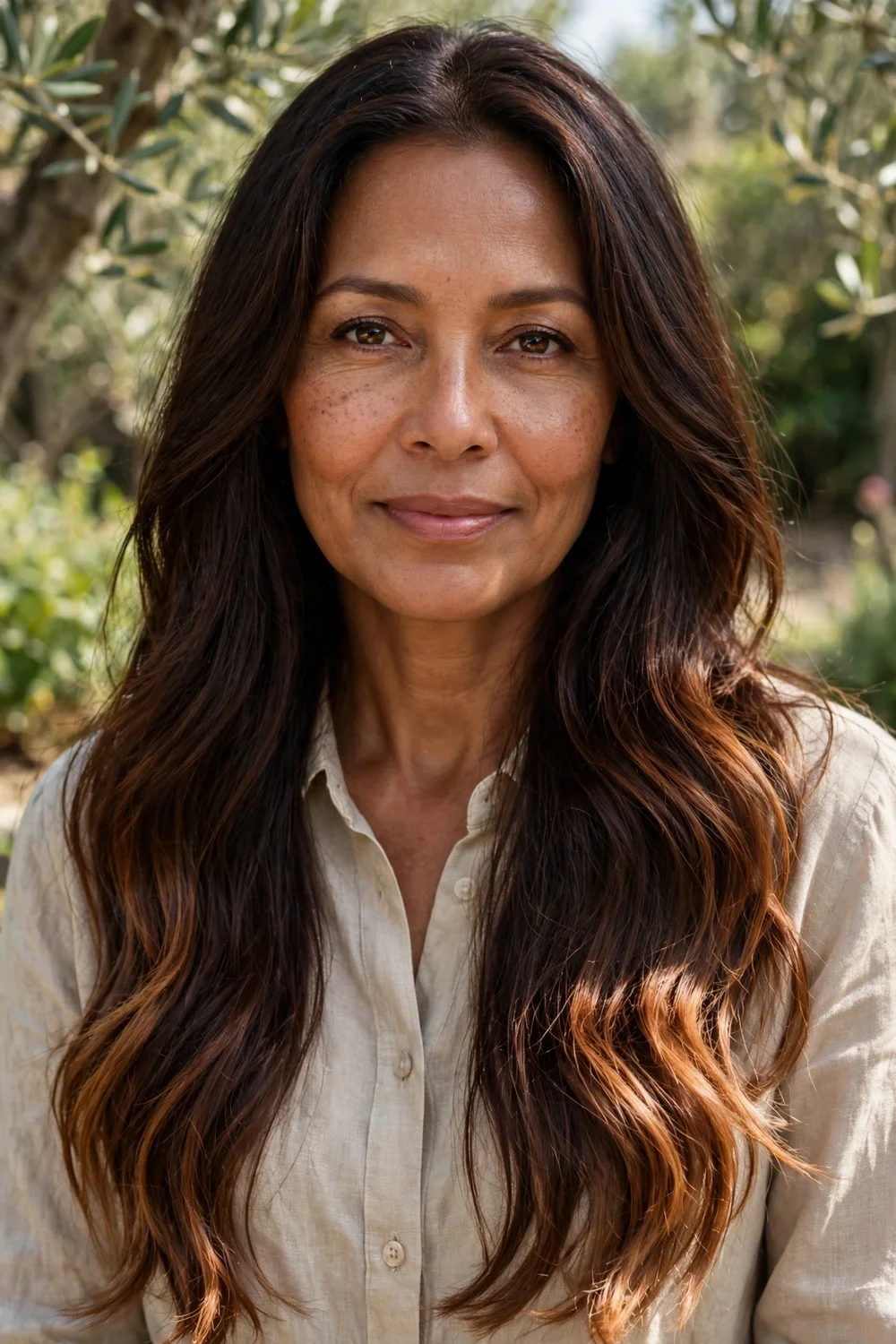
A deep toffee gloss is not a full color change but a level 4 to 5 golden-brown glaze over your existing dark base. It adds shine and a warm caramelized finish without lifting your natural color, which makes it the gentlest way to warm up dark hair. The effect is rich and dimensional rather than lighter.
It suits anyone whose base is already dark brown and who wants warmth with zero regrowth line. Because it is a gloss, it fades gradually over four to six weeks with no harsh line. Reapply as a standalone service between full colors to keep the warmth going year-round.
Try this: book the gloss as an add-on to your trim appointment so it never becomes a separate trip.
Difficulty: Low · Cost: $ (salon)
20. Rich Copper Balayage

Rich copper balayage paints level 6 to 7 copper pieces over a level 3 to 4 dark base, keeping all of your natural depth at the root. The highlights start mid-shaft rather than at the scalp, so the grow-out stays soft for months. It is the most flattering dimensional service for Deep Autumn because it adds warmth without lightness for its own sake.
It suits long to medium lengths where the hand-painted pieces have room to show. Ask your colorist to keep the pieces warm copper, not golden or honey, and to concentrate them around the face and mid-lengths. Unlike a blonde balayage on brown hair, which lifts too light for your contrast, this stays within your palette.
Try this: ask for a partial balayage rather than full, since it costs less and looks more natural on deep coloring.
Difficulty: High · Cost: $$$ (salon)
21. Warm Caramel Balayage

Warm caramel balayage uses level 6 to 7 caramel pieces on a level 4 to 5 chocolate base, creating sun-kissed warmth that still reads natural. The key word is warm: the caramel must have bronze undertones, not beige. Placement stays toward the ends and a few face-framing pieces.
It suits Deep Autumns who want visible dimension but shy away from red. Keep the lightened portion to about 15 to 20% of the hair at most, or the overall look starts washing out your depth. A warm-toned gloss at each touch-up stops the caramel from fading cool.
Try this: have your colorist melt the caramel into the base with a root shadow so there is no visible line as it grows.
Difficulty: High · Cost: $$$ (salon)
22. Auburn Foil Highlights

Auburn foils are traditional highlights done in level 5 to 6 auburn over a level 3 to 4 dark base, staying within two levels of the natural depth. They blend throughout the hair for all-over dimension rather than chunky pieces. The result reads as natural depth with red movement.
It suits straight to wavy hair where blended foils show evenly. Because foils start closer to the root than balayage, they need refreshing every six to eight weeks. Ask for fine, blended sections rather than bold slices so the red reads as dimension, not stripes.
Try this: request a red-based toner over the foils at each appointment so the highlights never pull orange.
Difficulty: High · Cost: $$$ (salon)
23. Mahogany Lowlights

Mahogany lowlights go the other direction: level 3 to 4 dark mahogany pieces woven under a level 4 to 5 lighter base. Instead of adding lightness, they add depth and richness, which is exactly what Deep Autumn coloring rewards. They sit underneath and at the roots for a shadow effect.
It suits Deep Autumns whose hair has lightened over time or who are growing out a lighter color and want their depth back. Lowlights are also the lowest-commitment way to test mahogany, since they peek through rather than taking over. Refresh every eight weeks as the base grows.
Try this: ask for the lowlights concentrated underneath the top layer, so the depth shows through when your hair moves.
Difficulty: Medium · Cost: $$ (salon)
24. Deep Caramel Lowlights

Deep caramel lowlights add level 5 to 6 warm caramel ribbons through a level 2 to 3 dark base, creating dimension without ever reading as highlights. On near-black hair this is the safest way to add movement, since the caramel stays close to the base depth. The warm tones catch light with every turn of the head.
It suits very dark natural hair that cannot or should not be lifted much. Because the caramel stays deep, grow-out is nearly invisible and appointments can stretch to ten weeks. Keep the caramel warm and bronze-toned so it never reads ashy against your base.
Try this: keep the lowlights to the interior layers for a subtle effect, or bring them toward the face for more visible warmth.
Difficulty: Medium · Cost: $$ (salon)
25. Bronze Money Piece

A bronze money piece puts two warm level 5 to 6 highlights right at the front of the hairline over a dark base. It brightens the face exactly where your coloring needs light, without committing any other part of the head. It is the highest-impact, lowest-commitment dimensional service on this list.
It suits anyone who wants to test warmth around the face before doing a larger service. Keep the pieces thin and blended; thick, high-contrast pieces look harsh against deep coloring. Refresh every eight to ten weeks, since the front grows out visibly.
Try this: ask for the money piece to start an inch back from the hairline so it blends softly instead of looking painted on.
Difficulty: Medium · Cost: $$ (salon)
26. Deep Root Shadow with Warm Ends

A deep root shadow keeps your natural dark level at the scalp and melts into warm copper-brown ends, around level 5 to 6. The smudged root means the grow-out is invisible for months, and the warm ends give you the copper feel without an all-over commitment. It is the most forgiving dimensional look here.
It suits long hair especially, where the gradient has room to develop. Ask your colorist to smudge the root with a level 3 to 4 warm brown rather than leaving it harsh, and to keep the ends warm rather than golden. A gloss every six weeks keeps the transition seamless.
Try this: style in loose waves to show the full gradient from dark root to warm ends.
Difficulty: High · Cost: $$$ (salon)
At a Glance: 26 Deep Autumn Colors Compared
| Shade | Best for | Why it works | Upkeep |
|---|---|---|---|
| Espresso Brown | Naturally dark hair | Darkest brown with warm roast tones | Roots every 6 to 8 weeks |
| Warm Black-Brown | High-contrast coloring | Near-black depth without cool harshness | Protect warmth from sun fade |
| Dark Chocolate Brown | Every Deep Autumn skin tone | Classic rich warm brunette | Demi-permanent, soft grow-out |
| Dark Chocolate with Red Tones | First-time red wearers | Conservative indoors, red in sunlight | Red-depositing conditioner between visits |
| Deep Chestnut | Visible warmth, tasteful | Red-brown balance between chocolate and auburn | Warm gloss every 6 weeks |
| Warm Chestnut | Golden and olive warm skin | Golden undertones brighten the face | Roots every 6 weeks |
| Rich Auburn | Fair warm skin | Signature Deep Autumn red-brown | Gloss every 4 to 6 weeks |
| Dark Auburn | Cautious first-time reds | Reads brown, reveals red in sun | Red-tinted conditioner weekly |
| Copper Auburn | Statement red wearers | Orange-red fire at full depth | Monthly gloss, copper mask weekly |
| Dark Mahogany | Olive and bronze warm skin | Refined burgundy warmth, polished | Confirm warm, not violet, formula |
| Copper Mahogany | Golden and bronze skin | Deep mahogany plus copper glow | Regular glosses for the copper |
| Copper Bronze | First copper from brown | Antique copper grounded in brown | Soft grow-out, gloss as needed |
| Deep Copper | Medium to deep warm skin | Saturated copper with real depth | Monthly copper gloss |
| Deep Russet | Distinctive earthy red | Autumn-leaf orange-brown, not bright | Regular glosses, reference photos |
| Bronze and Burnt Sienna | Natural-looking warm red | Earthy reds grounded in brown | Warm gloss every 6 weeks |
| Deep Walnut | Conservative settings | Warmth without obvious red | Roots every 8 weeks |
| Bronze Brown | Fine hair, golden skin | Metallic warmth adds depth | Gloss every 5 weeks |
| Warm Chocolate | First all-over color | Soft milk-chocolate warmth | Gentle grow-out |
| Deep Toffee Gloss | Zero-commitment warmth | Glaze adds warmth, no lift | Reapply every 4 to 6 weeks |
| Rich Copper Balayage | Long to medium lengths | Copper dimension over dark base | Soft grow-out for months |
| Warm Caramel Balayage | Subtle dimension seekers | Bronze caramel on chocolate | Warm gloss at touch-ups |
| Auburn Foil Highlights | Straight to wavy hair | Blended red depth throughout | Refresh every 6 to 8 weeks |
| Mahogany Lowlights | Growing out lighter color | Adds depth instead of lightness | Refresh every 8 weeks |
| Deep Caramel Lowlights | Very dark natural hair | Movement with near-invisible grow-out | Appointments every 10 weeks |
| Bronze Money Piece | Testing face-frame warmth | Brightens the face, tiny commitment | Refresh every 8 to 10 weeks |
| Deep Root Shadow with Warm Ends | Long hair, low maintenance | Dark roots melt to copper ends | Gloss every 6 weeks |
How to Choose Your Deep Autumn Shade
Start with your depth. If your natural hair is level 2 to 3, stay in the espresso, warm black-brown, and dark chocolate zone so your contrast stays intact. If your natural base is level 4 to 5, the auburn and mahogany family will feel natural on you. Your eyes help too: darker eyes pair with darker shades, while hazel and warm green eyes glow next to copper and russet.
Next, decide how much red you want the world to see. Some of these shades keep their red hidden until sunlight finds them, like dark chocolate with red tones and dark auburn, while others, like copper auburn and deep copper, show their warmth in every light. If you work somewhere conservative, pick a shade whose red stays discreet. If you want your hair to be the statement, go copper.
Finally, be honest about maintenance. Reds and coppers fade fast and need gloss refreshes every four to six weeks, while single-process browns can stretch to eight. Dimensional services like balayage and root shadows cost more up front but grow out so softly that you visit less often. Pick the schedule you will actually keep, since a faded copper looks duller than a fresh chocolate.
Color Care for Deep Autumn Hair
Fading. Warm tones, especially reds and coppers, wash out faster than browns because red color molecules are smaller and slip out of the hair shaft more easily. Wash with lukewarm water, use a color-safe shampoo, and add a color-depositing conditioner in a matching warm tone. A professional warm gloss every four to six weeks is the single best defense against fading.
Brassiness. When warm color fades on previously lightened hair, it can turn brassy orange. The fix is a red-based or copper-based toner rather than a purple shampoo, which cools the color down and works against your warmth. If brassiness keeps returning, your colorist may need to adjust the underlying formula rather than just toning over it.
Shine. Deep colors show shine better than light ones, which is an advantage you should protect. Weekly deep-conditioning keeps the cuticle smooth so light reflects cleanly. A lightweight shine serum on dry ends adds gloss without weight, and limiting heat styling preserves the color you paid for.
Frequently Asked Questions
What are the best hair colors for Deep Autumn?
The best hair colors for Deep Autumn are deep, warm shades at levels 1 through 4: espresso brown, warm black-brown, dark chocolate, rich and dark auburn, mahogany, copper mahogany, deep copper, russet, and deep walnut. Every shade should have golden, red, or copper undertones. Dimensional options that respect your palette include copper balayage, warm caramel balayage, auburn foils, and mahogany lowlights.
Can Deep Autumn go blonde?
As an all-over color, no. Blonde, even golden blonde, is too light for Deep Autumn and washes out the depth and contrast your coloring depends on. Most flattering blondes also run cool, which fights your warm undertones. If you want lightness, stick to level 6 to 7 warm accents like caramel or bronze balayage on a dark base, and keep the lightened portion under 20% of your hair.
What hair colors should Deep Autumn avoid?
Avoid anything cool or too light: ash blonde, platinum, ash brown, cool chocolate, blue-black, cool burgundy, cherry or violet reds, mushroom brown, and taupe. Light golden blonde and strawberry blonde are also too light. If a shade makes your skin look gray or sallow, your eyes dull, or your face washed out, it is fighting your natural warmth and depth.
What balayage and highlights work for Deep Autumn?
Rich copper balayage on a level 3 to 4 dark base is the most flattering option, followed by warm caramel balayage on chocolate, auburn foil highlights within two levels of your base, and mahogany lowlights for added depth. Keep the lifted portion to about 20% of the hair or less, never lift past level 6 to 7, and always keep the tones warm. Skip blonde balayage, chunky highlights, and any cool or ashy pieces.
How do I keep deep warm hair color from fading?
Use a sulfate-free color-safe shampoo, wash with lukewarm water, and avoid washing daily. Add a color-depositing conditioner in a matching warm tone once a week, and book a warm-toned gloss treatment every four to six weeks. Protect your hair from sun, chlorine, and salt water, which all strip warm tones fast. Touch up roots every six to eight weeks so regrowth never dulls the overall effect.
Final Thoughts
Deep Autumn hair color is really about trust: trust the depth you already have, and trust warmth to do the rest. Pick a shade at level 4 or darker with warm undertones, commit to the maintenance it actually needs, and you will have hair that makes your coloring look intentional instead of accidental.

