


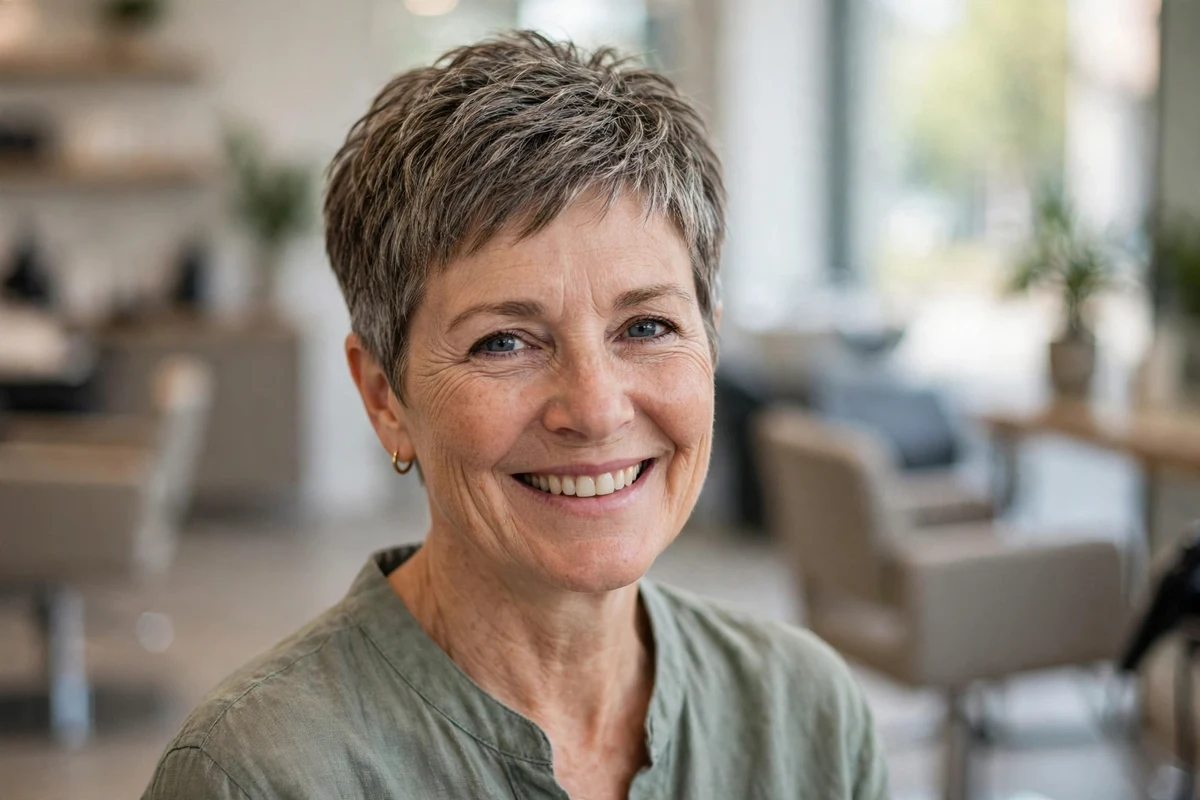
A short pixie haircut after 50 is one of the smartest choices you can make. It takes years of styling time off your routine, it works with the texture changes that come with age, and a good cut can make fine or thinning hair look fuller than it has in years.
The key is picking the right pixie for your hair, not just the prettiest photo. Below are 20 classic short pixie haircuts for women over 50, each with honest notes on who it suits, what to ask your stylist for, and what upkeep really looks like. A good rule: bring two photos to your appointment, one you love and one that shows your natural texture.
And if your main concern is fine strands, choppy pixie cuts for fine hair over 50 focuses on textured cuts that make thin hair look denser.
If your hair is thinning as well as aging, our guide to pixie cuts for thin hair over 50 focuses on volume-building cuts designed for this exact combination.
Quick Takeaways
- A classic pixie means tapered sides, a clean nape, and enough length on top to style. It suits most face shapes with small adjustments.
- Fine or thinning hair benefits most: short layers at the crown create lift and the illusion of density.
- Expect a trim every 4 to 6 weeks. A pixie loses its shape faster than longer cuts, so budget for regular maintenance.
- Bring reference photos and tell your stylist about your natural texture, cowlicks, and how much daily styling you will actually do.
- Gray and silver hair looks sharp in a pixie. A purple shampoo once a week keeps the tone clear instead of yellow.
20 Short Pixie Haircuts for Women Over 50
1. Classic Tapered Pixie

The benchmark every other pixie is measured against: neatly tapered sides and nape with a slightly longer top that can be smoothed or tousled. Ask your stylist for scissor-over-comb tapering rather than clippers if you want a softer grow-out. This cut flatters oval, heart, and square faces with almost no adjustment.
Styling takes under five minutes. Work a pea-sized amount of light pomade through dry hair, push the top forward or to the side, and go. It grows out evenly, which means the in-between stage never looks awkward.
Try this: change your part from one side to the other every few days. It keeps volume at the roots instead of letting the hair fall flat along a set part.
Difficulty: Easy · Cost: standard pixie cut ($45–$75)
2. Soft Side-Swept Pixie

A longer fringe swept across the forehead softens the whole face, which makes this one of the most requested pixies for women over 50. The side sweep draws attention to the eyes and cheekbones while downplaying forehead lines. It works on straight, wavy, and relaxed textures.
Ask for the fringe to hit just at or below the brow so it can be worn swept or tucked. A round brush and two minutes with a blow-dryer set the sweep; on busy days, a side part and finger styling do the job. If you wear glasses, keep the fringe above the frames so the two do not compete.
Try this: blow-dry the fringe in the opposite direction first, then sweep it into place. The roots lift and the sweep holds all day.
Difficulty: Easy · Cost: standard pixie cut ($45–$75)
3. Feathered Pixie

Feathered layering, cut with a razor or point-cutting shears, gives the pixie airy movement without sharp edges. It is a strong pick for fine to medium hair because the light layers create the impression of fullness. The finish looks soft rather than severe, which suits women who find blunt pixies too harsh.
Style with a light styling cream on damp hair and finger-comb everything into place. Skip heavy waxes, which collapse feathered texture. Trims every five weeks keep the feathering from turning shaggy.
Try this: flip your head upside down and rough-dry for one minute. The feathered layers separate and you get instant volume at the crown.
Difficulty: Easy · Cost: standard pixie cut ($45–$75)
4. Sleek Polished Pixie

For women who like a put-together finish, the sleek pixie is smooth through the sides with a clean side part and a polished top. It reads professional and works well for office settings or formal events. Straight or straightened hair holds this style best.
Blow-dry smooth with a small round brush, then run a flat iron over the top sections. Always use a heat protectant first, since short hair shows heat damage quickly. A drop of shine serum on the ends finishes the look. If you want something bolder than these classics, our edgy choppy pixie haircuts for women over 50 take texture much further.
Try this: tuck one side neatly behind the ear and leave the other side full. It adds shape without any extra styling time.
Difficulty: Easy · Cost: standard pixie cut ($45–$75)
5. Crown-Volume Pixie

Thinning at the crown is common after 50, and this pixie is built to handle it. Stacked, shorter layers through the crown create lift exactly where hair goes flat, while the sides stay neat. The result reads as fuller hair, not thinner hair styled to hide.
Ask your stylist to keep weight at the crown and remove it from the ends. Apply volumizing mousse to damp roots and blow-dry upward with your fingers. Avoid heavy conditioners at the roots, which pull the crown flat by midday.
Try this: a zigzag part instead of a straight one hides sparse spots at the part line instantly.
Difficulty: Easy · Cost: standard pixie cut ($45–$75)
6. Pixie with Wispy Fringe

A wispy fringe softens the forehead without the commitment of a heavy bang. The light, piecey pieces can be worn straight down or swept aside, so the cut stays flexible as it grows. This is a good choice if you want softness around the face but do not want bangs that need daily heat styling.
Ask for the fringe to be point-cut rather than blunt so it falls in separated wisps. It needs a light trim every three to four weeks, faster than the rest of the cut, so ask your stylist about fringe touch-ups between full appointments. Many salons do them free or cheap.
Try this: twist two small fringe pieces while damp and let them air-dry. They fall into soft separated wisps with no heat at all.
Difficulty: Easy · Cost: standard pixie cut ($45–$75)
7. Silver Gray Pixie

Natural gray hair and a pixie were made for each other. The short length shows off silver tones at their brightest, and the clean shape keeps gray looking deliberate instead of neglected. Women growing out dye often find the pixie is the fastest route to fully natural silver.
Gray hair can turn yellow from sun, heat, or minerals in water. Use a purple shampoo once a week and a clear gloss treatment every couple of months to keep the silver bright. Keep the cut sharp with trims every four to five weeks, since grown-out gray at the nape reads messy fast.
Try this: a silk pillowcase reduces friction on short gray hair, which tends to be coarser and frizz-prone overnight.
Difficulty: Easy · Cost: standard pixie cut ($45–$75)
8. Salt-and-Pepper Pixie

When gray comes in patchy, a salt-and-pepper blend makes it look intentional. Your colorist weaves dark lowlights through the gray so the two tones melt together instead of clashing. The pixie length keeps the blend looking crisp and modern.
This is lower maintenance than full gray coverage because regrowth blends in rather than showing a line. Plan a lowlight refresh every eight to ten weeks. For pixie inspiration aimed at every stage past 50, see our short pixie haircuts for older women for more gray-friendly ideas.
Try this: ask for the lowlights concentrated underneath and around the face. It frames the features while the silver shines on top.
Difficulty: Easy · Cost: pixie cut + lowlights ($100–$160)
9. Warm Auburn Pixie
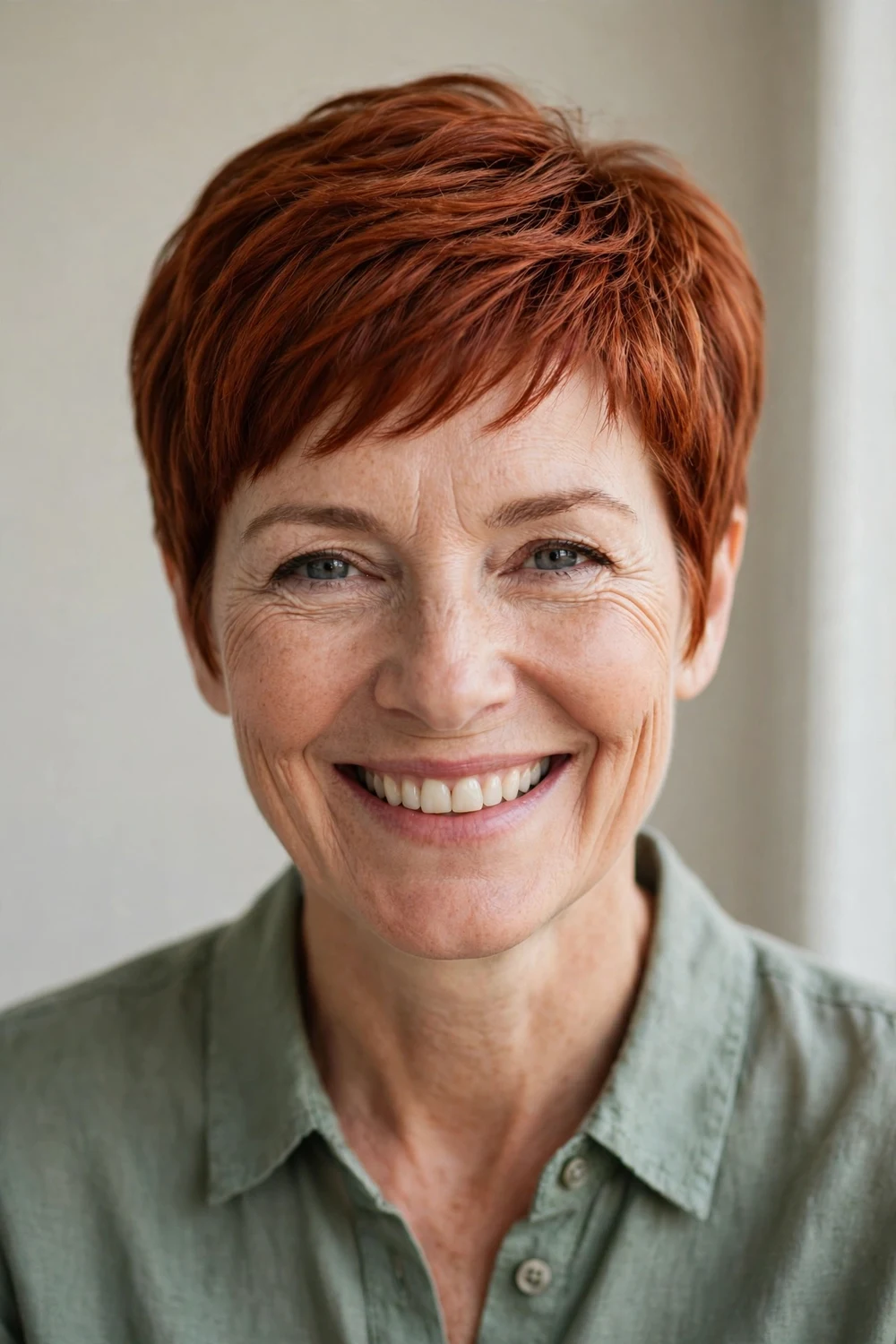
Warm auburn and copper tones bring light to the face, which is why colorists often suggest them for women over 50. On a pixie, the color reads rich rather than overwhelming because there is simply less hair. It suits warm and neutral skin tones especially well.
Red tones fade faster than any other color, so use color-safe shampoo and cool water when washing. A gloss treatment every six to eight weeks keeps the auburn vivid between full color appointments. The cut itself stays classic: tapered sides, textured top, clean nape.
Try this: a copper gloss, not permanent color, is the lowest-commitment way to test whether warm tones suit you.
Difficulty: Easy · Cost: pixie cut + color ($110–$180)
10. Classic Brunette Pixie

Rich brunette gives the pixie a sleek, polished finish that works in any setting. Darker hair shows the cut’s architecture clearly, so every layer reads as intentional. A demi-permanent gloss in a neutral brown boosts shine without changing your base color.
Dark hair shows regrowth and gray roots faster than lighter shades, so plan root touch-ups every four to six weeks if you color. Between appointments, a root-cover powder or spray handles the part line. Keep the shape sharp, since dark pixies look best with crisp edges.
Try this: shine serum, not oil, on brunette pixies. Oil can make short dark hair look lank by afternoon.
Difficulty: Easy · Cost: standard pixie cut ($45–$75)
11. Soft Blonde Pixie with Lowlights

All-over blonde on short hair can wash out the complexion after 50. The fix is lowlights: slightly darker pieces woven through the blonde that add depth and keep the color from looking flat. A soft root shadow does the same job while stretching the time between appointments.
Blonde pixies need moisture, since lightening dries the hair. Use a weekly mask and keep heat styling minimal. Toner every six to eight weeks stops the blonde from turning brassy. The cut underneath stays timeless: short sides, piecey top, soft edges.
Try this: ask for the lowlights in a shade close to your natural color. Regrowth becomes nearly invisible.
Difficulty: Easy · Cost: pixie cut + color ($120–$190)
12. Natural Curly Pixie

Curls give the pixie built-in volume that straight hair has to work for. The trick is cutting curls dry or on stretched hair so the length does not surprise you, and keeping enough length on top for the curl pattern to form. Shorter sides with a fuller curly top is the classic formula.
Style with curl cream on damp hair and either diffuse or air-dry. Never brush dry curls. A satin bonnet or pillowcase at night keeps the curls defined for second-day wear. Trims every six to eight weeks, since curly pixies grow out more forgivingly than straight ones.
Try this: pineapple the curls loosely on top of your head overnight. Morning refresh takes two minutes with damp hands.
Difficulty: Easy · Cost: curly pixie cut ($60–$100)
13. Deep Side Part Pixie

A deep side part adds instant structure and a touch of asymmetry without going edgy. The heavy side gets volume and sweep while the other side stays neat and close. It suits round and square faces because the diagonal line breaks up width.
Set the part while hair is damp so it dries in place. A little root-lifting spray on the heavy side keeps it from falling flat by evening. This cut grows out gracefully, since the part line simply softens over the weeks. Prefer more length overall? Browse short hairstyles for women over 50 for bob and lob options with the same classic feel.
Try this: train a new part by wearing it for three washes in a row. Hair learns the new direction faster than you expect.
Difficulty: Easy · Cost: standard pixie cut ($45–$75)
14. Longer-Top Pixie

Keeping extra length on top while the sides and back stay short gives you the most versatile pixie of the bunch. The top can be swept forward, pushed back, parted on either side, or given wave with a curling iron. It is the best pixie for women who like to change their look without changing their cut.
Ask for at least three to four inches on top with clean tapered sides. The longer top needs a trim every five to six weeks or it starts to flop. A small curling iron adds soft bends for evenings; finger styling with cream handles daytime.
Try this: push the long top straight back with a little pomade for a polished evening look. Same cut, completely different mood.
Difficulty: Easy · Cost: standard pixie cut ($45–$75)
15. Clean Nape Pixie

The nape makes or breaks a pixie. A clean, tapered neckline keeps the whole cut looking sharp even as the top grows, and it shows off earrings and necklaces well. Ask your stylist to taper the nape close and clean rather than leaving it soft and fuzzy.
The trade-off is maintenance: a crisp nape needs a neckline cleanup every two to three weeks between full cuts. Many stylists do quick nape trims free for regular clients, so ask at your appointment. At home, keep the neckline smooth with a light moisturizer, since short nape hair can feel prickly as it grows.
Try this: schedule nape cleanups halfway between full trims. The cut looks fresh twice as long for half the appointments.
Difficulty: Easy · Cost: standard pixie cut ($45–$75)
16. Wispy Pixie for Fine Hair

Fine hair needs a pixie that builds body instead of removing it. Wispy, point-cut ends keep the perimeter soft while the interior layers do the lifting. The critical instruction for your stylist: texture the ends, but do not thin the interior. Over-thinning is what makes fine pixies go stringy.
Wash with volumizing shampoo, apply mousse to the roots, and blow-dry with your head tilted for lift. Dry shampoo at the roots on day two brings back volume without a full wash. This cut looks best freshly trimmed, so book every four weeks.
Try this: sleep with your hair loosely clipped up on top of your head. Morning volume without restyling.
Difficulty: Easy · Cost: standard pixie cut ($45–$75)
17. Full Pixie for Thick Hair

Thick hair gives the pixie natural body, but it needs weight removed in the right places or the cut balloons outward. Ask for interior thinning and texturizing through the bulk, keeping the outline neat. Done right, thick hair produces the most substantial, long-wearing pixie.
Thick pixies take slightly longer to style because there is more hair to dry. Rough-dry most of the way, then smooth the top with a brush. A pea-sized amount of smoothing cream controls the ends. Trims every five to six weeks keep the shape from widening.
Try this: ask your stylist to thin from the interior, not the ends. Ends-only thinning makes thick pixies look frizzy instead of full.
Difficulty: Easy · Cost: standard pixie cut ($45–$75)
18. Wash-and-Wear Pixie

The lowest-maintenance pixie on this list: a cut designed to air-dry into shape with nothing but a little product. The layers are placed so the hair falls correctly on its own, which means the cut has to be precise. Tell your stylist you want zero-blow-dryer styling so they cut accordingly.
Wash, scrunch in a little curl cream or light mousse, and walk out. That is the whole routine. This works best on hair with some natural wave or bend. Pin-straight hair may still want two minutes with a dryer. For more easy-care inspiration across lengths, our short hairstyles for older women rounds up the simplest options.
Try this: wash at night and sleep on damp hair. A wash-and-wear pixie sets overnight and needs nothing in the morning.
Difficulty: Easy · Cost: standard pixie cut ($45–$75)
19. Softly Layered Pixie

Soft layering through the top and sides gives the pixie gentle movement without choppiness. It is the middle ground between a blunt pixie and a shaggy one, and it grows out better than either. If you are nervous about going very short, this forgiving shape is a safe first pixie.
The layers do the styling work, so all you need is a little cream worked through dry hair. Ask for the layers to be blended rather than disconnected. Because the shape is soft, it tolerates six weeks between trims without looking overgrown.
Try this: alternate which direction you sweep the top each day. It stops the layers from settling into one flat pattern.
Difficulty: Easy · Cost: standard pixie cut ($45–$75)
20. Polished Evening Pixie

Everyday pixies can dress up. The evening version is the same classic cut styled sleek: smooth sides, a defined part, and a glossy finish that catches the light. It pairs well with statement earrings, since nothing hides the ears and neckline.
Blow-dry smooth, define the part with a fine-tooth comb, and finish with shine spray rather than heavy gel. Gel can look wet under event lighting; shine spray gives glow without the crunch. Pin one side back with a decorative clip for extra polish.
Try this: a deep side part plus shine spray is the fastest way to turn a daytime pixie into an evening one. Two minutes, no extra tools.
Difficulty: Easy · Cost: standard pixie cut ($45–$75)
How to Choose the Right Pixie After 50
Start with your texture, not the photo. Fine hair needs crown layers and no interior thinning. Thick hair needs interior weight removal. Curly hair needs a dry cut and enough top length for the pattern. Wavy hair is the easiest; almost every pixie on this list works.
Then think about your routine honestly. If you will not blow-dry, say so and get a wash-and-wear cut. If you color, pick a shade close to your natural color so regrowth blends. And always bring photos, but also tell your stylist what you did NOT like about past haircuts. That information is just as useful.
| Pixie style | Best for | Daily styling | Trim cycle |
|---|---|---|---|
| Classic tapered | Most face shapes | Under 5 minutes | 4 to 5 weeks |
| Side-swept | Round faces, glasses wearers | 5 minutes | 4 to 5 weeks |
| Crown-volume | Thinning hair | 5 to 8 minutes | 4 to 5 weeks |
| Silver gray | Natural gray hair | Under 5 minutes | 4 to 5 weeks |
| Curly pixie | Natural curls and waves | 5 minutes, air-dry | 6 to 8 weeks |
| Wash-and-wear | No-heat routines | 2 minutes | 4 to 5 weeks |
| Longer-top | Women who like variety | 5 to 10 minutes | 5 to 6 weeks |
| Colored (auburn/blonde) | Warm or light skin tones | 5 minutes | 4 to 6 weeks + color upkeep |
If uneven lengths appeal to you, these asymmetrical pixie cuts over 50 showing 30 ways to wear longer-on-one-side shapes with modern polish.
Frequently Asked Questions
How often does a pixie need trimming after 50?
Every four to six weeks for most pixies. Short cuts lose their shape faster than long hair because there is less length to absorb growth. The nape and sideburns show growth first. If trims slip to eight weeks, the cut starts to look like a grown-out bob instead of a pixie.
Will a pixie suit thin or fine hair over 50?
Yes, and it is often the most flattering choice. Short layers at the crown create lift where fine hair goes flat, and removing length takes weight off so the hair does not hang limp. Tell your stylist not to thin the interior, since over-thinning makes fine hair look stringy.
What should I ask my stylist for at the appointment?
Bring two or three reference photos and be specific about what you like in each one. Mention your natural texture, any cowlicks, whether you air-dry or blow-dry, and how often you will come in for trims. A good stylist adjusts the pixie to your routine, not just your face.
How do I grow out a pixie gracefully?
Keep the back and sides trimmed while letting the top grow. This avoids the mullet stage that makes grow-outs awkward. Once the top reaches four inches, you can transition into a short bob or shag. Plan trims every six weeks during the grow-out to keep the shape intentional.
Does gray hair work with a short pixie?
Gray and silver look sharp in a pixie because the short length shows the color at its brightest. Use a purple shampoo once a week to stop yellowing, and keep the cut crisp with regular trims. Many women find the pixie is the easiest way to transition to fully natural gray.
Wispy bangs soften the crop beautifully: explore our choppy pixie cut with bangs guide.
Looking for pixies past 70? Our short pixie haircut for women over 70 roundup has 25 ideas.
Want pixies for the 40s specifically? Our short pixie haircuts for women over 40 roundup has 25 ideas.
For the curly take on short pixies at this age, see our curly pixie haircuts over 50 collection of 30 ideas.
Final Thoughts
The best short pixie haircut for women over 50 is the one that fits your texture, your routine, and your willingness to trim. Classics like the tapered pixie and the side-swept pixie have lasted for decades because they work on real hair, not just salon hair. Pick the version that matches how you actually live, and you will spend less time styling and more time enjoying it. For the full picture, start at our homepage to browse every hairstyle guide on the site.

